Updates: Recent Science Fiction Acquisitions No. CXCIV (Vance + Ellison + Durrell + Simak + Carter)

1. Doomsman (1967) is not supposed to be a worthwhile Harlan Ellison work… and one of his few novels. Part of a giant pile given to me by the family friend mentioned in my last acquisition post!

And there’s a short Lin Carter novella included as well….

Note: The cover is quite humorous. Paul Lehr, despite an isfdb.org error in citation, clearly added his touches (the shapes at the bottom, the planets, the colors) to an existing SF image. The face is copied from Ed Valigursky’s cover art for the 1955 edition of Isaac Asimov’s The 1,000 Year Plan (1951). 

2. More Jack Vance! And his first novel — also from the gift stack. And you know me and immortality (a favorite theme)–> I’ve compiled a list here.

3. Still haven’t read Clifford D. Simak’s short fiction…

4. Lawrence Durrell, yes the same Lawrence Durrell, wrote two novels (The Revolt of Aphrodite sequence) that are classified as science fiction. I’ve finally found a copy of the first in the sequence.

As always, thoughts and comments are welcome.

Note: covers are hi-res scans of my personal copies.

_

1. Doomsman, Harlan Ellison (1967) and The Thief of Thoth, Lin Carter (1967)

(Paul Lehr’s cover–repurposing a head Ed Valigursky’s 1955 cover for Isaac Asmov’s 1,000 Year Plan (1951)–for the 1972 edition) Continue reading

Updates: Kit Reed (June 7, 1932-September 24, 2017)

(A selection of my Kit Reed collection. Left and Right cover info below. Center cover: Peter Andrew Jones, 1978)

Today I learned on twitter that Kit Reed (1932-2017), one of my favorite SF authors, passed away back in September. Although I only had infrequent conversations with her via twitter, her charm and intelligence always showed through. Her most recent novels included Where (2015) and Mormama (2017) for Tor. I, of course, know her best for her 50s-70s short fiction and Armed Camps (1969), her single SF novel published before the 1980s. Continue reading

Book Review: The 1972 Annual World’s Best SF, ed. Donald A. Wollheim (1972)

(John Schoenherr’s cover for the 1972 edition)

3.5/5 (collated rating: Good)

The 1972 Annual World’s Best SF, ed. Donald A. Wollheim (1972) doesn’t feel like a “best of” collection. The majority of the contents are unspectacular space operas and hard SF in the Analog vein. Amongst the chaff, a few more inventive visions shined through—in particular, Joanna Russ’ mysteriously gauzy and stylized experiment replete with twins and dream machines; Michael G. Coney’s evocative overpopulation story about tourist robots; Christopher Priest’s “factual” recounting of human experimental subjects that isn’t factual at all; and Barry Malzberg’s brief almost flash piece about differing perspectives all tied together by the New York metro.

On the whole, I give it a solid recommendation although the best can be found in single-author collections.

Brief Analysis/Summary

“The Fourth Profession” (1971), novelette by Larry Niven, 3/5 (Average): Nominated for the 1972 Continue reading

Updates: Kate Wilhelm (June 8, 1928-March 8, 2018)

(My Kate Wilhelm collection)

Today I learned on twitter that Kate Wilhelm passed away on March 8th. A sadness has descended far more than I thought it would for someone I’ve never met…. But the intimate activity of reading always casts an entrancing net of familiarity with the creation and creator. If she’s new to you, I recommend her most famous Hugo- and Nebula-winning fix-up novel Where Late the Sweet Birds Sang (1976)–I’ve linked ta review from my friend Admiral Ironbombs. I’d returned to the novel myself over the last week in audiobook form on my drive to work. It’s as powerful and unsettling as I remember it from my first read-through as a teen somewhere between 2006 and 2008.

As frequent readers of my site might know, she is one of my favorite authors—especially in short story (novella) form–her short story collection The Downstairs Room and Other Speculative Fiction (1968) is required SF reading. My favorite short fiction includes the Nebula-nominated “Baby, You Were Great!” (1967) and the Nebula-Award winning “The Planners” (1968). They are entrancing, Continue reading

Adventures in Science Fiction Cover Art: The Recumbent Figures and Constructing Cities of Alberto Cavallari

(Alberto Cavallari’s cover for 1972 edition (Galassia 178) of the anthology The Dark of the Soul (1970), ed. Don Ward)

As my 60s/70s Italian SF art explorations continue on both my site (here and here) and on twitter (@SFRuminations), I’ve come to the conclusion that Italy’s SF easily ranks among the most appealing (at least to me) graphic explorations of the dynamic genre. For most fans of SF art, one name will immediately spring to mind (in part because he created a few covers for American editions)—the masterful Karel Thole. However, I am increasingly impressed by less known Italian artists brought in for shorter periods of time by the Italian press Galassia. This post will focus on one of those figures—Alberto Continue reading

Updates: Recent Science Fiction Acquisitions No. CLXXXIX (Ballard + Tennant + Guin + Anthology)

The move into my first house—with my ridiculous quantity of books—is nearly complete….

1. ….and so is my collection of 60s and 70s J. G. Ballard!

2. Currently reading this peculiar Emma Tennant vision… My third of her books — I never got around to reviewing Hotel de Dream (1976) as I grew disenchanted with the second half but thoroughly enjoyed The Crack (variant title: The Time of the Crack) (1973).

3. Not personally a huge fans of sports but enjoy when SF authors (for example Robert Sheckley, Barry N. Malzberg, and George Elec Effinger) take on future sport… A perfect topic for satirical commentary and sinister undercurrents….

4. I while ago I read and thoroughly enjoyed Wyman Guin’s short story collection Living Way Out (variant title: Beyond Bedlam) (1967). I found this in a thrift story for less than a 1$ so it ended up on my shelf.

Thoughts?

1. Concrete Island, J. G. Ballard (1974)

(Richard Clifton-Dey’s cover for the 1976 edition) Continue reading

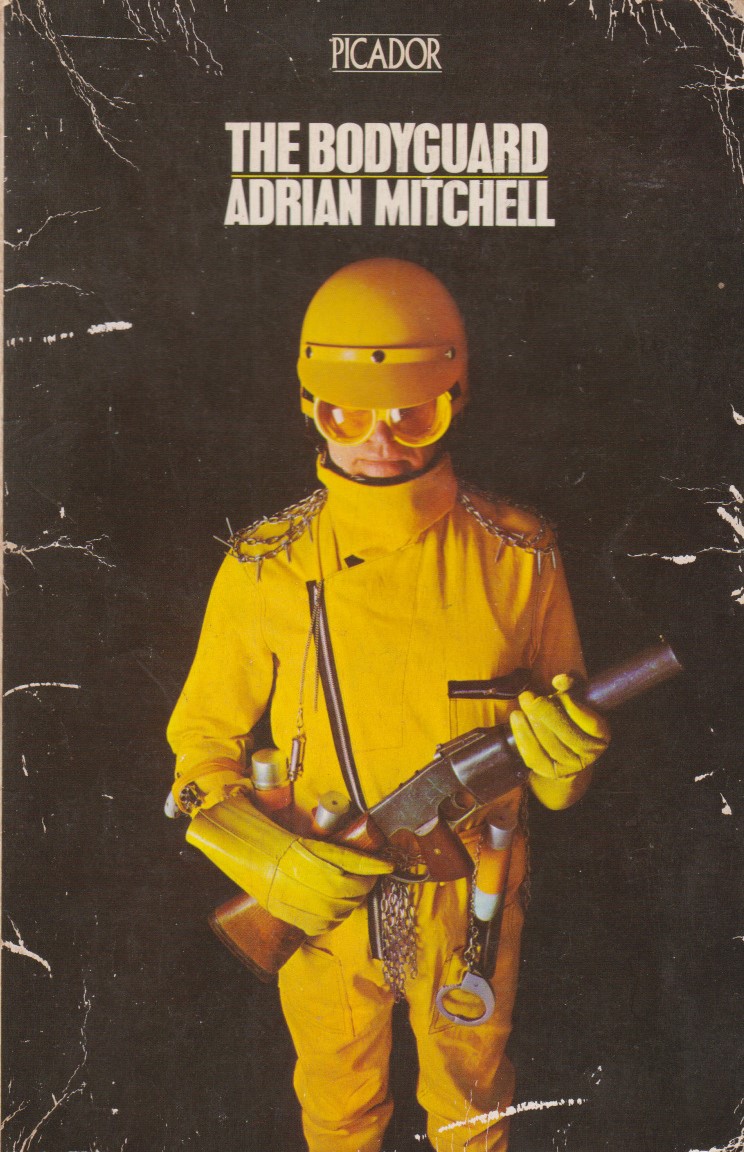
Book Review: The Bodyguard, Adrian Mitchell (1970)

(Roger Phillips’ cover for the 1972 edition)

3.5/5 (Good)

“[Lens] Rossman’s narrative is both single-minded and rambling, a tangle of facts and fantasies, distorted sexuality, obscured dates, anti-feminism, glorified brutality and narcissism” (153).

Adrian Mitchell’s sole SF novel The Bodyguard (1970) is a perverse romp through a diseased England viewed through the eyes of an equally diseased narrator. Lens Rossman’s deathbed ramblings of his “adventures” and “training” as a B.G. (bodyguard) in his fight against “The Rot” spread by leftist subverts, is, as the “editor” of the narrative indicates in a hilarious afterword, “a tangle of facts and fantasies” and “glorified brutality” (153). Mitchell presents Rossman’s account as a ghastly artifact of a pre-revolutionary era while simultaneously suggesting that the excess Continue reading

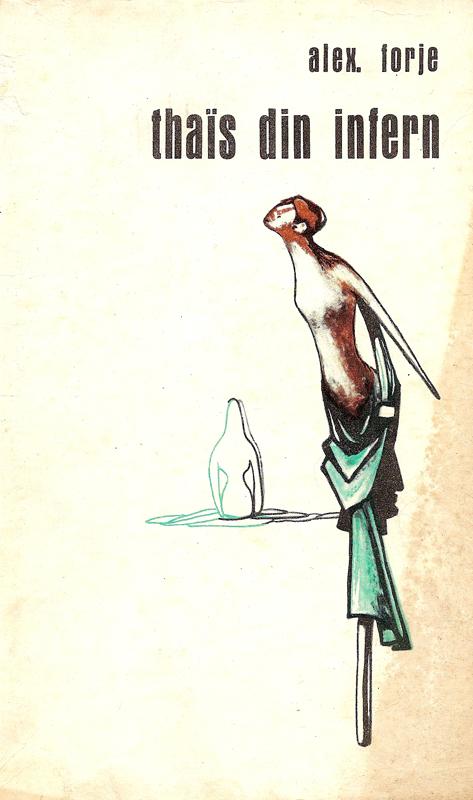
Adventures in Science Fiction and Fantasy Art: Women SF Illustrators of the 1960s/70s, Part V: The Eerie Figures of Marcela Cordescu

(Marcela Cordescu’s cover for the 1969 edition of Thaïs din Infern (1969), Alexandru Forje)

The Romanian graphic artist Marcela Cordescu produced a fascinating series of SFF covers from the 1950s-70s.  For more on her consult this short article (most resources are in Romanian unfortunately). Many of her covers graced editions of Vladimir Colin’s (her husband) SFF works. I came across her eerie figures researching the publication history of the French SF author Gérard Klein—a collection of his short stories appeared in Romania with a Cordescu cover in 1973 (below). Her cover for the 1969 edition of Alexandru Forje‘s Continue reading

Adventures in Science Fiction Cover Art: Philippe Curval’s 1950s Photo Collages, Part II

(January 1957)

Part II of my series on Philippe Curval’s SF art–check out Part I first if you haven’t already. In Part I, I included only his covers from 1956, his most productive year for the French SF magazine Fiction. In this post I include the rest of his 50s work, seven covers published between 1957-59. Curval published SF more and more as the 1950s progressed and I suspect writing was more lucrative than art….

This selection includes what I find to be his most disturbing and evocative cover–Fiction 47. Cyclopean imagery combines with odd textures and hair-like growths. I am partial to SF covers that explore skin, mutation, hands, heads, growths, eyes, etc…. And speaking of disquieting Continue reading