I’m periodically plagued by the virulent Esoterica virus, the relentless desire to catalogue and write about the less known, and even better, the completely unknown. While attending a Medieval English literature graduate class, I remember a conversation I had with the professor, Robert D. Fulk, during office hours about the sheer quantity of scholarship on Beowulf (here’s his edition of the iconic text). I pointed out the panic I experience if I’m unable to read ALL the scholarship on a popular text.
What pre-1985 science fiction are you reading this week?
I’ve settled on a monthly schedule for this column. Check out the previous installment!
If you’re new and curious about my rationale for the perimeters of my site, check out this recent interview and podcast. And follow me on Mastodon if you don’t already as I no longer post on my Twitter account.
And, most importantly, let me know what pre-1985 SF you’ve been reading!
The Photograph (with links to reviews and brief thoughts)
Judith Merril’s collection contains one of the feminist visions of the 50s — “Daughters of Earth” (1952). Reworking a standard pulp plot of alien contact, Merril recasts the encounter through multiple generations of women in one family. She adeptly inverts the Old Testament trope of tracing generations through fathers. Simultaneously, the story itself is a metatextual collection of rewritten family documents containing the lessons necessary for future daughters in the family. Brilliant and heady stuff.
Barry N. Malzberg’s The Men Inside(1973) remains one of his strangest works. A perverse (and Freudian) metafictional (and literary) retelling of Otto Klement and Jerome Bixby’s Fantastic Voyage replete with filmic flashbacks… For Malzberg fans only — if you’ve missed this one, track it down.
And now for something completely different: Murray Leinster’s S.O.S From Three Worlds (1967). I am unsure why I enjoy Leinster’s Med Service so much. Sometimes positivist stories about spacemen devoted to selfless service solving medical crises–and reigning in rampant unchecked capitalism–with their friendly tormals (think furry mobile petri dishes) bring a bit of warmth to my bitter heart.
I sneakily consumed Joe Haldeman’s masterpiece The Forever War (1975) while working my first job as an oil change cashier. In-between angry customers and running domestic incidents, I relished every moment of Haldeman’s defiant Vietnam War satire. As I’ve only reviewed Mindbridge (1976) on the site (I’ve read a bunch more), I’ve been meaning to return his work — maybe a resolution for 2024.
2022 was the single best year in the history of my site for visits and unique viewers!
As I mention year after year, I find reading and writing for the site—and participating in all the SF discussions generated over the year—a necessary and greatly appreciated salve. Whether you are a lurker, occasional visitor, or a regular commenter, thank you for your continued support.
Continuing a trend from 2021, I read only a handful of novels this year. Instead, I devoted my obsessive attention to various science short story review initiatives (listed below), anthologies, and histories of the science fiction genre. Without further ado, here are my favorite novels and short stories I read in 2022 with bonus categories. Descriptions are derived from my linked reviews.
Check out last year’s rundown if you haven’t already for more spectacular reads. I have archived all my annual rundowns on my article index page if you wanted to peruse earlier years.
My Top 5 Science Fiction Novels of 2022 [TITLES LINK TO FULL REVIEWS]
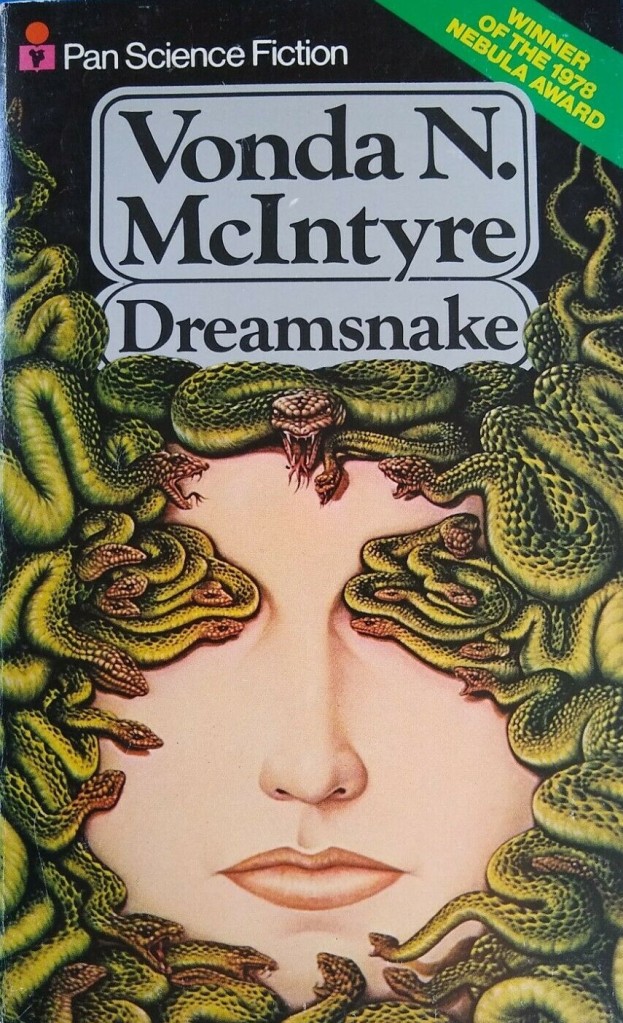
George Underwood’s cover for the 1979 edition
1. Vonda N. McIntyre’s Dreamsnake(1978), 4.75/5 (Near Masterpiece): Won the 1979 Hugo, Locus, and Nebula Award for Best Novel. Snake journeys across the post-apocalyptic wastes of a future Earth with three serpents healing the sick and caring for the dying. She is a member of the healers, who adopt orphans and rescue the oppressed and train them how to use the serpents. Mist and Sand are genetically modified vipers of terrestrial origin. But Grass comes from another alien world. Snake uses Mist and Sand’s venom to create vaccines, treat diseases, and cure tumors. Grass, the rare dreamsnake, with its alien DNA is the most important of them all–it provides therapeutic pleasure and dreams that facilitate conquering one’s fear and healing in the ill. In Snake’s voyages, she encounters prejudice and violence. A joyous sense of sexual freedom permeates the proceedings. A powerful and different take on a post-apocalyptic worldscape in every possible way.
Which books/covers/authors intrigue you? Which have you read? Disliked? Enjoyed?
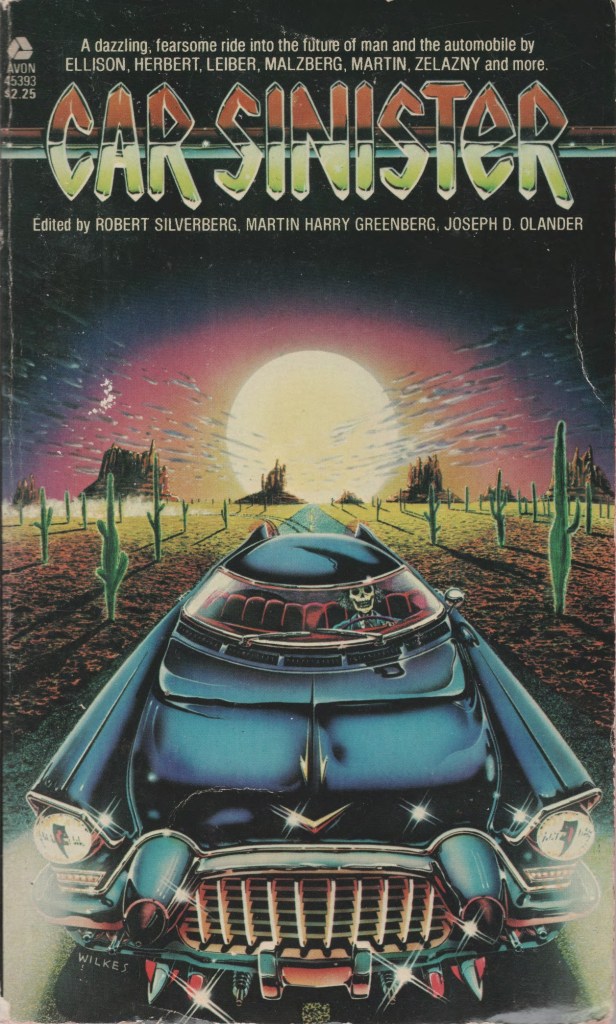
1. Car Sinister, ed. Robert Silverberg, Martin Harry Greenberg, and Joseph D. Olander (1979)
Mike Wilkes’ cover for the 1st edition
From the back cover: “MAN AND HIS MACHINE. The car is man’s most personalized machine; for teenagers it is a rite of passage and a statement of freedom; for adults it is a reflection of success, taste, and hopes; and for an entire culture it is a great and industrious mode of transportation–driving, perhaps, on the road of destruction. And the automobile–thrilling, honking, speeding, nerve-shattering–haunts us with the dark possibility that when our age of motoring innocence is over, we may no longer be the masters… CAR SINISTER–a splendid, imaginative vision of what lies down the road for all of us.”
Today I’ve reviewed the thirteenth story in my series on the science fictional media landscape of the future. Here, I finally return to the nightmarish embrace of Barry N. Malzberg.
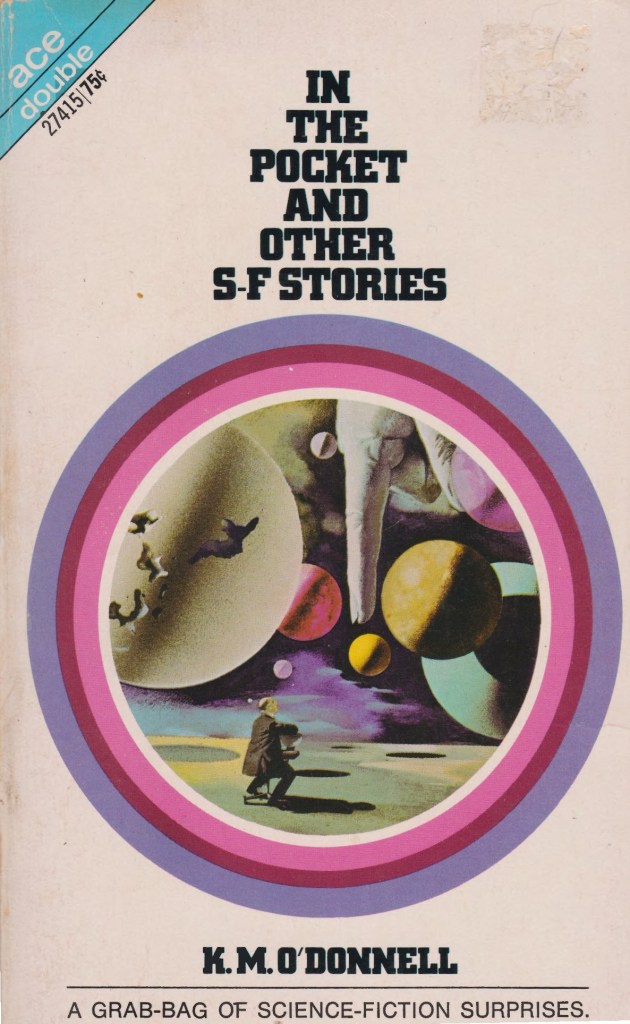
Karel Thole’s cover for the 1st edition of K. M. O’Donnell’s In the Pocket and Other S-F Stories (1971)
3.5/5 (Good)
Barry N. Malzberg’s “The Idea” first appeared in In the Pocket and Other S-F Stories (1971) (as K. M. O’Donnell). I cannot find the story online. Please contact me if you do not own a copy and want a PDF of the story. I recommend you procure the fantastic anthology TV: 2000, ed. Isaac Asimov, Martin H. Greenberg, Charles G. Waugh (1982) which “The Idea” also appears in. I’ll be returning to this volume in coming weeks for this series.
Reading a Barry N. Malzberg story is like returning to a familiar embrace–an embrace of the blackest satire conveyed via terrifying existential traps. Ever since I read his masterpiece Beyond Apollo(1972), a metafictional destruction of America’s obsession with space exploration, Malzberg joined the pantheon of my favorite authors.
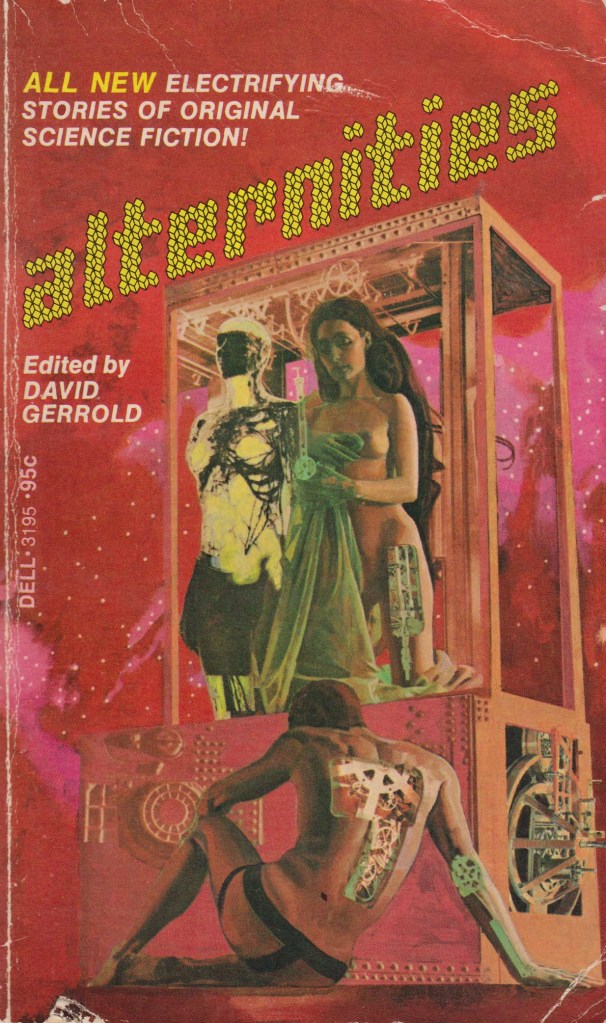
David Gerrold and his associate editor Stephen Goldin collect a bizarre range of SF oddities including an epistolary nightmare from Vonda N. McIntyre’s pen and a one-sentence “sign” by Duane Ackerman. Gerrold argues that he wants “science fiction to be fun again” without “literary inbreeding and incestuous navel-studying” (8). With a more than pungent hint of hypocrisy, he spouts “I’m tired of the kind of bullshitting that creates false images in the readers’ minds” (8). Alternities (1974) reads like the cast off stories from a New Wave (i.e. deliberately literary) Judith Merril or Harlan Ellison anthology with heavy dose of erotic comedy and shock value. A few–including E. Michael Blake’s “The Legend of Lonnie and the Seven-Ten Split,” Vonda N. McIntyre’s “Recourse, Inc.,” and Edward Bryant’s “Cowboys, Indians”–rise above the dross.
To be clear, I enjoy devouring anthologies like Alternities. The stories are originals and few are anthologized elsewhere. I adore reading authors I wouldn’t otherwise encounter (Robert Wissner, E. Michael Blake, et al.). Gerrold’s nonsense of an introduction aside, the anthology with its deliberate attempts at the “literary” (Greg Bear’s “Webster” and James Sallis’ “The First Few Kinds of Truth”) and “edgy” (Steven Utley’s “Womb, with a View”) firmly fit in the passing mid-70s foam of the New Wave movement.
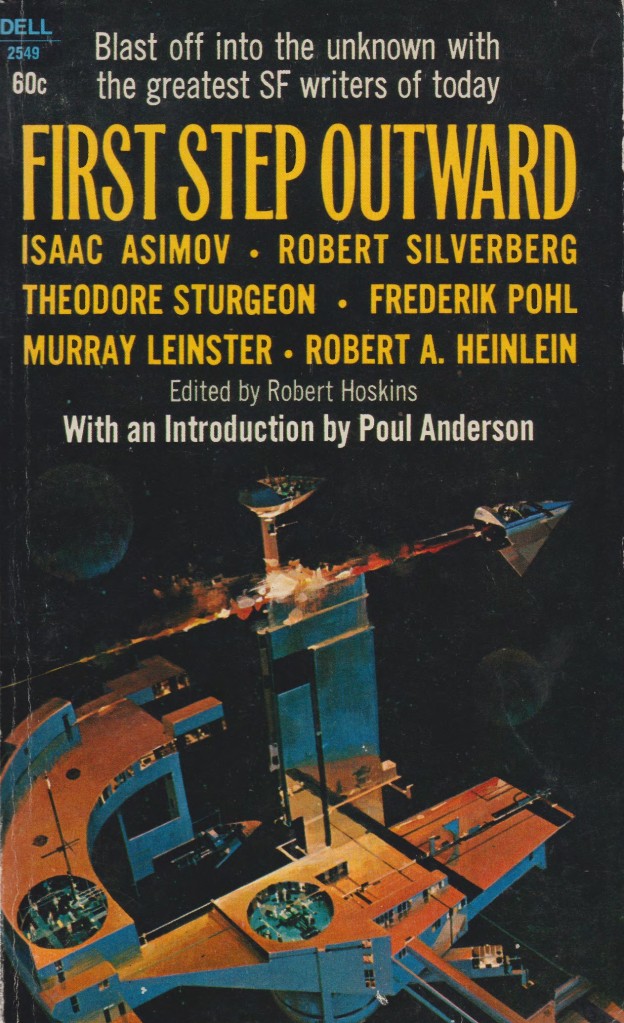
Published a few months before the Apollo 11 mission to the moon, Robert Hoskins’ anthology First Step Outward (1969) charts an imagined future history of humanity’s exploration of the galaxy. The stories, gathered from some of the big names of the day (Robert Heinlein, Robert Silverberg, Theodore Sturgeon, Isaac Asimov, Poul Anderson, etc.), are grouped as if part of the same future with headings such as “To the Planets” and “To the Stars.” As with most anthologies, this contains a range of gems (such as Sturgeon’s “The Man Who Lost the Sea”) and duds (Ross Rocklynne’s “Jaywalker”).
I’ve previously reviewed five of the thirteen stories in their own posts–linked for easy consultation.
Brief Plot Summary/Analysis
“Cold War” (1949), Kris Neville, 3/5 (Average): Previously reviewed in its own post here.
“Third Stage” (1963), Poul Anderson, 3.5/5 (Good): Previously reviewed in its own post here.
“Gentlemen, Be Seated!” (1948), Robert A. Heinlein, 2.75/5 (Vaguely Average): My first return to Robert A. Heinlein in around a decade is exactly like I thought it would be–thoroughly disappointing. Yes, yes, yes, I know this is far from what he was capable of. The number of reprints this misfire of a story receives mystifies (it appeared in the regularly reprinted The Green Hills of Earth and The Past Through Tomorrow).
This anthology contains the 4th post in a loose series on SF short stories that are critical in some capacity of space agencies, astronauts, and the culture which produced them. I decided to review the entire anthology!
Robert Hoskins “resurrected” Infinity Science Fiction magazine (1955-1958) as a five volume anthologies series between 1970-1973. The first volume, Infinity One (1970), contains sixteen original stories and one reprint from the original magazine–Arthur C. Clarke’s “The Star” (1955). SF Encyclopedia describes the anthology series as “a competent but not outstanding series.”
Eight of the seventeen stories fall into the “good” category. While none are masterpieces, Robert Silverberg, Arthur C. Clarke, Barry N. Malzberg co-writing with Kris Neville, Katherine MacLean, Gene Wolfe, and Poul Anderson Continue reading →




 Science Fiction and Other Suspect Ruminations