Updates: Recent Science Fiction Purchases No. CCCXIX (Kim Stanley Robinson, Pamela Sargent, Greg Bear, and René Barjavel)

Which books/covers/authors intrigue you? Which have you read? Disliked? Enjoyed?

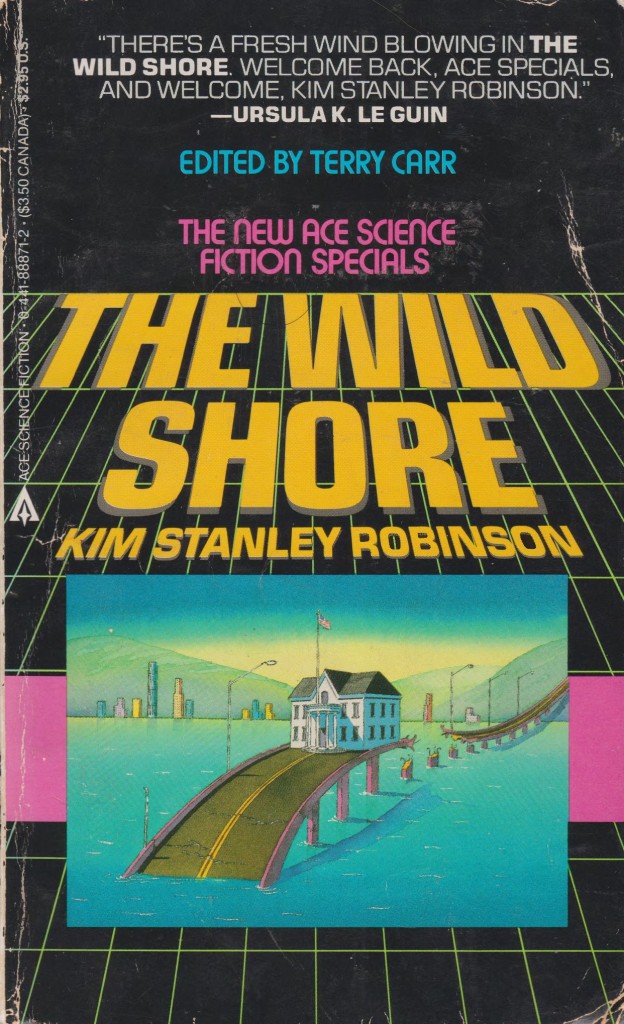
1. The Wild Shore, Kim Stanley Robinson (1984)

From the back cover: “Seventeen-year-old Henry wanted to help make America great again, like it had been sixty years ago, before all the bombs went off. But for the people of Onofre Valley, just surviving was challenge enough. Then one day the world came to Henry, in the shape of two men who said they represented the American Resistance…”

Continue reading

Short Fiction Reviews: George R. R. Martin’s “The Second Kind of Loneliness” (1972) and Tom Godwin’s “The Nothing Equation” (1957)

The following reviews are the 21st and 22nd installments of my series searching for SF short stories that are critical in some capacity of space agencies, astronauts, and the culture which produced them. Some stories I’ll review in this series might not fit. Many are far from the best. And that is okay. I relish the act of literary archaeology.

I’ve paired a take by Tom Godwin (1915-1980) and George R. R. Martin (1948-) on the psychiatric impact of isolation in the bleak emptiness of space. Both explore the interior landscape of the mind alone with itself and all its memories, and delusions, and terrors. There are no heroes in these pages.

Previously: Harlan Ellison’s “Psycho at Mid-Point” (1956) and “The Discarded” (variant title: “The Abnormals”) (1959)

Up Next: Philip K. Dick’s “The Infinites” (1953) and James Causey’s “Competition” (1955)

4/5 (Good)

George R. R. Martin’s “The Second Kind of Loneliness” first appeared in Analog Science Fiction/Science Fact, ed. Ben Bova (December 1972). You can read it online here.

At the Edge of the Vortex We Tell So Many Lies

The location: the Cerberus Star Ring, six million miles beyond Pluto (10). The manmade station, “a circle whose diameter is more than a hundred miles” (12), surrounds a nullspace vortex (think wormhole) to an unknown location across the universe. Humanity sends ships through the brightly colored swirling eddies of the portal to establish colonies somewhere beyond. A single man operates the machinery on the ring from a featureless white control room via a holograph helmet (11). The story follows the journal entries of an unreliable narrator ostensibly counting down the days until his relief arrives from Earth: “It will be at least three months before he gets here, of course. But he’s on his way” (10). It’s a mantra he tells himself. Relief is on its way. Relief is on its way. But does he want relief?

Continue reading

Updates: Recent Science Fiction Purchases No. CCCXVIII (Eric Frank Russell, Christine Brooke-Rose, Colin Kapp, and a Mars-themed anthology)

Which books/covers/authors intrigue you? Which have you read? Disliked? Enjoyed?

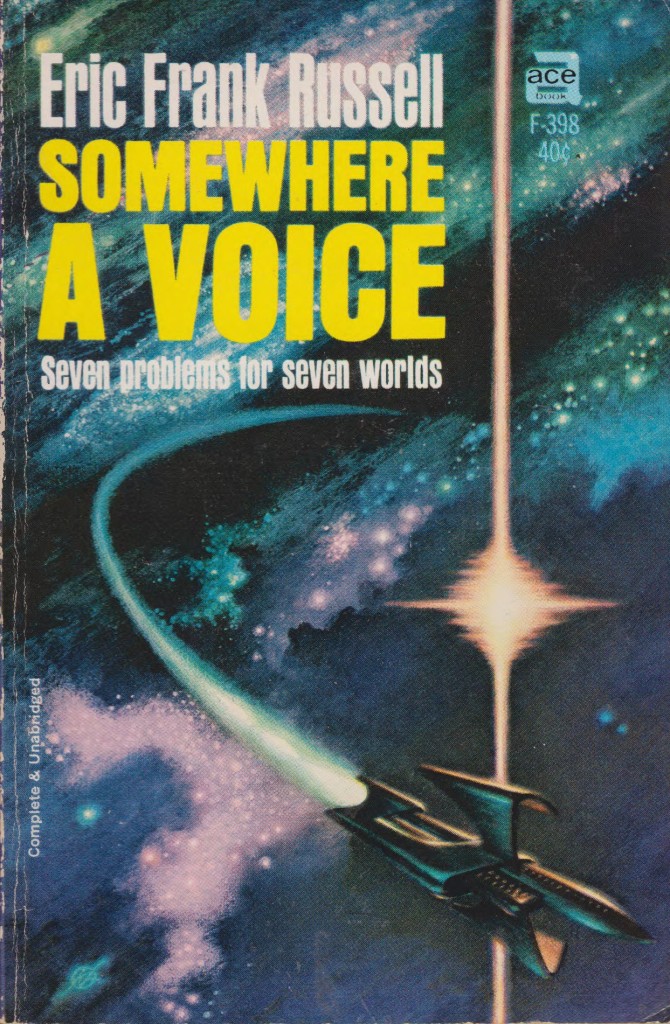
1. Somewhere A Voice, Eric Frank Russell (1965)

From the back cover: “A band of shipwrecked spacemen making their way across a world so fierce that all Earth’s jungles tame by comparison…

A future euthanasia agency with a double-barreled scientific secret…

The unexpected problem of a lone astronaut with an entire ocean world to himself…

Continue reading

Short Story Reviews: Richard Matheson’s “Through Channels” (1951) and Robert F. Young’s “Audience Reaction” (1954)

Today I’ve reviewed the twenty-fourth and twenty-fifth story in my series on the science fictional media landscape of the future. In Richard Matheson’s horror short “Through Channels” (1951), a terrifying entity comes through the TV! Robert F. Young, in “Audience Reaction” (1954), speculates on a new form of virtual reality immersion in which desires become enmeshed in the narrative.

Both stories I cover engage with the newly popular entertainment medium of television. According to Gary R. Edgerton’s magisterial monograph The Columbia History of American Television (2007), no “technology before TV every integrated faster into American life” (xi). As I’ve discussed TV’s impact on the American and British family, entertainment and free time, and its intersection with brainwashing and fears of Communism at length, I won’t belabor the point here. Check out my reviews of Ray Bradbury’s “The Pedestrian” (1951), Brian W. Aldiss’ “Panel Game” (1955), Ann Warren Griffith’s “Captive Audience” (1953), if you want additional 1950s historical context.

Previously: Two stories by Damon Knight: “Thing of Beauty” (1958) and “You’re Another” (1955).

Up Next: Kate Wilhelm’s “Ladies and Gentlemen, This Is Your Crisis” (1976) and Langdon Jones’ “The Empathy Machine” (1965)

4/5 (Good)

Richard Matheson’s “Through Channels” first appeared in The Magazine of Fantasy and Science Fiction, ed. Anthony Boucher and J. Francis McComas (April 1951). You can read it online here.

Continue reading

Short Story Reviews: Robert Silverberg’s “The Seed of Earth” (1958) and Doris Piserchia’s “Pale Hands” (1974)

I’ve decided to reframe my series on 50s sex and sexuality to include my entire area of SF interest (1945-1985). Thus, I’ve paired Robert Silverberg’s “The Seed of Earth” (1958), a rumination on colonization and human/alien sex, with Doris Piserchia’s “Pale Hands” (1974), a distressing dissection of a future society designed to fixate all sexual desire on masturbation stalls.

Here are the earlier installments in the series:

  1. Philip José Farmer’s “The Lovers” (1952)
  2. Sherwood Springer’s “No Land of Nod” (1952)
  3. Wallace West’s “Eddie For Short” (1953)
  4. Fritz Leiber’s “The Ship Sails at Midnight” (1950)
  5. Theodore Sturgeon’s “The Sex Opposite” (1952)
  6. Ward Moore’s “Lot” (1953)
  7. Langdon Jones’ “I Remember, Anita…” (1964)
  8. Damon Knight’s “Not With a Bang” (1950)

If any short stories published between 1945-1985 on sex and sexuality come to mind that I haven’t reviewed yet, let me know in the comments. I have a substantial list waiting to be covered but it’s far from comprehensive.


3.5/5 (Good)

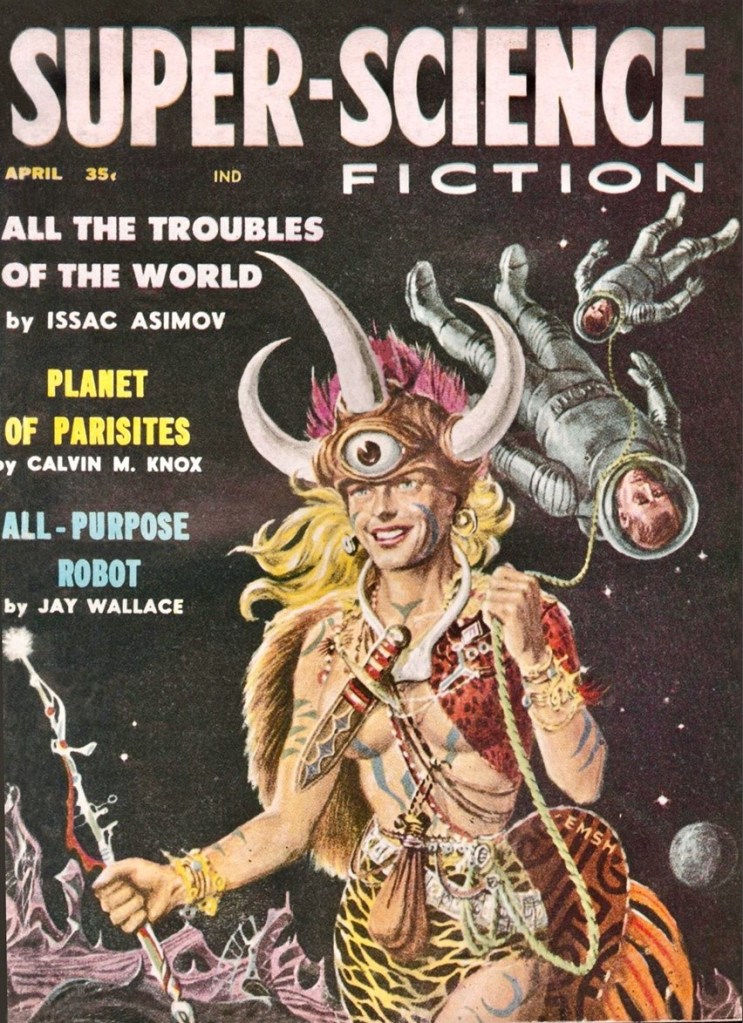
Robert Silverberg’s “The Seed of Earth” (variant title: “Journey’s End”) first appeared in Super-Science Fiction, ed. W. W. Scott (April 1958). You can read it online here. It is also available in his collection Dimension Thirteen (1969) that I plan on reviewing in the near future.

A preliminary note about publication: Silverberg reused the title “The Seed of Earth”–chosen by W. W. Scott over “Journey’s End”–for a later unrelated novella and a novel.

Continue reading

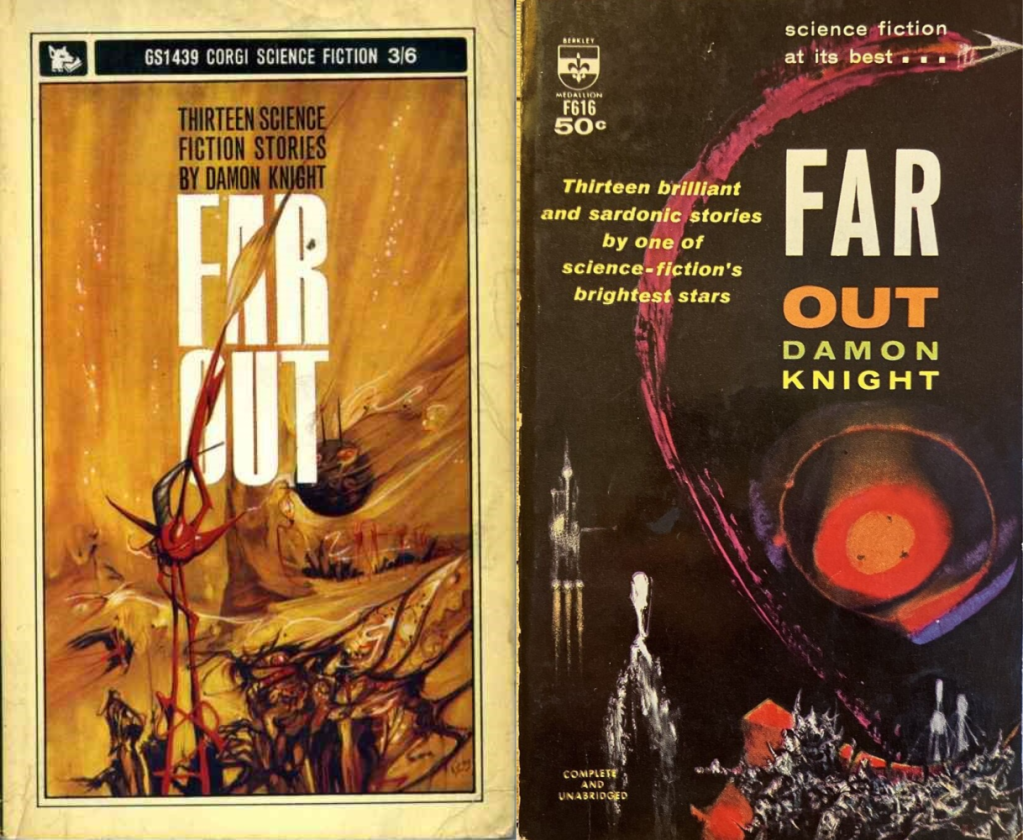
Book Review: Far Out, Damon Knight (1961)

Today I’ve reviewed the twenty-second and twenty-third story in my series on the science fictional media landscape of the future. In “Thing of Beauty” (1958) Damon Knight speculates on something very similar to AI art. And in “You’re Another” (1960) Knight conjures a delirious manifestation of reality TV unlike any other. I’ve gone ahead and included reviews of the rest of the stories in Knight’s collection Far Out (1961).

Previously: Ray Bradbury’s “Almost the End of the World”  (1959).

Up Next: Richard Matheson’s “Through Channels” (April 1951).

Robert F. Young’s “Audience Reaction” (February 1954).


3.5/5 (Collated rating: Good)

Damon Knight’s impact on the science fiction field can be felt to this day. He founded the Science Fiction and Fantasy Writers of America and co-founded two influential science fiction workshops (Milford and Clarion). Knight also edited the Orbit series of anthologies, notable for their larger-than-average number of female science fiction authors and overall quality–I’ve reviewed Orbit 1 (1966), Orbit 3 (1968), Orbit 4 (1968), and Orbit 8 (1970) so far. I can’t help but notice that his fiction, on the other hand, has faded a bit from popular knowledge. I struggle to identify a masterpiece Knight novel. Did he write one?

I’ve enjoyed his short fiction, notably “Down There” (1973) and “I See You” (1976), immensely. With that in mind, I consumed my first collection of his short stories. I can add “The Enemy” (1958), “You’re Another” (1955), and “Cabin Boy” (1951) to my list of favorite Knight visions.

Continue reading

Updates: Recent Science Fiction Purchases No. CCCXVI (Gore Vidal, Pat Murphy, Kris Neville, and J. T. McIntosh)

Which books/covers/authors intrigue you? Which have you read? Disliked? Enjoyed?

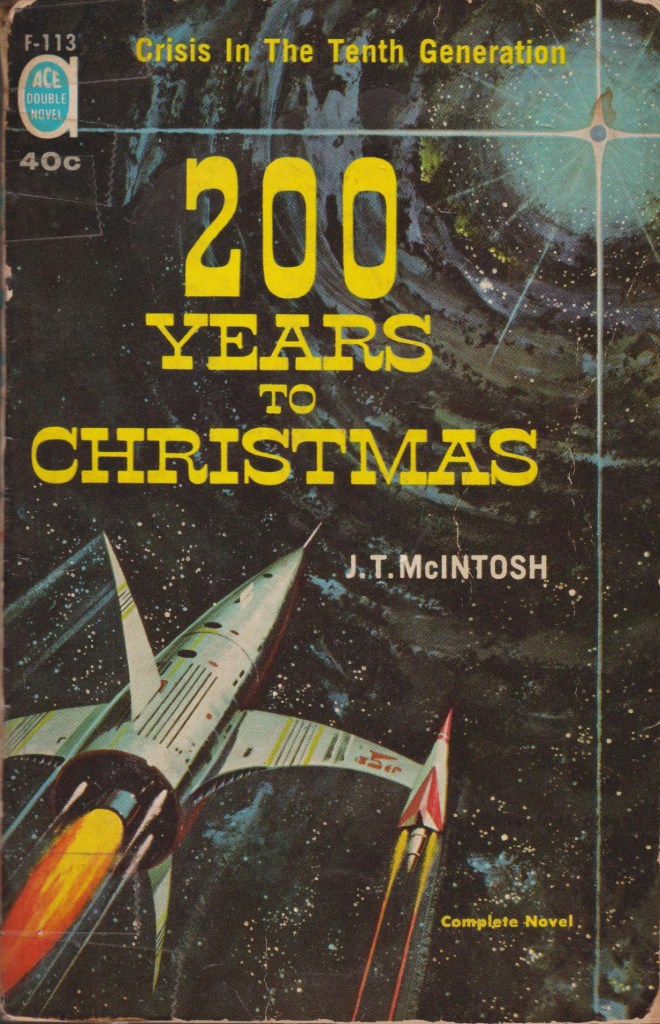
1. 200 Years to Christmas, J. T. McIntosh (1959)

From the inside flap: “For almost two centuries the huge spaceship had speared its way through the stars, bound for another two hundred years of travel before it would put down on a new planet, a new home for the Earth people.

On board the metal-enclosed worldlet were four hundred people; the last survivors of Earth. It was up to them to start life anew, to correct the mistakes their ancestors had made.

Continue reading

Updates: Recent Science Fiction Purchases No. CCCXV (John Brunner, Connie Willis, Cynthia Felice, Philip Wylie, and a themed anthology)

Which books/covers/authors intrigue you? Which have you read? Disliked? Enjoyed?

1. The Shockwave Rider, John Brunner (1975)

From the back cover: “Future shock!

In the obsessively technological, paranoidally secretive and brutally competitive society depicted by John Brunner, even personal identities are under threat. But one man has made it his mission to liberate the mental prisoners, to restore their freedom in a world run mad.

Nickie Haflinger, the only person to escape from Tarnover–where they raise hyper-intelligent children to maintain the political dominance of the USA in the 21st century–is on the run, dodging from loophole to crevise to crack in the computerised datanet that binds the continent like chains. After years of flight and constant changes of identity, at the strange small town called Precipice he discovers he is not alone in his quest. But can his new allies save him when he falls again into the sinister grasp of Tarnover…?”

Initial Thoughts: I read John Brunner’s The Shockwave Rider (1972) before I started my site–along with his other masterpieces Stand on Zanzibar (1968), The Sheep Look Up (1972), The Jagged Orbit (1969), The Whole Man (196), etc. Of his best known novels, I remember the least about The Shockwave Rider. However, I cannot find my copy for a rare reread! For all I know I gave it to a friend or lost it in a move. I sought out this UK edition due to the intriguing urban arcology background of the cover.

Continue reading

Short Fiction Reviews: Phyllis Gotlieb’s “A Grain of Manhood” (1959), “Phantom Foot” (1959), and “No End of Time” (1960)

Since 2021, I’ve put together a series on the first three published short fictions by female authors who are new(ish) to me and/or whose most famous SF novels fall mostly outside the post-WWII to mid-1980s focus of my reading adventures. So far I’ve featured Josephine Saxton (1935-), Carol Emshwiller (1921-2019), Wilmar H. Shiras (1908-1990), Nancy Kress (1948-), Melisa Michaels (1946-2019), Lee Killough (1942-), Betsy Curtis (1917-2002), and Eleanor Arnason (1942-).

I do not expect transformative or brilliant things from first stories. Rather, it’s a way to get a sense of subject matter and concerns that first motivated authors to put pen to paper and to further map the territories that fascinate me.

Phyllis Gotlieb (1926-2009) was one of a legion of authors who received a debut under the influential editorship of Cele Goldsmith (1933-2002). Goldsmith fostered the early careers of Ursula K. Le Guin, Keith Laumer, Thomas M. Disch, David R. Bunch, Roger Zelazny, among many others. For a fascinating look at her years at Amazing Stories, check this later reflection article. Goldsmith writes: “My greatest pleasure was developing and publishing new, talented writers. I was not a writer and never aspired to be. But I was an editor who loved to help writers adapt their ideas and copy for the audience. My requirements: credible (or incredible), well-plotted, care- fully developed stories. My criteria for acceptance: ‘goose flesh’ while reading a submission.” For more on her contribution to the field, check out “Friend of the Site” John Boston and Cora Buhlert’s article over on Galactic Journey. Barry N. Malzberg also interviewed her in 2003.

Gotlieb, also known for her poetry, was born in Canada and received an M. A. in English from the University of Toronto. Her first novel–which I acquired recentlySunburst appeared in 1964. Her novella “Son of the Morning” (1972) received a Nebula Award nomination. Here’s her complete bibliography. I have read none of her work until now!


Continue reading