Updates: Recent Science Fiction Acquisitions No. CCXXII (Vernor Vinge + Keith Roberts + Ted Mooney + Michael D. Weaver)

(Detail from Chris Foss’ cover for the 1977 edition of The Grain Kings (1976), Keith Roberts—full cover below)

1. Always thrilled to have a new Keith Roberts collection! And this one with one of the few Foss covers that appeals to me….

2. As a teen Vernor Vinge was a must read author. I devoured The Peace War (1984), Marooned in Realtime (1986), A Fire Upon the Deep (1992), and A Deepness in the Sky (1999). I haven’t returned to him since. I am curious about his earliest published novel—Grimm’s World (1969)—gorgeously decked out with a Paul Lehr masterpiece of a cover.

3. My knowledge of cyberpunk is mostly limited to the early works of Bruce Sterling and William Gibson. Here is a lesser known work that certainly wasn’t “talked about for years to come” (book jacket advertisement). Clones, sentient handheld computers, etc. Looks like a fun brew.

4. Another “let’s explore early cyberpunk” purchase—in this case a near future work about information overload (and dolphin + human sexual relationships) marketed as mainstream literature. SF Encyclopedia describes Ted Mooney’s Easy Travel to Other Planets  (1981) as follows: “Set on a Near-Future Earth against a backdrop of global information sickness, war in the Antarctic and a new emotion nobody has ever felt before, it tells a love story – with visionary ramifications – concerning a woman marine biologist and the dolphin on whom she conducts experiments in Linguistics. It has been seen as a proto-Cyberpunk work, but its cool, pellucid, dissecting style – perhaps influenced by J G Ballard – is far removed from the hectic insistence that has characterized much of that school” (full article on Mooney).

Let me know what books/covers intrigue you. Which have you read? Enjoyed? Continue reading
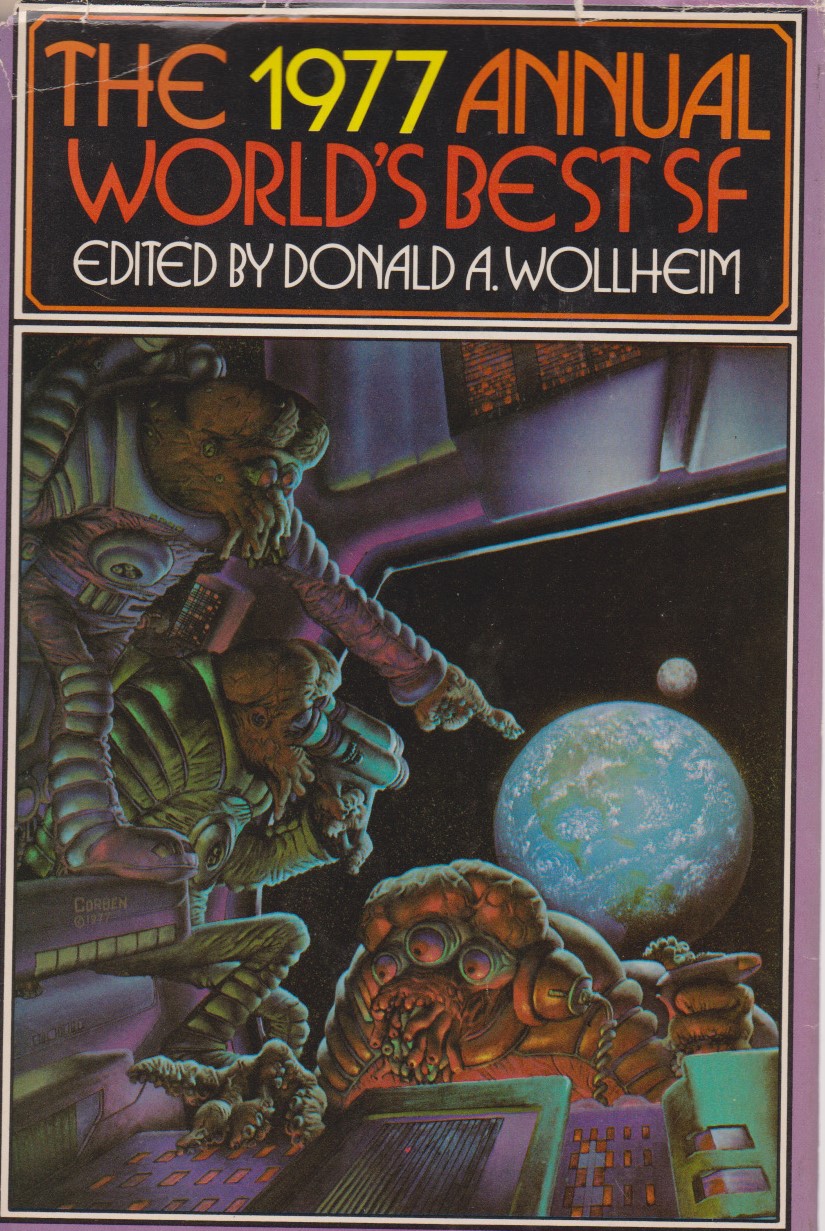
Book Review: The 1977 Annual World’s Best SF, ed. Arthur W. Saha and Donald A. Wollheim (1977)

(Richard Corben’s cover for the 1977 edition)

4.25/5 (collated rating: Very Good)

The 1977 Annual World’s Best SF, ed. Donald A. Wolheim and Arthur S. Saha (1977) is a glorious anthology of SF published from the year before containing rousing works by the established masters (Isaac Asimov and Brian W. Aldiss), philosophical gems from New Wave icons (Barrington J. Bayley), and gritty and disturbing commentaries on masculinity by the newer voices (James Tiptree, Jr.). While Richard Cowper and Lester del Rey misfire, the overall quality is high for a large Continue reading

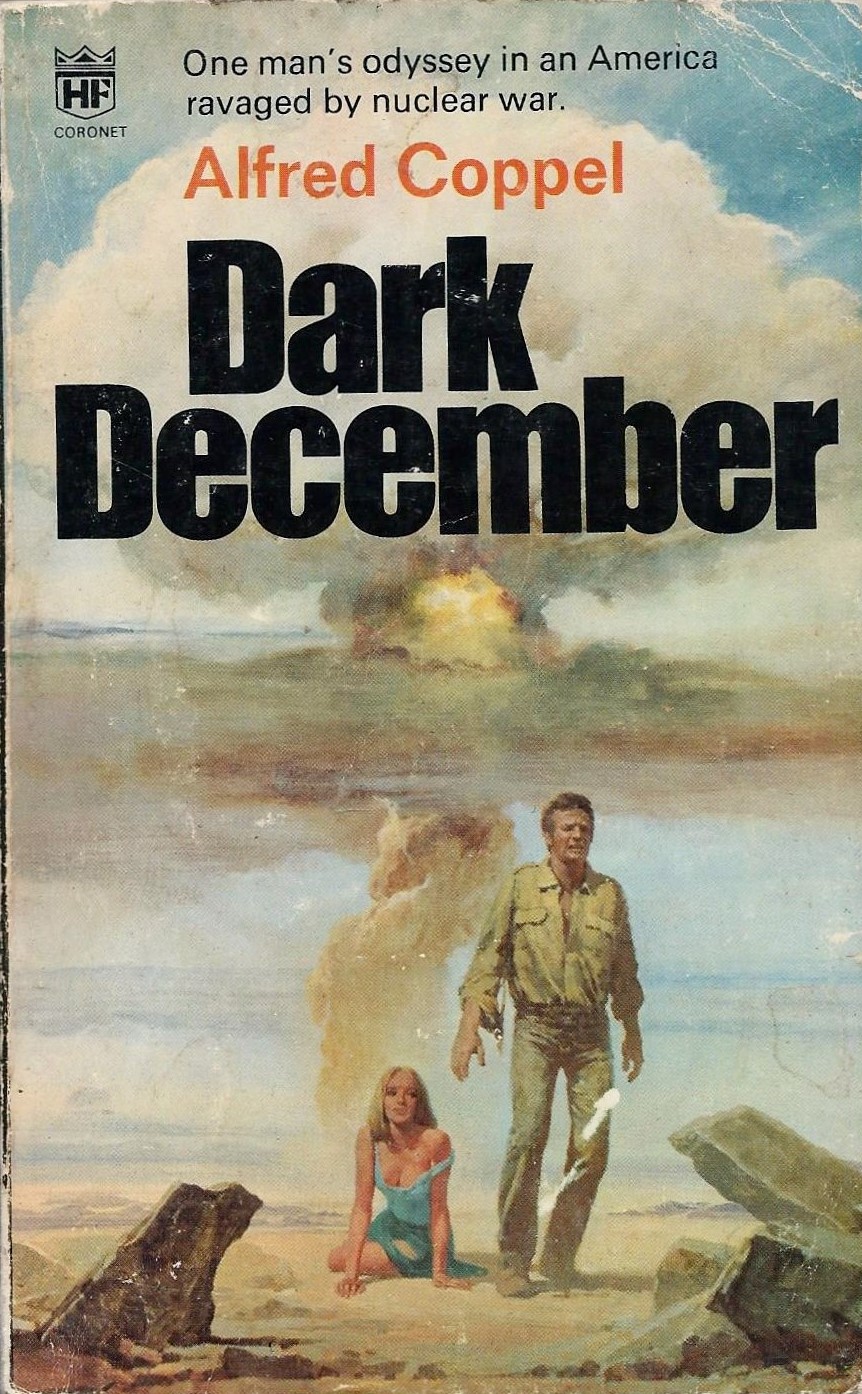
Book Review: Dark December, Alfred Coppel (1960)

(Uncredited cover for the 1971 edition)

4.25/5 (Very Good)

“In my holster I carried a pistol that had never been fired. Yet I was master of ten thousand graves” (72).

Occasionally my childhood love of survival tales—whether post-apocalyptic nightmares or sailors stranded on Pacific islands—rears its head and I am forced to track down a book, languishing in some forgotten corner, that satiates the craving. Alfred Coppel’s Dark December (1960), an unknown gem, successfully distills in ultra-realistic strokes the basic post-nuclear war survival formula: man traverses a bombed landscape, pockmarked with the vestiges of human habitation, on a quest to find his family. Dark December is a careful study of trauma and survival in the face of forces willing to plunge the world back into Continue reading

Adventures in Science Fiction Cover Art: Ice-Covered Cities, Part II

(Steve Crisp’s cover for the 1985 edition of The World in Winter (variant title: The Long Winter) (1962), John Christopher)

Hello fellow vintage SF fans!

I have for you Part II of my Ice-Covered Cities SF art post series–check out Part I (posted way back in 2012).  In Part I, I discussed the allure of the apocalyptic scenario of a coming Ice Age, inspired by my read through of John Carpenter’s odd black comedy The Long Winter (variant title: The Winter of the World) (1962). SF artists love destroying famous landmarks and a coming ice disaster is yet another exciting visual strategy for destroying urban symbology. Unsurprisingly, New York City (Twin Towers) and London Continue reading

Updates: Recent Science Fiction Acquisitions No. CCXVI (Le Guin + Leiber + Laumer + Martin)

1. Keith Laumer is an author I’ve only dabbled in—a few short stories in an anthology here and there. Another (one of twenty?) Laumer volume joins my collection. With a solid Richard Powers’ cover!

2. I finally picked up a copy of Ursula Le Guin’s The Lathe of Heaven (1971)—one of her few early works lacking from my collection. I recently read and enjoyed The Word for World is Forest (1972).

3. According to a goodreads review, Justin Leiber’s novel “a hard sci-fi take on gender dysphoria.” SF Encyclopedia emphasizes how Justin Leiber, Fritz Leiber’s son, “used sf as a medium  for speculation in his field of interest, the philosophy of the mind.” Call me intrigued about Beyond Rejection (1980)….. and suspicious.

4. The unknown quantity of this post. Have you read any of his work? Or heard of his most “famous” novel Time-Slip (1986)? Joachim Boaz, taking risks since the birth of this abomination (website).

1. Nine by Laumer, Keith Laumer (1967)

(Richard Powers’ cover for the 1969 edition) Continue reading

[Short] Book Reviews: Samuel R. Delany and Howard V. Chaykin’s Empire (1978), Kate Wilhelm’s City of Cain(1974), Charles Sheffield’s Sight of Proteus(1978)

My “to review” pile is growing and my memory of them is fading… hence short—far less analytical—reviews.

1. City of Cain, Kate Wilhelm (1974)

(Uncredited cover for the 1978 edition)

3.5/5 (Good)

Kate Wilhelm’s City of Cain (1974) is a moody, streamlined, and psychologically heavy near-future SF thriller. Peter Roos returns from the Vietnam War a scarred man both mentally and physically. After a technical error on a helicopter, a missile it was carrying explodes killing half the crew and sending shrapnel into Roos’ body. Back in the US, Roos engages Continue reading

Updates: Recent Science Fiction Acquisitions No. CCXV (Haldeman + Lerman + Vonarburg + Slonczewski)

An acquisition post of entirely 80s novels? Joachim Boaz, you must be kidding!

1. SF in translation from Quebec! My edition is banged up so I included an image for the 1st English language edition instead. Rachel S. Cordasco sings the sequel’s praises here.

2. I recently finished Joe Haldeman’s Mindbridge (1976), and, despite its rather canned plot, I adored his “way of telling” (use of memos, citations from invented essays, desk ephemera, etc.) I’ll post a review soon. As a result, I purchased another Haldeman novel missing from my collection–his take on near future SF.

3. I have yet to read any of Joan Slonczewski’s novels. This appears to be her best known one… Her first novel, Still Forms on Foxfield (1980) will also be joining the Joachim Boaz SF Library momentarily.

4. Rhoda Lerman’s SF(ish?) novel seems like a fascinating slipstream experiment in medievalism. I’m not sure what to make of the back cover. As always, I am up for a radical experiment.

Let me know what books/covers intrigue you. Which have you read? Enjoyed? Hated?

~

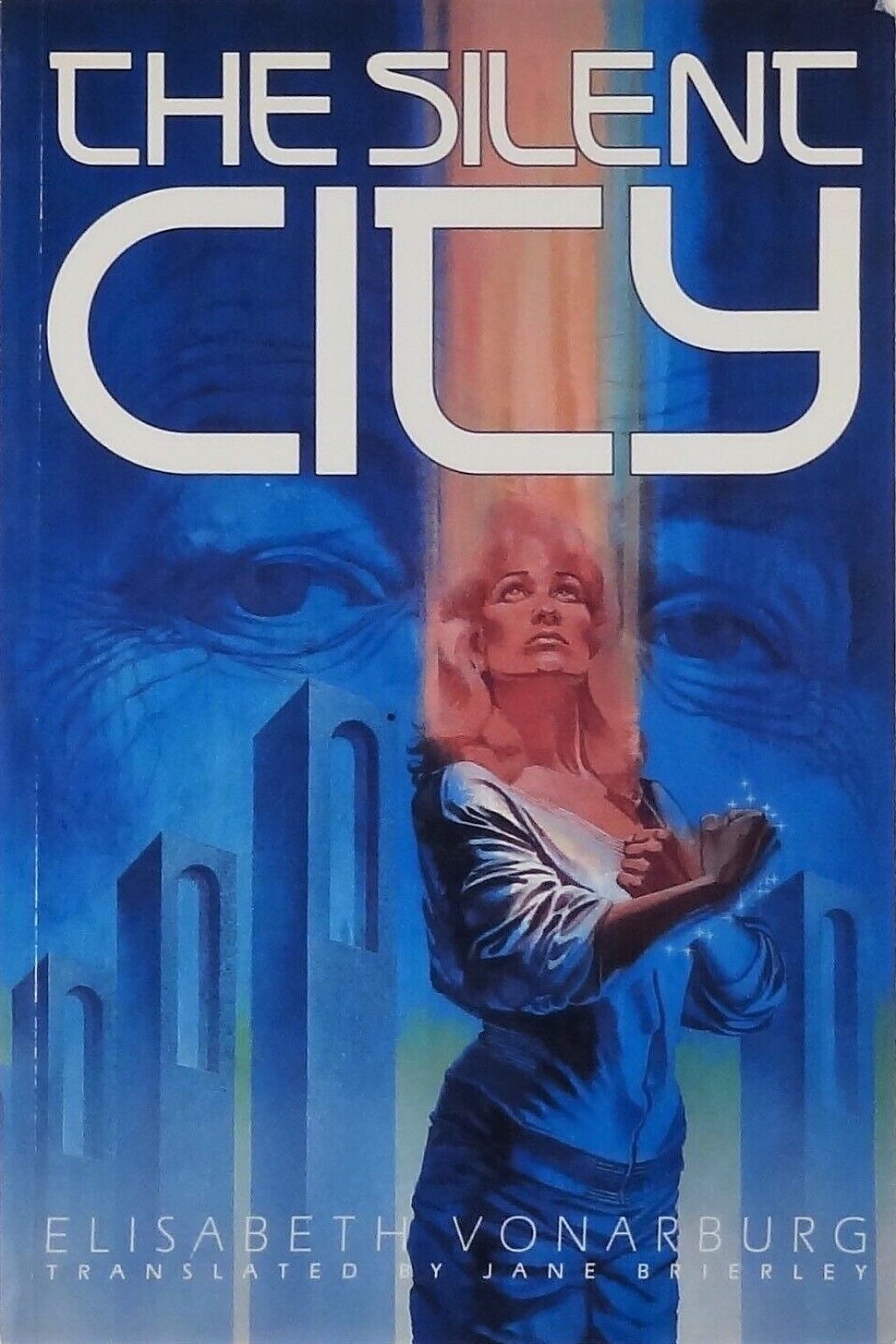
1. The Silent City, Élisabeth Vonarburg (1981, trans. by Jane Brierley)

(Ken Campbell’s cover for the 1988 edition) Continue reading

Book Review: Seeklight, K. W. Jeter (1975)

(Kelly Freas’ cover for the 1975 edition)

3.5/5 (Good)

K.W. Jeter’s first published novel is a promising one (*). On a nameless colony world, entropic forces influence all. Humankind speaks less and less and resorts to animistic grunts. Robotic priests go mad. Speculation abounds of a “Dark Seed” (52) implanted by the eugenicists on Earth in the colonist gene pool creating an increasingly crude and lazy population, “wretched and fearful of any change or effort” (46). The landscape itself  is inscribed with the entropic effects: most of the population seems to be engage in quarrying, hillsides are covered with the Continue reading

Book Review: Don’t Bite the Sun, Tanith Lee (1976)

(Brian Froud’s cover for the 1st edition)

3.75/5 (Good)

My friend Hergal had killed himself again. This was the fortieth time he had crashed his bird-plane on the Zeefahr Monument and had to have a new body made” (9).

Tanith Lee’s Don’t Bite the Sun (1976) posits a post-scarcity future  replete with advanced technology where youth, the Jang, are encouraged (and “taught” via hypno-schools) to engage in various forms of excess. The nameless female Jang narrator (N) attempts to find life’s purpose in a society without rules, struggle, Continue reading