Book Review: City Come A-Walkin’, John Shirley (1980)

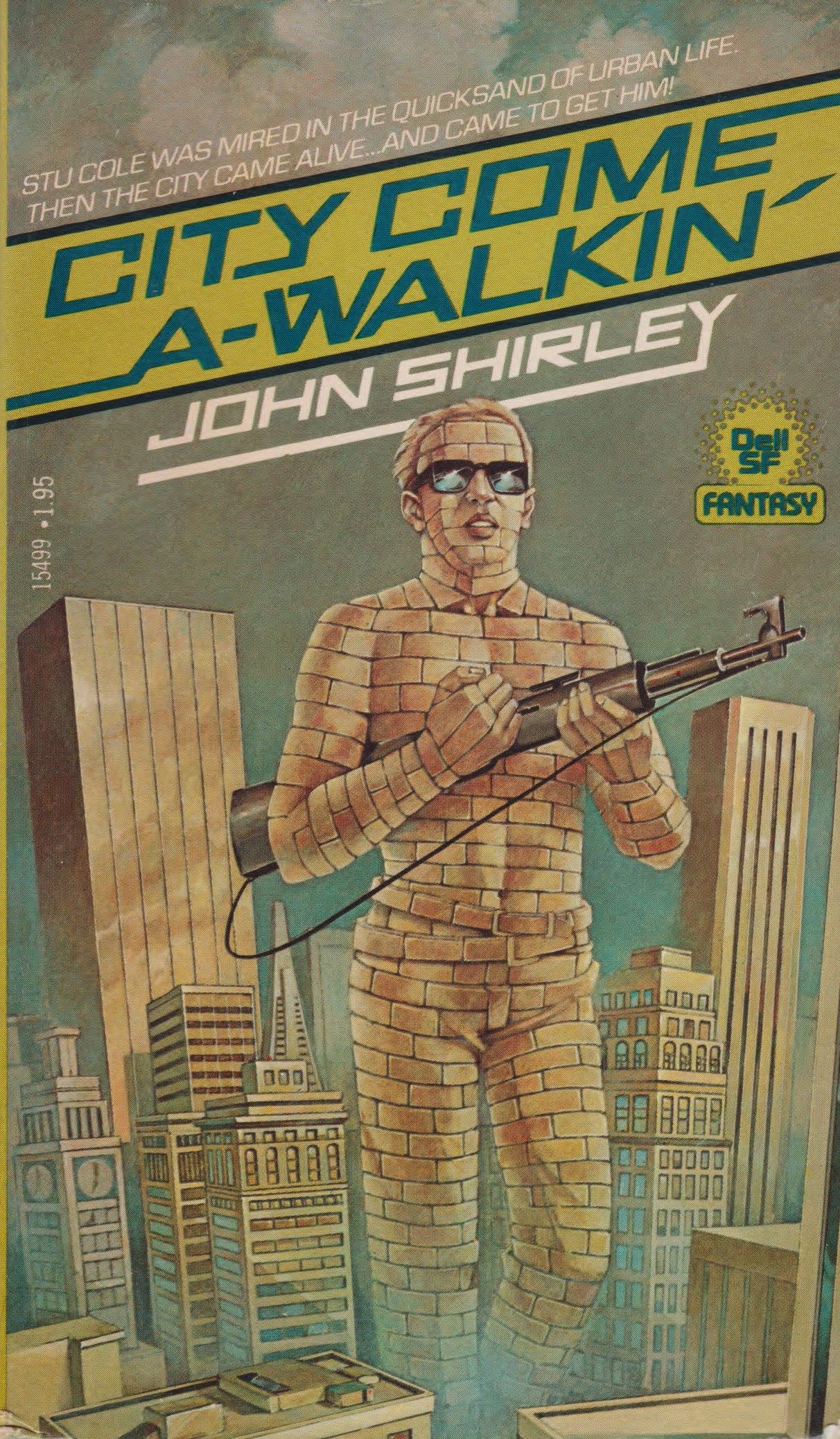
(Catherine Huerta’s cover for the 1st edition)

4/5 (Good)

“It’s the gestalt of the whole place, this whole fuckin’ city, rolled up in one man. Sometimes the world takes the shape of gods and those gods take the form of men. Sometimes. This time. That’s a whole city, that man” (18).

John Shirley’s City Come A-Walkin’ (1980), an early cyberpunk novel, succeeds as a surreal and earthy paean to  diverse urban community and punk rebellion. A club owner and angst rocker join forces with a physical manifestation of San Francisco to fight the forces of technological change. While a brilliant evocation of aesthetic and emotion with sympathetic main Continue reading

Updates: Recent Science Fiction Acquisitions No. CCL (Worlds of If and Galaxy magazines)

(David A. Hardy’s cover art detail from the September 1974 issue of Galaxy)

I am not a collector. “But Joachim Boaz you post recent purchases all the time!” Let me revise: I am a reader who procures a lot of science fiction novels, collections, and anthologies that I may never read. As a general rule, I only buy science fiction that I want to read. There’s a logic behind the handful of duplicate copies I own—for example, both the 1952 and the 1969 editions of Wilson Tucker’s fantastic The Long Loud Silence (1952) grace my shelf. Editors sliced and diced the 1st edition and Tucker Continue reading

Updates: Recent Science Fiction Acquisitions No. CCXLIX (Chelsea Quinn Yarbro, Alan Dean Foster, E. Everett Evans, Ron Montana)

(Back cover detail for the 1959 edition of E. Everett Evans’ Man of Many Minds)

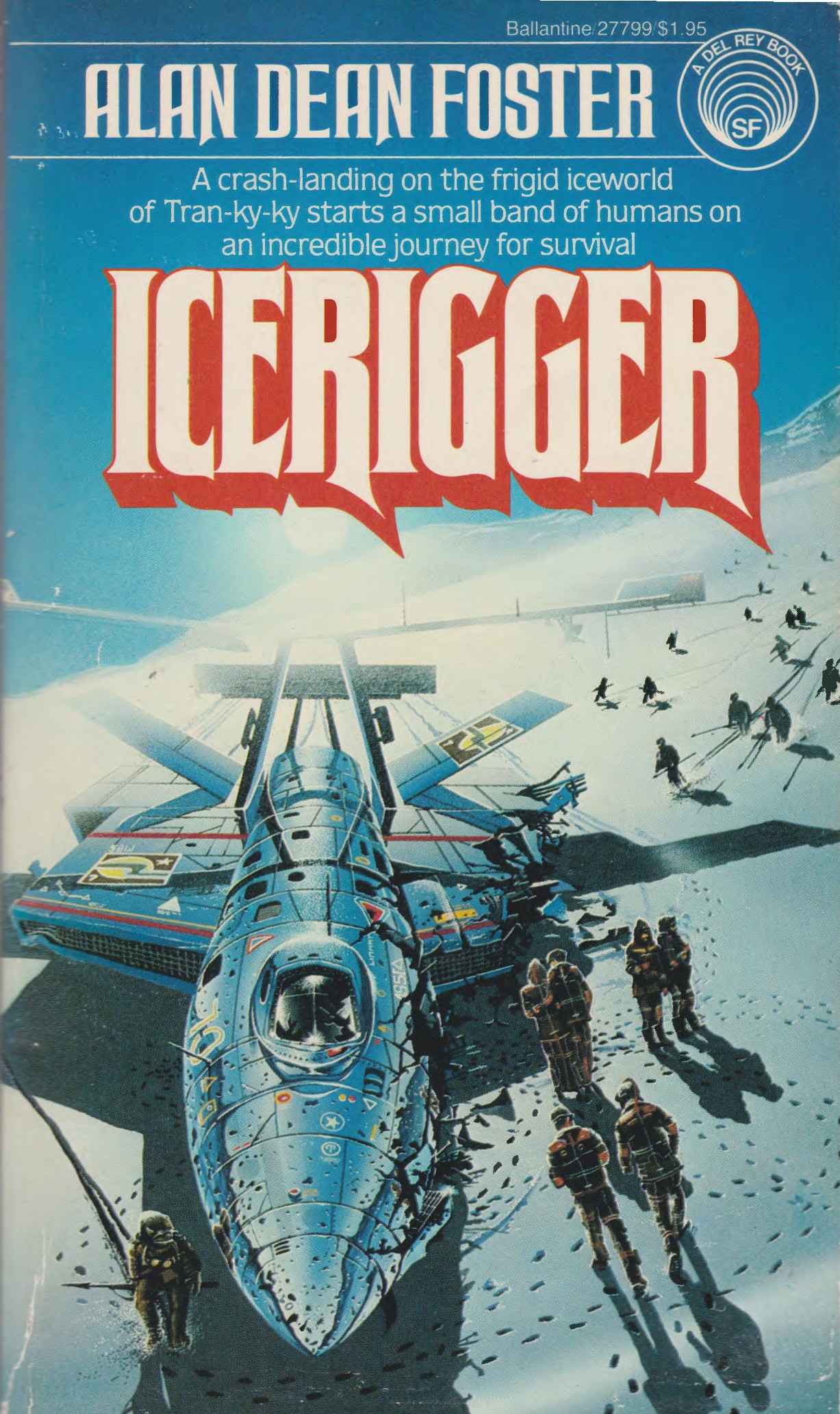
1. Looks like a fun adventure from Alan Dean Foster! And who can resist the crashed spaceship visual trope? I compiled three art posts on the topic: Part I, Part II, and Part III.

2. Of the bunch, Chelsea Quinn Yarbro’s Hyacinths (1983) appeals the most. I’m a sucker for SF stories about the dream state—i.e. Roger Zelazny’s The Dream Master (1966)—and commentaries on media and advertising. And of course, I’m fascinated Philip K. Dick’s dystopian formulations of the future of advertising which Hyacinths seems to expand on…..

I’ve previously reviewed Yarbro’s terrifying post-apocalyptic novel False Dawn (1978)

3. An alternate history where Native Americans defeat the colonizers? Intrigued but suspect it’s on the pulpy side of things. I wish I could find out more about Ron Montana. Was he of Native American descent? His first SF publication, “We the People” (1974), appeared in Craig Strete’s fanzine Red Planet Earth. Here’s his publication listing. Unfortunately, I assume he’s best known for his later copyright conflict with Craig Strete.

4. And finally, this one was hiding in a pile… I can’t remember how long I’ve had it or why I purchased it. Not an author I know and SF encyclopedia isn’t more than lukewarm in its assessment.

Let me know what books/covers intrigue you. Which have you read? Disliked? Enjoyed?

~

1. Icerigger, Alan Dean Foster (1974)

(Tim White’s art for the 1976 UK edition reused for the 1978 US edition) Continue reading

Updates: Recent Science Fiction Acquisitions No. CCXLVII (Candas Jane Dorsey, Michael Elder, Garry Kilworth, Sterling E. Lanier)

1. Sterling E. Lanier is best known for Hiero’s Journey (1973), which I procured in 2012 but haven’t yet read. Here’s the second of his singleton novels—Menace Under Marswood (1983). SF Encyclopedia describes it as “tamely repeat[ing]” (SF Encyclopedia) material from his earlier novels.

I’m a fan of the Darrell K. Sweet cover! Especially the mysterious creature decked out in scepter, robe, and hat.

darrell k. sweet Menace Under Marswood

(Darrell K. Sweet’s original canvas for the 1st edition)

2. A discussion on twitter about female authors of cyberpunk yielded a name unfamiliar to me — Candas Jane Dorsey. I procured a collection of her best known short fictions, which “polemically re-use and rework sf and fantasy tropes from a Feminist perspective, engaging most memorably, and fascinatedly [sic], in the title story of the first volume, “(Learning About) Machine Sex”, with the phallocentrism of much Cyberpunk” (SF Encyclopedia). Count me in!

3. My Garry K. Kilworth exploration series continues with Gemini God (1981). I must confess my enthusiasm has waned a bit after I read In Solitary (1977). See my review of The Night of Kadar (1978) for what he’s capable of.

4. This cover…. the gauze… the sheen…. the cheesiness. Explorations of media in SF is always something I gravitate towards—even when “graced” which such dismal artist failures.

Haven’t read anything by Michael Elder. I do not have high hopes!

Let me know what books/covers intrigue you. Which have you read? Disliked? Enjoyed?

~

1. Menace Under Marswood, Sterling E. Lanier (1983) Continue reading

Updates: Recent Science Fiction Acquisitions No. CCXLVI (Michel Jeury, Sheila MacLeod, Vietnam War anthology, The Year 2000 anthology)

1. I’m a sucker for themed anthologies! Especially of original stories… This one is on the top of my list to read!

2. The lengths the cover blurb goes to proclaim Sheila MacLeod’s Circuit-Breaker (1978) not SF is humorous. The blurb writer ends up describing the aim of New Wave science fiction (interior vs. exterior space). So many of these arguments demonstrate a lack of knowledge of genre and depends on dismissive stereotypes. As it my practice, I try to avoid these exclusionary/gate-keeping arguments. I recently picked up a copy of her only other SF novel Xanthe and the Robots (1977).

Curious about this one — and all SF about potentially insane astronauts.

A handful of favorite stories of (possibly) insane astronauts

Barry N. Malzberg’s Beyond Apollo (1972), The Falling Astronauts(1971), and Revelations (1972)

Gene Wolfe’s “Silhouette” (1975)

3. Another themed anthology! The topic here is the Vietnam War. Huge fan of Vietnam War inspired SF — especially Ursula Le Guin’s The Word for World is Forest (1972) and Kit Reed’s Armed Camps (1969).

What are your favorite Vietnam War-themed SF works? I’m thinking of putting together a resource on the topic.

4. French SF in translation. Here’s Michel Jeury’s bibliography. This appears to be the only one of his MANY SF novels to be translated into English. Alas.

Let me know what books/covers intrigue you. Which have you read? Disliked? Enjoyed?

~

1. The Year 2000, ed. Harry Harrison (1970)

(Pat Steir’s cover for the 1st edition) Continue reading

Book Review: Candy Man, Vincent King (1971)

(Patrick Woodroffe’s cover art for the 1973 edition)

3.5/5 (Good)

The Candy Man wanders from place to place in a crumbling mega-city with his sole companion, a mechanical dog named Wolf who comes with a handy handle. Candy Man instigates the lobotomized, with primal speeches and drugged sugar floss tinted with pulverized beetles, to revolution. His reward for turning in those he encouraged deviate from the will of the Deep Machine and their Teachers? Vials of drugs. Enter the hypnagogic world of Vincent King’s Candy Man (1971), an unsettled landscape inhabited by the degenerate remnants of humankind and the arcane workings of a computer program that cannot escape its original perimeters.

Fresh off Vincent King’s short story “Defense Mechanism” (1966), I tracked down a copy of his second novel. Occupying a similar space as “Defense Mechanism” (conceptual breakthrough in a decaying world city), King pushes the narrative Continue reading

Book Review: The Ship Who Sang, Anne McCaffrey (1969)

(The Brothers Hildebrandt’s cover for the 1976 edition)

4/5 (collated rating: Good)

Cyborgs. Grand adventure. Space plagues. Theater performances for aliens. Trauma and recovery. Anne McCaffrey’s fix-up novel The Ship Who Sang (1969) is comprised of four previously published short fictions and one specially written for the volume (listed below). The fourth section, published in Analog Science Fiction/Science Fact (June 1969) ed. John Campbell, Jr.  as “Dramatic Mission” (1969), was nominated for both the Nebula and Hugo Award (1970) for best novella. The stories follow the space opera adventures and emotional development of the cyborg Continue reading

Book Review: New Writings in SF 7, ed. John Carnell (1971)

(David McCall Johnston’s cover for the 1971 edition)

3/5 (collated rating: Average)

Preliminary publication note: The UK and US editions of the New Writings in Science Fiction anthology series (1964-1977) varied in content—even volumes indicated by the same number. They are often treated as separate entries in the isfdb.org anthology listing. I read and reviewed the US edition.

~

The back cover of New Writings in Science Fiction 7 (1971), ed. John Carnell promises a form of “future shock”—plunging us into a world derived from ours but foreign and alien. Is the collection successful? As with the three other volumes in this anthology series I’ve read—New Writings in SF 4 (1965), New Writings in SF 6 (1965), and New Writings in SF 9 (191972)–the answer is a mixed “somewhat.”

In the volumes I’ve explored so far, Vincent King is the biggest surprise—i.e. an author I had never read who produces regularly solid work. As with “Testament” (1968), King’s “Defence Mechanism” (1966) evokes “existential emptiness” Continue reading

Updates: Recent Science Fiction Acquisitions No. CCXLIII (Mary Gentle, Robert Reed, Mike Resnick, and Jayge Carr)

1. As a historian, I am particularly fascinated by future histories—stories or novels chronologically organized to convey the historical scope of a society’s evolution. Mike Resnick, a new author to me, presents a future history in the form of linked original short stories. The format reminds me of Michael Bishop’s Catacomb Years (1979), although the stories in the latter volume were previously published.

Barry N. Malzberg also tried his hand at a future history (albeit, a distinctly Malzbergian take) in the underrated Universe Day (1971).

2. I’ve read extensively about Mary Gentle but I haven’t picked up one of her novels–until now. I’d love to know your thoughts on this one.

3. Jayge Carr is best known for Leviathan’s Deep (1979) which I bought a few years back but haven’t read. Here’s a lesser known work—it only received one printing—in a trilogy.

4. And finally, another complete unknown…. SF Encyclopedia describes Robert Reed’s first novel, The Leeshore (1987), as “a tale which combines adventure-sf plotting (a pair of twins, the sole humans left on the eponymous water-covered colony planet, must guide a task force in pursuit of the Computer-worshiping zealots who have killed everyone else) with an almost mystical sense for the genius of place, the intricacies of self-hood.”

Count me intrigued! I’m all for unusual planets…..

As always, let me know what you think of the books and covers in the comments!

~

1. Birthright: The Book of Man, Mike Resnick (1982)

(Uncredited cover for the 1st edition) Continue reading