Adventures in Science Fiction Cover Art: Future Archaeology and Mysterious Artifacts (Alien + Human)

SPCSCNCFCC1953

(Hannes Bok’s cover for the  Space Science Fiction [UK], Volume 1 No. 4 (1953), ed. unlisted)

A spaceship arrives on Mars…  After a cursory initial exploration, the human astronauts conclude that the planet has always been barren and uninhabited.  But in some chasm or scattered in desolate plain, a column is found, and rows of mysterious buildings, and a pulsating crystal…  An abandoned outpost of an alien society?  Or, Earth’s mysterious forebearers…  Summaries such as this one proliferate the dusty SF paperbacks on back shelves of used book stores and the closets of SF fans — the variations are countless.

Queue my cover art theme: The future discovery of mysterious ruins/artifacts Continue reading

Adventures in Science Fiction Cover Art: Domed Cities (and Outposts) of the Future, Part IV

Screen shot 2013-01-25 at 9.47.21 PM

(Ley Kenyon’s cover for the 1953 edition of Adventures in Tomorrow (1951), ed. Kendell F. Crossen)

Since the release of the TV series Under the Dome (2013-), based on Stephen King’s 2009 novel by the same name, there has been a resurgence of interest in domed cities.  And for good reason — the trope is one of the most popular of science fiction artists and authors since the 30s (and probably earlier).  Not only do the societal implications and visual allure of the trope of a domed outpost on a harsh planet or a domed city amidst the ruins of Earth arouse the creative authorial juices but also generate some fantastically Continue reading

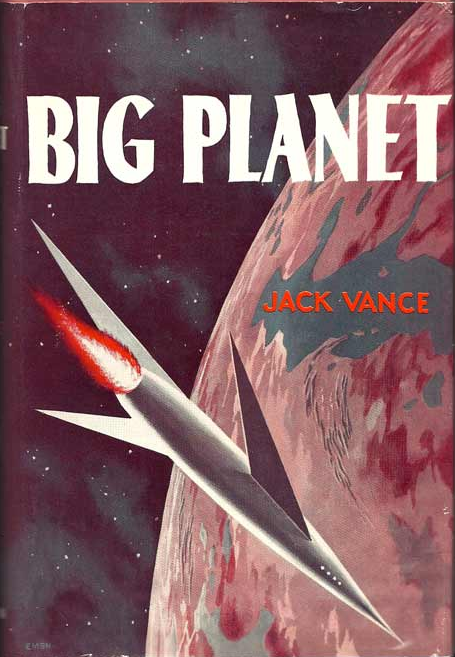
Book Review: Big Planet, Jack Vance (magazine publication 1952)

Screen shot 2013-06-01 at 6.18.27 PM

(Ed Emshwiller’s cover for the 1952 edition)

3.25/5 (Good)

After Jack Vance’s recent passing I decided that as an informal remembrance I’d review one of his novels.  However Big Planet (1952), the only unread novel of his I had on my shelf, is from early in his career and far from the level of his best works.  Of his novels I’ve read, Wyst: Alastor, 1716 (1978) and the loose sequel to Big Planet, Showboard World (1975) were the most satisfying.  The Blue World (1966), Marune: Alastor, 933 (1975), and City of the Chasch (1968) were all enjoyable adventure tales set in fantastic worlds.  I recommend those — along with his more famous novels — before picking up a copy of Big Planet.

Over the course of its publication history Big Planet was cut and modified multiple times from its original magazine form.  A restored text was published in 1978…  Unfortunately, I read the 1957 Ace Continue reading

Adventures in Science Fiction Cover Art: The Space Station, Part III

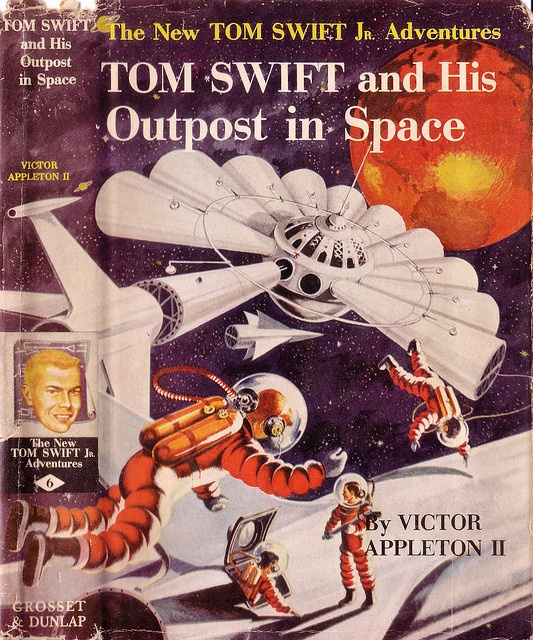
8fb71adc43d8c6f43977b5522a534504(Graham Kaye’s cover for the 1955 edition of Tom Swift and his Outpost in Space (1955), Victor Appleton II)

This is Part III of my series on space stations (Part I + Part II).  Ever since I watched 2001: A Space Odyssey (1968) as a teen I’ve been fascinated by space stations — platforms for further space exploration!  I can only imagine how exciting it was for fans of science fiction who read about stations before they existed to see them finally constructed. The fact that they became reality — well, perhaps not (yet) as a launching point for space going exploration vessels — almost vindicates the scientific extrapolation of some of these early visions.  Also, Arthur C. Clarke’s Islands in the Sky (1952) happened to be one of my first science fiction novels…..  And C. J. Cherryh’s Downbelow Station (1981) Continue reading

Book Review: Mortals and Monsters, Lester del Rey (1965)

(Richard Powers’ cover for the 1965 edition)

3.25/5 (collated rating: Average)

Lester del Rey’s collection Mortals and Monsters (1965) — first editions are adorned with a gorgeous collage by the superb Richard Powers — is comprised of eight short stories from the 50s and four from the early 60s.  The collection, as with all but the best collections, is a mixed bag.  ‘The Years Draw Nigh’ (1951) is almost a masterpiece while ‘Recessional’ (1965) is an upsetting exercise in 60s sexism despite the fascinating premise.

I found that a few of the del Rey’s shorts are some of the more blatantly sexist 50s works Continue reading

Updates: Recent Science Fiction Acquisitions No. LXVII (Simak, Clement, Bradley, White)

I just came back from more than a month in Paris where I was rather sci-fi deprived so I headed immediately (well, not literally) to the local used bookstore.  A nice collection of novels from some of the genre’s greats — Hal Clement, James White, Clifford D. Simak, and Marion Zimmer Bradley.  I’ve not read any of Bradley’s novels and I’ve heard that Darkover Landfall (1972) is probably the place to start.

And I’ve enjoyed James White’s work so far.  Clement isn’t exactly my cup of tea but it might be good to read another one of his novels before I come to a conclusion.

And some fun Paul Lehr covers…

1. Lifeboat (variant title: Inferno), James White (1972)

(John Berkey’s cover for the 1972 edition) Continue reading

Book Review: Croyd, Ian Wallace (1967)

(Paul Lehr’s cover for the 1968 edition)

2.5/5 (Bad)

The esteemed science fiction critic John Clute claimed quite adamantly that Ian Wallace’s Croyd (1967) and its sequel Dr. Orpheus (1968) “are among the most exhilarating space-opera exercises of the post-World War Two genre” (SF Encyclopedia entry for Ian Wallace).  With this endorsement in mind I picked up a copy with high expectations.  But Clute’s assessment leaves me utterly flummoxed.

Wallace attempts to channel A. E. Van Vogt’s 1940s at a time (the 60s) when a large percentage of the writers were eschewing this form for social science fiction and the literary aspirations Continue reading

Book Review: Time and Stars, Poul Anderson (1964)

TMNDSTRSQZ1965

(Richard Powers’ cover for the 1965 edition)

3.75/5 (collated rating: Good)

Time and Stars (1964) is a wonderful collection of short works by one of the greats, Poul Anderson.  Anderson is best known for hard science fiction novels such as Tau Zero (1970) as well as fast paced pulp adventures exemplified by his Dominic Flandry (à la James Bond in space) sequence which he started in the 50s.

Only one of the six shorts in the collection was subpar — ‘Escape from Orbit’ (1962) — which did not rise above the traditional we need to rescue some stranded astronauts plot.  All the others — for example, Hugo winning novella and well-told tale of a balkanized American Pacific coast ‘No Truce of Kings’ (1963), the fantastic evolved mechanical life forms in ‘Epilogue’ (1962), and the wit of ‘The Critique of Impure Reason’ (1962) — make the collection worthwhile for fans of classic science fiction (and obviously, fans of Poul Anderson).  The novella ‘Epilogue’ is the best of Anderson’s works Continue reading

Updates: Recent Science Fiction Acquisitions No. LXVI (Anderson + Simak + Ballard)

Gifts!  From my fiancé!

Four more wonderful books…  I can’t wait to read J. G. Ballard’s The Burning World (1964) and Poul Anderson’s short story collection Time and Stars (1964)…  Ballard is a genius and Anderson is a solid writer who always produced fun plot-driven works (I suspect his Hugo nominated There Will Be Time (1973) will be similar).  Also, despite my general frustration with Clifford D. Simak’s ouvre, I’m intrigued by Why Call Them Back From Heaven? (1967)….

Enjoy the two Powers covers!

1. The Burning World, J. G. Ballard (1964)

THBRNNGWR1964

(Richard Powers’ cover for the 1964 first edition) Continue reading