Book Review: A Scourge of Screamers (variant title: The Lost Perception), Daniel F. Galouye (1966)

SCRGSCRM1968

(Paul Lehr’s cover for the 1968 edition)

2.75/5 (Vaguely Average)

Recently I procured a handful of Daniel F. Galouye’s novels (here) for a few dollars on ebay because I enjoyed his first novel Dark Universe (1961), which is an underread/underrated classic of the early 60s.  In an effort to rekindle public interest in Galouye’s small ouvre (he died at 54 due to war injuries and was unable to write much in the last ten years of his life), he received the Cordwainer Smith Rediscovery Award in 2007.  Unfortunately, Galouye’s fast-paced sci-fi thriller A Scourge of Screamers (variant title: The Lost Perception) does not measure up to the claustrophobic and well-plotted social rumination (with a good dose of action) that is Dark Universe.

The most redeeming feature is Paul Lehr’s harrowing depiction of mental anguish Continue reading

Adventures in Science Fiction Cover Art: Nostalgic Visions — Plastic Toy Spacemen

6186728691_d76e9c6c89_z

(Uncredited cover for the 1970 edition of When Two Worlds Meet (1970), Robert Moore Williams)

A while ago I put together a post on the theme of Models, Dolls, and Mannequins in cover art.  Little did I know that Curtis Books (a rather minor publisher of generally minor authors) and Born, a Dutch imprint, used a substantial number of cover compositions comprised of manipulated photographs/collages etc of plastic toy spacemen in unusual alien environments.  Also, a few more major publishers/magazines — Four Square Science Fiction and Analog Science Fiction Science Fact — had their own take on the theme.

I find these covers very charming and fun (sort of like a science fiction B-film from the 50s) — not necessarily artistic masterpieces.  They certainly evoke childhood games with toy figurines — perhaps placed in the lawn or sandbox or amongst the grass. I’ve included a few from my previous post and another can be found in my post Continue reading

Updates: Recent Science Fiction Acquisitions No. LXIII (Simak + Tenn + Clement + Frayn)

A new bookstore in my hometown!  Great results! Dirt cheap (between 1-2 $ a book)!  Happy me!

I finally have a copy of Hal Clement’s hard science fiction masterpiece, Mission of Gravity (1953)…  And a collection of William Tenn’s short stories with a downright gorgeous Powers cover — Tenn is supposedly up there with Sheckley in the satirical pantheon of the 50s… Among others…

Has anyone read Michael Frayn’s A Very Private Live (1968)?  I’ve never heard of it before but the Lehr cover was too amazing to pass up…

1. The Human Angle, William Tenn (1956) (MY REVIEW)

THHMNNGLVW1956

(Robert Powers’ cover for the 1956 edition)

From the inside flap: “WIT: an extra-terrestrial sells pornographic literature Continue reading

Adventures in Science Fiction Cover Art: The Power of the Atom!

CRSSTWPGSN1958

(John Richards’ cover for the 1958 edition of Crisis 2000 (1955), Charles Eric Maine)

On science fiction covers from the 40s and 50s the atom is often emblematic of atomic power and all the dangers and promises that such a scientific breakthrough could (and did) yield.  In John Richards’ cover for the 1958 edition of Charles Eric Maine’s Crisis 2000 (1955) the humanoid super beings arrive from Saturn to terrorize Earthmen — and, carefully covering the private areas of one of these denizens of Saturn is the atomic symbol surrounded by blood. The cover is made even more unnerving by the multiplicity of identical Continue reading

Adventures in Science Fiction Cover Art: The Space Station, Part II

Screen shot 2013-03-31 at 12.09.55 PM

(Arthur Hawkins’ cover for the 1959 edition of Skyport (1959), Curt Siodmak)

Part II of my series on cover art depicting space stations (Part I).  Here are vast assortment of primarily Alex Schomburg and Vincent Di Fate’s artwork — they did love their space stations.  But, I think my favorite is by far Arthur Hawkins’ cover for the 1959 edition of Curt Siodmak’s Skyport (1959) — the author is of course famous for the novel Donovan’s Brain (1942).  The delightful color scheme, the 50s aesthetic, the vague indication of continents below, the cluster of Continue reading

Updates: Recent Acquisitions No. LX (Galouye 4x + Bunch)

What a group of novels!  Four novels by the highly underrated and underread 1960s/early 70s author Daniel F. Galouye — the only novel of his I’m missing is The Infinite Man (1973)…  I’ve previously read his most famous work Dark Universe (1961) — here’s my review (be warned, one of my first reviews on the site, I’d like to think that I’ve improved) — but copies tend to go for around $10+ online so I didn’t own a copy until I stumbled on a great lot of his novels on ebay for a few bucks…

Just read the back covers quotes (below).  They all sound disturbing and absolutely fantastic.  Rainer Werner Fassbinder — yes, you read that correctly — even made a German language miniseries adaptation, Welt Am Draht (1973) (World on a Wire), of Simulacron-3 (1964). Criterion just released a DVD….  And of course, Josef Rusnak’s more famous film The Thirteenth Floor (1999) was a lose adaptation of the same novel.

Also, I spent the most I’ve ever spend on a paperback for David R. Bunch’s near masterpiece, Moderan (1971).  I finished the novel last week (interlibrary loan) and had to find a copy…  They are usually $18 + online but again, found a copy on ebay and made an offer.  I’ll have a review of Moderan up in a few days, I promise!

1. Lords of the Psychon, Daniel F. Galouye (1963)

LRDSPSCH1963

(Uncredited cover Continue reading

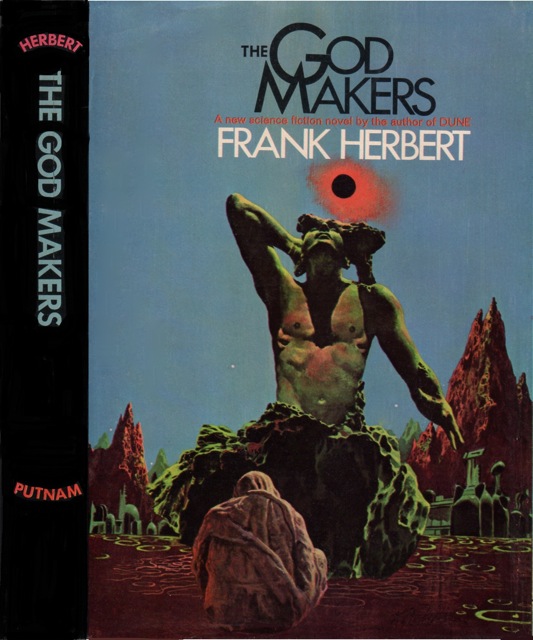
Book Review: The God Makers (variant title: The Godmakers), Frank Herbert (1972)

the god makers

(Vincent Di Fate’s cover for the 1972 edition)

3.25/5 (Average)

As of late I’ve been returning to the extensive catalogue of Frank Herbert’s non-Dune novels on my shelf — The Eyes of Heisenberg (1966) was an engaging read with adept world building which created an intriguing/harrowing dystopic future.  The God Makers (1972) lacks not only Herbert’s trademark dense prose (for example, constantly shifting perspective over the course of a conversation) but also features one of his more poorly conceived future worlds.  This might be due to the fact that the novel was cobbled together from four short stories Continue reading

Book Review: The Mile-Long Spaceship (variant title: Andover and the Android), Kate Wilhelm (1963)

(Richard Powers’ cover for the 1963 edition)

3/5 (collated rating: Average)

Kate Wilhelm, famous for her Hugo-winning masterwork Where Late the Sweet Birds Sang (1976), started her writing career with more modest works.  The Mile-Long Spaceship (1963) collects some of her earliest short stories from the late 50s and a few written for the collection in the early 60s — Clone, her first novel, co-written with Theodore L. Thomas would come out in 1965.  However, her best sci-fi was published in the late 60s to the mid-70s.  Before then her work tended to be straight-forward with an occasional interesting idea or poignant scene but generally unremarkable….

Three stories are worth reading in this collection: an early work of feminist science  Continue reading

Updates: Recent Science Fiction Acquisitions No. LVIV (Laumer + del Rey + Stableford + Dickson)

An overpopulation themed novel (at least for part) by Gordon R. Dickson….

A supposedly underrated/dark novel by Brian M. Stableford (according to some, one of his best)…

An early novel in Keith Laumer’s famous Retief sequence…

And a fun juvenile by Lester del Rey….

1. The Outposter, Gordon R. Dickson (1971)

(Bruce Pennington’s cover for the 1976 edition)

From the back cover: “Destination: Oblivion.  The Lottery played no favorites — if a person’s number came up, he joined the rest of the losers marked for exile from the overcrowded Continue reading