Adventures in Science Fiction Art: Doomed Cities Part III (the attack of the metal missile casings, monks among ruins)

(Rod Turner’s cover for the 1952 edition of The G-Bomb (1952), Vargo Statten (i.e. John Russell Fearn)

Make sure to check out Part I and Part II if you haven’t.  Some of the doomed cities are stunning!

Of all the 50s pulp covers, Rod Turner’s series for Vargo Statten’s novels (John Russell Fearn) has become one of my favorites (above).  Although they adhere to every possible cliché, the pure exuberance of delivery is addicting — the books themselves are supposed to be pure drivel.

Enjoy monks among ruins, spaceships hovering above the fragments of past cities, hordes emerging from the wrecked husks of our august metropolises, the attack Continue reading

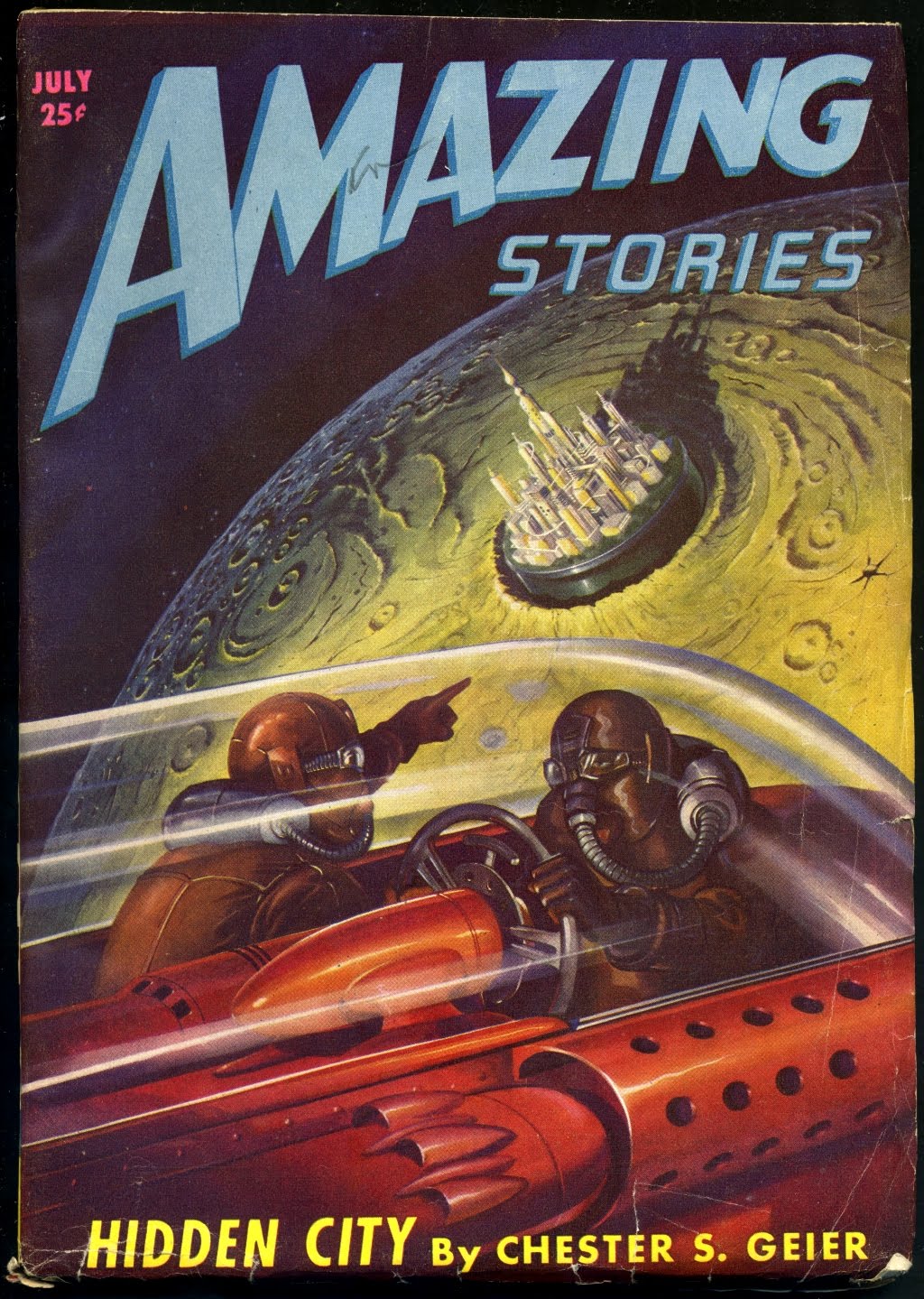
Adventures in Science Fiction Cover Art: Through the View Screen, Through the Window

(Julian S. Krupa’s cover for the July 1947 issue of Amazing Stories)

Through the window, through the view screen cities are discovered, worlds end in searing flame,  vectors to unknown lands are plotted, the horrors of earth are left behind.  Alone in a space station an astronaut observes the fragile construction arrayed around him.  Through the window, through the view screen aliens observe our strife, loved ones watch in agony, and the culmination of our era’s scientific endeavors are arrayed in orderly rows.  

In short, the possibilities are endless.  The glass (or some scientifically advanced clear material) frames the story, we watch others watching or we see what they see while we stand among them… 

Definitely a delightful sci-fi cover art trope worth exploring.  Here are a broad selection of covers from juvenile science fiction novels, pulp magazines, edited Continue reading

Updates: Recent Science Fiction Acquisitions N. XXIII (Farmer, Malzberg + et al.)

A while back I slogged through Philip José Farmer’s dismal To Your Scattered Bodies Go (1971) (the worst novel ever to win the Hugo Award?) and all the increasingly terrible sequels and made a solemn vow to wait a few years before I returned to his extensive oeuvre — so, against my better judgement I picked up a copy of  Traitor to the Living (1973).  I don’t have high hopes (but I love the cover!).  I hope my two dollars were well spent.

Malzberg is shaping into my “under read/unjustly forgotten author of the year” whom I’ll showcase.  Last year’s winner was the brilliant D. G. Compton (see INDEX for reviews).  Fresh off Conversations (1975) and In The Enclosure (1973) I picked up a copy of Guernica Night (1975).  I can’t wait!

Harold Mead’s The Bright Phoenix (1955) is yet another against the oppressive state à la Orwell’s 1984… But, I’ve found that the premise generally holds up despite frequent re-interpretations…

Greenfield’s Waters of Death (1967) should be avoided — at all cost.  I’ve already written a scathing review (rant).

1. Traitor to the Living (1973), Philip José Farmer (MY REVIEW)

(Hans Ulrich Osterwalder and Ute Continue reading

Updates: Recent Science Fiction Acquisitions N. XXII (Cooper + Wilhelm + Kornbluth + Merril)

I was so impressed with C. M. Kornbluth’s masterful collection The Explorers (1954) that I picked up a copy his 1958 collection A Mile Beyond the Moon (I own the hardback first edition but I prefer Powers’ cover below).  Also, recently inspired (again) to read more 1960s works by female authors I bought a collection of three novellas by Merril and a 1963 collection of shorts by Kate Wilhelm.  Wilhem and Merril aren’t always top-notch but worth a read (and in Wilhelm’s case, a second chance — I enjoyed Where Late the Sweet Birds Sang (1977) but I’m still not convinced it was Hugo/Nebula quality work).

Cooper’s Seed of Light (1958) is considered one of his more mature works — to the chagrin of some of his fans who prefer his more “pulpish” works — but my obsession with generation ships was my real motivation to add it to my collection.

One short story, a novel, and one of the novellas take place on generation ships!

A nice haul — a mixture of lesser known works by some famous figures.

Enjoy (the covers)!

1. Daughters of Earth (1968), Judith Merril (MY REVIEW)

(Robert Foster’s cover for Continue reading

Adventures in Science Fiction Cover Art: Rocket, Field, Figure Part I

(Rod Dunham’s cover for the 1953 edition of Planet of the Dreamers (1953), John D. MacDonald)

First (archetypal) incarnation: rocket, field, figure.  Second incarnation: rocket with extra fins, field with unusual terrain, human staring at alien figure (s).  Repeat with virtually infinite variation.

By far one of my favorite science fiction cover tropes, rocket/field/figure evokes covers spanning the entire history of science fiction.  Rod Dunham’s cover for the 1953 edition of John D. MacDonald’s Planet of the Dreamers (above) perfectly evokes the archetype in its pure unadulterated form.  Emswiller’s cover for the 1960 issue of The Magazine of Fantasy and Science Fiction (below) uses a more traditional perspective but manipulates the field with a Continue reading

Book Review: The Man in the Maze, Robert Silverberg (1969)

(Ron Walotsky’s cover for the 1978 edition)

4.5/5 (Very Good)

The Man in the Maze (1969) is yet another glorious novel from Silverberg’s best period (1967-1975).  Silverberg adeptly recasts Sophocles’ play Philoctetes (perhaps more of a loose inspiration) in an inventive and fully realized science fiction future where man has newly come into contact with interstellar beings.  As with some of his more serious works (The World Inside, Downward to the EarthHawksbill Station, etc.) the tone is that of a dark and brooding rumination.  The setting, a massive and unexplained ancient maze/city on the planet of Lemnos, is the perfect backdrop for the thought-provoking human drama that unfolds.

Plot Summary

Our hero, Richard Muller, is a one-time diplomat famous Continue reading

Updates: Recent Science Fiction Acquisitions N. XXI (Silverberg + Compton + Malzberg + Anderson)

A few more Christmas gift card purchases…

Dying Inside (1972) is often considered one of Silverberg’s best works and I can’t wait to read it (I will after my soon to be hellish weekend grading ~60 undergrad history papers).  Despite a painfully negative review on Amazon slamming Compton’s The Silent Multitude (1967) as a dull imitation of J. G. Ballard, it is high on my to read list — almost any experimental (allegorical) work exploring a crumbling city intrigues me.  Malzberg’s Conversations (1975) was a shot in the dark — it might be the least read of any of his novels — hence, my interest.

Pohl Anderson is almost always worth reading — even his middling short stories are fun.

Enjoy!

1. Dying Inside, Robert Silverberg (1972)

(Jerry Thorp’s cover for Continue reading

Updates: Visit + Submit to the BSFA Award Nominated Review Site SF Mistressworks


Hello all,  Ian Sales’ wonderful SF Mistressworks (link), a review collating blog, has recently been nominated for the BSFA award (British Science Fiction Association) in the non-fiction category (link for the list).  I’ve submitted nine of my reviews of sci-fi works written by women over the last few months.  It was created in direct response to the absence of sci-fi masterpieces by women on a list by The Guardian, a lack of general knowledge in the sci-fi community about early female pioneers in the genre, and general lack of readership for their many award-winning works.

If you’ve written reviews of science fiction works by women (the novels/short story collections need to be written before 2000) please submit them as well (500 words or so is preferred)!  So, gather up any Russ, Norton, Cherryh, C. L. Moore, Merril, Brackett, Piserchia, Le Guin, MacLean, Butler, etc etc etc reviews you might have on your blog or anywhere else.  It’s a great resource for finding seldom read works/authors which deserve a greater readership. Continue reading

Updates: Recent Science Fiction Acquisitions N. XX (Clifton + Aldiss + et al.)

Christmas giftcard expenditures continue…

An interesting collection of acquisitions — Clifton’s Eight Keys to Eden (1960) is considered, at least by the reviews I’ve found online, to be a little read classic — i.e. my kind of sci-fi novel.  Aldiss always has wonderful ideas and The Long Afternoon of Earth (variant title: Hothouse) is generally proclaimed one of his best — I’m still waiting for work which garners the same magic as his masterpiece Non-stop (variant title: Starship) (1958).

After reading Kornbluth’s masterful short story collection The Explorers (1953) I felt obligated to pick up a copy of one of the more famous Pohl + Kornbluth collaborations, Gladiator-In-Law (1954).

A few intriguing Malzberg stories in Future City (1973) compelled me to snatch one of his lesser known novels off of the shelf — In The Enclosure (1973) tells the story of an alien tortured by his human captives.  I find Malzberg’s relentlessly dark visions very appealing…  He has a HUGE catalog I’ve yet to read.

1. The Long Afternoon of Earth (variant title: Hothouse), Brian Aldiss (1962)

(Uncredited cover for the 1962 edition) Continue reading