Updates: Recent Science Fiction Acquisitions No. CCXXI (Nancy Kress + Norman Spinrad + Charles Sheffield + Graham Dunstan Martin)

1. A lesser-known novel by Nancy Kress… She remains a complete unknown author to me. I’ve heard high praise for her best-known novel–the Hugo and Nebula-nominated Beggars in Space (1990).

2. In the mid-80s Bluejay Books released a series of illustrated editions of previously published novels and novellas from the likes of Vernor Vinge, Rosel George Brown, and Theodore Sturgeon. As I’ve long respected the work of Norman Spinrad, I tracked down a Bluejay Books edition of his Hugo-nominated novella “Riding the Torch” (1974) with illustrations by Tom Kidd. At first glance the illustrations are not my cup of tea…. but the Spinrad novella has a wonderful premise.

I’ve previously reviewed Spinrad’s meta-fictional masterpiece The Iron Dream (1972) and his worthwhile short story collection The Last Hurrah of the Golden Horde (1970).

3. I recent reviewed Charles Sheffield’s novel Sight of Proteus (1978) and was impressed enough to track down a short story collection. Unfortunately my copy is rather battered, obfuscating my absolute favorite Attila Hejja SPACE SCENE cover!

4. Post-apocalyptic nightmares where survivors are forced to live inside radiation suits? Yes! Raving preacher promising deliverance if survivors leave their radiation suits? Yes! Probability of novel being a “lost” masterpiece? Close to zero.

Let me know what books/covers intrigue you. Which have you read? Enjoyed? Hated?

~

1. An Alien Light, Nancy Kress (1988)

(Ron Walotsky’s cover for the 1st edition) Continue reading

Book Review: Under a Calculating Star, John Morressy (1975)

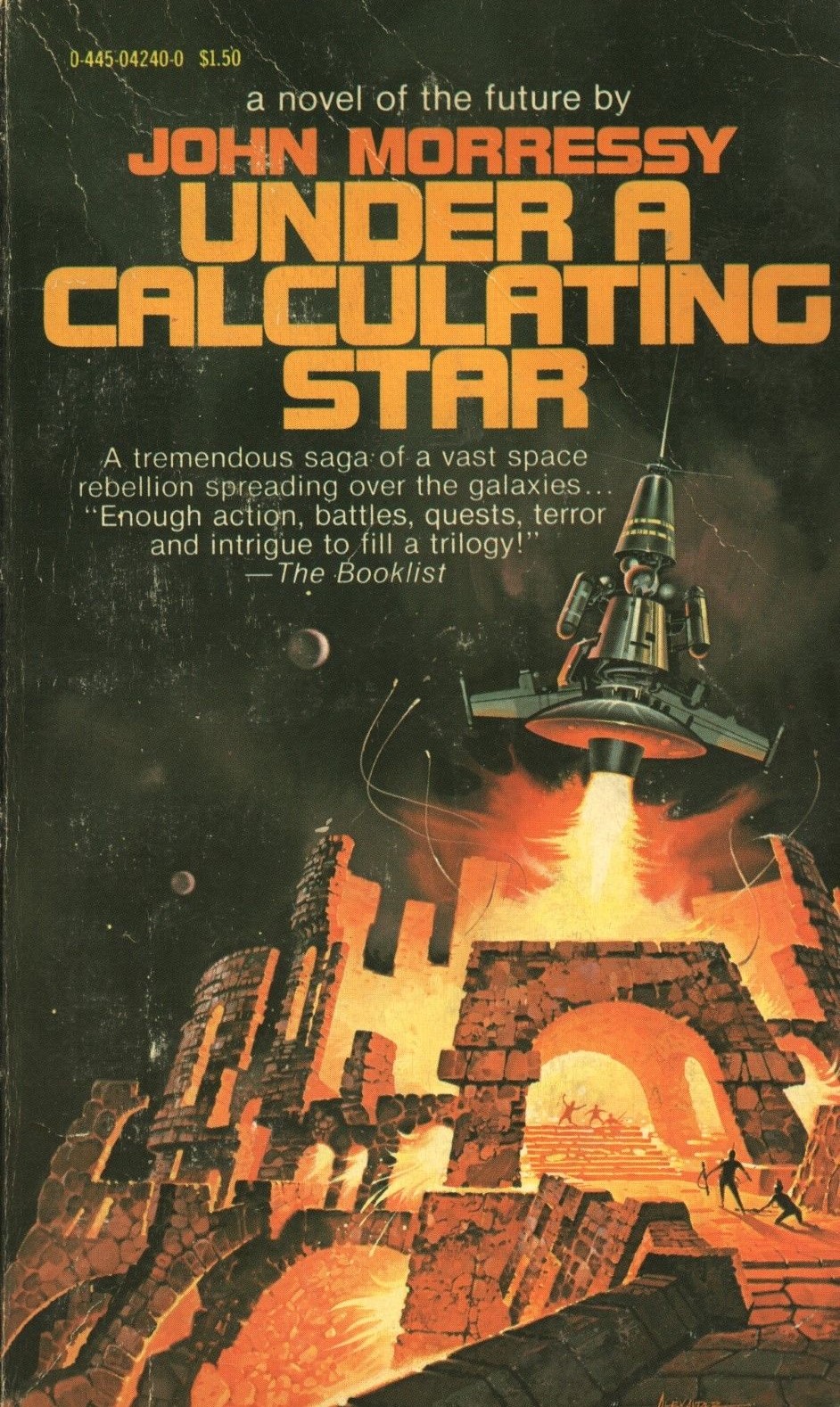
(Paul Alexander’s cover for the 1978 edition)

3/5 (Average)

After finishing John Morressy’s Frostworld and Dreamfire (1977), I tracked down another volume of his Del Whitby sequence. Although far from as engaging and emotionally affective as the former, Under a Calculating Star (1975) provides the historical background to the Morressy’s weirdly primitive far future world: the origins of the Sternverein (the dominant business polity), the explanation of why swords and knives are the weapons of choice while high-tech spaceships roam the interstellar expanses, and the role of Old Earth in the colonization of the far flung reaches. Historical content aside, Under a Calculating Star‘s plot and characters fail to engage and the worlds and societies are one-dimensional in comparison to Frostworld and Dreamfire‘s metamorphic Onhla and the planet Hraggellon, locked in its unusual orbit. Continue reading

Updates: Vonda N. McIntyre (August 28, 1948 – April 1, 2019)

Vonda N. McIntyre (August 28, 1948 – April 1, 2019) passed away yesterday from pancreatic cancer. McIntyre, best known for her Hugo and Nebula-winning SF novel Dreamsnake (1978) and her Star Trek Novels and film adaptations (1981-2004) (bibliography), published her first SF story “Breaking Point” in in the February 1970 issue of Venture Science Fiction Magazine. John Clute in SF Encyclopedia describes her two best-known SF novels: Continue reading

Adventures in Science Fiction Cover Art: Crashed Spaceships, Part III

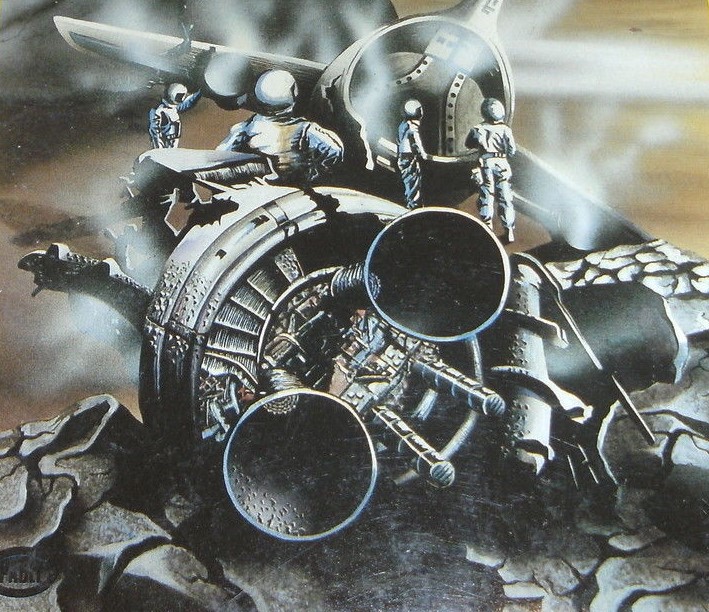
(Detail from Alan Daniels’ cover for the 1980 German edition of Open Prison (1964), James White)

The crashed spaceship — a wrecked hulk spinning in the emptiness of space, shattered metal struts strewn across an alien landscape…. I find few SF scenarios more nostalgic than this one as a younger me was obsessed with books about the societies formed from the survivors of such cataclysms (Anne McCaffrey’s Acorna Universe sequence, of dubious quality now, was a cornerstone of my youth).

I have selected a range of fascinating covers which add to a series I made in 2012 (Part I) and 2013 (Part II). My favorite of the bunch is Tibor Csernus’ cover for the 1973 French edition of Clifford D. Simak’s Time and Again (1951) due to the verdant and wet landscape the spaceship finds itself in. My second favorite is Dean Ellis’ “descriptive” cover for the 1974 edition of Alan Dean Foster Icerigger (1974). It doesn’t try to be surreal but rather depicts a scene straight from novel. I usually prefer when the artist takes a more unusual approach but in this case Ellis narrows in on the wonder of the premise. Continue reading

Adventures in Science Fiction Interior Art: The Power of a Good Introduction (Judith Merril’s 1968 New Wave Anthology England Swings SF)


(Ron Walotsky’s cover for the 1970 Ace edition)

I must confess, I generally skip the introductions to anthologies—even if they are written by my favorite authors who happen to be notable anthologists (Judith Merril, Robert Silverberg, Barry N. Malzberg, etc.). While paging through various collections hunting for stories, I encountered Judith  Merril’s micro-introduction to her famous New Wave anthology England Swings SF (1968). Here’s a list of the contents.

Although it is spread across three pages, it is only a few lines of text–a poetic beckoning, itself a condensed version of what the New Wave embodied. Merril’s intro as poem demonstrates literary invention, the blend of old (“scout ship”) and new (“heading out of sight into the multiplex mystery of inner/outer space”) images, and references to both high (“surrealism) and pop culture (“Beatles”). Continue reading

Book Review: Emphyrio, Jack Vance (1969)


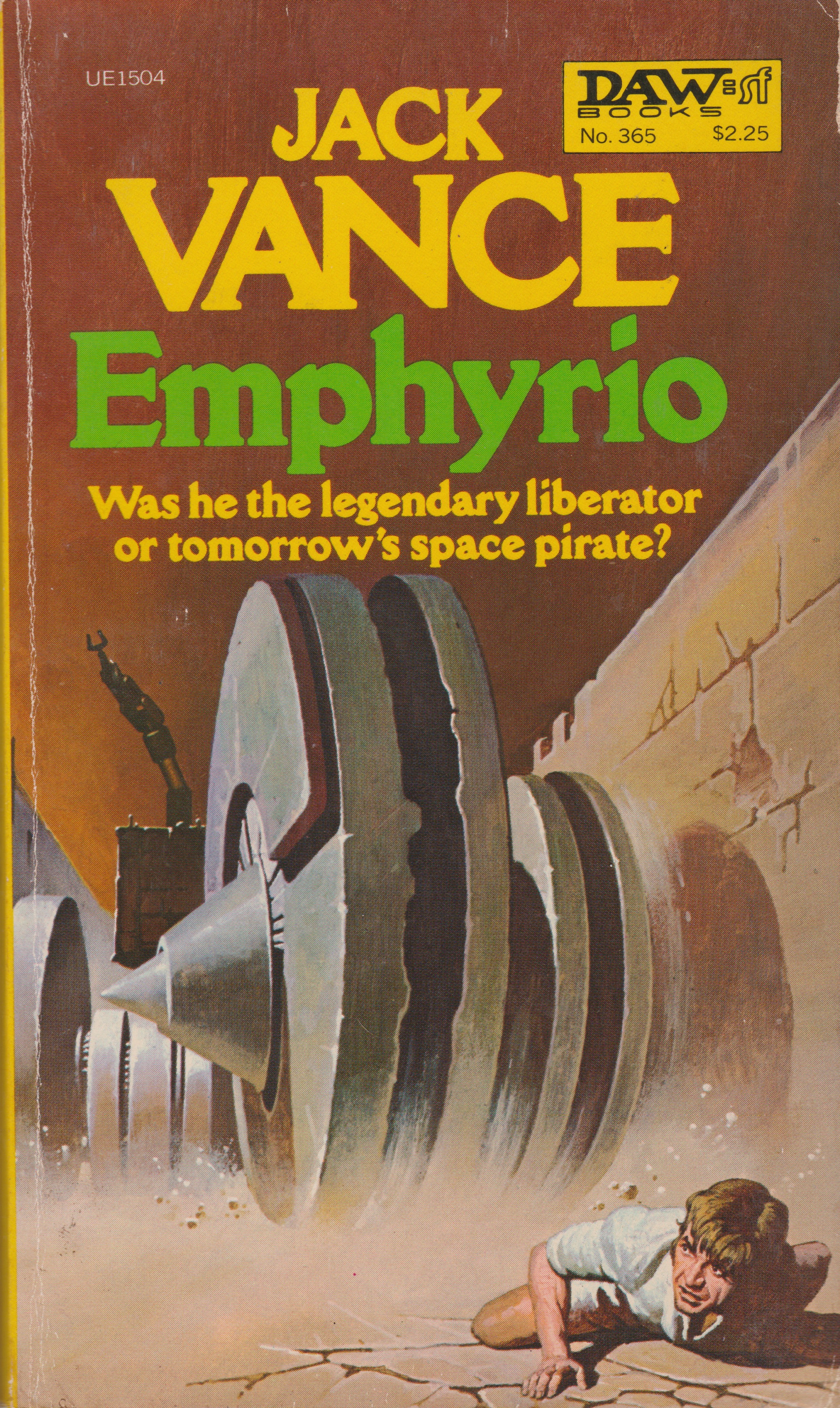
(Gino D’Achille’s cover for the 1979 edition)

3.5/5 (Good)

Jack Vance’s Emphyrio (1969) is a story about how a story can create change and heighten our own yearning for escape. Although a pulp coming-of-age adventure at heart, Vance reigns in his baroque descriptive tendencies to spin a narrative that tries (successfully) to say something meaningful about the impact of storytelling.
Continue reading

Updates: Recent Science Fiction Acquisitions No. CXCIII (Wolf + Simak + Reynolds + Anthology edited by Silverberg)

1. I recently proclaimed my fascination with sports-related SF (despite my general lack of interest in sports) in my review of William Harrison’s “Roller Ball Murder” (1973)… A few of my blog friends have favorably reviewed Gary K. Wolf’s Killerbowl (1975) — couldn’t resist buying a copy online.

I reviewed Wolf’s The Resurrectionist (1979) last year.

2. An anthology edited by Robert Silverberg filled with a veritable horde of great authors–Ursula Le Guin, Terry Carr, R. A. Lafferty, James Triptree, Jr…..

3. A family friend sent me a large box of science fiction paperbacks, which arrived on my doorstep while I was hiking in the Adirondacks—I’ll be posting them slowly. Some I’d purchase if I’d encountered them in a used book stores, others I’d avoid… All greatly appreciated!

And goodness me does this Simak novel have a stunning Richard Powers cover!

4. Part of the gift–Mack Reynolds. Hmm. I am always weirdly excited about opening his books only to discover shoddy plots, half-baked political philosophy, and a few fun ideas hidden in forgotten corners…. At first glance, this fix-up novel reminds me of Rick Raphael’s slice of life novel Code Three (1967).

As always. thoughts and comments are welcome.

Note: Images are hi-res scans of my personal copies.

_

1. Killerbowl, Gary K. Wolf (1975)

(Steve Marcesi’s cover for the 1975 edition) Continue reading

Updates: Recent Science Fiction Acquisitions No. CXCII (Sturgeon + Turner + Schenck + Best of 1973 Anthology)

1. I seldom buy duplicate editions. I originally read Sturgeon’s masterpiece as a teen and I’m unsure where my original 70s edition with a Bob Pepper cover ran off to…. And this perfect condition 1960 edition has glorious Richard Powers art!

2. George Turner—an author I know next to nothing about. I’ve already read 75 pages of his first novel and am absolutely entranced.

3. Hilbert Schenck—another author who is new to me. He published primarily in the early 80s and snagged a few Nebula nominations for his short fiction. His second novel proved to be a dud (I’ll have a review up soon).

4. Why are you buying another Donald A. Wollheim Best Of collection when you’re firmly in the Terry Carr camp of Best Of anthologies? Good question.

That said, I recently reviewed The 1972 Annual World’s Best SF (1972) and it was solid.

Note 1: All images are hi-res scans of my personal copies — click to expand.

Note 2: A diligent Twitter follower indicated that the 1984 edition cover of the Turner novel is Tony Roberts’ work.

Thoughts? Comments? Tangents? All are welcome.

_

1. More than Human, Theodore Sturgeon (1953)

(Richard Powers’ cover for the 1960 edition) Continue reading

Adventures in Science Fiction Art: A Nostalgic Piece of Space Art + Rumination

(Don Dixon’s cover art for the 1st edition of The Crucible of Time (1983), John Brunner)

This post is about a Don Dixon SF space art cover that gives me nostalgic chills. But first, a rumination….

As with so many new readers, my first science fiction adventures–almost a decade and a half ago–followed the Hugo Awards closely and the back catalogue of the established male “masters” (often those whom my dad remembered reading in his childhood–Heinlein, Clarke, Brunner, Herbert, Pohl, Anderson, etc.). And boy did John Brunner feature heavily! I read everything of his I could get my hands on. From the genius that STILL is Stand on Zanzibar (1968)–my first New Wave SF novel–to the half-hearted pulpy adventures (Born under Mars, Meeting at Infinity) that scream paycheck. These novels were some of my first reviewed works on my site (John Brunner review list below). As my readers know, my tastes have changed radically as my willingness and knowledge of lesser known authors and/or “unpopular” authors expands as I read more along the edges. Brunner’s radical  New Wave SF (and at some degree his short fiction) remains a constant.

All of this is to say that it’s unsurprising that Don Dixon’s cover art Continue reading