Book Review: Out of Bounds, Judith Merril (1960)

OTFBNDS1960

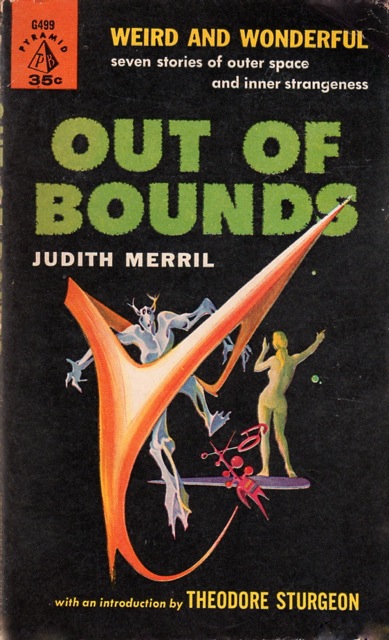
(Art Sussman’s cover for the 1960 edition)

3.25/5 (collated rating: Vaguely Good)

I have long been a fan of both Judith Merril’s fiction and edited volumes.   The eponymous novella in the collection Daughters of Earth (1968) is one of more delightful visions from the 1950s I have encountered. Merril reframes biblical patrilineal genealogy as matrilineal–i.e. humankind’s conquest of space is traced via the female descendants of an august progenitor.  The story is brilliant in part due to a remarkable metafictional twist, the story itself is compiled from historical documents to serve as an instructional template for future generations of women.  Despite substantial editorial control that forced Merril to include a rather hokey plot on two hokey planets, the story remains memorable for the well crafted feminist Continue reading

Book Review: Orbit 1 (James Blish, Sonya Dorman, Kate Wilhelm, Thomas M. Disch, Richard McKenna, Poul Anderson, Allison Rice, Keith Roberts, Virginia Kidd), ed. Damon Knight (1966)

P1050365

(Richard Powers’ cover for the 1966 edition)

3.25/5 (collated rating: Good)

Damon Knight’s Orbit anthology series ran from 1966-1976.  A while back I reviewed Orbit 8 (1970)–which contained the brilliant Gardner Dozois “Horse of Air” (1970 and a selection of intriguing Wolfe and Lafferty short stories—and was impressed enough to snatch up a copy of Orbit 1 (1966).  And it is graced with a Richard Powers cover I had not seen…

Orbit 1 contains nine short works (with four by women authors) and maintains solid quality throughout.  None of the stories—other than Sonya Dorman’s dark and terrifying “Slice of Life”—are masterpieces but Keith Roberts, Kate Wilhelm, Richard McKenna, James Blish, and Thomas M. Disch Continue reading

Book Review: We All Died at Breakaway Station, Richard C. Meredith (1969)

WLLDDBKYS1969

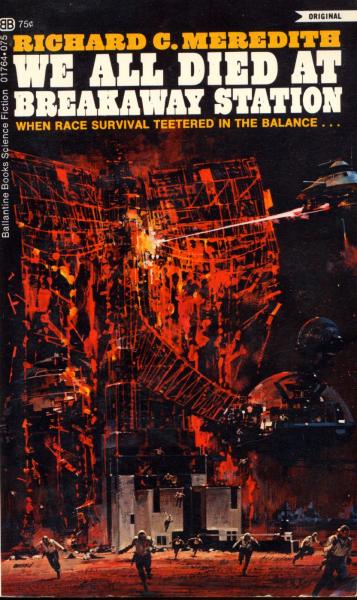
(John Berkey’s cover for the 1969 edition)

3/5 (Average)

Automated machines rummage through the wreckage of a spaceship—after a battle with the Jillies—gathering the human dead and placing them into cold storage, to be stitched together again for another fight.   Absolom Bracer is one of the casualties of Earth and its colonies’ war with the a vaguely known alien foe (the before mentioned Jillies) doing their “damnedest” to “eat up every crumb” of the “apple pie” (as sophisticated as a Richard C. Meredith gets)  (192).  Captain (eventually Admiral) Bracer of the warship Iwo Jima after his death becomes one the resurrected—“a shiny meter-tall cylinder of metal supporting what was left of the upper torso of a man” (9).  What remains are a “few bones, a little living flesh and muscle” and most importantly, “a collection of tangled Continue reading

Updates: Recent Science Fiction Acquisitions No. CXXVIII (Roberts + Cherryh + Blish + Knight + Pangborn)

Finally, a famous (“Joachim Boaz you will adore it”) fix-up novel by Keith Roberts enters my collection….

Overpopulation SF never gets old—even if I have low expectations about this one.

More Pangborn and a singleton Cherryh novel I had never heard of….

Thoughts?

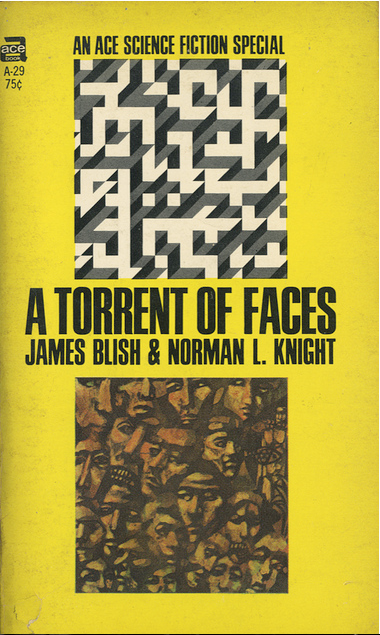
1. A Torrent of Faces, James Blish & Norman L. Knight (1967)

screen-shot-2013-02-09-at-12-16-53-am

(Diane and Leo Dillon’s cover for the 1968 edition) Continue reading

Guest Post: The Killer Thing, Kate Wilhelm (1967)

The sixth in my Kate Wilhelm’s SF Guest Post Series (original announcement and post list) comes via 2theD (twitter) over at Potpourri of Science Fiction Literature and Tongues of Speculation. He is a prolific blogger of vintage, translated, and newer science fiction.  Unfortunately, and much to my frustration (he knows!), he is on something of a hiatus (other than short story summaries and ratings).  Thus, when I approached him about participating in this series he volunteered one of his older reviews.  As I remembered it fondly, I agreed.

Thanks so much for contributing!

~

THKLLNGTHN1972

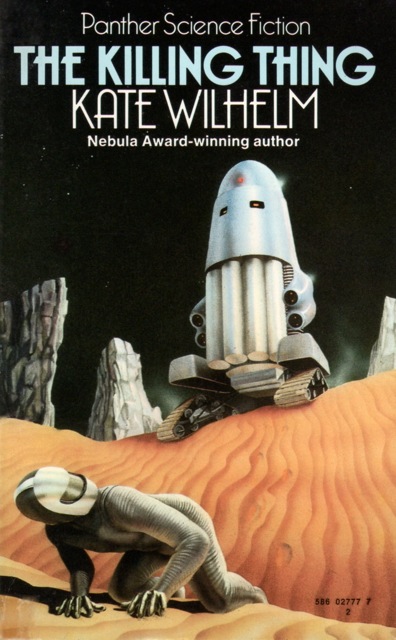
(Patrick Goodfellow’s (?) cover for the 1972 edition)

Kate Wilhelm is among a handful of female science fiction writers who need no introduction. She’s authored scores of short stories, about thirty-six genre novels, and eleven collections. She’s probably more prolific than many common and respectable male authors, yet she receives very little of the limelight that’s due to her (outside of SFMistress’s occasional posting on her work). Of her novels, I read her most popular work Where Late the Sweet Birds Sang (1976) and the much lesser popular Let the Fire Fall (1969), their respective popularity very much reflecting their quality. The two-story collection in Abyss (1971) had some Continue reading

Book Review: Starswarm, Brian W. Aldiss (1964)

STRSWRMPSJ1964

(William Hofmann’s cover for the 1964 edition)

4/5 (collated rating: Good)

Filth.  Decay.  Mud.  Transmutation.  Brian W. Aldiss’ SF is filled with such images:  Men—with limbs removed—who are slowly (and artificially) transmuted into fish, writhe around in the mud of their tanks grasping at the last shards of their humanity;  A powerful matriarch lords over a planet where her pets transform at will;  A tall tale about a planet filled with strange life and a human hero who cannot get over the fact that everything smells like garbage…. Aldiss’ novel The Dark Light-Years (1964), despite its poor delivery, is the best example of these themes—humans encounter sentient aliens who spend their days copulating, laying around, and eating in their own fifth.  And they are happy with their lot.

Starswarm (1964) is comprised of three novelettes and five short stories with conjoining explanatory material that links the previously published short fiction into a cohesive collection.  The modus operandi of such a conjoining concerns the “Theory of Multigrade Superannuation” where “the universe is similar to the cosmic clock; the civilizations of man are not mere cogs but infinitely smaller clocks, ticking in their own right” (7).  Thus, the inhabited solar systems of Starswarm—our galaxy—will exhibit all the characteristics through which a civilization can Continue reading

Book Review: The Far Call, Gordon R. Dickson (serialized 1973, book form 1978)

THFRCLLXXXX

(Robert Adragna’s cover for the 1978 edition)

2.5/5 (Bad)

Gordon R. Dickson introduces a medieval tapestry (perhaps The Lady and the Unicorn in Paris’ Musée national du Moyen Âge)—filled with symbolic representations that make up the sum of the world—as the central framing metaphor for The Far Call (1978).  Our idealistic young politician main character sees himself and everyone else as “caught up in its pattern” where “countless threads like his own make up the background.”  The brighter threads “would be the movers and shakers among the people” yet no one would be more than a single thread (35).   Continue reading

Guest Post: Welcome, Chaos, Kate Wilhelm (1983)

The fourth in my Kate Wilhelm’s SF Guest Post Series (original announcement and post list) comes via Megan (twitter)—who blogs on both vintage classics and lesser known work to the recent BSFA-nominated SF novels at From Couch to Moon.  This is her second contribution to one of my guest post series and is definitely worth the read.  Her first guest post review was for my Michael Bishop series: check it out!  Thanks Megan!

~

WLCMCHSMKZ1983

(Jane Mackenzie’s cover for the 1983 edition)

Two parts mainstream Cold War espionage thriller to one part bio-social science fiction, Welcome, Chaos is a departure from Wilhelm’s reflective, elegiac vision of seven years prior: the captivating, multiple award-winning Where Late the Sweet Birds Sang (1976). In many ways common with one another, both novels contain themes of pre- to post-apocalypse, survival via artificial biological advancements, ethics of scientific Continue reading

Updates: Recent Science Fiction Acquisitions No. CXXVI (Lessing, Silverberg, Sheckley, Dickson)

I have yet to read anything by the Nobel Prize for Literature-winning author Doris Lessing…  And she wrote numerous SF novels—I’m very excited that I found one in a clearance section for 2$.  I also found one of the very few 1970s works by Silverberg not in my collection.  Dickson’s supposedly most mature novel (which I doubt is very good) also joins my collection.  So far the only Dickson I can tolerate are a handful of his short stories. And finally, my last acquisition is one of Robert Sheckley’s best-loved novels.

Thoughts?

1. The Memoirs of a Survivor, Doris Lessing (1974)

0394757599.01.LZZZZZZZ

(Brad Holland’s cover for the 1988 edition) Continue reading