Adventures in Science Fiction Cover Art: The Space Station, Part IV

192dc8791f8ad474dd5bfcf367a3fe82

(Uncredited cover for the 1963 edition of The Changeling Worlds (1959), Kenneth Bulmer)

Part IV of my space station themed sequence (Part IPart IIPart III)–if you have not yet checked them out I recommend you do.

Vincent Di Fate is the master of space station art.  They are hyper realistic and detailed.  Although I definitely prefer his earlier surrealist work (for example, here) there is a certain appeal to more technical depictions of future space technology.  However, my favorite of the handful Di Fate pieces I cobbled together is his for the 1975 edition of The Other Side of Tomorrow (1973)—the screens are windows into the future, and a space station is featured prominently.  I sort of enjoy Bob Eggleton’s cover for the 1993 Italian edition of To Open the Sky (1967) as well—although I suspect the cover was published on an English language book earlier, Continue reading

Updates: Recent Science Fiction Acquisitions No. LXXXV (Fowler + Bishop + Brunner + Blish)

Dallas Part V (and some older finds) (Part IV, Part III, Part II, Part I)!

Love Brunner, want his short stories, enough said….

Also, I have a love hate relationship with Blish (love his “hard” SF and dislike his juveniles of which he wrote a many and often in a “hard” SF series)—The Frozen Year (1957) supposedly is his attempt at a “realistic” SF novel.  I’ll just have to see…  I feel weirdly compelled to read it.

As for the Karen Joy Fowler collection—yes, she wrote in the 80s!—the book sorters at the Half Price Books failed to realized that it was a signed copy!  So for a mere dollar I now have only my second signed SF work after D. G. Compton’s Scudder’s Game (1988).  As people have probably realized, I completely eschew conventions and have little connection with fandom and thus do not go out of my way to procure signed editions…

Michael Bishp=one of my new favorite authors (after reading Beneath the Shattered Moons and A Funeral for the Eyes of Fire).  Hence, Catacomb Years (1979) is a welcome addition to my collection.

Thoughts?

1. No Future in It, John Brunner (1962)

(Uncredited cover for the 1965 edition) Continue reading

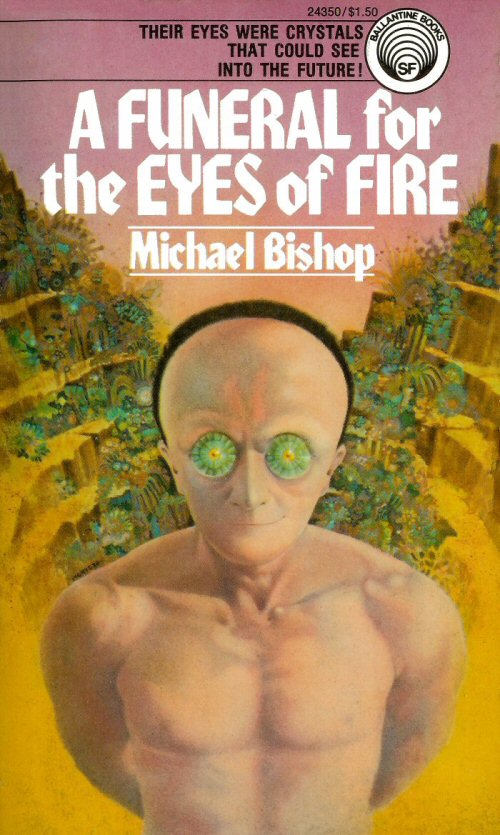
Book Review: A Funeral for the Eyes of Fire, Michael Bishop (1975*)

funeral

(Gene Szafran’s cover for the 1975 edition)

Nominated for the 1976 Nebula Award for Best Novel

5/5  (Masterpiece)

*First, a preliminary note on the publication history:  I read the original, unabridged 1975 edition.  However, Michael Bishop “completely rewrote” the novel in 1980 (according to ISFDB and his introduction to the later edition).  The 1980 rewrite—initially titled Eyes of Fire but later confusingly released under the original title, A Funeral For the Eyes of Fire-–was the one republished and recently available as an eBook through SF Gateway according to Bishop’s wishes.  I would prefer my readers, if they are interested in the volume, to not hesitate in snatching up the original.  I suspect both are worth reading.


Fresh off Michael Bishop’s strangely wonderful And Strange at Ecbatan the Trees (variant title: Beneath the Shattered Moons) (1976) I eagerly devoured his first published novel, A Funeral for the Eyes of Fire (1975)—and with this work, bluntly put, he enters my pantheon of favorite SF authors.  Bishop, completely in command of his narrative, weaves together a literary and anthropological tapestry filled with stories within stories and delicate interplay between these layers.

The deceptively simple premise unfurls into a complex and moving meditation on culture clash and the power of ritual, threatening at every moment to explode into violence.  This is perhaps the most sophisticated rumination I  Continue reading

Book Review: Yesterday’s Children (variant title: Starhunt*), David Gerrold (1972)

(Paul Lehr’s cover for the 1972 edition)

3/5 (Average)

*The 1980 edition, still under the title Yesterday’s Children, was substantially rewritten.  In 1985 David Gerrold released it under a new title, Starhunt.  This is a review for the original 1972 edition.  I have not read the later rewrite so I am unsure how much was modified.

David Gerrold, best known for writing the famous Star Trek: The Original Series episode “The Trouble With Tribbles” (1967), has continuously produced SF novels since the early 70s.  I had previously read the disappointing Space Skimmer (1972) which combined a fascinating premise with puff-puppies, annoying princes, and bad poetry.  Yesterday’s Children (1972) (variant title: Starhunt) likewise combines a fascinating premise with a less than satisfactory delivery, numerous narrative hiccups, and uneven tone and characterization.  I am not surprised that the novel was rewritten due to the slightly rough Continue reading

Updates: Year in Review (Top Ten SF Novels + Top Ten Short Stories/Novelettes/Novellas + other categories)

Everyone likes lists!  And I do too….  This is an opportunity to collate some of my favorite (and least favorite) novels and shorter SF works I read this year.  Last year I discovered Barry N. Malzberg and this year I was seduced by…. Well, read and find out.


Top Ten Novels

1. We Who Are About To…, Joanna Russ (1976): A scathing, and underread, literary SF novel by one of the more important feminist SF writers of the 70s (of The Female Man fame).

2. A Funeral for the Eyes of Fire, Michael Bishop (1975): A well-written anthropological clash of cultures novel.  Slow, gorgeous, emotionally engaging….

3. Level 7, Mordecai Roshwald (1959): A strange satire of the bomb shelter…  Everyday surrealism. Continue reading

Book Review: Cloned Lives, Pamela Sargent (1976)

(Walter Rane’s cover for the 1976 edition)

2.5/5 (Bad)

There is a reason that Pamela Sargent’s Cloned Lives (1976) has been overshadowed by Kate Wilhelm’s clone-themed Where Late the Sweet Birds Sang (1976), which garnered a Hugo award and a Nebula nomination, released the same year. While Sargent’s vision is painfully melodramatic and descriptive to a fault where pages and pages and pages pass without a single metaphor or simile, Wilhelm’s was psychologically taut and beautiful.  Cloned Lives is comprised of three previously published works, the short story “A Sense of Difference” (1972), the novella “Father” (1974), and the novelette “Clone Sister” (1973).  Each section shifts perspective between each of the clones and their father (with a culminating “Interface” section).    

Despite Cloned Lives’ manifold flaws there are a few moments of interest, notably amongst descriptive postulations about the nature of her futuristic society, that are prescient and thought-provoking.  Likewise, Sargent’s conscious effort to integrate a vast assortment of races (Indians, Arabs, Africans, etc) and gender roles (homosexual couples who use cloning to have children, female scientists, etc) is admirable and appealing.  However,  these brief (yet intriguing) interludes and observations do not redeem the banal melodrama Continue reading

Updates: Recent Science Fiction Acquisitions No. LXXXIII (Randall + Brunner + Shaw + Jones)

Dallas Half Price Book Store Part III (Part I, Part II)!

A short story collection by an author I have termed Mr. Perpetually Average But Readable, Bob Shaw.  I am interested in whether or not his visions are more concise/poignant in short story form.  I suspect a book like One Million Tomorrows (1971) would have been amazing in short form, especially the disturbing portions that take place in Africa (the UN forcefully administering immortality treatment on people who do not want them)….

A Nebula award nominated novel by Marta Randall, Islands (1976)—immortality themed, seems (at first glance) to be on the allegorical side = I have high hopes.

More Brunner! (Despite his warning, I was influenced by a review over at Speculiction…. here)  But then again, I am a Brunner completest…. And finally, a relatively unknown British SF novel, Implosion (1967) about a decreasing population.  Despite words of warning from reviews like Ian Sales’ (here) I couldn’t resist the Vincent Di Fate cover.

Thoughts?

1. Tomorrow Lies in Ambush, Bob Shaw (1973)

(Uncredited cover for the 1975 edition) Continue reading

Book Review: The Men Inside, Barry N. Malzberg (1973)

(Ron Walotsky’s cover for the 1973 edition)

4.5/5 (Very Good)

Caveat: If a perverse (and Freudian) metafictional (and literary) retelling of Otto Klement and Jerome Bixby’s Fantastic Voyage replete with filmic flashbacks does not intrigue you then stay away….

There are few SF authors who utilize metafictional elements as gleefully and effectively as Barry N. Malzberg.  Beyond Apollo (1972), his masterpiece, is a labyrinthine sequence of 67 short chapters of a novel written by the main character who may or may not be recounting real (imagined?) events.  While in In the Enclosure (1973) the excruciating paranoia that permeates the pages and the impossible escapes that transpire, recounted as if they were entries in a diary, could indeed be generated by an external force—the exact nature of which is unknowable—implanting memories.  Revelations (1972) was entirely comprised of a sequence of documents (interview transcripts, diary fragments, epistolary fragments) Continue reading

Book Review: Fireship (variant title: Fireship / Mother and Child), Joan D. Vinge (1978)

(Stephen Hickman’s cover for the 1978 edition)

3.5/5 (collated rating: Good)

Like so many SF fans, my first exposure to Joan D. Vinge’s work was via her wonderful Hugo-winning novel The Snow Queen (1980).  Eventually I found a copy of her first published novel, The Outcasts of Heaven Belt (1978), which had an intriguing premise but a less than satisfactory delivery (poor characterizations, pacing, etc).  The collection Fireship (1978) is comprised of two novellas: the Hugo- and Nebula-nominated “Fireship” (1978) and one of her earlier works, “Mother and Child” (1975).

The title story is the lesser of the two despite its (dare I say dubious) award nominations.  It’s a light-hearted and unchallenging proto-cyperpunk Continue reading