
Peter Jones’ cover for the 1975 edition
3.75/5 (Collated rating: Good)
After Frederik Pohl (1919-2013) left his editorial position at Galaxy and If in 1969, he set his pen towards a productive vein of form in the 70s that would culminate in his Hugo and Nebula-winning Gateway (1977). The Gold at the Starbow’s End contains five short stories–including the first of his Heechee sequence–from this period. Two of the best stories, the titular “The Gold at the Starbow’s End” (1972) and “The Merchant of Venus” (1972), demonstrate Pohl’s characteristic blend of hyperbolic satire and delirious energy. There are no duds in this collection.
If you want to read the first Heechee story or enjoy early 70s SF of the more satirical bent, track this collection down.
Brief Plot Summary/Analysis
“The Gold at the Starbow’s End” (1972), 4.5/5 (Very Good): First appeared in Analog Science Fiction/Science Fact, ed. Ben Bova (March 1972). You can read it online here.
Nominated for the 1973 Hugo and Nebula for Best Novella. Won the 1973 Locus Award for Best Novella.
The best story in the collection, “The Gold at the Starbow’s End” is a maniacal deluge of SF tropes and frenetically rendered chaos. At first, everything reads as a straight-laced adventure. The first narrative is recounted in a series of messages by Lt.-Col. Sheffield N. Jackman on the US Starship Constitution. His crew of eight, four couples, sets off for the planet Alpha Aleph. They will be the “first human beings to enter upon the depths of interstellar space” (7). For them to keep their minds from the doldrums of the voyage, the ship library contains all forms of mathematical quandaries to ponder. And sexual stimulants keep the couples obsessed.
The second narrative follows the ex-pat Nazi scientist Dr. Dieter von Knefhausen, the brain behind the expedition, now employed by the President of the United States. An urban guerilla war rages outside of the White House, conducted by the various factions of the radical left. His untouchable position as the mind behind the grand expedition grows more tenuous when the Russians claim no planet Alpha Aleph exists and the crew has been sent to their deaths.
The communications back to Earth become more and more off-kilter. The crew doesn’t seem to be following the guidelines set out by Knefhausen. Rather than the math problems and focus on nuclear family, they become obsessed with cryptic hermetic knowledge and free love. As the mob infringes on the White House lawn, pressure grows on Knefhausen and soon the President forces him to reveal the charade. But the experiment takes on a life of its own. And the crew of the Constitution soon discover the purpose of their mission. They lop off their pinky-toes to make bones for hexagrams and communicate back home in gödelized language that the best scientific minds back home cannot entirely decode!
“The Gold at the Starbow’s End” functions as a satire of the morality of the post-WWII military-industrial complex, willing to sacrifice its citizens for the sake of national security on the taxpayer dime. While I am not sure which experiments were known to Pohl, numerous non-consensual experiments on human subjects occurred across the 1950s and 1960s–from Operation Top Hat to the terrifying skin toxin and mind-altering drug experiments at Holmesburg prison. Pohl suggests that the manipulated offspring of such a system will turn on their elders.
The story is also a literary success. It spirals so deliciously out of control. We can only understand, via the infrequent communications, a limited sense of what is actually happening on the Constitution. One gets the sense that generations and generations of change occur in mere months. We peer into the petri dish of social explosion desperate to know what happens next!
I loved this one. Pohl at his best.
“Sad Solarian Screenwriter Sam” (1972). 3/5 (Average): First appeared in The Magazine of Fantasy and Science Fiction, ed. Edward L. Ferman (June 1972). You can read it online here.
Alien watchers within our solar system, representatives of distant godlike entities, rouse themselves when humanity takes up tools and pushes itself much violence and devastation–into the modern era. In pulp shades of Jack Williamson’s The Trial of Terra (1962) and countless other powerful aliens hold tribunals on bumbling earthlings, the watchers randomly select a single individual to be judged. Pohl deliberately satirizes this always (at least to me) cringe premise by making it even more outrageous!
The fate of all living creatures on Earth falls, unknowingly, to Sam Harcourt, a Hollywood screenwriter on the hunt for his next film project. As an Earth expedition to Mars had recently found real live Martians, Sam decides to cash in on the hype and create an adaptation of Edgar Rice Burroughs’ Barsoom stories–and maybe the Martians themselves would make an appearance. He attempts to sway director Daniel Chavez, who made it big with Master of the Maelstrom, a science fiction shocker “shot principally in his backyard swimming pool, which had a center-draining plug” (73), to join his project. Chavez has been down on his luck recently creating B-pictures and nudies and is reluctant to join the project. With Chavez, and his editorial changes begrudgingly accepted, on board, Sam calls his agent Oleg. There’s a bit of a complication. The Martians, well, they ain’t exactly like the gorgeous Dejah Thoris.
This is a humorous metafictional look at the operations of science fiction à la Barry N. Malzberg’s The Empty People (1969) or Robert Silverberg’s far more serious “The Science Fiction Hall of Fame” (1973). Pohl suggests that the clash between the nostalgic pulp of youth and the “reality” of the world beyond our planet generates potentially cataclysmic emotions. I can’t help but imagine that the target of Pohl’s ire is the aliens judge earthlings premise vs. those caught up in a bit of wishful thinking. And yes, he’s also poking fun at B-film writers and directors, humans more interested in cashing in on the wonder of exploration than actually discovering and experiencing the new.
There are a few humorous touches about adaptation and reinvention throughout. In one instance, Sam’s pitch to Chavez includes an update on the original Burroughs story to reflect the concerns of the day, John Carter is now Vietnam vet. I chuckled a few times. But… it’s not incisive in the same ways that Malzberg, Silverberg, and Spinrad’s commentaries on genre mastered.
“Call Me Million” (1970), 3.5/5 (Good): First appeared in Worlds of Fantasy, #2, ed. Lester del Rey (1970). You can read it online here. Charley DiSalle, at slim and twenty, “sideburns down to his earlobes and duck-ass hair,” gets drafted to serve in Vietnam (87). His goal? “He did not want his own only self to get killed” (87) — and he was willing to desert if it meant he could survive. The only problem? The Viet Cong find him immediately and want his life (88). In that moment with the V.C. standing over him with a knife, DiSalle’s disturbing power manifests itself. He consumes the soul of the V.C. The shambles off and dies. The memory of that first meal–“a thousand or ten thousand tasty tidbits later”—remains with him at 50 (88).
Pohl allegorically conveys the bleak horror of war and the traumas that lay in wait. DiSalle emerges from the conflict a changed man addicted to consuming the souls of all he encounters–from children to momentary lovers. Pitch black and brutal, “Call Me Million” throbs with apocalyptic undertones as DiSalle stumbles across an emptying Earth with increasing probability of encountering his own progeny.
“Shaffery Among the Immortals” (1972), 3/5 (Average): First appeared in The Magazine of Fantasy and Science Fiction, ed. Edward L. Ferman (July 1972). You can read it online here.
Nominated for the 1973 Nebula Award for Best Short Story.
Jeremy Shaffery is a down-and-out astronomer/mathematician who models his life on Einstein. His latest posting, Director of the Carmine J. Nuccio Observatory in the Lesser Antilles, serves as a tax evasion scheme maintained by a Las Vegas gambling syndicate. Shaffery is no longer invited to give academic papers after a string of erroneous and ridiculous claims. He periodically shifts through a drawer of half-hearted attempts to debunk mainstream scientific views—last gasps at relevancy in an academic community rapidly forgetting his existence. His wife–who seems to have a more than valid view of his complete failure to look toward their future–avoids his interactions. As does the board of the observatory, who will only tolerate his claims of future discovery for so long. Shaffery spends his pathetic days drinking beer in a child’s float puttering around the bay. But Shaffery’s name will become known… for reasons he could not have foreseen. And the story takes a bleak apocalyptic left turn.
A darkly humorous jab at the scientific community’s all-consuming drive to discover the next great thing. That said, I am retrospectively befuddled at its Nebula nomination.
“The Merchant of Venus” (1972), 4/5 (Good): First appeared in Worlds of If, ed. Ejler Jakobsson (July-August 1972). You can read it online here. The first story in the Heechee sequence that gains its real shape with the masterpiece Gateway (1977).
The second-best story in the collection “The Merchant of Venus” follows Audee Walthers on his quest for a new liver, which would cost far more than what he makes in a year. A satire of free market capitalism, Audee scratches out an existence from fleecing visiting tourists on Venus. Only the wealthy can afford a visit. And only the ultra-wealthy can afford a trip across the surface and a chance to uncover real alien artifacts. The mysterious Heechee left tunnels and artifacts under the Venusian surface, most of which remain undeciphered by human explorers. As there’s great profit in new discoveries yet the costs to send out an expedition are exorbitant, Audee must rely on the arrival of a billionaire. With the arrival of the aged Boyce Cochenour, on Full Medical which keeps his body young, and his female companion Dorotha Keefer, he sees an opportunity.
Serving his satirical aims, Pohl effectively places exploration and the joy of discovery as secondary to Audee’s desperation to make enough money to keep his liver from killing him. He’d return to this idea in Gateway, where Stetley Broadhead attempts to put off exploration for as long as possible until he starts running out of money. I wish I had read Gateway more recently to see other similarities between the stories.
I found “The Merchant of Venus” a well-wrought satire possessed by a vibrant sense of place that snarks and jests its way beneath the Venusian surface.
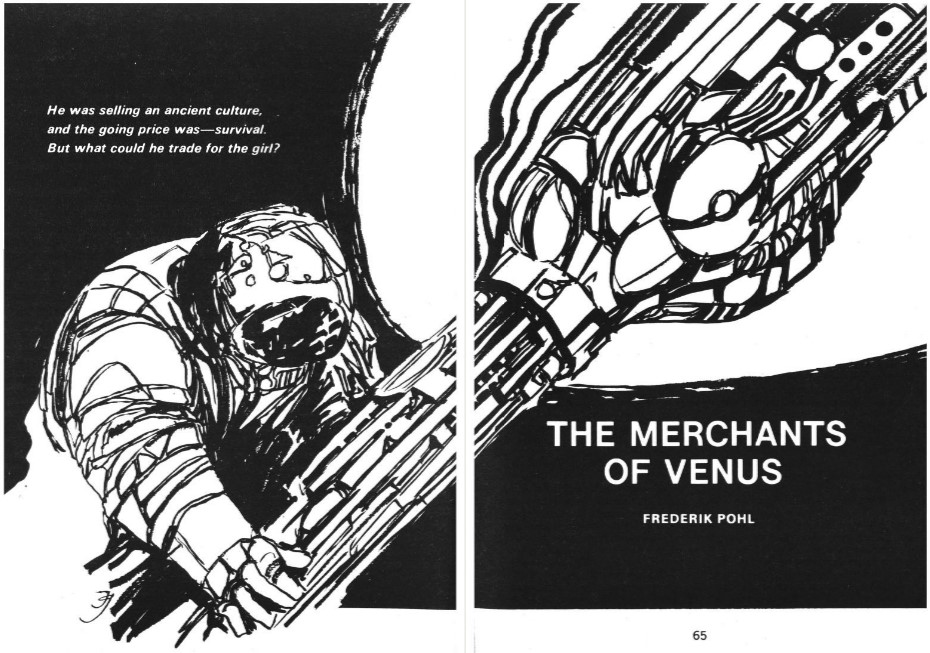
Jack Gaughan’s interior art for “The Merchant of Venus” in Worlds of If, ed. Ejler Jakobsson (July-August 1972)
For book reviews consult the INDEX
For cover art posts consult the INDEX
For TV and film reviews consult the INDEX
 Science Fiction and Other Suspect Ruminations
Pohl is one of my favorites- I’ve never read the novella version of Starbow’s End, but I did read the novel version.
Hello Andrew,
From what I read about the novel, Pohl expands the sections about what the crew is actually doing on the Constitution. In the novella form, it’s entirely conveyed via messages back to Earth. That limited view of the crew keeps a fascinatingly mystery about the proceedings. I can’t imagine that works as well in novel form.
I have a copy of this collection so maybe it’s time to dust it off. Certainly for ‘Sad Solarian Screenwriter Sam’. But also for ‘The Gold at the Starbow’s End’ and ‘The Merchant of Venus’.
Pohl is a strange one for me. Often his satire is razor sharp; other times meandering and perhaps a little to forced. I can’t help but feel that his misanthropy wins out over his early allegiance to left-wing politics. But maybe this judgement is way too hasty of me, considering I have only ever read a small portion of his oeuvre. It’s more ofa feeling (and maybe related to Pohl’s friendship with Kornbluth?).
Amusingly enough, I took your comment re: Burroughs on my blog as referencing William S. Burroughs rather than Edgar Rice. Now there is a mashup that would pique my interest, though arguably one already carried out by WSB!
I found so many errors in my review…. I’m just emerging from my stressful haze of August. I hope the review makes more sense now!
But yes, I definitely meant the Burroughs of Barsoom and sexy Martian princesses and grand pulp adventure! hah.
The basic premise of “The Merchants of Venus” tells you all you need to know. Man must make money off of a multi-millionaire in a crapshoot on the horrific surface of Venus so that he can get just enough money to save his liver because healthcare is too expensive… if that won’t motivate you to explore, what will? Hah. It’s concise. It’s incisive.
What did you think of Gateway?
I have a big soft spot for The Princess of Mars. My dad was a ER Burroughs fan, something I only discovered after reading him.
I haven’t read Gateway, but I do have a copy. Maybe the Merchants can be my entree to this world.
If I remember correctly, Gateway has a major Freudian angle that I did not completely understand at the time. I think I would like it even more now than in my late teens.
I love major Freudian angles!
Gateway is a book I’ve been meaning to read for almost forever it seems.
Too many books to read, even when limiting sf reading to pre-1990…
Me too!
There’s a far greater sense of chance and dread in Gateway than in “The Merchant of Venus” that I appreciated as well. And a main character desperate not to do anything until his money ran out struck me as unusual. I would not doubt that I missed Pohl’s criticism of modern capitalism as well.
“a main character desperate not to do anything until his money ran out struck me as unusual”
This reminds me of blissful days, sadly long gone, living on the dole (unemployment benefits) over here.
That mashup exists: “The Jungle Rot Kid on the Nod,” by Philip Jose Farmer, which postulates that Tarzan was invented by William S. and not Edgar Rice. It appeared in NEW WORLDS #200 (April 1970), but you’re more likely to be able to find it in Norman Spinrad’s anthology THE NEW TOMORROWS or in several Farmer collections you can identify easily at isfdb.org.
Thanks for the heads up. It sounds great. I’ve never read any of Farmer’s sly takes on the pulps etc, though I have a copy of ‘The Other Log of Phileas Fogg’ staring at me from a near. I’m keen to get my hands on a copy of ‘New Tomorrows’. I really should bump up this work and Farmer’s ‘Riders of the Purple Wage’ to the top of my reading list.
I, too, am interested in the mashup. Thank you for the reminder John!
I never heard of Frederik Pohl. Having been enjoying reading older SF books I will has to look into this author.
Ah, he’s one of the most influential SF editors of all time– not only did he put together the first original SF anthology series ever (Star Science Fiction) but he helmed some of the most influential magazines of the day as well.
As for his fiction, he’s probably best known for his co-written The Space Merchants (1952) with C. M. Kornbluth and the Hugo and Nebula-winning Gateway (1977) — both of which I thoroughly enjoyed before I started writing about genre. Gateway might be the place to start…
I really enjoyed Wolfsbane, A Plague of Pythons and The Drunkard’s Walk by him when I read them all last year. There are definitely worthwhile novels in his oeuvre.
I’ve reviewed Drunkard’s Walk on the site. Not the biggest fan of that one.
I think I first read “The Gold at the Starbow’s End” in a back issue of Analog borrowed from my local library. It was also collected in the one issue of Ace’s best of the year series that Pohl edited — and he claimed that he only picked it because he had blown the budget for the book and he was the only writer he was willing to ask to take less money for the reprint. He also said that, actually, he felt like the story definitely deserved to be in a best of the year volume.
And I basically agree — it’s a brilliant story. (The math trick they used to compress their message is absurd, by the way, and it’s pretty easy to prove it won’t work — but to be honest I bought it hook, line, and sinker when I was 14.)
The funny thing about that Best of the Year book is that it came out in 1972, just a few months after the story appeared. The book is ostensibly for stories from 1971, though one other story in the book was from 1972, Doris Piserchia’s “Sheltering Dream”. But on the whole Pohl did a decent job — great stories by Niven, Pohl, and Brunner, and some other fine stories, and a translated story. Alas, he chose two Harlan Ellison pieces — one would have been plenty! But it could have been worse, and the next year, it did get worse, because the editor was the execrable Forrest J. Ackerman. After that Ace discontinued the series (which of course had been edited by Wollheim and Carr for a long time before they both left the company.) I should say that Ackerman did choose the other great Pohl story from 1972, “The Merchants of Venus” (the title obviously playing on his great collaboration with Kornbluth, The Space Merchants, which is largely set on Venus.) And he chose a good Spinrad story. But also a Milton Rothman story!
Anyway, I think your review is pretty much exactly as I feel, though I tend to rate “The Merchants of Venus” as more or less tied with “The Gold at the Starbow’s End”. I should say that the novel length expansion, STARBOW, doesn’t really add anything of real worth.
Rich: The math trick certainly won’t work for almost any given message. But I was willing to accept that a crew of superhumans who are actively trolling the people receiving the message would be able to construct a message for which the trick would work.
Yeah, I’m with Andrew. Even with my limited to non-existent math knowledge it sounded absolutely ridiculous. That said, the idea that there could be a mathematical way to convey language in an hyper-condensed form does sound within the realm of possibility. Far more so than all the other crazy stuff that happens in the story! hah.
Incidentally the stories I’ve read from this are this are the first and last, which are also the longest. “The Gold at the Starbow’s End” is excellent. I read it in Hartwell’s A World Treasury of Science Fiction. I would say it should’ve gotten the Hugo that year, but hmmm, “The Fifth Head of Cerberus”…
I made a Xitter post a while back about how 1972 was a knockout year for novellas, if the Hugo shortlist is anything to go by.
There are also the best stories in the collection by a pretty clear margin. I loved the maniacal energy of “The Gold at the Starbow’s End.” I still haven’t read that Wolfe. I have a copy.
But as of now, the Le Guin would be my choice over the Pohl. My memories of that section of Haldeman’s The Forever War, “The Hero,” are too vague to make a decision about that one. I enjoyed the fix-up novel version The Forever War immensely in my late teens.
I have to confess, I am not a big fan of “The Word for World is Forest”. My clear choice — by a very wide margin — for Best novella of 1972 is “The Fifth Head of Cerberus”. Second place is more or less a tie between the two Pohl novellas.
As long as you don’t say that the Pournelle would be your first choice! haha.
To be honest, Keith Roberts’ “Weihnachtsabent” might be my novella of choice for the 1973 Hugo…. and it wasn’t even nominated.
I actually did an article about the Hugo choices for 1972 (1973 Hugos). It’s in Steven Silver’s fanzine Argentus, issue 2. (Here: http://www.stevenhsilver.com/argentus2.pdf) In that I choose “Weinhnachtsabend” as my choice for Best Novelette. (I think it’s about 16,000 words, just a bit short of official novella length.)
If you do read that article, please note that I completely disown what I said about Silverberg’s DYING INSIDE. I’ve reread it since then, and I was plain wrong to call it “minor”.
I also chose “The Gold at the Starbow’s End” for best novella, but only because I disqualified “The Fifth Head of Cerberus” in favor of giving the novel version of it the Hugo!
I agree that ‘The Word for World is Forest’ is not a great work of Le Guin’s. Unquestionably her heart and head was in the right place, re: the Vietnam War. But this parable is, to my thinking, a caricatural criticism, which tries to understand the Vietnam solely as a moral contest–which it certainly was in part, but also much more. Perhaps I am expecting too much from this slim work, but from someone like Le Guin who was capable of complex and subtle political and cultural criticism, it is a minor work.
Rant over.
That’s pretty much exactly how I feel about “The Word for World is Forest”. The problem it has is, I think, very common with writers who are angry — perhaps especially when their anger is entirely justified — about an issue. They feel it essential to nail their point down via caricature and demonization.
The thing is, it’s even more effective when you can show that the people you see doing terrible things are actually real people. When we see that even basically decent people can be led into atrocity, the message strikes home more effectively. It’s too easy to simply say about a story like TWFWIF that, well, without that cartoonish Colonel, things would have been just peachy. (Same complaint applies to R. F. Kuang’s recent novel BABEL with its cartoonish portrayal of British people.)
The best part of TWFWIF is, then, its portrayal of the Athsheans, and the tragic fact that even while “winning” they are losing really crucial parts of their culture.
Ah, for some reason when I checked the Roberts story on isfdb.org I thought it said Novella not Novelette — oops.
Changing perspective on texts is natural. Sometimes I ponder whether to delete some early reviews of mine (mostly Jack Vance) in which I was far too effuse. But… it’s helpful for me to see my own evolution as a reader. But yes, I love Dying Inside.
Sounds a good collection, will add it to the great sf reading list of infinity.
I’ve had a mixed experience with Pohl, albeit from an extremely small, unrepresentative sample of his work. I loved ‘The Space Merchants’ (appreciate that was a collaboration) but ‘Gateway’ left me cold. My notes of the time say, unhelpfully, that I found it ‘…surprsingly dull but the ending is good’. However given that it’s one of the acclaimed sf novels of the 1970s and was garlanded with every prize save the Nobel, I suspect my opinion is in the minority!
Gateway checks a lot of my boxes. Dwells on the interior drama of the main character, positions exploration as a personal crisis that must be resolved rather than some noble desire, deeply Freudian, fascinating alien landscape/backdrop…. I should reread it!
I came to it with ridiculously high expectations, which perhaps didn’t help – and maybe I just read it in the wrong moment / mood.
It’s been several decades since I read Pohl’s “The Gold at the Starbow’s End”, but one thing I recall is that, being published just a few months into Ben Bova’s reign as “Analog” editor, it absolutely freaked out some elements of the old-school Campbellian crowd. Whether it was the satirical elements or the comparatively mild sexual aspects I can’t recall, but some folk really didn’t like it. Thing is – I’ve always wondered whether it was Campbell himself bought it?
That reminds me – when I started reading IASFM in 1980 or so, the letter column was full of complaints about the serial of Pohl’s Cool War which had appeared a few months earlier.
When I get back home I’ll be able to add more to my comment. In Mike Ashley’s volumes on the history of SF magazines, he discusses that intermediary period of Bova’s takeover. Before Campbell, Jr. he died purchased quite a few things — including some “scandalous” interior art — that readers thought were Bova’s doing. I’ll check the volume to give ya’ll more particulars.
I’ve got the Ashley book so I can check myself but if you get there first, I was interested in whether or not JWC bought Niven’s “Cloak of Anarchy” or Waldrop’s first sale, “Lunchbox”.
THE COOL WAR is an interesting case of “serial” — it was clearly serialized, but since IASFM didn’t run serials (as a rule) they presented it as a series of novellas instead.
I think it’s a fun piece.
Yeah; another case of “not really serializing” was Steele’s Coyote, which was published piecemeal in Asimov’s as novellas (the same may be true of Longyear’s Baraboo – and they published two thirds of Brin’s Postman, too).
As I recall, Asimovs did do a couple of no-kidding serials (Count Zero and Vacuum Flowers)
Hey there Mr. Boat, I have been wanting to ask you, how are you able to read up to three or four books at the same time? Do you have a schedule in which you allot times for different books? Do you just read them back to back? What’s your method? I have so many old science fiction books on my shelves that I have been meaning to read but I constantly get distracted by other things, so could you give me a few pointers on how to read?
Three or four books at the same time? I’m not sure where that impression comes from.
I think we all find our own paths on “how to read.” I draw deeply on my training in history (PhD) and tend to treat what I read, at least partially, as primary source evidence. I’m not sure I can be of much help. I find reading a meditative personal type of thing and I definitely don’t make a schedule.
I got the impression because you show three or four books in your pictures in your blog post about what you’re reading. My bad.
Oh, those are books I’ve read and/or reviewed on the site. I include links to the relevant posts under the photo.
Boaz, I think that was autocorrects fault.
No worries. I can edit the original post if you wish.
Another question. Which science fiction writers do you think were able to use science fictional concepts to tell universal themes? If that sounds vague, let me explain. Someone I think fails at this is Theodore Sturgeon most of the time. Out of all his works that I have read he seems to be unable to make the science fictional concepts blend together with humanistic themes. What I’m trying to say (poorly) is that a lot of Theodore Sturgeon’s short stories feel like it doesn’t need the sci-if concepts to tell their stories and convey their themes. A prime example for me is “A Saucer of Loneliness”. That story, it seems to me could’ve worked just fine without the flying saucer bit and should have just told the story of a lonely woman dealing with isolation. What do you think?
I am unsure how someone can write–SF or not–without addressing in some manner (maybe more successful than someone else) universal themes. I am very open to SF visions–like Sturgeon–which might position the SF element as secondary or tertiary. As I’m a historian mapping a territory, I’m interested primarily in what SF tells us about the era which it was written. I am fascinated by figures like Sturgeon who attempted to write more literary treatments of standard SF tropes.
As I point out on my about page: “Science Fiction and Other Suspect Ruminations maps the varied landscape of SF produced during the turbulence of the post-WWII to the mid-1980s world. I am fascinated by the ways authors responded to the advent of nuclear weapons, the rise of 50s suburbia and commercialism, the Civil Rights movement, the Counterculture and radical student politics, the Vietnam War, and the 1970s political backlash. I chart what’s produced in a specific time and territory to understand the people who dwelled at that moment—their dreams for the future, their fears of the present, and all the manifestations of estrangement and elation generated by a rapidly transforming world. Science fiction is a fantastic way to get at the zeitgeist of an era.”
I know that probably dodges the question a bit. As for themes and manner of telling that resonates with me, my 2022 in review is probably a great place to start: https://sciencefictionruminations.com/2023/01/01/updates-my-2022-in-review-best-sf-novels-best-sf-short-fiction-and-bonus-categories/
I have no idea how Sturgeon would tell a deeply humanist story like More Than Human without its central science fictional (for the time) premise of a gestalt mind…
Ok, I’ll give you that. But I guess what I am trying to say is that science fiction is at its best when it uses science fictional concepts to amplify literary themes. The masters of this, in my opinion, is Gene Wolfe and Robert Silverberg.
To be honest, I care little about how prominent or hidden or central or tangential the science fiction concept is within the story. What it is trying to say, how it is told, and what it reveals about that moment in the time is what interests me.
Silverberg is one of the most reviewed authors on my site. And while I’ve covered far less Wolfe, I find his fiction fascinating. Check the index on the top bar if you haven’t already. It’s organized by author and rating. https://sciencefictionruminations.com/science-fiction-book-reviews-by-author/