My rough start to the semester proves hard to dispel. I’ll get back to my regular programming soon–I promise. In the meantime, I’ve collected some goodies!
Which books/covers/authors intrigue you? Which have you read? Disliked? Enjoyed?
1. The Man Who Fell to Earth, Walter Tevis (1963)

Jim Burns’ cover for the 1982 edition
From inside page: “He was not a man; yet he was very much like a man. He was six and a half feet tall, and some men are even taller than that; his hair was as white as that of an albino, yet his face was a light tan color, and his eyes a pale blue. His frame was improbably slight, his features delicate. There was an elfin quality to his face, a fine, boyish look to the wide intelligent eyes.
His fingernails were artificial, for he had none by nature. There were only four toes on each of his feet. HE had no appendix and no wisdom teeth. HE weighed very little, about ninety pounds. HE was human; but not, properly, a man. Though, like a man, he was susceptible to love, to fear, to pain, to pity…”
Initial Thoughts: I included Tevis’ magisterial Mockingbird (1980) on my best reads of 2022 list. I might as well track down the rest of his science fiction. And no, I haven’t seen the 1976 movie adaptation of The Man Who Fell to Earth (1963), yet. I rather read the book first anyway! I realized after this purchase that Tevis revised the post-1976 editions…. this one included. I am always the most interested in the original version unless it was cut and published without the author’s permission. In this instance it appears Tevis added references to 70s history like the Watergate Scandal.
2. Star Rigger’s Way, Jeffrey A. Carver (1978)

George Tsui’s cover for the 1978 edition
From the back cover: “IN THE STREAMS OF SPACE
His rigger teammates suddenly and horridly dead, Gev Carlyle drifted in the Flux–the “subjective sea” that carried starships at father-than-light speeds–alone in the Sedora with a castaway alien.
Only a complete rigger team, meshed in psychic unity, could meet the perils of the Flux without disaster, and Sedora was being drawn toward the unthinkable stresses of the Hurricane Flume.
Carlyle needed the catlike alien’s help for even a million-to-one chance of survival–but the price of that help was a complete merging of minds and memories.
And Carlyle dreaded that union more than death.
Initial Thoughts: This novel is the first-written and fourth in internal chronology in the Star Rigger sequence. I know little to nothing about Carver and impulsively grabbed this off the used book store shelf. The premise sounds fun–other than the cat alien bit. Read any of his work?
3. The Trouble with You Earth People, Katherine MacLean (1980)

Frank Kelly Freas’ cover for the 1st edition
Contains no informational blurb.
Contents: “The Trouble with You earth People” (1968), “Unhuman Sacrifice” (1958), “The Gambling Hell and the Sinful Girl” (1975), “Syndrome Johnny” (1951), “Trouble with Treaties” (1959), “The Origin of the Species” (1953), “Collision Orbit” (1954), “The Fittest” (1951), “These Truths” (1958), “Contagion” (1950), “Brain Wipe” (1973), “The Missing Man” (1971), “The Carnivore” (1953).
Initial Thoughts: I’ve thoroughly enjoyed what I’ve read of MacLean in the past–especially the novel expansion of her Nebula-winning novella “Missing Man” (1971). Not sure about this silly Freas cover! I do not find the Starblaze Editions an attractive publication series.
4. The Tin Men, Michael Frayn (1965)
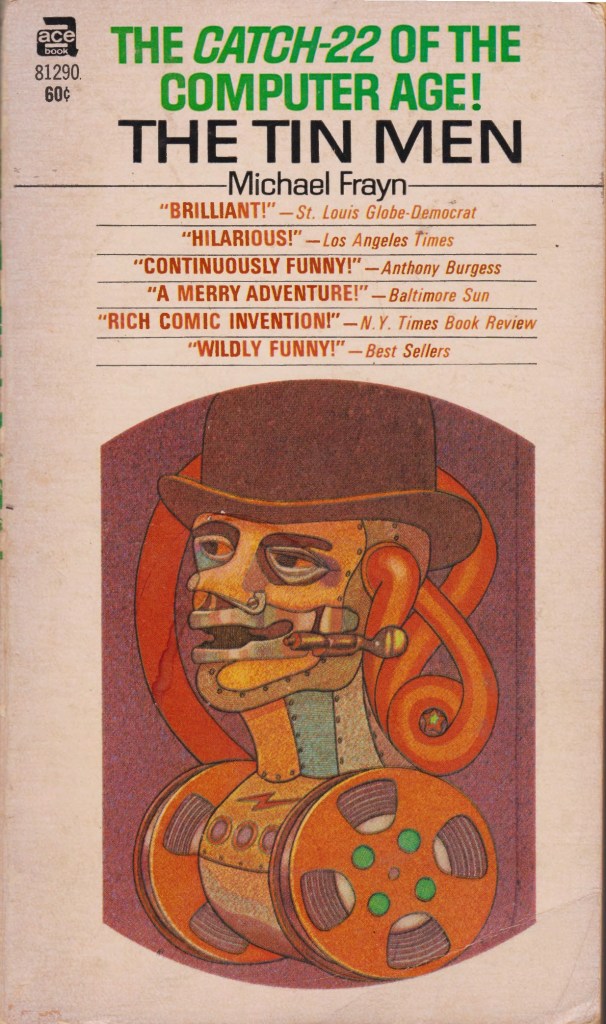
Uncredited (Wilson McLean?) cover for the 1969 edition
From the back cover: “In this wildly comic novel of a research center for the study of computers and their impact on Man, Michael Frayn has considered just about everything: computerized newspapers, computerized ethics… even computerized sex.”
Initial Thoughts: Michael Frayn is best-known for his non-genre work. He’s one of many mainstream authors who dabbled with SF themes–often to great critical success (The Tin Men won the Somerset Maugham Award). I also acquired a copy of his dystopia A Very Private Life (1968) back in 2013 but haven’t picked it up yet.
For book reviews consult the INDEX
For cover art posts consult the INDEX
For TV and film reviews consult the INDEX
 Science Fiction and Other Suspect Ruminations
The Tevis is a good one. Not spectacular, but entertaining. Could have been sharper.
Did you review it? I thoroughly enjoyed Tevis’ Mockingbird (1980).
review is here: https://wp.me/p1tcLv-8mt
On the strength of Man Who Fell, I’ll read more of Tevis in the future, so Mockingbird could be the next one.
Here’s my review of Mockingbird. I do get the sense that both novels explore some of the same ideas (addiction of a different sort features here). https://sciencefictionruminations.com/2022/06/23/book-review-mockingbird-walter-tevis-1980/
I think it´s basically his only theme.
I dunno. Mockingbird seems to be far more about the power of the written word in all its manifestations. I described it as “Paean to the power of reading” in the first sentence of my review.
it´s just that in everything I read about his works, addition always comes up, but you are right there´s other stuff too. I should have written ´main´ instead of ´only´.
To be honest, I think that theme is quite unusual for SF and I have nothing against it — sometimes “mainstream” lit authors introduce themes that just aren’t touched by most genre authors. Note: just talking about my decades of interest (40s-80s). I know as cyberpunk became increasingly popular, traumatic pasts, including addiction, became a bit more run-of-the-mill.
I’ve read “The Man Who Fell to Earth”. There’s nothing exciting or surprising about it, just an acceptable, bland science fiction story. The only other thing I’ve read by him, is the short story “Far From Home”, about a whale stranded in an empty swimming pool, which was more exotic, but I didn’t get it. I don’t think Tevis is an author for me.
It’s not ruminative in anyway? Sometimes more interior introspection and a beautiful phrase appeals deeply to me.
It’s not badly written, it’s done in a mainstream fashion, but like some or more mainstream novels, it’s rather dull, it isn’t written with the sharp flourish that you’d expect from “new wave” SF authors such as J. G. Ballard and Harlan Ellison, or Anna Kavan. I think it does focus sympathetically on the plight of the alien visitor, but I don’t think there’s anything startling about it.
I’m pretty sure both mainstream and genre novels are equally plagued by dull examples Richard!
Of course Joachim, I know a lot of SF is too, I just meant that the quality of the prose was unremarkable and didn’t do anything to enliven a standard science fiction novel. There was nothing daring or original about it.
But yeah, I would acquire his short fiction collection Far From Home (1981) but it’s quite pricey. There’s a new omnibus with The Steps of the Sun (1983) but it’s an ugly new volume… hah.
“The Man Who Fell to Earth” is a wonderful read. It helped get me back into sci-fi. I think it’s possible to read it as a metaphor for autism as well.
The movie is different, very druggy and ‘70s. Though Bowie is well cast, it’s not my favorite.
I look forward to it. I thoroughly enjoyed Tevis’ Mockingbird: https://sciencefictionruminations.com/2022/06/23/book-review-mockingbird-walter-tevis-1980/
I’m going to have to disagree with you about the Kelly Freas cover. I’d never seen it before, but it just became one of my favorites.
Yeah, Freas is one of my least favorite major SF artists of the era — I’m in the Richard Powers and Paul Lehr camp for sure.
I enjoyed The Man Who Fell to Earth (exact same release as yours) but I did see it shortly after watching the movie. I preferred the novel, which as you state, are often better than the cinematic adaptions. Thankfully this made me seek out more Tevis which led me to Mockingbird, which I loved even more. My Tevis was rekindled last year after watching The Queen’s Gambit miniseries. While not SF (all about Chess in case you hadn’t heard) but still sounds like it would make an awesome read. Curious to know from those that have read that and his SF how the two genres compare.
Yeah, I can’t help with the final question but hopefully others who stop by can.
Mockingbird felt a bit older than its pub date but the fascinating intertext of silent film intertitles and obsessive encyclopedic look at writing of all forms fascinated me. Good stuff.
Nice to see a Burns cover I haven’t seen before.
I’ve read Carver’s 1988 From a Changeling Star, an early nanotechnology novel. I was not aware of his books of his.
Did you review From a Changeling Star?
No, I’ll put up the Raw Feed “review” tomorrow.
Good good.
The MacLean collection contains one of her best stories (“Unhuman Sacrifice”), another almost as good (“Contagion”), and one of her most shocking (“Syndrome Johnny”). The rest are OK. THE DIPLOIDS is a better MacLean collection.
I own The Diploids as well!
I read “The Man Who Fell to Earth” last year… I liked the idea behind the story, but it grew to be quite sad. Not that I need every story to have a cheerful second half and ending. But the ongoing addiction part of the plot was a bummer for me.
My blog friend a long while back mentioned that I like my SF “moody, broody, meta, and twisted.” So yeah, sounds like it’s a story for me! (at least on the moody and broody elements).
I can’t remember if we’ve talked about Tevis Mockingbird before. I recommend Mockingbird — while some of the themes are similar, the gloom does lift. https://sciencefictionruminations.com/2022/06/23/book-review-mockingbird-walter-tevis-1980/
We haven’t talked about Tevis’s “Mockingbird” before. Thanks for that recommendation! I’ll keep an eye out for the book, especially since the gloom lifts in it 🙂
I still remember the David Bowie film.that scene when an extremely Stoical man got chucked out a window!
I haven’t seen it, yet.
I much prefer the film adaptation of The Man Who Fell to Earth. The novel I found somewhat bland.
Ah, the two Brits in the comments hold the same opinion! (You and Richard). Have you read Mockingbird? That’s my only exposure to his work and I did not find it bland.
Good to have you back 🙂
The Man Who to Fell to Earth is one of my favorite novels of all time. It functions as both a religious allegory and deconstruction of first contact with aliens. Also has one of the saddest endings of any book I’ve ever read. To this day I find it hard to re-read it because of the anxiety and pain that ending caused me.
I’ve yet to read Missing Man.
The Tin Men sounds intriguing.
I look forward to it. As I mentioned to others, I thoroughly enjoyed Tevis’ later SF novel Mockingbird (1980).