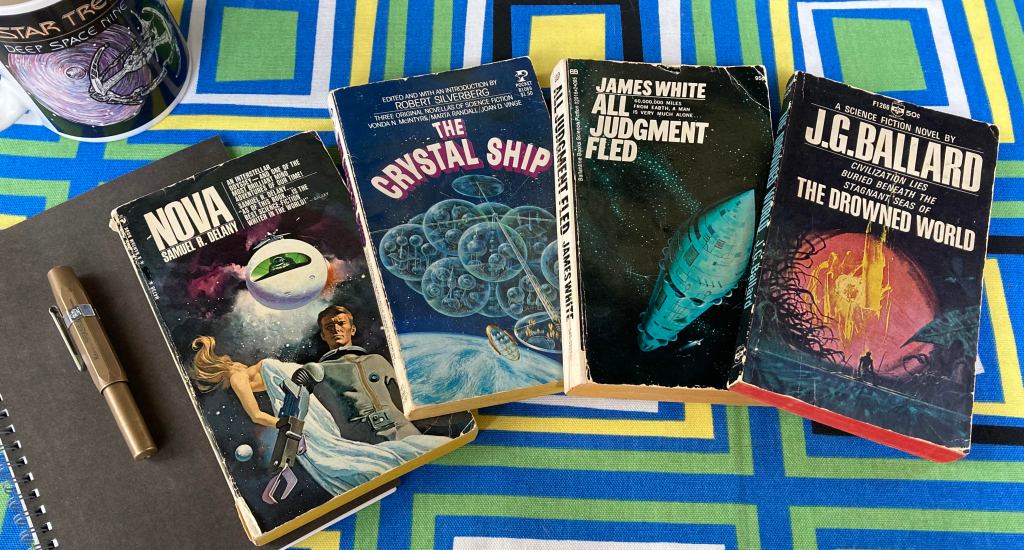
A selection of read volumes from my site
What pre-1985 science fiction are you reading or planning to read this month. Here’s March’s installment of this column.
Before we get to books and birthdays and writing plans…
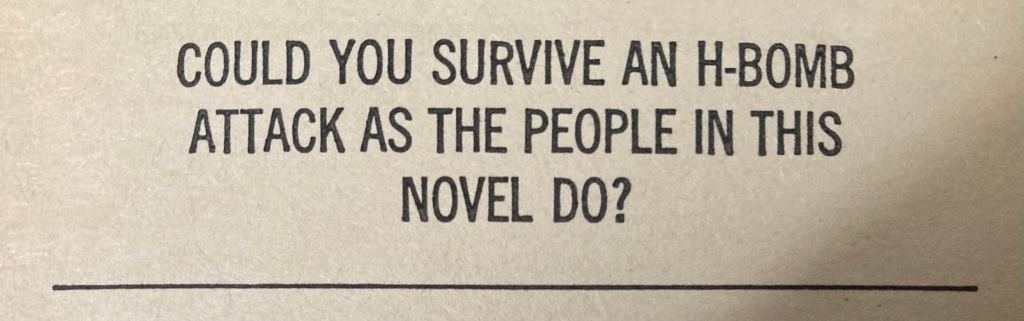
Advertising blurb from the 1970 Bantam edition of Pat Frank’s Alas, Babylon (1959). I assume it appeared in earlier Bantam editions as well.
I am fascinated by the way SF novels from the era I study were marketed to people. I often think, retrospectively, it’s easy to get caught up in how SF was advertised as revealing the nature of genre at that moment vs. the actual texts we are reading. As an example, I am one of many readers who assumed that the 50s were dominated by a positive strain that morphed with the New Wave in the 60s. It’s easy to fall into that trap if you focus on how science fiction was advertised as providing a window into the technological achievements of the future. Of course, the reality is far more complex. The post-WWII 50s were hardly one of a dominate positivist language and ideology. Writers and people were terrified by a rapidly changing world.
Do you have any other humorous examples of how SF was sold to readers before 1985?
Let’s get to the books in the photo and what I’ve been reading and writing.
The Photograph (with links to reviews and brief thoughts)
- Samuel R. Delany’s Nova (1968). One of the few SF novels I’ve read three times! Unfortunately, never managed to review it. Of the Delany I’ve read so far, it remains my favorite — followed closely by Babel-17 (1966) and The Einstein Intersection (1967). I have never managed to finished Dhalgren (1975). I should try again!
- The Crystal Ship, ed. Robert Silverberg (1976) contains novellas by Vonda N. McIntyre, Marta Randall, and Joan D. Vinge. One of a handful of women-only anthologies from my period of focus. I particularly enjoyed Vonda N. McIntyre’s “Screwtop” (1976).
- Of the hilariously titled Big Dumb Object sub-genre, James White’s All Judgement Fled (1968) remains my favorite. Yeah, better than Clarke’s Rendezvous with Rama (1973). I’ve always respected White’s pacifism as well. I need to read more of his fiction!
- My favorite of Ballard’s dystopias — so far. Unfortunately, I was unable to review it. I wish I had.
What am I writing about?
The accumulation of incomplete reviews and endless pages of notes depresses me. I have many projects. I am slowly working through them. Stay tuned for more apocalyptic nightmares, Brazilian dystopias, and cities trying to land the death blow!
Recent reviews include the latest post in my series on translated short fiction. Rachel and I wrote about a wonderful Romanian SF story that provides a revisionist take on Stanisław Lem. I also reviewed Henry Kuttner and C. L. Moore’s Clash by Night and Other Stories (1980).
What am I reading?
Lots and lots of history. When I’m behind on reviews it’s hard for me to make room for more science fiction. Taras Young’s Nuclear War in the UK (2019) was my last read. It’s more a coffee table book with FASCINATING images of British nuclear war pamphlets than detailed historical analysis. However, the bibliography let me to other scholarship that I might feature later on the site.

A Curated List of SF Birthdays from the Last Two Weeks
April 1st: Anne McCaffrey (1926-2011. I adored her work as a kid. I read everything I could get my hands on–even from the lowest points in her career i.e. the Acorna Universe sequence and co-written Dragonriders of Pern novels with her son.
April 1st: Author Samuel R. Delany (1942-). As I mentioned above, I need to finally complete Dhalgren (1975).
April 2nd: Artist Mitchell Hooks (1923-2013). One of the underrated SF artists of the 50s-70s in my view.
April 2nd: Artist Murray Tinkelman (1933-2016). Another underrated SF artist… How can your forget his iconic cover for Brunner’s The Sheep Look Up?
April 2nd: Author Joan D. Vinge (1948-). The intriguing ideas in The Outcasts of Heaven Belt (1978) reminds me that I should read more of her fiction.
April 3rd: Author Colin Kapp (1928-2007). Want to push my buttons? Recommend stories for me to read like Kapp’s “Hunger Over Sweet Waters” (1965). You’ll have to read my review (an exercise in snark) to find out why.
April 3rd: Author Reginald Hill (1936-2012)
April 3rd: Author Peter Tate (1940-). One of those British New Wave authors I should read more of… I recently acquired Tate’s The Thinking Seat (1969).
April 4th: Stanley G. Weinbaum (1902-1935).
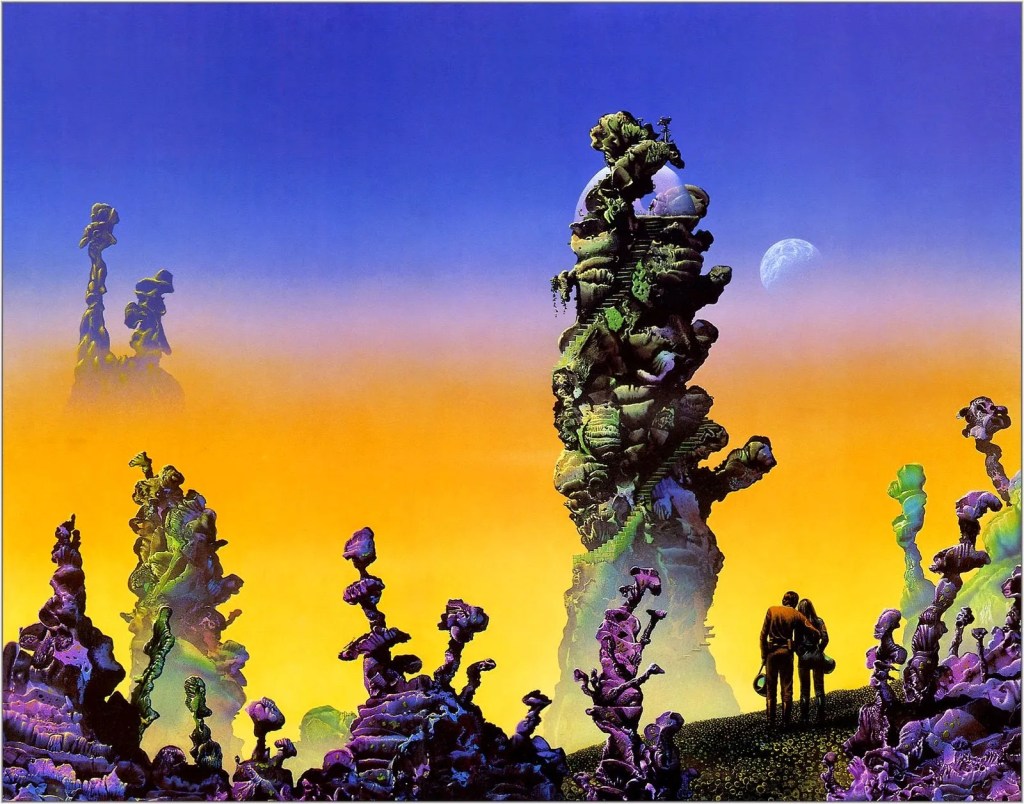
Tim White’s interior art canvas illustrating John Varley’s Barbie Murders (1986) in Grant Masters of Fantasy Art
April 4th: Artist Tim White (1952-2020). I learned recently that he as a “kind of an Easter egg thing […] usually put his astrology sign symbol (ram’s horns) in his paintings.”
April 5th: Author Robert Bloch (1917-1994)
April 5th: Author Ann Maxwell (1944-)
April 6th: Author Sonya Dorman (1924-2005). Check out Dorman’s hellish “Go, Go, Go, Said the Bird” (1967).
April 7th: Henry Kuttner (1915-1958). I recently reviewed Clash by Night and Other Stories (1980) (with C. L. Moore).
April 7th: James White (1928-1999). He wrote a lot of great stuff beyond his Sector General series!
April 8th: Influential UK editor John Carnell (1912-1972) — i.e. the guy at New Worlds before Michael Moorcock.
April 8th: Influential US editor Cele Goldsmith (1933-2002). She helmed Amazing and Fantastic Stories of Imagination through the era of the Great Magazine Constriction.
April 9th: Author George O. Smith (1911-1981)
April 9th: Artist Mati Klarwein (1932-2002)
April 9th: Author Barrington J. Bayley (1937-2008).
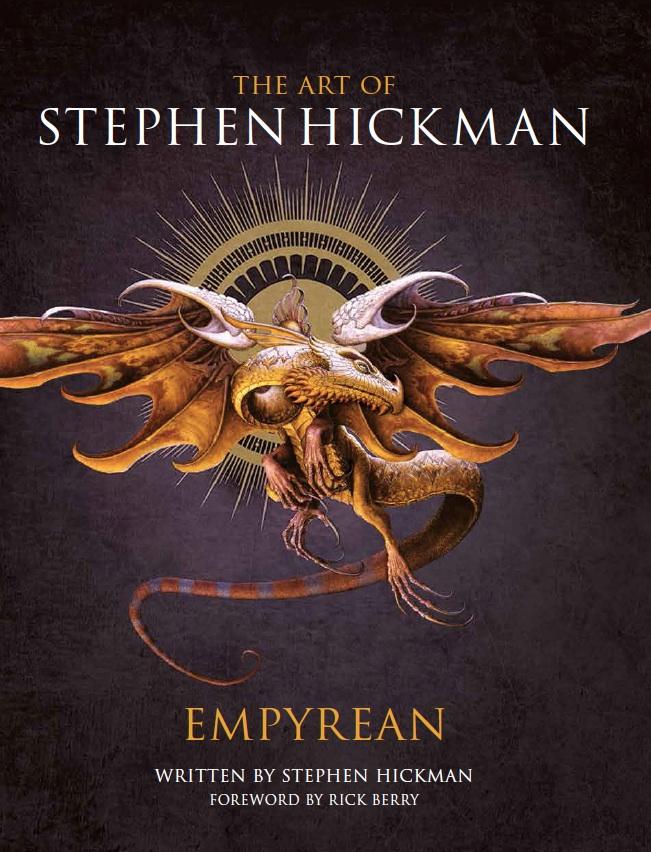
The Art of Stephen Hickman: Empyrean (2015)
April 9th: Artist Stephen Hickman (1949-2021). I love his dragons.
April 10th: Anna Kavan (1901-1968). Check out Ice (1967)!
April 10th: Artist Henri Lievens (1920-2000).
April 10th: Artist Jim Burns (1948-)
April 10th: Artist David A. Hardy (1936-)
April 10th: Author John M. Ford (1957-2006). I recently reviewed my first Ford work: The Princes of the Air (1982).
April 11th: Artist Gene Szafran (1941-2011). I call him Mr. FUZZY 70s PASTEL. Which is fine. But…
April 11th: Author James Patrick Kelly (1951-).
April 12th: Emil Petaja (1915-2000).
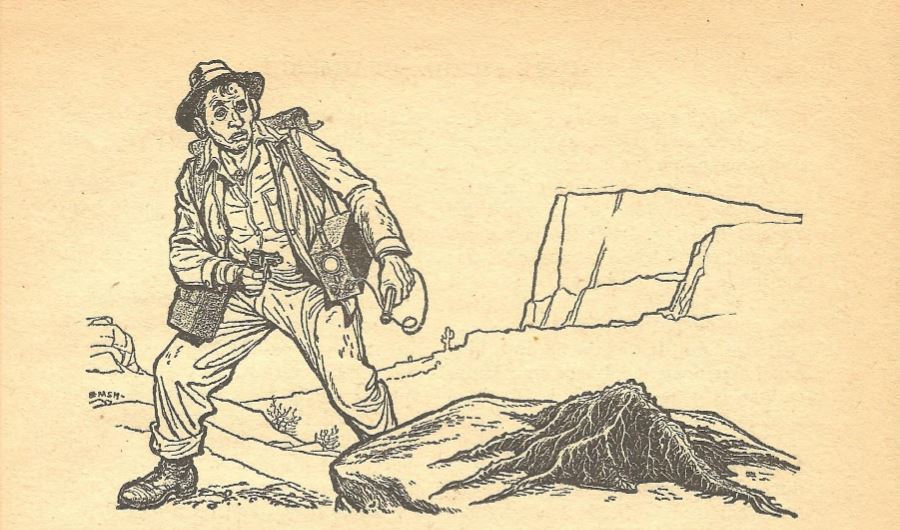
Ed Emshwiller’s interior art for Carol Emshwiller’s “The Piece Thing” in Science Fiction Quarterly (May 1956)
April 12th: Author Carol Emshwiller (1921-2019). I’ve reviewed all of her short fiction written before her early 60s break. Here’s the first post in my amazing (and very unpopular) series.
April 13th: Author Theodore L. Thomas (1920-2005). I reviewed three of his short stories here.
April 13th: Author Jonathan Fast (1948-). On a short list of father son SF authors… Howard and Jonathan Fast. Fritz and Justin Leiber. Frank and Brian Herbert. There must be more?
April 14th: Author Bruce Sterling (1954-).
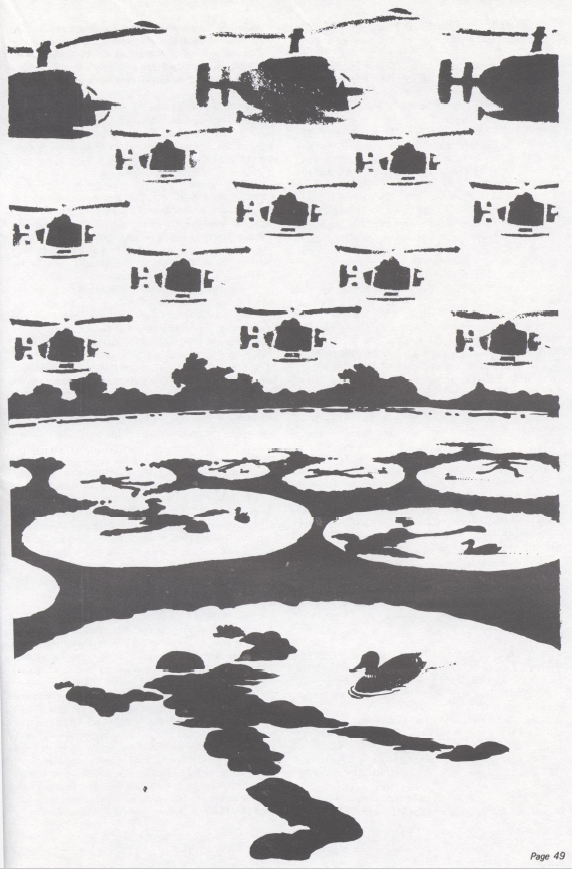
Mal Dean’s illustration of J. G. Ballard’s “The Killing Ground” in New Worlds (March 1969)
April 15th: Artist Mal Dean (1941-1974)
For book reviews consult the INDEX
For cover art posts consult the INDEX
For TV and film reviews consult the INDEX
 Science Fiction and Other Suspect Ruminations
One typo in the Mitchell Hooks entry — he was an artist, not an author. And a wide-ranging paperback artist — he did excellent covers for crime fiction too. (I have two Hooks’ covers on my blog — one for an “A. A. Fair” (Erle Stanly Gardner) mystery and one for a Marion Zimmer Bradley Ace Double half!) His work for crime fiction reminds me of Robert MacGinnis, who was one of the very best paperback artists.
I look forward to more of your allegedly unpopular reviews of Carol Emshwiller! Sonya Dorman did some really good work — the Roxy Rimidon stories are lots of fun, and other stories like “When I Was Miss Dow” are as intriguing as “Go! Go! Go! said the Bird”. And of course I echo your recommendation of Anna Kavan!
Thank you. I’ll fix it.
Feel free to link the Hooks covers.
I still haven’t convinced myself to dive head-long into her more overtly New Wave stuff. It can be a bit oblique.
But yes, I need to read more of Dorman’s stories.
Also, what pre-1985 SF are you currently reading or plan on reading later this month?
I forgot to mention those! I read de Camp’s THE FALLIBLE FIEND a week or two ago — I’ll send something to Black Gate about that. And just yesterday my look at Frenchman Gerard Klein’s THE MOTE IN TIME’S EYE appeared there: https://www.blackgate.com/2024/04/14/adventure-in-the-magellanic-cloud-the-mote-in-times-eye-by-gerard-klein/, this will be followed by a review of BACKFLASH by Laurence James in a little bit.
I have read other even older stuff — for example David Garnett’s 1924 novella LADY INTO FOX, a short fantasy. (The other old things aren’t SF: Trollope’s 1859 FRAMLEY PARSONAGE and Margaret Kennedy’s 1924 novel THE CONSTANT NYMPH.)
I do plan to read Eleanor Arnason’s TO THE RESURRECTION STATION very soon. But as that came out in 1986 it’s JUST a bit outside of your official purview!
Yeah, I snagged a copy of the Arnason after I reviewed her first three published SF stories.
I’ll take a look at the Klein review.
There was a line of danish SF paperbacks, from the seventies mostly, that were always advertised with the motto “more exciting than any crime novel” on the covers, anything from Asimov to Ballard. They also had coupons where you could save money on the first available commercial moon travel in some of them. The cover blurbs were often every bit as bland or even mislieading as your example. For Ballards Terminal Beach, it even seems like they’re describing a completely different book, perhaps thinking no one would buy it if they tried to actually describe the content. But it could also have been a mistake I guess.
As for recent reads – I read Silverbergs Dying Inside some weeks ago, by far the best Silverberg I’ve read, but then, I’m not really a fan (I know – sacrilege in this comment section). The basic idea is brilliant (as it often is with Silverberg), and here I also found the execution very good.
Right now I’m going through Gravitys Rainbow, which I think is seen as a SF by some. I’m not sure I would call it that.
I thoroughly enjoyed Dying Inside as well. But, yes, I am a big fan of Silverberg’s.
I have read small parts of Gravity’s Rainbow. I think that’s what a lot of people say about Pynchon though. he’s a hard nut to crack. And I can’t imagine the work that goes into translating his work into other languages!
If you can find any images of those Dutch books, let me know! Sounds like a ridiculous advertising gimmick. And one in which the gullible reader is sure to feel conned!
I don’t know if there’s a complete database of the covers out there, but this guy has quite a few, and there’s many others here and there, I’m particularly fond of A Handfull of Darkness, The Terminal Beach and The Sirens of Titan; despite the low budget quality and misleading advertising, the covers were often really good, and the publisher seems to be remembered quite fondly by dansih SF enthusiasts today – they did have a lot of really good stuff, in particular Ballard, Dick, Aldiss and Vonnegut.
The publisher was called Stig Vendelkær, so a search for Stig Vendelkær science fiction, or just SV science fiction, should bring up more if pictures if you’re interested. Incidentially, they also had another line called “dangerous books”, focusing on the subversive/semi pornographic, where they also tried to sell Alfred Jarry and William Burroughs as a kind of erotica.
As for Gravity’s Rainbow: Some years ago there was a danish translation of Mason & Dixon which was quite a success and allegedly quite good (I haven’t read it), but as far as I know nobody has tried with Gravity’s Rainbow, so I’m reading the original. What makes it hard, I think, is not just the hermetic prose (which in itself doesn’t seem more inaccessible than, say, Burroughs or for that matter The Atrocity Exhibition), but rather that there’s so much of it. To me it most of all feels like if Umberto Eco tried to emulate Burroughs (or maybe the other way round), and partly succeeded.
Thank you for the links. I always enjoy seeing vintage covers for presses that I don’t know too much about. Thanks!
I recently read John M. Ford’s Growing Up Weightless, which misses the before 1985 window, but to make up for it, I recommended a few William Tenn stories to my wife, who wanted to sample his works (“Betelgeuse Bridge,” “Servant Problem,” “Down Among the Dead Men,” “On Venus Have We Got a Rabbi,” and “The Dark Star.” (and maybe a few others) were the ones she read)
What did she think of Tenn? “Down Among the Dead Men” is spectacular. I’ve reviewed quite a bit of his stuff on the site.
She liked them all, though I think she preferred the humorous ones.
I like his darkest black comedies vs. the more farcical ones! Haha.
“Eastward Ho!” (1958) and “Generation of Noah” (1951) are my most recent Tenn reviews: https://sciencefictionruminations.com/2023/03/04/short-story-reviews-william-tenns-generation-of-noah-1951-and-eastward-ho-1958/
Thanks!
No problem. Thank you for the Tenn reminder. I’ve been meaning to read “Alexander the Bait” (1946) for one of my review series.
Alas Babylon?! Alas the present time! Babylon ain’t seen it!
Have you read the novel?
No, I haven’t.
It’s one of those iconic late 50s post-apocalyptic novels — of the more positivist (survival is possible) bent than something like On the Beach (1957).
I actually have pertinent contributions to this topic for this month. I always ruminate over the fact that a few years ago, I would have had lots of comments to offer as I was mainly reading pre-1990 science fiction. I’ve read so much of it now that I found myself moving on to reading mostly recent genre fiction.
A local used book store bought the contents of an estate sale featuring all 1960s-1980s science fiction and horror novels. I was able to find a few gems missing from my collection.
So, for this instalment, I have been reading The Man Who Folded Himself by David Gerrold. I have been interested in this novel for some time. It was worth the wait. It’s a quick and easy read, but it definitely seems to have been a very personal work by Gerrold.
I also found a copy of Cross of Fire by Barry Malzberg. I know Malzberg is a favourite around this site. I have read a quantity of Malzberg’s fiction, but this is a novel by him I have wanted to add to the list.
Plus, I bought Gabriel by Lisa Tuttle. That is outside of the scope of this site being horror fiction and published in 1987. It was still a novel I was happy to find.
Good good. I still have not read Gerrold’s The Man Who Folded Himself. I should. I will. Eventually.
Yes, I love Malzberg. I have not read Cross of Fire yet. Let me know how it goes.
As for Tuttle, she is a hole in my knowledge. I have her short story collection A Spaceship Built of Stone and Other Stories (1987) that I’ve been eying.
Agree with your high regard for James White’s ALL JUDGMENT FLED. If you want to read another good one of his, you might try THE ESCAPE ORBIT a/k/a OPEN PRISON, which plods along capably along conventional and predictable lines until suddenly it doesn’t. To my taste it’s at least a minor and unassuming tour de force.
So you enjoyed the White more than Clarke’s take? I found Clarke’s vision so sterile… I liked the grim and guts of White’s far more visceral vision.
I snagged a copy of The Escape Orbit a while back after similar comments related to its value. I have it on the list.
I would never have thought to compare ALL JUDGMENT FLED to RENDEZVOUS WITH RAMA despite the gross thematic similarity. Sterile is right. I read RWR when it appeared and thought it should have been cut down to a novella for ANALOG. I then tuned out on Clarke entirely after THE FOUNTAINS OF PARADISE. His work of the ’50s was monumental, but the trouble with monuments is that they never change, and the pleasure in going back to visit them is one of diminishing returns.
I remember seeing Clarke on TV in the mid-1970s, talking about humanity’s glorious future in space after mentioning vaguely that he expected there would be some sort of “Time of Troubles” between now and then. I felt like shouting at the screen “Yes! Tell us about the Time of Troubles! That’s what’s interesting!”
I was pretty obsessed with him in my earliest years of reading SF (late teens and early 20s i.e. the early 2000s). I also thought that Imperial Earth was a genuine masterpiece — not sure what I would think now!
Well, White, immersed in the real Troubles in Northern Ireland integrates a bit of the brutal reality of life in his fiction which I enjoy.
I’m reading All Judgment Fled and enjoying it so far.
Rendezvous with Rama was one of the books I loved as a teenager, primarily for the ideas. Rereading it recently as a curmudgeonly senior and sometimes writer, I was shocked at,as you say, the sterility of it. Days after reading it I couldn’t remember anything about any of the characters except that 1.) one was a priest, which didn’t matter because there was no significant content or discussion of the religious implications of the discovery; and 2.) one of them owned an ultra-light glider and had smuggled it onto his ship for no obvious reason, other than that the plot required it.
Just finished Christopher Priest’s “Palely Loitering,” which I didn’t like as enthusiastically as you did. It turns into a bit of a clusterfuck, but it’s also interesting.
I am a bit peeved that it was his only story to snag major award nominations in the US. If I’m not mistaken… he wrote better. Although, it’s still great. And I’m a huge fan of the metaphoric sculpted landscape-style of fantasy and SF.
I’ve finished neither ‘Dhalgren’ nor ‘Gravity’s Rainbow’.
I’ve yet to read ‘Nova’, I didn’t mind ‘The Einstein Intersection’, and did not finish ‘Babel-17’. I really need to read more Delany. I’ve enjoyed his short stories more than his novels so far.
I enjoyed ‘All Judgement Fled’, on your recommendation. I’m still not sure if it’s better than ‘Rendezvous with Rama’. I loved the latter and read it repeatedly around the age of 12, 13, 14. Not since then though. Maybe this choice is too emotionally fraught. Like choosing parents over a good friend. Next thing you’ll be asking me to choose Pynchon over Clarke…
If you review the Ballard you must write it in the style of Ballard, i.e., as a report given by a typical Ballard protagonist.
Short sf is best sf. I read more long form in non gerne these days. Though an sf novel will occasionally barge its way in.
For instance, I am keen to read Adam Wisniewski-Snerg’s ‘Robot’.
We should come of with a club name for the did not finish Dhalgren and Gravity’s Rainbow!
I don’t think I completely understood the textual metafiction stuff of The Einstein Intersection when I read it i.e. pairing the travelogue bits with the story. As someone who grew to adore generating interesting relationships and interactions by paired texts, I think that would resonate with me more.
What would we call it? Dhalgren’s Rainbow? Ghraviten?
The Einstein Intersection hasn’t stayed with me. I enjoyed parts of it, and loved the conceit of the non-human people who came after taking up the myths and stories of the humans.
I read “Dhalgren” a couple years ago, and it was a slog. Part of me wanted to put the book down, but another part of me felt compelled to keep seeing what happened next in the book. While I was impressed by the accomplishment of the long novel, the story felt repetitive.
I tried to read it a good decade ago. I think I put it down due to a change of my reading whim vs. any active frustration or dislike. But then again, I did not get far enough to identify repetition etc. The novel itself does form a circle. It ends where it starts.
I’m re-reading MAN PLUS by Frederik Pohl, from 1976.
https://en.wikipedia.org/wiki/Man_Plus
I recently snagged a copy. I have yet to feature it in my purchase posts.
What are your thoughts so far?
I’ve just finished Wolfbane (1959) by Frederik Pohl and Cyril M. Kornbluth. I’d previously read The Space Merchants and Gladiator-at-Law but this one may be may favourite by that duo. The last third or so is particularly good.
Next, I’m reading The Fall of Chronopolis (1974) by Barrington J. Bayley – my second by him, after thoroughly enjoying The Garments of Caean.
Hello Andy,
I’ve reviewed three of those five novels on my site — albeit, more than a decade go. I also read Space Merchants before I started reviewing SF (my read the classics phase). I haven’t read Wolfbane, yet.
To be honest, you’re one of the few people I’ve heard who’ve said nice things about Wolfbane! I’d love to hear your thoughts. Do you write reviews?
I haven’t seen much coverage of it from others yet. Compared to the social SF of the earlier two books I’ve read, there is a large shift in approach with Wolfbane – perhaps some found that off-putting. I will be publishing a piece about all three of the Pohl and Kornbluth collaborations I’ve read, hopefully next week.
In a nutshell though, I found it an intriguingly strange look at the relationship between biological and machine “life”. It could be called an early story about tranhumanism, and in some ways it anticipates The Matrix. Little of that is hinted at in the early chapters… it’s a book in which the situation radically changes in a short page count. There are some striking images of grim industrial processes, altered mind-states, and so on. I liked it a lot.
I’ll keep an eye out. Feel free to link your review here when you post it.
The most recent rundown I read (last year) was Michael R. Page monograph Frederik Pohl (2015) for U. Illinois Press’ Masters of Science Fiction series. https://www.press.uillinois.edu/books/?id=p081156
My piece on The Space Merchants, Gladiator-at-Law, and Wolfbane is now live on my site.
Thank you. I’ll take a look later today.
Just finished the Strugatskys’ Roadside Picnic, a re-read after 30+ years. Weirder than I remembered. Review soon.
Not one I’ve tackled — yet. In part because the older editions are so expensive… and I like my old paperbacks! 🙂
Feel free to link your review so others can see it!
Finally got around to posting a Strugatsky review!
I’ve finished reading all the Hugo winners and nominees and am now working through the same thing for the Nebulas, and attempting to start at the beginning. 1966 had over a dozen nominations so just that year will take a while.
I finished “The Clone” by Kate Wilhelm and Theodore Thomas. I was expecting to at least find it passable because of Wilhelm’s other work I enjoyed, but it was awful, in my opinion. Very “monster of the week” with barely any connection to plot or characters. I also finished “Nova Express,” which was atrocious. Totally incoherent ramblings of the worst sort. I hated it so much. Hoping the rest of that year’s nominees will fare better.
Yeah, someone covered it for my guest post series on Wilhlem back in 2016. I’ve never read anything positive about it. On the other hand, I recently reviewed a worthwhile Wilhelm novel — that didn’t pick up a nod: https://sciencefictionruminations.com/2024/01/15/book-review-kate-wilhelms-the-killer-thing-1967/
I’m a post-modernist at heart. I have a lot of tolerance for Burroughs and that sort of experimentation.
Brace yourself and I will say something positive about THE CLONE.
What a geek-fest! Especially the beginning, which is not much changed from the original short story in FANTASTIC 12/59, where it appeared under Thomas’s sole byline, and where I read it at age 11 and was quite captivated. I wouldn’t want to read something like that every day, but every 50 or 60 years or so . . . just right!
Do you know what the bifurcation of labor looked like in that book? Were they already friends who decided to work together? Or did Thomas just give Wilhelm permission to expand the story or did he play an important part in the novelization as well?
Not a clue.
Trying to be more productive this spring, so I’m going back to reading shorter stories, beginning with the collection The Last Hurrah of the Golden Horde by Norman Spinrad. Time out of Mind by Pierre Bouelle is next after that.
I need a good fix for mature new wave-y SF like Langdon Jones, Charles Platt and Thomas M. Disch.
I enjoyed the Spinrad collection: https://sciencefictionruminations.com/2014/09/28/book-review-the-last-hurrah-of-the-golden-horde-norman-spinrad-1970/
Unfortunately, I’ve read little Sprinrad since other than “The Weed of Time” (1970): https://sciencefictionruminations.com/2022/12/17/short-fiction-reviews-norman-spinrads-the-weed-of-time-1970-and-william-morrisons-the-addicts-1952/
Sounds like a good plan! I enjoy some Platt (The City Dwellers is his best) and lots of Disch and Jones. The latter two are frequently reviewed on the site as you are probably aware.
● Being over sixty, and besides my duties as an editor at ISFDB, and reading my favorite type of sf, sf-action, or sf-horror, I’ve been revisiting several novelists/writers that I grew up reading. Recently I’ve read one of John Christopher’s lesser Dystopian juveniles “A Dusk of Demons”. His Tripods novels were read to pieces in my youth. His sf/horror/siege novel “The Possessed” scared the bejesus out of me in my early teens.
● I’ve read “Deathworld” by Harry Harrison and found it a bit of a let-down, being a typical John Campbell adventure novel. Fitting, I guess, as it appeared first in “Analog”. Probably would have liked it more when I was thirteen.
● I’ve also revisited a novelist I loved as a teen, and that is the British author L. P. Davis who wrote a lot of mystery-sf thrillers. ”Twilight Journey” was a convoluted, but interesting, Dystopian novel of a man who is lost in his own mind, but who also has the capacity to bring down the new world order. Davies may be mostly forgotten today, but he was popular in his day, with several of his novels even being filmed.
● My favorite Murray Tinkelman piece of cover art is for Richard Matheson’s “The Shrinking Man”. He’s also did some great western paperback covers. He had a unique style.
Hello Mark, I hope you’re doing well. So you’re telling me that you’re now my isfdb.org liaison if I identify an entry that needs fixing?! Haha.
I also loved Christopher’s Tripods novels. I think I read each one twice after my dad or mom read them to me the first time around. I can remember exactly. I have not returned to them. I also did not care for Deathworld although I did not read it as a teen. I listened to it as an audiobook a few years ago and thus never managed to write a review.
Just read ‘Murder on the 31st Floor’ by Per Wahloo.
Written before the famous Martin Beck novels that he co-authored with the missus, to whom this novel is dedicated. I have a weakness for Wahloo’s solo novels (I found the Beck sequence started running out of steam well before its end; a personal favourite is ‘The Laughing Policeman’).
Anyhow, ’31st Floor’ has a future setting, a cop lead, an investigation with a tight deadline into the crime of people thinking for themselves and is full of the usual (realistically portrayed) lefty ideas that crop up in his work. Like all of Wahloo’s solo work the novel burns on a very slow fuse and is worth sticking with.
Separately, I was delighted to see some SF creep into Richard Stark’s (D Westlake) ‘Plunder Squad’ (1972), via a dream one of the characters is having. Whether or not this dream – an idea of planets chained together – made it into one of Westlake’s SF shorts, or reflects something he had already written, I have no idea. Needless to say the dreamer is not Parker. ‘Plunder Squad’ also references the Anthony Powell sequence ‘Dance to the Music of Time’. If only Powell had added ‘Travel’ at the end.
Happy reading!
Yeah, I’m a big fan of Scandinavian SF and I have that one on my list. I someone recently snagged Wahloo’s near future dystopia The Generals (1965): https://sciencefictionruminations.com/2020/08/21/updates-recent-science-fiction-purchases-no-cclvi-joan-sloczewski-barrington-j-bayley-james-gunn-per-wahloo/
Currently rereading Van Vogt’s The Universe Maker, although I’m not entirely sure why. Possibly because I picked up an old Ace double of it and The World of Null-A (which I’d never read), and I want to get rid of the book.
I love Dhalgren. I’ve read it three or four times. I’m currently working my way through The Fall of the Towers, which I last read 40 years ago, and enjoying it. I also have The Einstein Intersection on the TBR, which I also last read 40-odd years ago. My absolute favourite Delany, however, is Empire Star.
I’ve only read Kapp’s novels, and enjoyed his Cageworld series. I spent ages tracking down a copy of his well-regarded Unorthodox Engineers collection, but the stories weren’t that good.
I’ve read most of Reginald Hill’s Dalziel & Pascoe series, but gave up after one book was pretty much dialogue from start to finish. The TV series was good, although I’ve always been a fan of Warren Clarke.
Finally, I have Ford’s last unfinished novel, Aspects, on the TBR. I’ve liked what I’ve read by him, and I plan to read more.
I adore Aspects, and desperately mourn the loss of John M. Ford (and the concomitant loss of the rest of Aspects, to be sure.) My review: https://www.blackgate.com/2022/06/28/emaspectsem-by-john-m-ford/
I have also read and reviewed that Van Vogt Ace Double. It is fair to say that I do not “get” Van Vogt. I am firmly in the Damon Knight camp. https://rrhorton.blogspot.com/2023/03/ace-double-reviews-76-world-of-null-by.html
I need to reread both The Fall of the Towers and Dhalgren — I read both in my teens, probably too early to read Dhalgren. (My absolute favorite Delany is Nova, unless it’s Driftglass, the collection.)
RH: It is fair to say that I do not “get” Van Vogt.
[1] Without Van Vogt, cosmic jerrybuilder, no Philip K. Dick. (Nor Harness, nor Barrington Bailey, nor much of the Kuttners’ longer work.)
[2] Furthermore, occasionally the ad hoc Van Vogtian reality-busting twists every 800 words come together to create something ideationally coherent and so imaginative — and ideational imagination is the name of the game in SF — that it’s a thing of beauty.
Try ‘The Monster’ aka ‘Resurrection’
https://www.isfdb.org/cgi-bin/title.cgi?63319
Most recently reprinted in THE OXFORD BOOK OF SCIENCE FICTION STORIES. But look at how many times and in how many languages this sucker’s been reprinted since its first appearance in ASF in 1948; I first read it as a kid in Kingsley Amis and Robert Conquest’s SPECTRUM II. It must be working for readers over the decades in some way, right?
The “influence” argument is fair as far as it goes — no denying that van Vogt profoundly influenced many many writers, including some truly great writers. But that’s like saying the mystery and miracle plays are important because without them there’d be no Shakespeare. (OK, that’s true but slightly unfair to van Vogt.) What I mean is, he did some fascinating stuff, but most of it, even with fascinating aspects, wasn’t really any good! (I concede a few shorter and quite powerful pieces like “The Monster”.)
I have my early writers whom I love who I have to concede were clumsy and imperfect. Harness is a great example! But still, yes, he was following in van Vogt’s footsteps, but for me, to much great effect. And, also, at times to sheer absurd silliness.
If you want to say “You can’t tell the “story of SF” without van Vogt” you are absolutely correct, though! (And, hey, I’ve read a lot of van Vogt and I have liked some of it. Which isn’t doing too bad for any writer long after his death.)
I’ve been trying to get my head around what it is that van Vogt does. The science and philosophy are risible bollocks, but he throws in these occasional eyeball kicks which end up being the only thing you can remember about the book – and so you remember them more fondly that they deserve. EE Doc Smith did something similar, by revealing ever larger vistas and throwing out ever more ridiculous numbers that just about hovered on the edge of suspension of disbelief, such as a million-ship battle fleet.
There is one van Vogt novel I’d happily recommend: The House that Stood Still (AKA The Undercover Aliens). Which I once described as the mutant offspring of Raymond Chandler and Buck Rogers. 1940s noir, a secret society running the town, and behind it all an ancient buried spaceship. The last idea also appears in van Vogt’s The Players of Null-A. Which also features shadow people and a population living in airships. As does The Universe Maker. Van Vogt was nothing if not adept at mining his own back-catalogue.
I never really took to Nova. There are too many info-dumps in it. I also have Triton the TBR, which I’ve not read for several decades. Stars in My Pocket Like Grains of Sand took me three goes to finish, but I when I finally did a few years ago, I found myself liking it a lot.
Ian Sales: There are too many info-dumps.
How are you with Kim Stanley Robinson then?
I tend to view the value or art in the “information dump” as, with all elements of the story, depends entirely on how its used by the author. If the goal is an encyclopedic gaze, Stand on Zanzibar or that ilk, then the information dump can be a literary tool to achieve that. It all depends on the purpose and craft of telling.
Reading H. Beam Piper’s Uller Uprising.
Thoughts on it so far? I picked up a copy a few days ago.
Finally made it to the end of Here Comes Civilization, the second half of NESFA’s complete William Tenn, after cycling through some other things … Of Men and Monsters made a satisfying conclusion, but it was a long slog in the middle. I really question the decisions the NESFA folks made about assembling these books. Most of what I consider the top tier is in the first volume, and what’s here (aside from a couple stone classics) suffers from being clumped thematically, so it’s hard to read them back to back; and there’s a big lump of early stories that Tenn himself basically writes off as journeyman work. It’d honestly have been more fun working through the old Ballantines.
Also worked my way piecemeal through a 1984 artifact, Savoy Dreams, a sort of post-mortem troll through the ruins of the police-assisted collapse of Savoy Books. The porn-bust saga gets extensive rehashing both sfnal (by Charles Partington) and extended-polemical rant; one of Moorcock’s letters from California; an essay about Tarzan-as-Civilizational-Unconscious by Burne Hogarth and one on M. John Harrison by Colin Greenland; bits of a graphic novel by Kris Guidio featuring The Cramps and zombies; some scatalogical poetry from Heathcoate Williams; and a long “Book Reviews” section that’s actually a mass of reviews of various Savoy Books from elsewhere. But we’re here for the fiction! Aside from the Partington: an excerpt from Burroughs’ “Place of Dead Roads”, transcribed from a reading; the first appearance of Harrison’s “Lords of Misrule”; “In the Gas Oven”, a rare SF story by aussie Tom Thompson, which is basically a mash-up of Platt’s “The Gas” and “Sister Ray”, all the degeneracy ascribed to a house full of junior English Department faculty; and Michael Butterworth’s “A Hurricane in a Glass Jar”, an almost incomprehensible post-apocalypse slice of death in the manner of mid-60s Burroughs.
A mixed bag obviously but interesting as a sort of last hurrah of the New Wave dissolving into the Thatcherian swamp. Man, do I need something ordinary now.
Somewhat unexpectedly, by the way, I am at last reading the only adult novel by Ursula K. Le Guin that I had not yet read — Always Coming Home, which does barely fit in your time frame (it was published in 1985.)
It is fascinatingly imagined, and has moments of brilliance, but much of it is a slog, too. I see what Le Guin was doing, and it’s a worthwhile effort, and I’m glad I’m reading it. But also sometimes it seems like a writer including all her research notes ….
For no particular reason beyond a desire to try a random Ace Double, I’ve picked up John Rackham’s 1969 Ipomoea. So far, John Clute’s description of Rackham/Phillifent’s writing as “second-rank but convention-savvy fiction demanded by an entertainment genre hungry for copy” is bearing up.
You know, feel free to pick up some of the worthwhile vintage stuff I review!
John Rackham is a “no thanks” in my book. Haha.
Ha! Oh, I have a lengthy list. At some point this year I intend to fill several of my Malzberg gaps.
Good good!