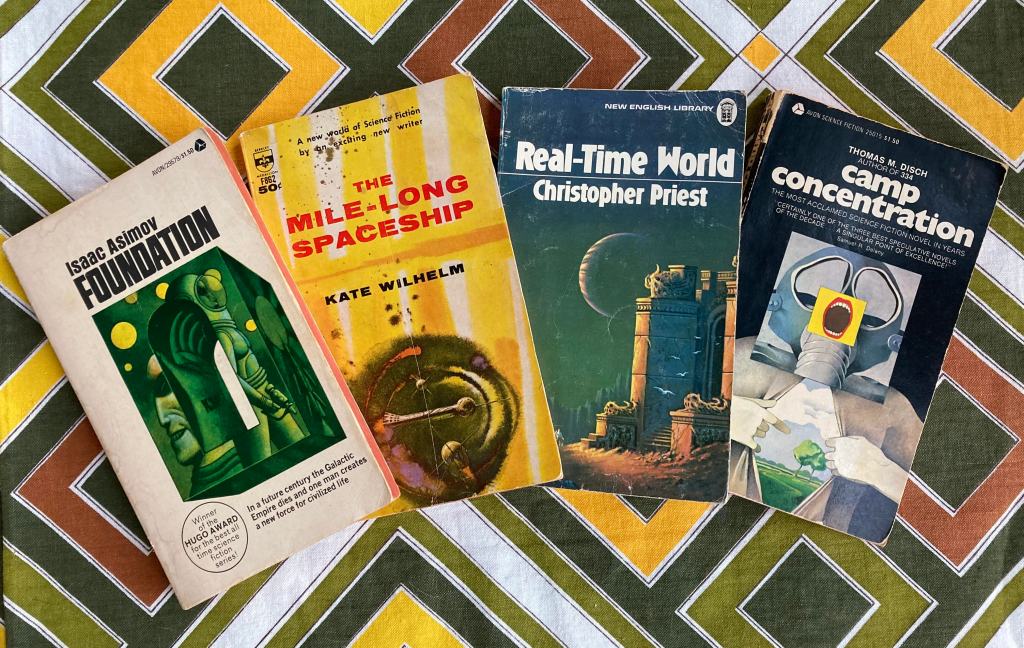
A selection of read volumes from my site
What pre-1985 science fiction are you reading or planning to read this month?
Here’s April’s installment of this column.
First, a bit about Isaac Asimov’s Foundation (1951) from M. Keith Booker’s Monsters, Mushroom Clouds, and the Cold War: American Science Fiction and the Roots of Postmodernism, 1946-1964 (2001), my current history of science fiction read:
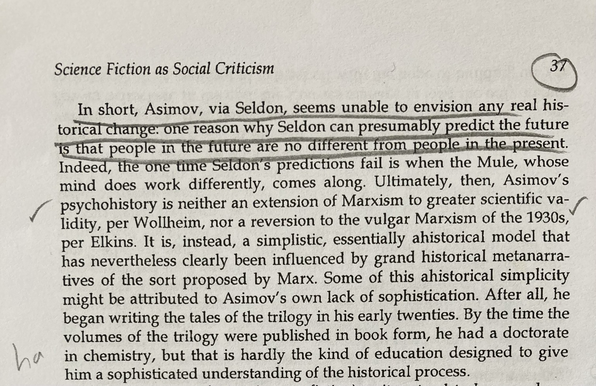
Booker wants to make the argument that science fiction in the 50s demonstrates some of the features that will coalesce into postmodernism. He highlights Asimov’s inability (deliberate or otherwise) to show historical change in his fiction. Characters think the same, other than the Mule, in the far future. Booker also navigates scholarly arguments about how inspired Asimov was by Marxism. Author and influential early SF scholar James Gunn refused to believe, despite the proliferation of evidence, that Asimov utilized Marxist ideas at all. Other scholars wanted to read him as an updated version of Marx. Booker argues that while Asimov is obviously inspired by general Marxist views on grand narrative, his variation (and hence proto-postmodern) is a flattening of historical time. This passage also contains one of the more snicker-inducing swipes at Asimov…. There is FAR more to Booker’s argument. His fascinating book is available online in a PDF, so please do not take this one passage out of context.
Let’s get to the books in the photo and what I’ve been reading and writing.
The Photograph (with links to reviews and brief thoughts)
- Isaac Asimov’s Foundation (1951). I read this one in my teens. I remember little other then the sense of long durée, which appealed my younger reader self who primarily enjoyed multi-volume/epic/boated fantasy at that point.
- Kate Wilhelm’s The Mile-Long Spaceship (1963). Wilhelm’s first collection contains a solid range of her earliest visions. In my review I highlighted “The Man Without a Planet” (1962), a moody rumination on the claustrophobia of space travel and “No Light in the Window” (1963), an intriguing work of feminist science fiction.
- Christopher Priest, one of my favorite SF authors, recently passed away. I thoroughly enjoyed many stories in Real-Time World (1974).
- Thomas M. Disch’s Camp Concentration (1968). Placed here as a reminder that I need to reread this one!
What am I writing about?
End of the school year stress and sheer exhaustion slows my writing rate. I posted reviews of two early Clifford D. Simak short stories critical of capitalism: “Masquerade” (1941) and “Tools” (1942). And a new installment in my multi-year series on generational voyage: Fred Saberhagen’s “Birthdays” (1976). Of course, there can’t be a month without post-apocalyptic nightmares. Robert Bloch’s “Daybroke” (1958) and “The Head” (1976) fit the bill this time around. Reviews of Brazilian, Belgian, and American dystopia await in the wings.
What am I reading?
Lots and lots of Clifford D. Simak. I have reasons.
A Curated List of SF Birthdays from the Last Two Weeks
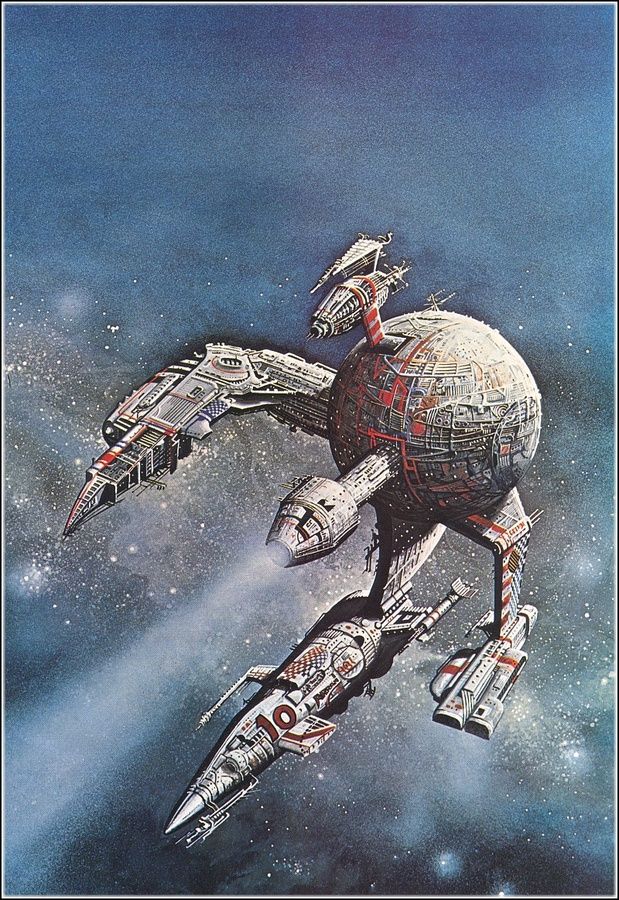
Bob Layzell’s canvas for the 1980 edition of A Sea of Space, ed. William F. Nolan (1970)
May 4th: Artist Bob Layzell (1940-).
May 5th: Author Pat Frank (1907-1964). Alas, Babylon (1959) is on my immediate horizon.
May 5th: Author Lee Killough (1942-). I’ve covered a few of her short fictions on my site. A good place to start is my post on her first three published fictions: “Caveat Emptor” (1970), “Caravan” (1972), and “Sentience” (1973).
May 6th: Cherokee Author Craig Strete (1950-). One of the great unknowns. Check out The Bleeding Man and Other Science Fiction Stories (1977).
May 6th: Artist Gordon C. Davies (1923-1994). A second-to-third rate SF artist that spewed out an endless proliferation of hackneyed covers for 1950s UK publications. His career petered out abruptly in the late 50s. A later career covers, that demonstrate a bit less rush, appeared in the 70s.
May 6th: Author Gaston Leroux (1868-1927)
May 6th: Author Jack Sharkey (1931-1992)
May 7th: Author Gene Wolfe (1931-2019). One of the depressing elements of posting birthdays for the last four or five years (on social media before I started my reading update posts here), is the yearly reminder that plans to tackle in a more serious manner authors I’ve avoided have not come to fruition. I love Wolfe’s short fiction. I have not read a single novel, yet.
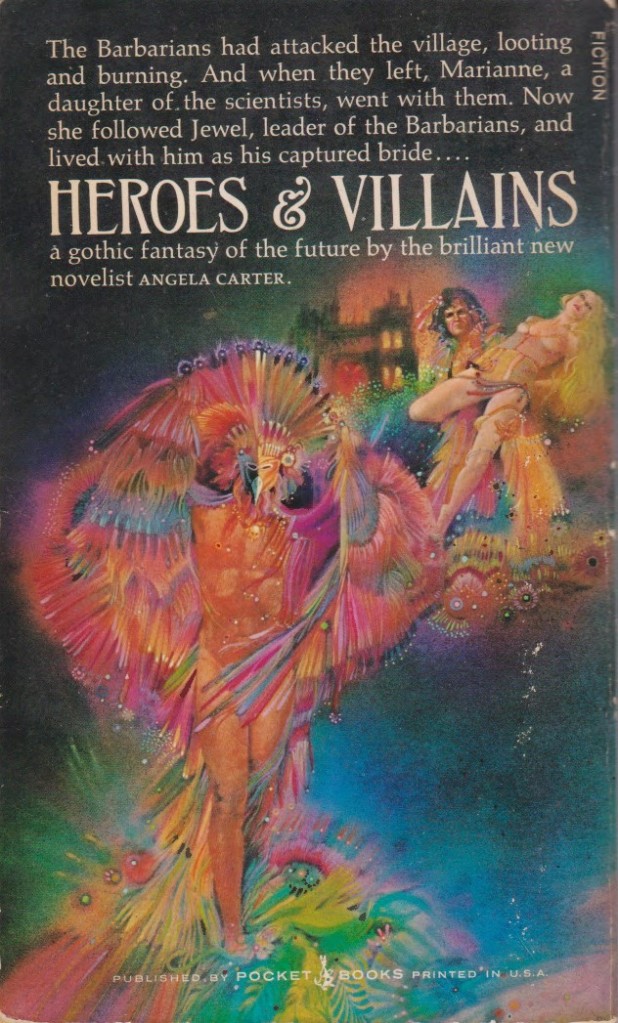
Gene Szafran’s cover for the 1972 edition
May 7th: Author Angela Carter (1940-1992). Carter’s The Infernal Desire Machines of Doctor Hoffman (1972) ranks in my top 10 SF novels of the 1970s. While I never managed to write a review of that imposing masterpiece, I gathered the strength to cover Carter’s worthwhile Heroes & Villains (1969). I am similarly overwhelmed by the prospect of reading and writing about The Passion of New Eve (1977).
May 8th: Artist Moebius (1938-2012). Everyone knows Moebius, right?
May 8th: Artist Stanislaw Fernandes (1945-).
May 8th: Artist Ron Miller (1947-)
May 9th: Author William Tenn (1920-2010). I love Tenn. If he’s new to you, here’s my most recent review.
May 9th: Author Richard McKenna (1913-1964). Best known for his non-SF, McKenna crafted quite a few gems before his early death. “Hunter, Come Home” (1963) is my personal favorite.
May 9th: Author Richard Adams (1920-2016). Watership Down (1972) and Plague Dogs (1977) gave me nightmares as a kid. In my teenage fantasy craze, I adored Shardik (1974) but never got to the sequel Maia (1984).
May 9th: Author André Carneiro (1922-2014). A Brazilian SF author with three short stories available in translation for English-language readers.
May 9th: Author Kris Neville (1925-1980). For a recent review of his fiction, check out Mission: Manstop (1971).
May 9th: Author Richard Cowper (1926-2002). While best known for his ruminative The Road to Corlay (1978), Cowper also excelled in the madcap fun department — Profundis (1979).
May 9th: Author George Schelling (1938)
May 9th: Author Geoff Ryman (1951)
May 10th: Olaf Stapledon (1886-1950)
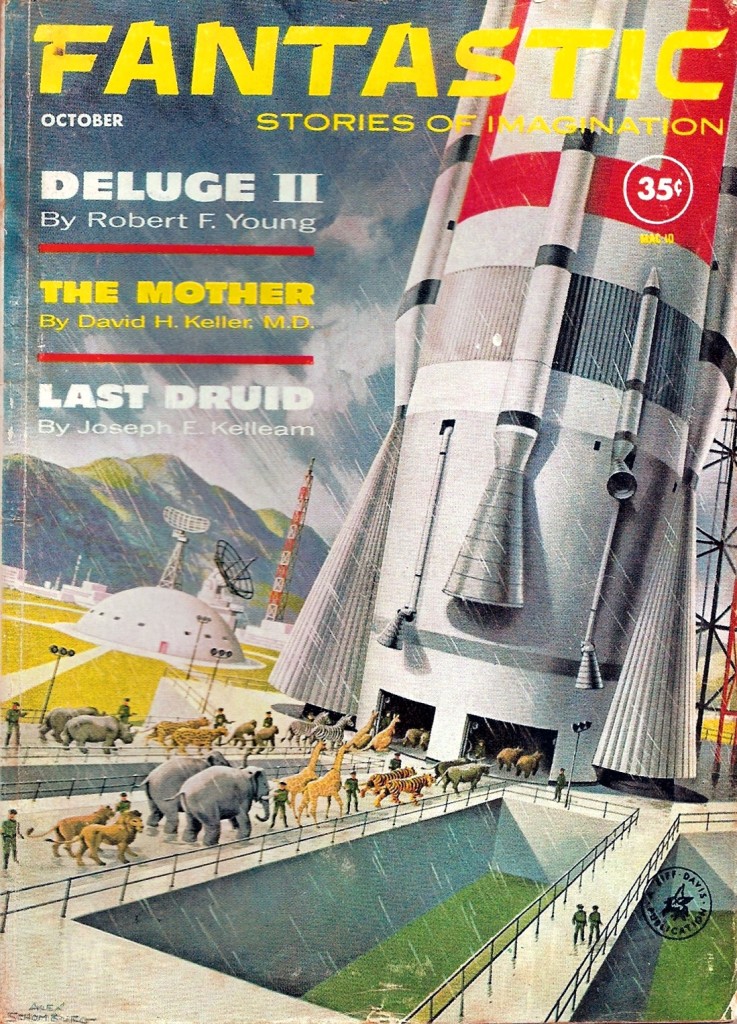
Alex Schomburg’s cover for Fantastic, ed. Cele Goldsmith (October 1961)
May 10th: Artist Alex Schomburg (1905-1998). Of the non-surreal/more pulpy aesthetic of SF art, Schomburg has always been my favorite!
May 10th: Artist Bruce Pennington (1944-). One of the more appealing British SF artists, in my view. Longtime readers know my dislike of Foss and his clones.
May 12th: Philip Wylie (1902-1971).

David Pelham’s cover for The Studio (November 1962)
May 12th: Artist David Pelham (1938-). Yes, we all know his Ballard covers. They are rightly considered genius. If you’re a fan, check out his pre-Penguin cover art!
May 12th: Barry B. Longyear (1942-)
May 12th: L. Neil Smith (1946-2021)
May 13th: Daphne du Maurier (1907-1989). I recently snagged a copy of her final, and only, SF novel–Rule Britannia (1972).
May 13th: Roger Zelazny (1937-1995). My most recent Zelazny review — To Die in Italbar (1973).
May 14th: Herbert W. Franke (1927-2022)
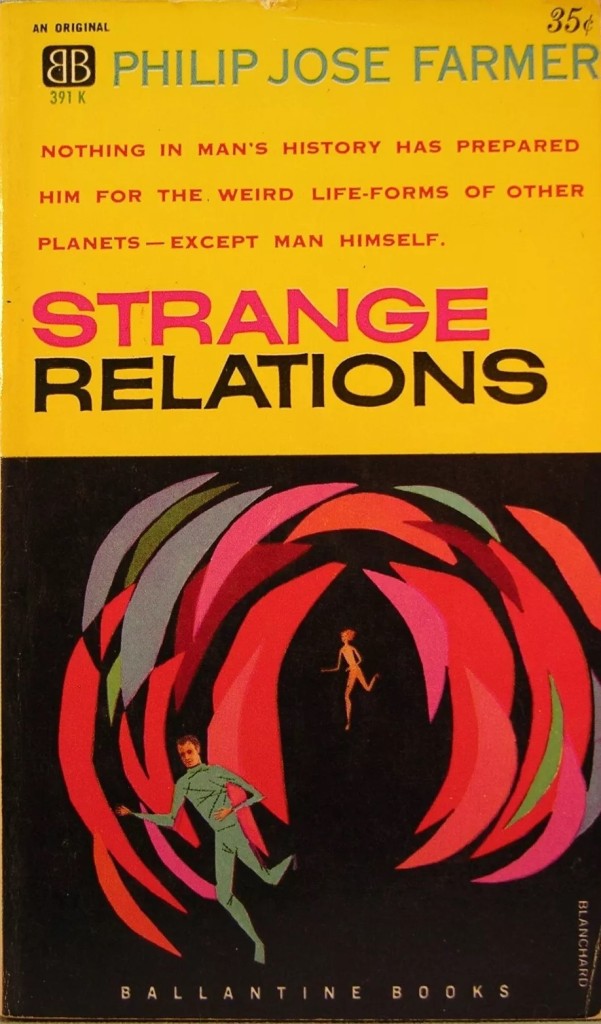
Bob Blanchard’s cover for the 1st edition of Philip José Farmer’s Strange Relations (1960)
May 16th: Bob Blanchard (1914-1993). Is there a better representation of a Philip José Farmer’s early science fiction? Woman chasing man through a stylistic vaginal passage? Check out my review of the collection in question if you are perplexed!
May 16th: Pierre Barbet (1925-1995). French pulp SF author I’ve yet to explore.
May 17th: F. Paul Wilson (1946-).
May 17th: Colin Greenland (1954-): scholar of the New Wave–The Entropy Exhibition: Michael Moorcock and the British ‘New Wave’ in Science Fiction (1983)–and SFF author. I found Daybreak on a Different Mountain (1984) a worthwhile read!
May 18th: Fred Saberhagen (1930-2007). I’ve covered two of his generation ship short stories: “Birthdays” (1976) and “The Long Way Home” (1961).
For book reviews consult the INDEX
For cover art posts consult the INDEX
For TV and film reviews consult the INDEX
 Science Fiction and Other Suspect Ruminations
The depressing part of the birthday list for me, is the reminder of how many people whose work I ate up yesterday afternoon (ie, 1974) are dead!
“He highlights Asimov’s inability (deliberate or otherwise) to show historical change in his fiction. Characters think the same, other than the Mule, in the far future.”
This is the reason the mad rush to develop “AI” scares me witless. Crystalizing human thought in an eternal framework of technology as it is now will warp and stunt the future possibilities of it in a moment of human history I despise and despair over. AI developed now most likely will be the carrier of the disfiguring soul-rot of capitalism and libertarianism. I can think of nothing less worthy of perpetuation.
I do not think we can crystalize human thought in an eternal framework of technology, at least as of now. I am far more worried about people thinking that AI “thought” is a worthwhile thing — the dumbing down of the internet, and believing that “critical thinking” no longer has value, as an endless regurgitative process of copying. But then again, I am not AI expert.
Any vintage SF reading plans on the horizon for you?
I hope you’re right…
No, I’m really focused on getting my DRC reviews done this year.
Good good. Maybe a short story review at some point in the future will tempt you… 🙂
I’m tempted every time you post a list, let alone a review, Dr. B–just that I need to discipline myself and talk about the new books.
Why? Other than obligations… reading “obligations” are overrated. read what you really want! haha.
I got the Obligation Blues. Literally hundreds of DRCs from publishers that I liked, but gawdlrmitey does it take it out of my elderly hands to type my reviews.
I tried the dictation software and it is just too darn slow for me, sadly. I’d use it in a trice if it could keep up with me.
There’s a reason I am uninterested in ever receiving DRCs. Takes the enjoyment out of reading in my view. I rather read and write about whatever I want to at that moment — even if that means I don’t get free books.
Understandable…my desire to read is, I have to say, undiminished by the review “expectation” mostly because I need to write about what I’ve read to retain any memory of it.
That’s been true for decades now so I don’t see any burden in that. As for mood reading, with so many DRCs I’m good to go with any mood I’ve ever had! Plus, let’s face it, I’m a lot more omnivorous a reader than you are. I wouldn’t have the discipline to go as deeply as you have into SF, no matter what the subject. Hence your doctorate to my academic failures.
Yes, but you JUST said that they are preventing you from reading some of the stuff I’m covering. I’m riffing on your words 😉 haha
But yes, I understand.
Indeed…I was interpreting your unwillingness to feel obligated not to mood-read differently.
I would love to relieve myself of the obligation to write about what I read but it’s so ingrained that I just can’t. It’s that obligation that dissuades me, not the possession of other things to read. Same end result, though.
As long as you’re reading what you want to read, everything is good.
But also let yourself be tempted! 🙂
Seldon does not appear to have wondered if the product of a decaying society was in a position to accurately judge what’s best for the galaxy, which is why his plan seems to be to engineer the restoration of a galactic empire, the very system in the process of falling apart.
End of Eternity had a very different take on whether it was prudent for a secretive cabal to shape history.
To be honest James, I read Foundation FAR too long ago to remember much details — other than the general scope of things. Asimov’s Currents of Space was the VERY first SF novel I read off my dad’s childhood shelf. And I quickly read the Foundation novels soon afterwards on his recommendation. My dad stopped reading SF at 14 until I started my site in my early 20s. And I didn’t watch the show.
Reading any worthwhile vintage stuff?
Coming up tonight: Brunner’s Manshape. Not sure which Brunner will follow. If my June theatre schedule is hectic, maybe The Times of Time, which I don’t recall at all.
I think I will succeed Shockwave Reader with a similar project for Walter Jon Williams.
I should tackle Zanzibar Cat, now that I have a copy.
I don’t know anything about Walter Jon Williams. I look forward to your reviews — of his earliest stuff.
I’m slowly making my way through Thomas M. Disch’s CAMP CONCENTRATION. Although, a degree in English Literature would greatly enhance my understanding of the many literary allusions. My current side reading is a couple Sophie Wenzel Ellis stories from 1930 ASTOUNDING issues.
Yeah, I read it around a decade ago and I was impressed. It’s really due for a reread because I never managed to write a review. I know the name Sophie Wenzel Ellis but haven’t read any of her stories. Are they interesting?
Ellis’s work is definitely “of it’s time”, but I’m reading “Creatures of the Light” which has some chilling imagery of growing a race of perfect children. The science fiction take on eugenics and the perils of creating a superior race are worth a read.
Considering how popular eugenics was in American society at the time, it’s always nice to see a critique! Even if it’s very pulp in its perimeters.
I came across a copy of The Gasp by Romain Gary. It counts. I’ve been searching for a novel by Gary for quite a while, since I read the story by him in one of Merrill’s “best of the year” anthologies. The used book stores don’t tend to get in copies of his work often (I try not to order online that much anymore due to my having such a back-log of books waiting to be read. At this point in my collecting, I enjoy stumbling upon pleasant surprises in local shops).
As for the novel, it reminds me very much of Stanislaw Lem meets Kurt Vonnegut.
I acquired a copy of The Gasp in 2016. I have not read it yet.
Which short story did you read? What is the general premise of The Gasp?
it was “Decadence” (1962) which was reprinted in the 10th Annual Year’s Best SF edited by Judith Merrill.
The Gasp has some fantasy elements (in that a tangible soul exists), but it was considered “speculative fiction” by the SF Encyclopedia. It’s a critique of the Cold War, as scientists realize that the energy expended by the release of the soul upon death can be weaponized leading to another arms race between the two Blocs.
It reminds me of the critique of the military application of science in Lem’s His Master’s Voice but written in the satirical style of Vonnegut’s fiction.
I enjoy both Lem and Vonnegut. And His Master’s Voice is my favorite Lem novel.
The idea of an existing spiritual substance that can be “utilised” for some utilitarian or military purpose sounds like it might be inspired by Capeks The Absolute at Large.
I’ve often felt that some of Capeks stuff was a precursor to both Vonnegut and Lem in some ways.
I read Foundation for the first time in 1976, and ate it up. I’ve reread it many times (so many that I probably can’t give an unbiased evaluation of it); maybe it’s time for another go. Asimov was surely more influenced by Gibbon than by anyone else (though he probably had a decent knowledge of some Marxism at the time – he was close friends with far more politically engaged folks).
I recall Camp Concentration was very good – I read that one in the 1980s when I had the chance to raid the SF shelf of my cool older cousin. Thanks Bill!
Asimov was quite political himself! He was a strong liberal supporter of the New Deal during the Great Depression. The 30s were the heyday for the Popular Front (who often believed that Roosevelt did not go far enough). I read Foundation and its sequels sometime in the very early 2000s — my mid-teens.
Yeah, I owe a lot to a shelf at my grandfather’s house that used to be my dads. My eyes saw Currents of Space… and I ate it up. Although, it was a while in that period of my mid teens in which I moved away from all the Tolkein rip-off fantasy novels that I was obsessed with to predominately SF.
You could be right about that – I think of Asimov as someone with strong opinion about politics, but who didn’t do much with them – at least compared with Heinlein (who ran for office on a socialist platform) and Pohl (president of the local Young Communist League). Asimov may have felt constrained by his immigrant status to be a bit less visible in his politics too – or I could be giving too much credence to his autobiographical writings (which downplay his political activities)
I’ll get back to you in a bit on Asimov’s political background in the 30s. I feel like I read about it somewhere and I need to go digging…
But yes, post-WWII lots of people were obfuscating their political and personal pasts — McCarythism, the unions evicted Communist members, Lavender scare, etc.
JB: I feel like I read about it somewhere and I need to go digging…
Since I haven’t don’t see your reviews of them, if you haven’t read The Way the Future Was by Frederik Pohl and The Futurians by Damon Knight, they are primary sources you will want to at some point to read.
In Memory Yet Green: The Autobiography of Isaac Asimov, 1920–1954 is also valuable, apparently (obviously!) but I confess I haven’t yet plowed through it.
Also Better to Have Loved: the Life of Judith Merril by Merril and Emily Pohl-Weary is another book that Lavie Tidhar speaks well of as a source for understanding this era of SF.
I confess I’m always amused by the idea of Donald Wollheim as the most successful Communist publisher in U.S. history.
—
As far as pre-1985 SF I’m (re-)reading, I’m still on a Pohl kick, with The Age of the Pussyfoot and Drunkard’s Walk.
Sorry about the typo up top!
@Andrew and Mark
Oh, I was talking (not very clearly, alas) about digging in the book that I mentioned in the beginning of the post– M. Keith Booker’s Monsters, Mushroom Clouds, and the Cold War: American Science Fiction and the Roots of Postmodernism, 1946-1964 (2001).
Unfortunately, Booker only says that “in any case, the vaguely anti-Nazi tone of the trilogy does carry echoes of Asimov’s background in Popular Front politics” […] (34), but he does not explain what he means or cite a source. I assume, as the passage below demonstrates, he’s just drawing on Knight’s book on the Futurians.
He does write that “as late as 1979, Asimov was thus able to convince the gullible Gunn in an interview [referenced in Gunn’s 1996 book on Asimov] that, even then, he had ‘never read anything’ about Marxism. Gunn, in fact, presents this statement as evidence that Asimov’s conception of psychohistory could not possibly have influenced by Marxism in any way, ignoring all those years (including the years when the tales on which the trilogy would eventually be based were being composed) in which Asimov participated in the Furturians, a Marxist-oriented group of science fiction writers and enthusiasts” (35). He cites Knight’s book on the Futurians here.
@Mark
I don’t review non-fiction. I mention examples I’ve read here and there but never in a systematic manner. I have thought about putting together a Simak annotated bibliography because I’ve read all the scholarship I’ve been able to find online or buy. It’s not a large quantity. I’ve even tried to buy a German (I could stumble through it, badly…) short monograph but copies are not available online.
Yes, I am definitely aware of all those primary sources. If you read as much history of science fiction scholarship as I do, they are frequently mentioned and mined as sources! For Merril, I recommend Dianne Newell and Virginia Lamont’s monograph Judith Merril: A Critical Study (2012) which obviously draws on her autobiographical pieces as well.
Connected to your recent Pohl obsession, I assume you’ve read Michael R. Page’s monograph Frederik Pohl (2015)? (I might have told you about it before, if so, alas). As with many in the series, I wanted it to be SOOO MUCH LONGER. Great stuff. https://www.press.uillinois.edu/books/?id=p081156
Thanks. I’ve read a lot of Asimov’s autobiographical material, but there’s no doubt more I’ve missed (Have you ever read “Conversations with Isaac Asimov” (https://www.amazon.com/Conversations-Isaac-Asimov-Literary/dp/1578067383) – some very revealing stuff there.
Thank you for the link, I have not.
Tangentially related, eating up my last couple weeks: Jake Arnott’s “The House of Rumour” … Conspiracy Theory in the form of a novel rather than brreathless middens of milieu analysis, centered around Rudolf Hess’s flight to Scotland. 2013, but I nudge it in here because of a Dramatis Personae that includes Ian Fleming, Aleister Crowley, Robert A. Heinlein, Jack Parsons, Ed Hamilton and L. Ron Hubbard, with guest spots from Jim Jones, early 80s goths, and the saucer cult from “Where Prophecy Failed”. Really entertaining if you’ve spent any time in Conspiracyland to watch the erector set being bolted together with familiar pieces.
Sounds like an intense undertaking…
Any vintage SF reads in your plans?
SS-GB by Len Deighton.
Deighton’s only foray into SF as far as I’m aware (though Billion Dollar Brain may count). A hugely enjoyable novel.
Deighton’s not one for overlapping realities, however, nor characters fiddling around with the I Ching – more a fairly literal imagined novel of a dismal, defeated Britain. Sarky backchat and a diabolical plot hatched by the (upper-class dominated) resistance.
Maybe Deighton meant it as a commentary on 1970s Britain but I suspect it’s more his having a bit of fun and breaking away for a short while from the spy genre.
It’s on my list.
I read the other great British Nazis winning WWII novel relatively recently — Sarban’s The Sound of His Horn (1952). I thought it was great: https://sciencefictionruminations.com/2023/12/03/book-review-sarbans-the-sound-of-his-horn-1952/
Thanks.
On the subject, I’ve never got round to watching the film It Happened Here, which has its fans.
Happy reading.
Oh, I didn’t even know that film existed. I might give it a go.
I also want to watch The Guardians (1971), about the rise of homegrown fascism in England in the near future of the 80s. It’s available on youtube. https://www.imdb.com/title/tt0066666/?ref_=ttls_li_tt
And while not about fascism, I just learned that there is a film adaptation of Doris Lessing’s SF novel Memoirs of a Survivor! https://www.imdb.com/title/tt0082733/?ref_=ttls_li_tt
The copy I had of Memoirs – a Picador – had a photo still from the film on the cover. Julie Christie I think. I’ve never seen it. It’s a post apocalypse novel I’ve meant to come back to.
Yeah, I haven’t read the Lessing novel either, yet. I should!
There’s also the book Dominion (2012) by the recently deceased historical novelist C. J. Sansum. Too recently written for you but I really enjoyed it! https://www.flickr.com/photos/17270214@N05/8198693567/in/photolist-duurXD
Good good.
Any vintage reads on the horizon?
Nothing actually lined up; I keep getting all these brand new titles arriving at the shop! I did listen to Vance’s Star King (Demon Prince # 1) recently though! Apart from that, I’ve only read two older sf novels so far this year – Waldrop’s Them Bones & Stableford’s To Challenge Chaos (both re-reads).
How was Them Bones? You might have told me already…. but I forgot.
I liked it but want to re-read one of the strands (Leake the scout) to see how it stands up on it’s own! More comment than usual here: https://www.flickr.com/photos/17270214@N05/53514031592
I can’t access the link. I think they require you to have a flickr account now… I used to easily be able to read your comments on books.
Could be; I checked it just now and it worked for me but I know they’ve been messing with the interface. I think I can only edit my comments, etc. using a PC, bot the phone app.. Anyway, here’s a much longer post than I usually make here!
One of the first of the New Ace Specials when the series was relaunched in 1984. Authors also in this series of first published novels include William Gibson, Michael Swanwick, Kim Stanley Robinson, Lucius Shepherd & more!
It was as if two separate stories had been braided together, both with the same starting point. As far as I can tell, the scout’s (Leake) story was completely incompatible with mere time travel and involved alternate worlds or alternate history. The other two strands fitted together much better, the expeditionary force sent back in time to change the timeline and thus save the world (but arriving way off target!), and the archaelogists excavating their final resting place despite (real, historical) rain & flooding in Louisiana.
The main thing the two timelines (the lone scout alternate history* one & the historic one the following 148 troops ended up in) had in common seemed to be mound-building. But at least the scout survived and chose his own future in a world where western civilisation never came to exist, instead of the catastrophic future he came from. Old World diseases have finally arrived though, and warlike Aztecs have expanded to within a few days march so it won’t all be plain sailing!
The Old World Arab/Greek civilisation had been aware of the Americas for centuries but had only recently started to try and trade with the inhabitants now that they had reliable enough steamships.
comment by Paul posted on another site I use:
I loved Them Bones, Mike, but, then, Howard Waldrop is one of my favorite authors. The thing you need to keep in mind is that the scout and the expeditionary force come from a world that is dying. The culture of the mound builders, where the scout finds himself, is dying. The expeditionary force finds itself in an era with people they are unable to deal with so they die, insuring the culture they come from also dies. Nature conspires to wipe out the evidence the archeologists have discovered; they are also in the middle of the Great Depression which threatens to wipe out their own culture and society. Even the Mormons are a sign of the apocalypse. This is not a happy book. Carolyn was in tears when she finished it and refuses to read it again; she is afraid it will break her heart.
my response:
I agree the future the time travellers came from is doomed, and their last-ditch attempt to alter history has failed, with the deaths of all the main party. They were meant to return to approx the time of the archaeologists (1929) but radically overshot so i’m not sure why they were so heavily armed – huge amounts of ammo, machine guns, phosphorus grenades (I think), etc. – were they meant to stage a coup!? Kill everyone involved with atomic research? It seemed like they had a lot more armament than necessary for their (expected) personal safety. I guess the scientists didn’t really trust their own machine to work properly.
Leake the scout ended up in a world where Western civilisation had never arisen and was advancing more slowly – ocean-going steamships by the late 20thC – and possibly more peaceably, in the Old World.
The New World is strange as the first incoming humans hadn’t help wipe out the megafauna, but had allowed the Aztec empire to expand greatly. Maybe fewer humans arrived, and headed south to Central America more quickly?
Anyway, Leake rejected returning to the dead-end future and decided to make his home among new friends (including returning traders, I expect) whatever the challenges from newly introduced diseases and encroaching Aztecs. That sounds quite positive to me.
And the archaeologists lost their dig to the floodwaters but they did retain crates of recovered items, all logged positionally, and the notebook describing the expedition’s fate. Which is success of a sort, although probably not enough for any history to be changed to save the future.
Basically, all three of the ‘Western civilisation’ threads fail to change the future but the wild leap sideways at least has a chance!
I’ve also just finished Them Bones by Howard Waldrop. It was as if two separate stories had been braided together, both with the same starting point. As far as I can tell, the scout’s story was completely incompatible with mere time travel and involved alternate worlds or alternate history. The other two strands fitted together much better, the expeditionary force sent back in time to change the timeline and thus save the world (but arriving way off target!), and the archaelogists excavating their final resting place despite (real, historical) rain & flooding in Louisiana.
The only thing the two timelines (the lone scout alternate history* one & the historic one the following 148 troops ended up in) had in common seemed to be mound-building.
Sorry about the bold title; don’t know how that happened!
No worries. WordPress now allows much easier formatting of comments. It does not automatically clear formatting like it did before. I’ll change it for readability.
Thank you! I’ll read it when I get home.
I’ve not read (Dominion) it but have nearly picked it up secondhand a couple of times. At some moment I’m sure I’ll succumb. Elements like the puppet government are mentioned in the Deighton but not dwelt upon.
Lavie Tidhar’s A Man Lies Dreaming is worth a look, on the recent front.
Kralin: ‘Lavie Tidhar’s A Man Lies Dreaming is worth a look, on the recent front.’
I’ve just read Tidhar’s The Circumference of the World and am in a few chapters into Unholy Land, and he’s a talented — maybe extremely talented — fellow.
I’d only read a steampunk-type Tidhar novelette years ago in Asimovs and been seriously turned off by that. Furthermore, he’s prolific at the short lengths and the quality of a lot of that is likely to be poor.
But on the basis of the novels I’ve read so far and glancing at his mainstream efforts, there’s definitely something happening there.
And now back to pre-1984 programming!
Late responding because I was exhausted caring for my granchildren the last two weeks, and now I’m fighting a pretty severe flu — one of those where running your hand through your hair hurt.
I’m trying to read through all the Hugo nominated novels this year, so that’s meant reading much fewer old books. But I am currently reading Eleanor Arnason’s TO THE RESURRECTION STATION. I love Arnason, but this early work is (so far) a bit of a mess. Or maybe that’s because reading it in between getting up to calm down a two year old, or while every muscle in my body hurts, messes things up.
No worries! I was wondering if everything was okay.
I look forward to your review of To the Resurrection Station. As you know, I have it on my shelf. I really wish she wrote more SF in the 70s… alas.
Get better soon!
I’m once again reminded that I should try and get my hands on The Infernal Desire Machines of Doctor Hoffman and Heroes & Villains – I liked The Magic Toyshop and especially The Passion of New Eve a lot, and these sounds like good ones to go after next.
Since last time I finished Gravity’s Rainbow. Often ejoyable, profound, captivating, but certainly a slog at times, strained and repetitive, where I was just longing for some cahpters to end so things could get interesting again. But all in all, I’m glad I read it.
Afterwards I read Riddley Walker, which I enjoyed very much. Found it reminiscent of both Engine Summer and In Watermelon Sugar, though not quite as good as either. It’s all about the immersive world that is built of course, whereas the plot seemed a bit too rushed.
The comparison of Riddley Walker to Engine Summer is an intriguing one. (I haven’t read In Watermelon Sugar, though based on descriptions I’ve seen I can see where that applies too.)
Engine Summer is one of my very favorite novels of all time. Riddley Walker is very good, but not quite at that level.
I have read In Watermelon Sugar but not Riddley Walker or Engine Summer. Two big holes in my knowledge that I must fix… eventually. Caught up in so many projects right now and the stress of the end of the semester!
Hilariously, a SF novel by a mainstream “non-genre” author—In Watermelon Sugar–is my single most popular review by viewership numbers on my entire site… https://sciencefictionruminations.com/2021/09/12/book-review-in-watermelon-sugar-richard-brautigan-1968/
I recently finished Pebble in the Sky, which is set earlier in the Galactic Empire. The rest of the Empire thinks Earth’s inhabitants are inferior and Earth’s local government is an unpleasant authoritarian regime that is plotting to wipe out the rest of the Empire. So, very similar to the authoritarians of the 20th century.
My interpretation was that he saw it as an outgrowth of human nature: technology will advance but human nature stays the same so we’ll keep doing the same things with the new technology. Predicting the future is a lot easier if human nature is the most important driving force. I’m not familiar with Asimov’s writing or life so I may be off base.
I recently read Pebble in the Sky, which is set in the Galactic Empire well before Harry Seldon and it is striking how the Galactic Empire had a lot of the same problems as Earth in the first half of the 20th century. My read of it was that human nature isn’t going to change even as technology advances: a thousand years from now we’ll be doing the same things we do today but with more advanced technology.
I’m not familiar with Asimov’s other work so maybe I’m misinterpreting his writing given that the idea that the human mind was a blank slate was so popular during the middle of the 20th century.
I liked Pebble in the Sky a lot. It was a good adventure story with so spot-on social commentary. One thing that really struck me was how the science of biology today is more advanced than it is in this novel set 50,000 in the future. When he wrote the book, we weren’t even certain that DNA was the genetic material and now we have recreational genomic sequencing.
I enjoyed Pebble in the Sky when I read it back in 2013 or so. It’s actually one of the few Asimov works I’ve covered on the site — most of my Asimov reading happened before I started writing about genre. I remember little other than what’s in my review: https://sciencefictionruminations.com/2013/03/17/book-review-pebble-in-the-sky-isaac-asimov-1950/
Note: It’s a very early review and I’d like to think I’ve improved in the last decade plus!
Also, I see that you posted the same comment (albeit a slightly different version) twice. The original comment was caught by the spam filter but I always check and made sure to unspam it yesterday.
I was wondering why the first one didn’t post! I figured something had gone awry when I was trying to sign in.
I think you’re spot on with the review of Pebble in the Sky — the biological weapon came out of nowhere the book would have worked better if there had been at least some foreshadowing.
No worries. I always check the filter. It’s not the most reliable thing in the world.
thank you for the kind words about my Pebble, despite its age and my lack of writing practice at the time. I can’t add anything to your comments as I can remember little about the novel — one of the many reasons I write reviews!
Annually I seek out a post-apocalyptic novel to get me through the spring-summer period since there’s a nice contrast between the good weather and a dark romp after the end of the world.
Having read a prelude in the form of A Sweet, Sweet Summer by Jane Gaskell (which I highly recommend if you can get a copy, mine was admittedly uploaded onto Archive.org by a user, but had awkward cropping in later chapters making it virtually unreadable at the end), this summer I’m considering something I haven’t read, but not sure which to pick first: Davy, The Committed Men, and Dark Universe.
Yes, I’ve had the Gaskell on my radar for a long long long time. Prices are astronautical last time I checked. Unfortunately, I cannot read long form SF online… As I spend so much time on the computer, I prefer paper copies. I print out all the stories that I review that I don’t have physical copies for!
If there’s a complete PDF that anyone can find, let me know. I’ll print it out.
I mean, you can’t go wrong will all three of your potential next reads — I’ve covered them all (I assume may that’s why you listed them? haha). Davy is the best of the bunch.
Hi Joachim,
Yes, I’ve listed those specifically because you reviewed them. You have a knack for finding great post-apocalyptic literature. Davy sounds like it would be a engaging read from how you’ve hyped it up.
The premise and emphasis of religious themes of Davy remind me a little of a very grimdark novel called Through Darkest America by Neal Barrett Jr.
Have you ever read that one? It’s set after a world war and has the United States divided and in the midst of a second civil war. The protagonist is raised by Old Testament leaning parents on a farm that harvests mute, naked humans as cattle. If I recall correctly, the rest of it then becomes a revenge/rescue adventure taking him from his state to California. It’s been a while since I read it and I don’t recall finishing it because it was that grim and depressing.
Davy is quite different from what I know about the Barrett Jr., novel (I have it on my to purchase list). Davy does not try to be as visceral and to impact via the details of his world. Instead, the emotional power comes from his character and how he presents himself at what point in his life and the darkness looming over it all. There’s no real adventure in the same way in Davy. It’s a coming of age story at its heart.
Working through Xanthe and the Robots by Sheila Macleod at the moment. I wasn’t expecting much as I started but I’m starting to get drawn in. Plot revolves around a robot programming centre and the staff who work there. It focuses on the dynamics between the programmers themselves as well as those with the robots they are developing. Seems to be starting to move towards how robots may become self-determining and develop more human characteristics which edges into contemporary discourse around AI, so becoming quite interesting. Will see where it goes.
Definitely let me know your final thoughts on the Macleod. I own her two SF novels, Xanthe and the Robots and Circuit-Breaker, but have not dived in yet…
Chesterman’s trash cover didn’t help! Hah.
I’ve been reading a lot about the Hugo Awards lately, and I’d like to re-read James Blish’s A Case of Conscience, which won the Hugo in 1958 (I think?) and was an expansion of a short story published in If. Haven’t gotten around to it yet, though. I read it a long time ago.
Hello!
I have fond memories of A Case of Conscience — I read it in my Hugo Award binge in my late teens (i.e. early 2000s). I have not returned to it since. He won in 1959. Isfdb.org is always the easiest place to check 🙂 https://www.isfdb.org/cgi-bin/title.cgi?2276
I have reviewed some Blish relatively recently though: https://sciencefictionruminations.com/2022/12/22/book-review-so-close-to-home-james-blish-1961/