Spring semester in the books! It’s now time to read (and go on vacation).
Which books/covers/authors in the post intrigue you? Which have you read? Disliked? Enjoyed?
1. Invaders from Earth and To Worlds Beyond, Robert Silverberg (1980)
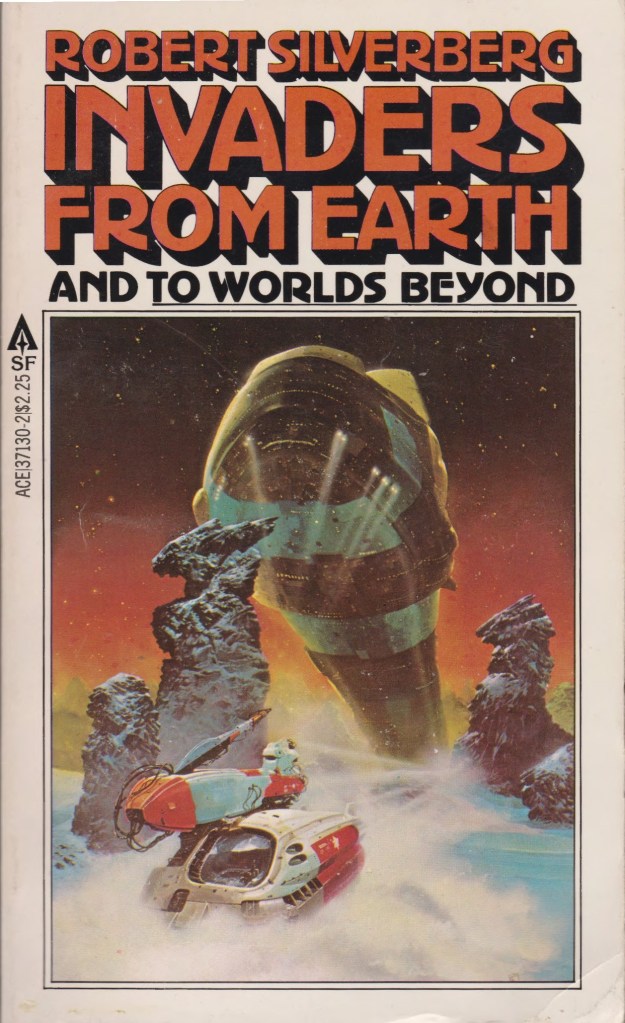
Chris Foss’ cover for the 1st edition.
From the back cover: “The Ganymedians had a rich, peace culture, peaceful culture extending back hundreds of thousands of years in human time. But the soil of their Jovian moon held uncountable riches in the form of the nuclear fuels Earth so desperately needed. It was a pattern that had been repeated many times in humanity’s bloody history; in Asia, in Africa, in the American West–but the nations of mankind were not ready to make the same mistake again. So when the Corporation decided it wanted those fissionables whether the Ganymedians wanted to give them up or not, they knew they had a job of selling of their hands, to swing the weight of public opinion behind them. And that was a job for Ted Kennedy, ad-man supreme. Kennedy’s record showed he could sell the public on just about anything. Even genocide.”
Contents: Invaders from Earth (1958) and his collection To Worlds Beyond (1965). The latter includes “The Old Man” (1957), “New Men For Mars” (1957), “Collecting Team” (1956), “Double Dare” (1956), “The Overlord’s Thumb” (1958), “Ozymandias” (1958), “Certainty” (1959), “Mind for Business” (1956), “Misfit” (1957).
Initial Thoughts: I’m always eager to track down more Silverberg short fiction. And it’s added bonus when the omnibus volume also contains an early SF novel! I feel like someone recommended Invaders as a (was it you Rich?) solid pre-Thorns (1967) example of his novelistic output. For a recent review of Silverberg’s short fiction, check out Dimension Thirteen (1969).
2. Flight of the “Hesper”, George Hay (1952)
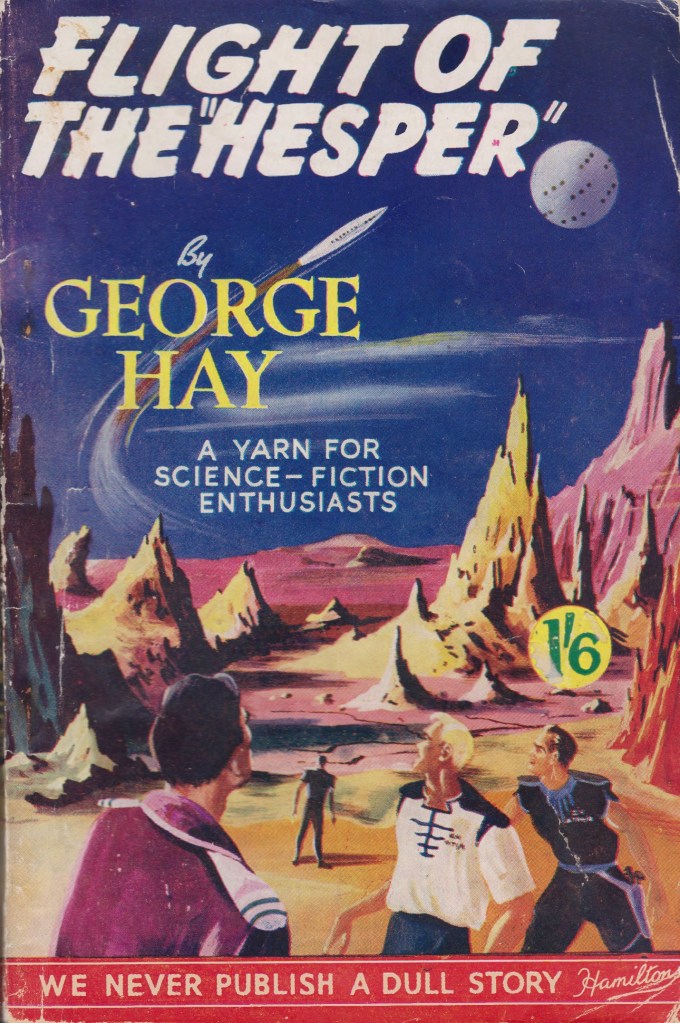
George Ratcliffe’s cover for the 1st edition
From the back cover: No blurb on book. It’s a generation ship story!
Initial Thoughts: I aim to read all the available English-language generation ship short stories and novels written before 1985! I finally got my paws on this hard-to-find volume. Hay strikes an intriguing figure. He wrote four pulp (I assume) SF novels in the 1950s, and then “From the end of the 1960s, Hay worked to establish some formal organization to promote sf in the UK, and was instrumental in the establishment of the Science Fiction Foundation in 1972 […].” For more on his contribution, check out his SF Encyclopedia entry.
3. Judgement Night, C. L. Moore (1943)
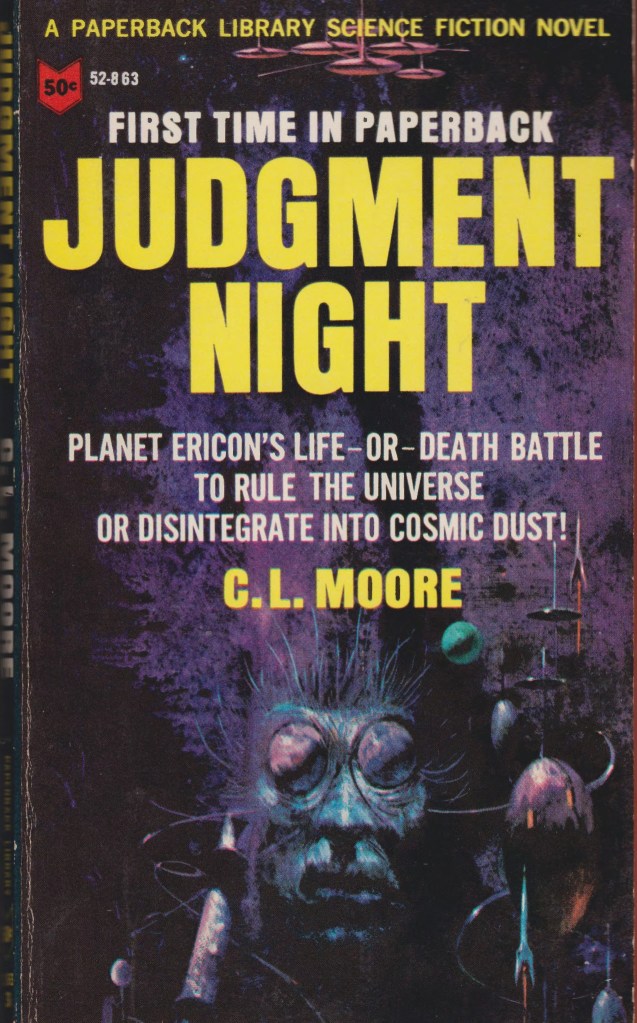
Uncredited cover for the 1965 edition
From the back cover: “WHICH OF THESE ALIENS AND HUMANS WOULD SURVIVE?
THE LENS OF DEATH was the most dreadful weapon of history. Control of this infernal machine meant man’s only chance at survival if the cosmos was hurled into fiery oblivion on JUDGEMENT NIGHT.
JUILLE
A beautiful Amazon, heiress to the ruling galaxy, risks the destruction of the universe to outwit the arrogant masculinity of the man who could be her lover–or her killer.
EGIDE
The godlike warrior from an alien, savage world torn between his love for Juille and his vow to obliterate her people from the galaxy.
JAIR
Brutal, incredibly cunning, with a sinister power no mere human could subdue.
THE ENNOY FROM DUNNAR
A mysterious being always shadowed by the weird intelligent creature called Ilar. Does he already know the decision of Judgement Night?”
Initial Thoughts: C. L. Moore’s work was on my mind as I recently reviewed her co-written collection Clash by Night and Other Stories (1980).
4. The 1979 Annual World’s Best SF, ed. Donald A. Wollheim (1979)

From the back cover: “Jack Gaughan’s cover for the 1st edition
Contents: F. M. Busby and Frank Herbert’s “Come to the Party” (1978), David J. Lake’s “Creator” (1978), Jack L. Chalker’s “Dance Band on the Titantic” (1978), C. J. Cherryh’s “Cassandra” (1978), Gregory Benford’s “In Alien Flesh” (1978), Ursula K. Le Guin’s “SQ” (1978), John Varley’s “The Persistence of Vision” (1978), James Tiptree, Jr.’s “We Who Stole the Dream” (1978), Greg Bear’s “Scattershot” (1978), Dan Henderson’s “Carruthers’ Last Stand” (1978).
Initial Thoughts: I adore anthologies. And it’s been too long since I’ve read one…. I have yet to read any anything by Jack L. Chalker, David J. Lake, or Dan Henderson.
For book reviews consult the INDEX
For cover art posts consult the INDEX
For TV and film reviews consult the INDEX
 Science Fiction and Other Suspect Ruminations
I own Judgment Night but haven’t read it.
The anthology looks quite intriguing. That strikes me as an usually eclectic mix of authors. I’ve only read the Benford and Cherryh stories in it.
After reading the solid collection of co-written stories with Kuttner, I was in the mood for more of her work. Unsure when I’ll get to it. But… I will keep a lookout for your review if you get to it before ,e!
The Moore book is on the Golden Age Masterworks series, so it might be good? The thing I found with the SF Masterworks series is that it’s lobsided in terms of quality and selection.
Not a huge fan of Silverberg’s early stuff but you can see the foundations of his later sensibilities and controversial subject matter in some of them.
The only story I read from that 1979 anthology is John Varley’s Persistence of Vision, which despite the interesting premise, still came across as unsettling considering the “love” story, a subject matter he explores in a lot of his stories. He’s a tough author to read for that and other reasons. I will delve into that anthology later, though.
The SF Masterwork series is more what they have available and get the copyright for than some direct sign of critical quality — at least that’s my take. They publish tons of good books of course.
I am not a fan of SIlverberg’s early novels but some of the 50s/early 60s short stories are great — as I hope my review of Dimension Thirteen showed — it contained “Warm Man” (1957), “Dark Companion” (1961),and “Journey’s End” (1958)
Other worthwhile 50s/early 60s short stories include: “Godling, Go Home!” (1957), “Why?” (1957), “There Was an Old Woman–‘ (1958), “To See the Invisible Man” (1963) and “The Man with Talent” (1956).
My absolute favorite early Silverberg short story so far is “The Pain Peddlers” (1963)
Thanks for the suggestions. What would you say is his best novel overall?
Tentative list from what I remember — some were read around a decade ago. I am something of a pre-1985 Silverberg completist. I’ve read and reviewed 46 short stories and twelve novels. I’ve already read but never reviewed A Time of Changes (1971), The Masks of Time (1968), Tower of Glass (1970), and the stories in Capricorn Games (1976).
Tentative top five. I am still not done reading novels from his best period — 1967-1975.
Although, on another day I might insert his rather controversial but brilliant The Second Trip (serialized: 1971) up there as well… Or maybe A Time of Changes (1971) (not reviewed)…
“The Persistence of Vision” is very good, and I reread it nearly two years ago. It has a strong background and deals with ideas of perception.
That’s what people say whenever I post something written by Varley! I’ll get to it, eventually (more soon than later, I hope). haha.
What older SF have you been reading recently Richard?
“Science Fiction Stories”, a hardcover anthology published by Octopus books in 1979 and reprinted in 1985 and edited by Tom Boardman Jr. It includes the first pieces I’ve read by Frederick Brown, Katherine Maclean, Eric Frank Russell, Frank Roberts, Cyril Kornbluth and James White. There’s also two by Brian Aldiss [including “Who can Replace a Man”, that I’ve read before], and others by H. G. Wells, John Christopher and Harry Harrison [the original “The Stainless Steel Rat” piece]. I don’t think that even the best of them were much more than fairly good, and I think it was an unambitious collection.
Yeah, I need to read more by MacLean. I should go ahead and feature her in my series of the first three published SF stories by female authors I should know more about…
I remember Jack Chalker’s “Dance Band On The Titanic” vividly, although I think I read it in a collection of his own fiction. It’s a very Twilight Zone sort of story.
He’s not an author I’ve read, yet.
I consider him firmly in the New Wave camp. He’s most famous for the Well Of Souls series, which I didn’t care much for, but his stand alone novels, particularly The Devil Will Drag You Under, are a nice mix of SF, Fantasy, and Weird.
I don’t often see him described as a New Wave author. Especially as the movement had essentially disappeared by the mid 70s when he started publishing.
Fair point. Might be more accurate to say that he took advantage of the freedoms that the New Wave movement pioneered to explore uncomfortable themes and also to blur genre distinctions in his work.
Sounds interesting!
Pity you got the Pocket edition of Moore’s JUDGMENT NIGHT from 1965, rather than this Dell edition from 1979 —
https://www.isfdb.org/cgi-bin/pl.cgi?19159
Which admittedly has a rather amateur, lurid cover —
But it contains four Moore novelettes that are otherwise very hard to find, and which, IMO, are of rather more interest than than the (quite short) novel, JUDGMENT NIGHT, which first appeared as a two-parter in ASF in 1943. Not that JUDGMENT NIGHT is without interest. But it’s a baroque far-future space opera with sword-and-sorcery and romance atmospherics that hark back to Moore’s stories for 1930s-era pulp outlets like WEIRD TALES.
Whereas the four Moore novelettes in the 1979 Dell edition are fully SF in the vein of other Moore SF first printed in Campbell’s ASF, like ‘Vintage Season’ (1946) and ‘The Children’s Hour’ (1944). If not at that level — but what is? — two of these stories seem notable to me: ‘Heir Apparent,’ which I could make a contorted argument for as the first cyberpunk story, in ASF in 1950 (!?!); and ‘The Code’ from 1945, which seems to me even more wildly out there than ‘The Children’s Hour’ and maybe almost as much of an unknown masterpiece, but which John Boston rates as somewhat of a mess.
Anyway, interesting stuff. Those novelettes are available in the Gollancz Masterowks edition from 2014-2018.
Hey, it’s called browsing the shelves at a local store in this instance — you get what you find. But in all seriousness, a lot of the short SF I read I print out from Internet Archive, or depending on its length, just read there. And all issues of Astounding can easily be found on Internet Archive. All of those stories appeared in the 1952 Gnome edition as well.
I’m not sure (albeit I am ignorant of the story) how one could make an argument for a 50s story as cyberpunk. Like all historical literary movements, there’s the necessary historical context that emerged in the 80s that gave rise to a linked group of stories that received that designator. Genre or subgenre is predicated on a common awareness of similarities BETWEEN stories rather than singular examples of things. A 50s story thus could not possibly BE “cyberpunk.” It could have surface elements that make it appear similar. Or that were coincidentally or deliberately picked up later…
My quibble aside, I am definitely more interested in the short stories you list than Judgement Knight itself.
I’m not sure (albeit I am ignorant of the story) how one could make an argument for a 50s story as cyberpunk.
It would be a contorted, somewhat strained argument, like I say. But the story’s central idea is the sort of thing that didn’t show up again in SF till some thirty-five years later and the cyberpunk era.
Glad to hear you’re using the archival possibilities of the internet. I had the impression that maybe you were being a purist about working only from dead tree texts. But what’s the point of that when some of this stuff is significant — like these Moore stories — and yet difficult to impossible to find in that form?
“But the story’s central idea is the sort of thing that didn’t show up again in SF till some thirty-five years later and the cyberpunk era.” — Exactly. That makes it not cyberpunk. The designator of a subgenre implies a group of interrelated works which are viewed as distinct. But yes, I got some proto cyberpunkish vibes from Kuttner’s “Year Day” — the physical sense of inundation from media and the almost supra-reality that it generates.
I try to link isfdb.org on every single short story I review so that others can read along. Occasionally that’s also where I read it. As for “dead tree texts,” I usually still print the stories out from isfdb.org and mark them up. I rarely check if something is in print.
Endorse all of Mark’s comments about the larger version of JUDGMENT NIGHT, and add that “Paradise Street” is probably the best Bat Durston story ever published. Qualify my own referenced comment that “The Code” is a mess–it’s a very interesting mess. And suggest that “Judgment Night” itself, which appeared during the period when ASTOUNDING was full of stories that were really about World War II, is the best and subtlest of that magazine’s WWII stories. Though I couldn’t coherently defend that proposition without rereading the story, which I have been meaning to do for 30 or 40 years.
John Boston: (I) suggest that “Judgment Night” itself … is the best and subtlest of that magazine’s WWII stories.
Huh. That never occurred to me.
Probably that argument is as much of a stretch as mine about ‘Heir Apparent.’ Still, I’ll have to look at ‘Judgment Night,’ which I do recall having a ‘feel’ that was singularly unlike any other space opera and that I just attributed to it, firstly, having been early in that sub-genre’s development before it was so codified and, secondly, Moore’s background with her Jirel of Joiry/Northwest Smith material in 1930s-era Weird Tales.
As for ‘The Code’ it is a mess, if only because Moore resorts to pseudoscience bafflegab a la Van Vogt for sections. Still, I can’t recall ever seeing that central idea ever getting treated anywhere else, unless it’s that old (1980) Ken Russell-Paddy Chayevsky film Altered States and — not really, because that doesn’t begin to rise the blazingly strange conceptual developments Moore’s story does.
I read Invaders from Earth about 2-3 years ago. It’s very much of its era. The ad man who finds his conscience is so common in science fiction from the ’50’s and 60’s that it’s probably a cliche. (I often wonder why so many characters in science fiction novels of that era are ad men, PR men or marketing guys.) A lot of science fiction of that era also had a weird take on what relations between men and women would be like in the future and this book has that too.
That said, I liked it. Silverberg talks about Ganymedians’ language, which is simple because they’ve removed anything that’s unnecessary for communication. That’s not something that’s all that common in science fiction of that era. The Ganymedians also live a life that’s a combination of Fully Automated Luxury Communism, back to the land and hippie spiritualism. I can understand why it would be so appealing to an ad man.
The prevalence of ad men/TV men, etc. is directly connected to the hyper saturation of marketing media (according to social critics of the day) that the advent and impact of television had American society in the late 40s and 50s. The 50s are often characterized as a period where a dominate vision of the perfect, consumerist, life was sold — by hook or crook. Simultaneously, post-Korean War, there was the growing fear of brainwashing in the United States. If Communists could influence Americans with brainwashing techniques, maybe the same thing is happening to Americans at home by means of big business advertising (and perhaps this is why weakness at home — think McCarthy’s speeches — is directly connected to Communist gains abroad). Thus, when you have a heroic character as an advertising man, they’re presented as the insider, the perpetuator of commercialism and mass culture. They often see that they are wrong and instruments of the machine. If you’ve touched on something that makes my historian sense ravenous, it’s this!
My media landscapes of the future series explores this in great detail. You can work through the series from the beginning here: https://sciencefictionruminations.com/2022/01/22/the-media-landscape-in-science-fiction-short-stories-lino-aldanis-good-night-sophie-1963-trans-1973/
The reviews that I touch on commercialism and advertising include (but are not limited to): Henry Kuttner’s “Year Day” (1953)
Ann Warren Griffith’s “Captive Audience” (August 1953).
Frederik Pohl’s “The Wizards of Pung’s Corners” (1958)
C. M. Kornbluth’s “The Advent on Channel Twelve” (1958) and Alice Eleanor Jones’ “The Happy Clown” (December 1955).
Fritz Leiber’s “The Girl with the Hungry Eyes” (1949) and “A Bad Day for Sales” (July 1953).
Of course, this is not only American. Here’s a great mid 60s French language (the author is Belgian) example I just covered. The narrator is an ad man, responsible for perpetuating the hypersexualized world he so detests — https://sciencefictionruminations.com/2024/05/27/short-book-reviews-clifford-d-simaks-they-walked-like-men-1962-and-jacques-sternbergs-sexualis-95-1965-trans-1967/
That is so interesting — television is so much a part of our lives that it’s hard to imagine people not being cynical about it. And TV is so different today compared to the shows of the ’50’s.
As for the brainwashing, I love The Manchurian Candidate (Frank Sinatra should have quit singing and become a full-time actor) even though the brainwashing thing seemed implausible. But then I’m old enough to remember when people claimed that video games were turning teenagers into school shooters.
I am going to need to set aside some to for “Year Day.” That sounds just up my alley.
Let me know your thoughts when you get to it!
I thought Judgement Night was great – although I keep on wanting to spell it Judgement Night. It’s probably the most space opera space opera that ever space opera’d, and was still one of the early works in the subgenre. I reviewed it on SF Mistressworks – and Moore’s daughter left a comment saying how much she appreciated my review.
‘The Persistence of Vision’ has not aged well and reads pretty skeevy these days. I’m a big fan of Varley’s works, but where he was ahead in respect of some sensibilities, he was very much of his time in others. Varley wrote some stone-cold classic sf stories, but multi-award winner ‘The Persistence of Vision’ is not one of them. Its success say more about US sf fans in 1979 than it does about sf in 1979.
And I remember your review! I don’t remember her daughter’s comment — but super nice!
As for Varley, all I can say is “yes.” I’ve read all the stories in Barbie Murders (never reviewed the collection). He feels very much like a product of the late 70s, and as a historian, I have the ability (muahaha) to place something in its context.
I did not enjoy Judgement Night. My review on Goodreads: https://www.goodreads.com/review/show/4626644021
I do not expect to enjoy it either. That said, check out my review of a collection of co-written stories with her husband Kuttner that I recently reviewed: https://sciencefictionruminations.com/2024/03/29/book-review-clash-by-night-and-other-stories-henry-kuttner-and-c-l-moore-1980/
I rank one of the stories in the collection as a top-5 tale from the 40s