Bizarre alien civilizations. Homesickness as psychiatric treatment. The dangers of space travel. Capitalism unleashed. Utopian possibilities? Welcome to the strange wonders of Clifford D. Simak.
Today I’ve gathered together three more fascinating Simak tales that chart his deeply critical views of American business ethic. As in my previous post on the theme, the Grandmaster creates a future in which colonization goes hand-in-hand with the exploitation of resources, workers, and threatens the often bizarre alien intelligences they encounter.1
Two of the three rank among my best reads of the year. And now, to the stories!
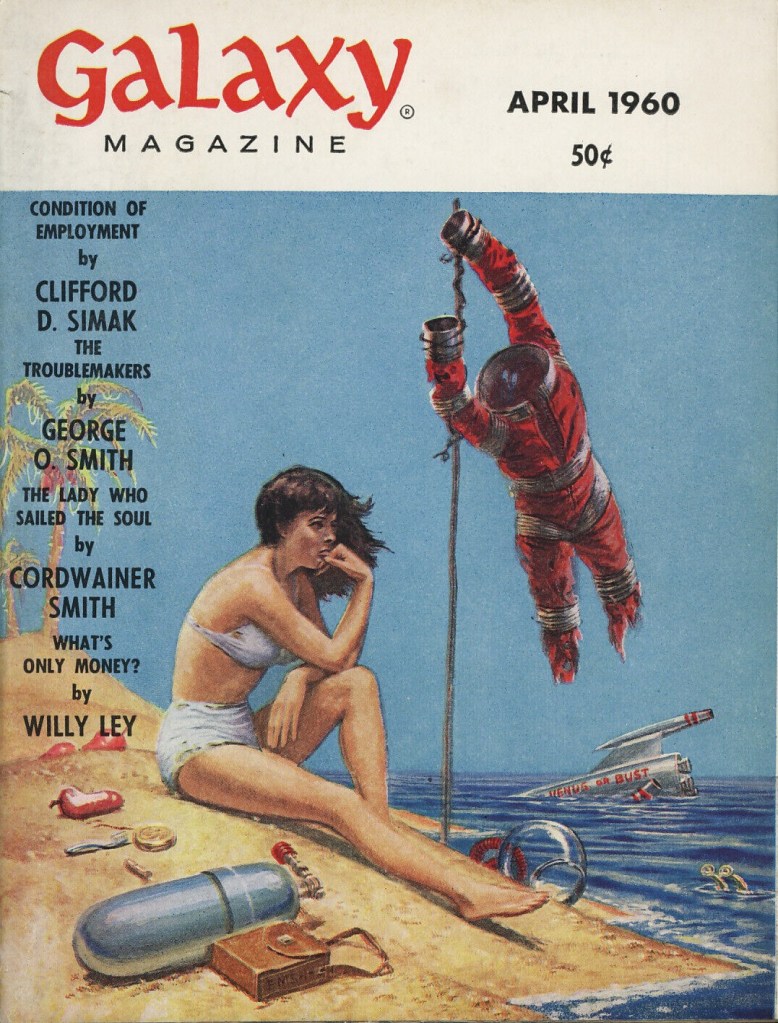
Ed Emshwiller’s cover for Galaxy Magazine (April 1960)
4.75/5 (Near Masterpiece)
“Conditions of Employment” first appeared in Galaxy, ed. H. L. Gold (April 1960). You can read it online here.
Easily the best Simak I’ve read in a long long while! “Conditions of Employment” operates on the premise that space travel places inhuman stress on the worker: intense work hours, sleep deprivation, the terror that a slight mistake would spell death, tension and psychical discomfort, and the existential “dead, black fear of space itself” (40). The average passenger or colonists receives a tranquilizer. But a spacer can’t have their senses obscured. Radical steps must be taken to convince a spacer to return to space.2
The story follows Anson Cooper, Engineer first class. He wakes up on Earth in a drab room redolent with the must “human smell” of a man “caged” too long, beset with “loneliness and a sense of not belonging” (33). He feels out of place on the verdant earth. He yearns for Mars: “he’d go back to the ranch and stay there as his father had wanted to do. He’s marry Ellen and settle down” (34). He’d give up the spacer life. There’s a problem. His record contains multiple blemishes that aren’t entirely clear, perhaps psychiatric breaks during space travel. A captain arrives with a ship bound for Mars and an emergency mandate to round up a crew as fast as possible. There’s a medical emergency on Mars. Anson’s money is running our so he joins up. He’s willing to risk everything to get back home.
Back on Mars he checks in with the doctor. Cooper confesses that the trip was one of the worst he’s ever been on. He admits that “I never could have made it” if he hadn’t “been psychoed” (42). But there’s far more to the manipulation. The loneliness and homesickness returns… this time for Earth.
“Conditions of Employment” contains a brief mention of a spacer’s guild-style union that attempts to protect workers and guarantee the quality and expertise of their union members. After the Captain gives Cooper the job and rushes him to the ship, the union agent interjects: “you can’t rush off a man like this. You have to pick up his duffle” (38). As Cooper’s record indicates multiple problem, the union agent warns the Captain that they cannot vouch for “a man with a record such as his” (39). After the story’s final reveal, it’s obvious that the union operates more as a Band-Aid on a gushing wound: normal worker unions can’t begin to protect the spacer, at least at this point in the technological development of space travel, from the conditions of employment. Capitalism is that dehumanizing.
In Simak’s formulation, exploration and space travel further his critique of technology implemented without thought for those who might be detrimentally effected. Humanity’s drive to act, exploit, and expand remains a constant in so many of his worlds. Aliens–for example, in the two other stories in the post–might provide a glimpse of alternative ways of living but for characters like Cooper, they are little more than chaff in the machine, unable to effect real change.
Highly recommended.
This neatly fits my series on “SF short stories that are critical in some capacity of space agencies, astronauts, and the culture which produced them.”
Previously: Kate Wilhelm’s “Planet Story” (1975) and Clark Ashton Smith’s “Master of the Asteroid” (1932).
Up Next: Clifford D. Simak’s “Founding Father” (1957)

Robert Gibson Jones’ cover for Fantastic Adventures (July 1951)
4/5 (Good)
“‘You’ll Never Go Home Again!'” (variant title: “Beachhead”) first appeared in Fantastic Adventures, ed. Howard Browne (July 1951). You can read it online here.
This bleak nightmare follows a seemingly routine expedition of the Human Planetary Survey Party to establish a bridgehead on an alien planet (73). Like a horrifying formulation of Taylorism, the robotic workers erect a defense against an often “extremely violent” reaction to human arrival and manage the systematic documentation of information on the alien to be “inserted in the galactic files” while their human overseers sip highballs waiting for the go ahead to descend to the surface (74).3 The leader of the expedition, Tom Decker, smugly ruminates, “there was nothing in the galaxy, so far known, that could stop a human survey part” (74). Once the robots and the human military forces establish a beachhead and the brains send back collated information to central, the Survey Party will depart: “A man doesn’t even put his foot on the ground until he has a steel ring around the ship to give him protection” (75). Others will tab the planet for “an exploitation gang” to extract its riches or “a pitiful bunch of bleating colonists” (74).
The robots march outward establishing alarm posts and deploying flamethrowers to eradicate all life in a “barren circle on the hilltop” around the ship (77). Radiation generating machines pour “pure death into the soil” that “boiled” as the “dying life forms fought momentarily and fruitless to escape” (77). As if some cybernetic boil on the planet’s skin, at night lights illuminate the barren circle as “gleaming robots toiled in shining gangs” erecting new robots and driving lumbering machines (78). Ruthless efficiency.
An unusual alien, “a match-stick man” (80), walks unafraid towards the operation. Decker places a “mentograph” on his head and the alien follows. Decker chants a mantra of uplift and colonial paternalism4 through the device: “We are friendly. We are friendly” (81). He continues: “We will not harm you […]. We will stay and be friendly. We will stay and teach you. We will give you the things we have brough for you” (81). The alien only has one thing to say: “You will never leave” (81). Decker detects cracks in his own self-assurances that this will be a mission like all his other missions. What does the alien’s phrase even mean? When they approach the alien village in an attempt to learn more, they find simple huts without sanitation or metal tools and silent inhabitants (83). Nothing happens for weeks. And then….
“‘You’ll Never Go Home Again!'” contains often verdant imagery in its descriptions of nature and an effective use of lists and clipped prose to convey the encyclopedic systemizing conducted by the survey team. This is a stark and powerful depiction of Simak’s critique that technology is used “to advance the cause of our commercial-industrial society” rather than purely the “betterment of mankind.”5 As for the scientific mystery? I often find that Simak’s cute twists doesn’t entirely work.6 This one is middle-of-the-road but doesn’t detract from the story’s power. It effectively emphasizes the importance of cultural relativism and the dangers of pre-supposed categories and values placed on the other.
Recommended.

Alex Schomburg’s cover for Science-Fiction Plus (April 1953).
3/5 (Average)
“Retrograde Evolution” first appeared in Science-Fiction Plus, ed. Hugo Gernsbeck (April 1953). You can read it online here.
M. Keith Booker, in Monsters, Mushroom Clouds, and the Cold War: American Science Fiction and the Roots of Postmodernism, 1946-1964 (2001), argues that western anxieties about “degeneration,” or backward evolution, popular in the late 19th century experienced a resurgence in the 1950s. Exacerbated by 50s fears over atomic war, and the general knowledge that “evolution was driven by mutation and that mutation could be caused by radiation,” Americans worried a reversion to the primitive could occur.7 Reversion was dangerous! The West must be more civilized, technologically advanced, and morally superior to the Soviets.8 Simak takes fears of “degeneration” and utterly turns them on their head. At first glance an alien society’s “degeneration” appears to be a disaster but in reality it’s a ingenious attempt to avoid the horrors of war and exploitation.
Rather than a focus on mutants or monsters caused by radiation, the most overt manifestation of this anxiety, “Retrograde Evolution” explores the notion of societal devolution. The gentle Kzyzz people of Zan, charted by Earth’s first interstellar explorers five hundred years in the past, grow a unique “babu” root used on Earth to cure rare nervous disorders stemming from “a sense of guilt, arising from the inability to forget past experiences” (24). Traders from the Culture (the name for the intergalactic human polity) stop at the planet, pick up the root, and collect a tidy profit. But this time there’s no root waiting for them load into their holds. Even more unusual, the Kzyzz recently abandoned their agricultural villages for hovels: “An alien equivalent of a return to nature?” (19). Sheldon must hold back his eager, impulsive, and ignorant Captain Hart while he investigates the anthropological mystery. The Culture’s encyclopedic system for notating and designating the level of civilization by gauging technology usage doesn’t seem to work when applied to the Kzyzz. There’s far more than meets the eye.
As with his best-known fix-up work City (1952), “Retrograde Evolution” reads as a product of a man “terribly disillusioned” with what the “human race was doing to itself” and an America which continues to use “war as a matter of national policy.”9 Throughout the story there’s the sense that if it weren’t for caring individuals like Sheldon, the capitalistic machine that places profit above all else would exploit its own workers and destroy native people. The Culture provides an apparatus to protect those at risk. Early in the story, Sheldon attempts to remind his boss that the crew has time to figure out the mystery and that they cannot to continue to drive the “crew in violation of Labor’s program of fair employment” (18). Culture also establishes standards of protocol for interaction with aliens (18). Sheldon despairs their accidental impact on Kzyzz society irrevocably ruined their radical attempts to avoid conflict: “It must not be allowed to fail because of the profit that traders made out of the babu root” (25). Only conscientious individuals like Sheldon stand in the way of cataclysm.
I’m not sure “Retrograde Evolution” entirely works as story. It relies entirely on the compelling anthropological mystery and contains no well-wrought descriptions, beautiful passages, or tension. It reads more like a manifesto of Simak’s central worries: 1) what will happen when humans, convinced of their own exceptionalism, confront alien cultures that manage to avoid bloodshed and violence? 2) the possibility of utopian futures sans capitalism 3) and the importance of leading a simpler existence that values and tolerates radical difference.
Recommended only if a sustained rumination on Simak’s ideas interest you.
Notes
- For a rundown of the scholarship that covers his main themes, please consult the footnotes of my recent post on two of Simak’s “apprentice” stories for John W. Campbell, Jr. in Astounding: “Masquerade” (1941) and “Tools” (1942). ↩︎
- This critical take on the health effects of space travel crops up even in his earlier work for Campbell such as “Spaceship in a Flask” (1941), which I’ll cover in a later post. ↩︎
- Wikipedia article on “scientific management.” ↩︎
- Simak even references sexual conquest as a key component of colonization: “Someday, he thought, I’ll find a pleasant planet […] and natives that are intelligent to talk with and companionable in other ways…” (80). ↩︎
- Interview in the fanzine Luna Monthly, #57 (Spring 1975), 3. I summarize and link the interview here. ↩︎
- Don’t get me started on the horrible ending to They Walked Like Men (1962). ↩︎
- Booker, 9-10. ↩︎
- Booker, 8-9: This uneasily went hand-in-hand with Cold War fears of the Soviet Other, often depicted with “negative” Orientalist stereotypes and “as foreign as possible.” Booker draws on William Pietz, who characterizes the rhetoric of the cold War as a sort of “substitute for the language of colonialism” in which many Western stereotypes of the Soviets seem to have been almost direct reinscriptions of the attitudes toward the East that Said describes in Orientalism (1978). ↩︎
- James E. Gunn’s video interview with Clifford D. Simak in 1971 at World Science Fiction Convention in Boston. I summarize and link the interview here. ↩︎
For book reviews consult the INDEX
For cover art posts consult the INDEX
For TV and film reviews consult the INDEX
 Science Fiction and Other Suspect Ruminations
Interesting stuff, I’ve read a couple of Simak’s short fiction collections but none of these sound familiar. The capitalist critique angle sounds of a piece with some of his contemporaries (Pohl, Kornbluth etc.) Not really a fan of the cutesy twist endings of the era but it’s kind of inescpable, it was just part of the genre toolbox.
I wonder if Iain Banks was familiar with Simak’s “Culture” conception…
Well, if you ever get to either of the two solid ones in this post, let me know!
I’ve never read Banks’ Culture novels so I wouldn’t know. That said, “Retrograde Evolution” is far from one of Simak’s best known works so I highly doubt it. He doesn’t exactly explain what type of government exists, etc. It’s definitely just a word for an unexplored concept.
I’m not a big Banks fan by any means and Simak’s concerns (and general style) are vastly different, seems most likely it’s just an odd coincidence
I’ve only read Bank’s The Wasp Factory. I simply discovered his SF too late. I imagine I’d have enjoyed him more than the David Brin, Charles Stross, and Robert Charles Wilson I was inhaling in my late teens and early 20s And by the point I knew about him (~2010), I had moved to the decades I primarily focus on now.
“Condition of Employment” is the second piece by him I’ve read, the other one was “The Creator”. I’m not sure why I haven’t been drawn to any of his novels. This one is obviously sceptical of the romance of space travel and that the life it would lead to will be dull. There is far more comfort and excitement in a life back on Earth. The scepticism with space travel would emerge more strongly with the “new wave” SF writers.
I think it’s more common than your giving it credit for in the 50s and early 60s. Just look at 50s examples in my subversive takes on space travel!
It’s in most of Simak’s work long before the New Wave and he was quite popular. I’d suggest its present in some of PKD’s early work — “The Infinites” (1953), “Precious Artifact” (1964); Henry Slesar’s “Mr. Loneliness” (1957), James Causey’s “Competition” (1955), Tom Godwin’s “The Nothing Equation” (1957), Harlan Ellison’s “Psycho at Mid-Point” (1956); Alfred Coppel’s “The Hunters” (1952), “The Dreamer” (1952); Walter M. Miller, Jr.’s “The Hoofer” (1955) and “Death of a Spaceman” (variant title: “Memento Homo”) (1954); Frederik Pohl’s “The Hated” (1958), I could go on. And that’s just some of what I’ve covered in the series.
As for “The Creator,” he couldn’t get it published elsewhere so he settled on a fanzine. It was considered radical and different at the time!
You’re right. I did think of more radical 1950s authors such as Alfred Bester and Robert Sheckley, as well as Philip K. Dick and Harlan Ellison, who were ambivalent towards space travel and planetary colonisation before the 1960s, but for some reason, I felt bias towards the “new wave”. There’s also Ray Bradbury, who could also be said to have been a radical author during the 1950s, but I think that his attitude towards it, hovered between romanticism and scepticism.
I don’t mean to diminish New Wave takes (which I also adore)– they certainly put their own spin on it. A handful of authors dominate our perception of 50s SF. So much of it is pessimistic, far from utopian in its future formulations, and deeply critical of 50s society in all its forms.
Yes, Ballard for a start, was very sceptical regarding space exploration as benefitting humankind’s spiritual well-being and advancement. With the possibility of space flight becoming a greater probability, SF authors in the 1950s looked towards more social and existential themes to write about.
I’ve covered one of his early 60s short stories explicitly for the series. I should add another. That said, my mind as been elsewhere — this accursed Simak article — as of late.