
Graphic created by my father
“We also encountered many gay people, feminists and progressives of every stripe. These people were at the convention because present day science fiction has much to offer them. Science fiction is the fiction of ideas, and the ideas coming from the minds of the new writers more and more concern progressive analyses of social issues.”
— Pat M. Kuras and Rob Schmieder (1980)
At the 38th World Science Fiction Convention (29th August–1st September, 1980) held in Boston, MA, organizers scheduled the first Worldcon panel with an openly LGBTQ topic: “The Closed Open Mind: Homophobia in Science Fiction Fantasy Stories” moderated by Jerry Jacks, one of the “early openly gay fans.”1 Around 200 fans attended to hear Elizabeth A. Lynn (SFF author), Samuel R. Delany (SFF author), Frank M. Robinson (SF author and activist), and Norman Spinrad (SFWA President and SF author) (“the token straight”) discuss issues of representation.
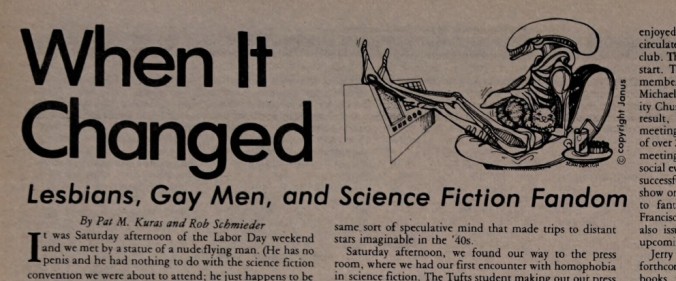
Pat M. Kuras and Rob Schmieder’s “When It Changed: Lesbians, Gay Men and Science Fiction Fandom” in the September 27th, 1980 issue of Gay Community News
Pat M. Kuras and Rob Schmieder, reporters for Boston’s Gay Community News, excitedly wrote up their experience attending the con in “When It Changed: Lesbians, Gay Men, and Science Fiction Fandom.”2 The article includes paraphrase and commentary on the historical panel, short summaries of interviews with gay and lesbian fans, mention of relevant SF on queer themes, discussions with authors–including Samuel R. Delany–on the importance of inclusion and representation, and observations on the con in general (including Robert Silverberg’s racist jokes as Toastmaster, Isaac Asimov’s overt sexual harassment of female attendees, and the cosplay). An excerpted version of the article reappeared in the Winter 1980 issue of the fanzine Janus. The Gay Community News version even included art from an earlier issue of Janus.3
After covering each panelist’s contribution to genre,4 Kuras and Schmieder summarize the various discussion points. Lynn emphasized the sheer paucity of “gay characters” and “women and people of color in sf” (8). Delany surveyed examples of cliche used to create homosexual villains. Spinrad parroted “liberal” talking points by warning “oppressed groups” that they shouldn’t “tamper with freedom of expression, as they have more to lose than the majority in any clampdown on such freedom” (8). Frank M. Robinson attacked Spinrad’s position and highlighted the history of “censorship of gay material by straight editors, and the crying need of gay people for positive images in fiction” (8). Robinson surveys his own attempt to include gay characters (in the non-genre 1974 thriller The Glass Inferno) that grows throughout the story and becomes the one of the novel’s heroes (according to Kuras and Schmieder, “courageous, poignant and quite unforgettable”) (9). Predictably, the character was cut from the 1974 Hollywood adaptation of the novel.
As we are in a terrifying moment in the United States with the history of trans pioneers in particular under threat, I found Kuras and Schmieder’s short paragraph summaries on the experiences of LGBTQ fans (Denys Howard, Jerry Jacks, Jeanne Gomoll, Eric Garber, Robin Johnson, etc.) simultaneously heart-rending and uplifting. They collectively emphasize the community that SF fandom provides, the close alliance with the feminist movement, and its connection to progressive politics. From Kuras and Schmieder’s report you can sense how collectively inspiring and important the con’s representation and events were to the attendees. One fan, Robin Johnson, shared the “problems of being gay in fandom” due to their invisibility even among the SF’s “clannish subculture of people who feel alienated from society” (9). Samuel R. Delany mentioned the lack of a “formal support network for lesbian and gay sf writers” but indicated the “underground links” that tied those in the know together (10).
The article shifts to coverage of the “Post-Holocaust Themes in Feminist SF” panel, various fanzines on feminist and queer issues, the award ceremony itself, and a gay and lesbian fan afterparty in which Marion Zimmer Bradley5 and Samuel R. Delany stopped by. I highly recommend you read the report as it is hard to summarize due to the sheer exuberance and range of coverage.
Reach out if you want to the full Gay Community News article.
List of Science Fiction Covered on Gay and Lesbian Themes with Kuras and Schmieder’s Comments
Damon Knight’s Orbit anthology series “introduced many of today’s more progressive writers and opened the door to the many original anthologies being published. Orbit and its followers were pivotal influences in sf’s move from technology-dominated fiction and space westerns to the examination of biological, anthropological, social and sexual issues” (8).

Uncredited cover for the 1974 edition of Thomas M. Disch’s 334 (1972)
Thomas M. Disch’s 334 (1972): “Disch was the first sf writer we encountered who has a long-standing record of successfully incorporating gay characters into his fiction. His novel 334 is remarkable for its images of both male and female gay couples in a more liberal, though materially bleaker, New York of the near future; and all his novels and stories have incorporated sexuality in a markedly more sophisticated way than run-of-the-mill sf” (8).

Erik Ladd’s cover for the 1980 edition of Elizabeth A. Lynn’s Watchtower (1979)
Elizabeth A. Lynn’s Chronicles of Tornor sequence: “her writing is suffused with homoerotic relationships [..] It is indicative the current acceptability of homosexuality in sf that this has not hindered her success” (8).
Frank Herbert’s Dune (1965): “Delany disputed the notion that there are no awful characters, saying that there is, in fact, a long history of homophobic characterizations, and named as one of the more salient the Baron Harkenden [sic]” (8).
Joanna Russ’ “When it Changed” (1972): “a landmark gay sf story, delas with this very cliché.” “The monosexual culture, which eagerly embraces the arrival of a member of the opposite sex” (8).
Ursula K. Le Guin’s The Left Hand of Darkness (1969): “[…] Delany described The Left Hand of Darkness as an example of the ‘doomed homosexual relationship’ plot, which ends with one of the lovers dying. ‘True artistic freedom,’ Delany said, ‘comes only with the abandonment of such cliches… Narrative conventions victimize artists” (8).
Charles Beaumont’s story “The Crooked Man” (1955): “The story (which was written in the ‘50s) concerns a society in which homosexuality is the normally-accepted lifestyle while heterosexuality is seen as a heinous perversion. The plot concerns two heterosexual lovers who sneak around to meet; by the end of the story, the two lovers have been scooped up by vice squad offivers and are on their way to be ‘cured,’ a process involving electro-shock and glandular operations. In Beaumont’s story, although the gays are considere the norm, there is nothing attractive about them. They’re monstrous and grotesque. However, the stories serves as a neat, allegorical horror story. With its switcheroo theme, it gives straights a taste of oppression and, perhaps, may set some to consider their own prejudices and ignorance.” (9)
Robert Silverberg’s The Book of Skulls (1971), “has a gay character, Ned, who is purely vicious and evil. Ned triggers the suicides of three other gay men, who all happen to have him. With this book, Silverberg is whipping gays with a double whammy—we’re shown as being either horrible, self-centered monsters or death-wishing sadsacks” (9).
Notes
- See Jerry Jack’s entry at Fancyclopedia 3. ↩︎
- Pat M. Kuras and Rob Schmieder’s “When It Changed: Lesbians, Gay Men and Science Fiction Fandom”, Gay Community News, 8 (10) (1980), pp. 8-10. While Gay Community News was based in Boston, it had national reach and frequently debated important issues within the community–from Gay rights to class struggle. See the Making Gay History podcast for a fantastic episode on the magazine. ↩︎
- You can access the Janus version here. Please email me for the full Gay Community News version. For the sake of this article, I will focus on the full report. ↩︎
- Spinrad’s presence is described as such: “His novel Bug Jack Barron, loathed by feminists, at least has the distinction of having broken ground in treating sexuality in science fiction, a genre once distinguished by its almost complete asexuality. Though his lack of understanding of lesbian and gay issues made him poorly equipped to participated in the discussion, his presence on the panel gave it the cachet of approval from the straight sf establishment.” ↩︎
- I am aware of the controversy over Marion Zimmer Bradley. In the article, the reporters include her comments on her non-sf gay novel The Catch Trap (1979) and recount her history writing under her own name in the early Daughters of Bilitis (the first lesbian civil and political rights organization in the US) publication The Ladder. ↩︎
For book reviews consult the INDEX
For cover art posts consult the INDEX
For TV and film reviews consult the INDEX
 Science Fiction and Other Suspect Ruminations
The artist for that Thomas M. Disch’s 334 (1972) Cover is the famous Mad magazine artist Al Jaffee
Hello Brian,
Thanks! Do you have a citation? I base my citations on isfdb.org and unfortunately it is not credited there: https://www.isfdb.org/cgi-bin/pl.cgi?176. I would love a citation to send to someone to change the entry.
Sorry for late reply. I am relying on my decades of MAD magazine reading and collecting and would be shocked! Lol, to be wrong …I will however try to find some info …..
No worries. Unfortunately, isfdb.org won’t change the listing without some form of proof. I’ve spotted obvious Lehr covers based on style and they wouldn’t change the listing… alas.
Makes sense….Jaffee has a very distinct style like Don Martin.
Image search NOT helpfull
https://www.bing.com/images/search?view=detailV2&insightstoken=bcid_srk747xUrR0IyQ*ccid_uTvjvFSt&form=SBIIRP&iss=SBIUPLOADGET&sbisrc=ImgPaste&idpbck=1&sbifsz=1358+x+1692+%c2%b7+35.74+kB+%c2%b7+png&sbifnm=image.png&thw=1358&thh=1692&ptime=236&dlen=48796&expw=537&exph=669&selectedindex=0&id=1642960860&ccid=uTvjvFSt&vt=2&sim=11
Yeah, I’ve looked before and found little.
nope…I’m guessing the image was cropped of signature by overlaying that diamond window trim
https://concord.fandom.com/wiki/334
On Mon, Feb 17, 2025 at 5:18 PM Science Fiction and Other Suspect
To think that in 1980 the AIDS crisis was still a few years off, as well as the cyberpunk movement. But the ’70s, which were by no means a golden age for queer folks in America, certainly saw a massive leap forward in public visibility of queerness and queer struggles. We’re not even getting into authors, illustrators, and other creatives who either stayed in the closet or were suspected of being queer but never confirmed. Also, no mention of Theodore Sturgeon, who (supposedly this comes from Delany) may have been bisexual. There was Arthur C. Clarke, who was almost certainly gay. There was Edgar Pangborn, who was probably gay. Hannes Bok was apparently gay, although it was only known among his closest friends.
One of the funny ironies of Astounding/Analog being to sex is that rarely do women appear on the covers in any capacity, but conversely, men usually featured prominently, and these men may be drawn in various states of undress. These drawn men also tended to be, let’s say rather muscular. There was even occasionally a male nude. The result was some unintentional male homoeroticism in what was the most aggressively straight SF mag on the market.
There are two long letters/memoirs by Sturgeon collected posthumously as “Argyll” as their major matter is Sturgeon’s relationship with his abusive stepfather. One of the incidents he relates is of being left in the care of his family doctor one time as a teenager when his parents had to go off somewhere. It turned out the doctor was secretly gay and living with his boyfriend who spent the weekend taking Sturgeon’s virginity. So that’s Sturgeon himself admitting to a same-sex experience.
This and similar matters (though not the one particular rumour about his sex-life) are in a long essay I wrote about Sturgeon, something like a compact biography covering all periods of his life, all his fiction and how the markets in magazines and elsewhere supported him and shaped his career:
https://efanzines.com/SFC/SteamEngineTime/SET13.pdf
Hello Matthew,
Thank you for the link. I look forward to reading your essay on Sturgeon. I really need to get around to “The World Well Lost” (1953).
In the discussion with Delany, the two reporters mention that “Dropping names of sf writers of varying degrees of closetedness would be pointless; but we began to realize that the gay presence in sf is much greater than we had thought, and this leaves room for the hope that gay themes will continue to emerge in the writing of both the established and newer writers.” It almost sounds like Delany told them some other information about well known names! Of course, this is speculation… I am regularly frustrated by these older reports that Sturgeon’s “The Worlds Well Lost” isn’t mentioned as an iconic and historically important early work on the theme. Another article on a similar theme that I covered early in this series misdated the Sturgeon work a decade later!
In terms of who knew what about whose sexuality and how express they’re prepared to be, there’s a long interview with Disch from 1981 in “Body Politic”, Canada’s major gay journal, which sort of talks around Disch’s homosexuality. There are one or two brief mentions of his sensibility, but then again if someone gave a long interview in a gay magazine at this time one could assume that this was always a nod to the wise, unless they felt the need to stress their heterosexual credentials. Admittedly if you ever met Disch, as soon as he opened his mouth there was The Authentic Sound Of The American Homosexual (I’m under no illusions as to my straight-passing abilities as I sound like Kenneth Williams being nostril-raped by a wasp).
https://archive.org/details/bodypolitic79toro/page/28/mode/2up?view=theater
Turning over Internet Archive every so often I remembered a very positive gay-oriented review of Disch in the “Bay Area Reporter” and when I found it again discovered it was actually by Jerry Jacks, as mentioned in the original con-report!
https://archive.org/details/BAR_19810910/page/n27/mode/2up?q=%22thomas+m.+disch%22++&view=theater
I thought I’d have a look in fanac as Jacks stresses his fan credentials in BAR and found a letter recounting some of his experiences coming out in fandom
https://fanac.org/fanzines/Outworlds/Outworlds25.pdf
(internal pagination 967)
Thank you for all the links Matthew.
Fascinating stuff, would definitely like to read the original article if you wouldnt mind emailing it. Thx!
Absolutely. I’ll send it your way.
Pingback: Pixel Scroll 2/24/25 It’s Only A Pixel Moon | File 770