
MacGowan’s illustrations for Neil Shapiro’s “Starman of Faraway Station” in Vertex (July 1975)
Rodger B. MacGowan (1948-2025), best known for his wargame art and design, passed away yesterday.1 Most of the memorial posts I’ve seen on social media focus on his later career paths in the board-gaming world. Thus, I thought it would be worthwhile to narrow in on his contribution to science fiction art. After graduating UCLA, where he studied art, motion pictures, and graphic design, MacGowan found work at an advertising agency and an opportunity to create art for one of their accounts, the short-lived Vertex science fiction magazine.2
Mike Ashley describes Vertex as conceived as “a top-quality slight sf magazine, like nothing else around.”3 Unfortunately, the magazine’s editor Donald J. Pfeil was given little time to plan the first issues and the general impact was “disappointing” with a heavy reliance on reprints, although more and more original works filled later issues. As a wannabe slick, Vertex included tons of photographs, book reviews, news items, book covers, and large cover art spreads. I tend to think Vertex as the the unpolished, draft, and rushed original conceptual grandfather of what would become Omni. Ashley praises the interviews (Harlan Ellison, Norman Spinrad, et al.) and essays (Joanna Russ’ “The Image of Women in SF” for example) but dismisses the general quality of the stories.4 MacGowan contributed one cover and illustrated seventeen stories from 1974-1975. Vertex only lasted sixteen issues from 1973-1975. Afterwards (or simultaneously), MacGowan’s focus shifted to the war gaming publishing world. You can purchase a book on his art through GMT games. I am unsure if it includes examples of his earliest SF-related work.
I was briefly in touch with MacGowan at one point after he saw one of my tweets about his SF art. I wish I had followed up with him with some questions about his work for Vertex. I find it (often) striking stuff!5 My favorite are his illustrations Neil Shapiro’s “Starman of Faraway Station” in Vertex (July 1975) (above and last image below). I find it a more approachable take on what appeared in New Worlds in the late 60s.
I’d love to hear your thoughts. I plan on further installments on Vertex an its artists.

MacGowan’s cover for Vertex: The Magazine of Science Fiction (April 1974)
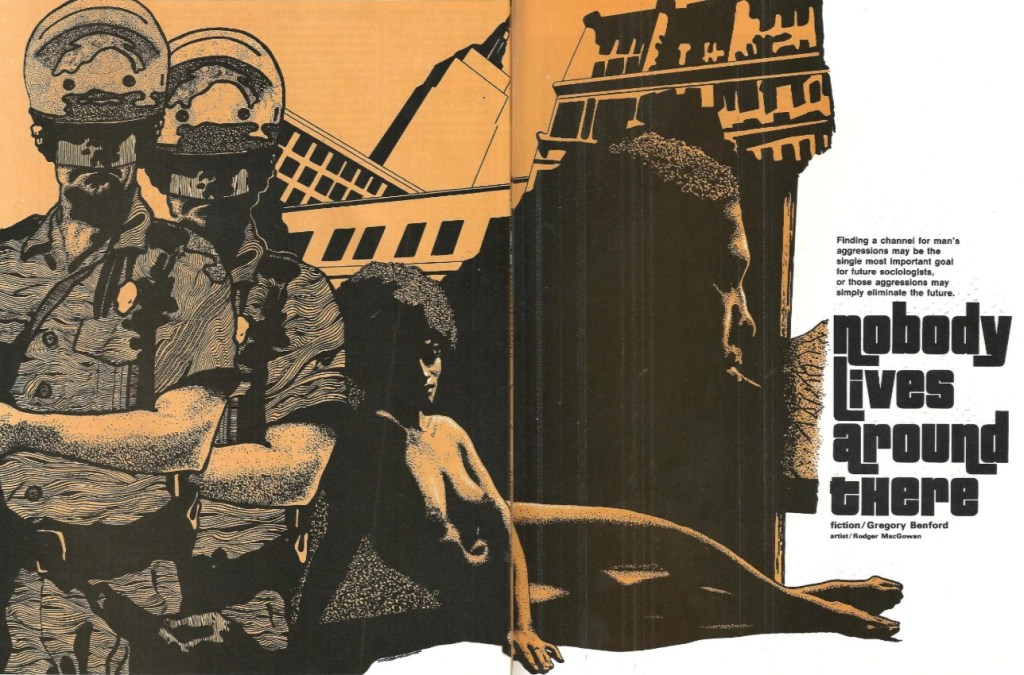
MacGowan’s interior art for Gregory Benford’s “Nobody Lives Around There” in Vertex: The Magazine of Science Fiction (February 1974)

MacGowan’s interior art for Alice Laurence and William Carlson’s “Guilty as Charged” in Vertex: The Magazine of Science Fiction (February 1974)
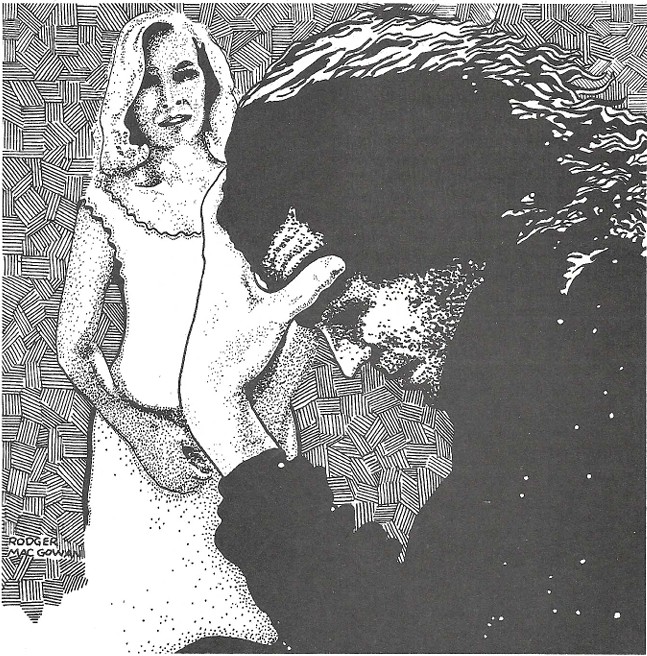
MacGowan’s interior art for Alice Laurence and William Carlson’s “Guilty as Charged” in Vertex: The Magazine of Science Fiction (February 1974)
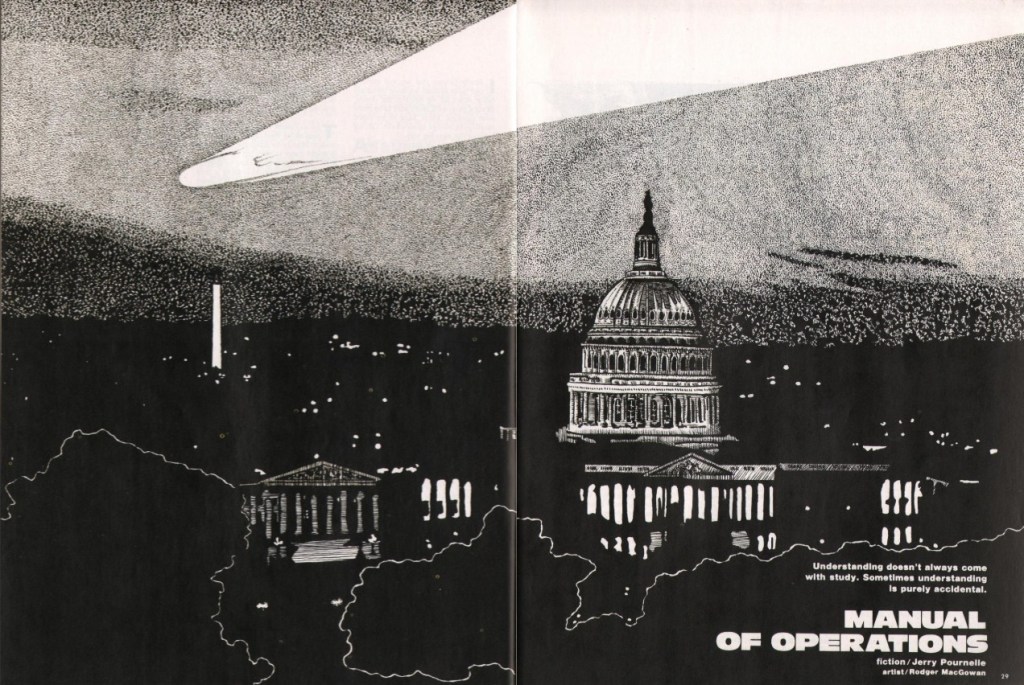
MacGowan’s interior art for part two of Jerry Pournelle’s “Manual of Operations” in Vertex: The Magazine of Science Fiction (April 1974)
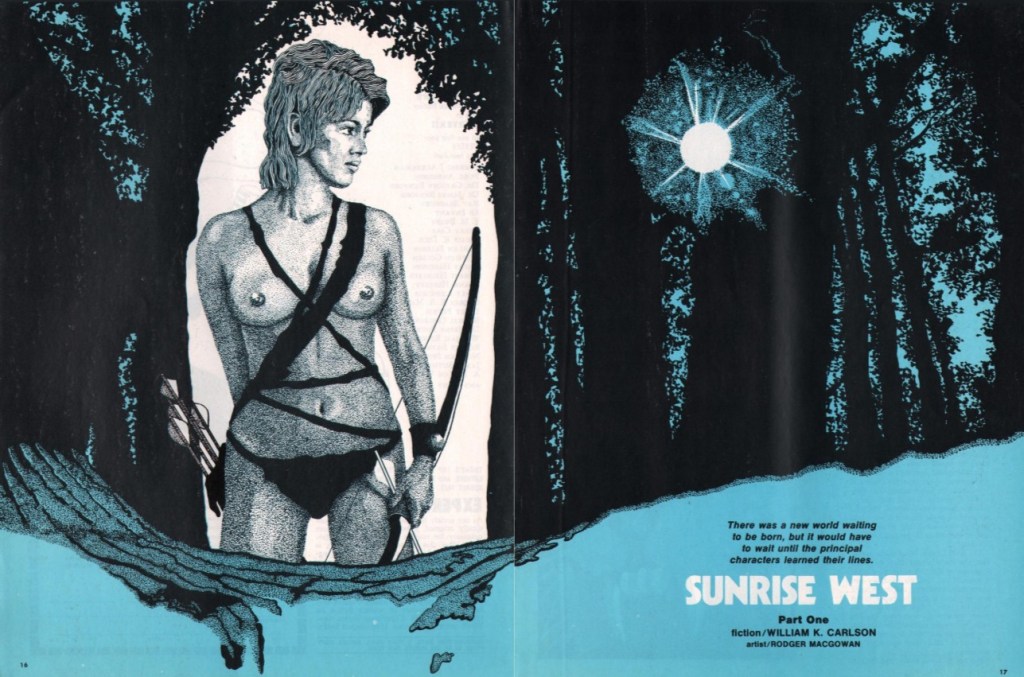
MacGowan’s interior art for part one of William K. Carlson’s “Sunrise West” in Vertex: The Magazine of Science Fiction (October 1974)

MacGowan’s interior art for John Varley’s “Scoreboard” in Vertex: The Magazine of Science Fiction (August 1974)

MacGowan’s interior art for part one of William K. Carlson’s “Sunrise West” in Vertex: The Magazine of Science Fiction (October 1974)
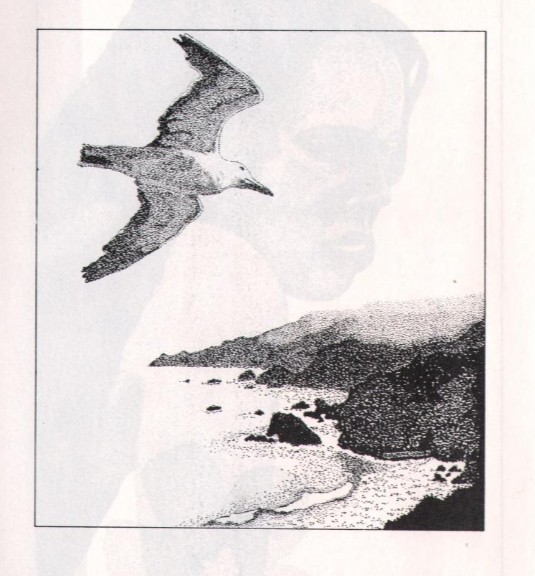
MacGowan’s interior art for part one of William K. Carlson’s “Sunrise West” in Vertex: The Magazine of Science Fiction (October 1974)
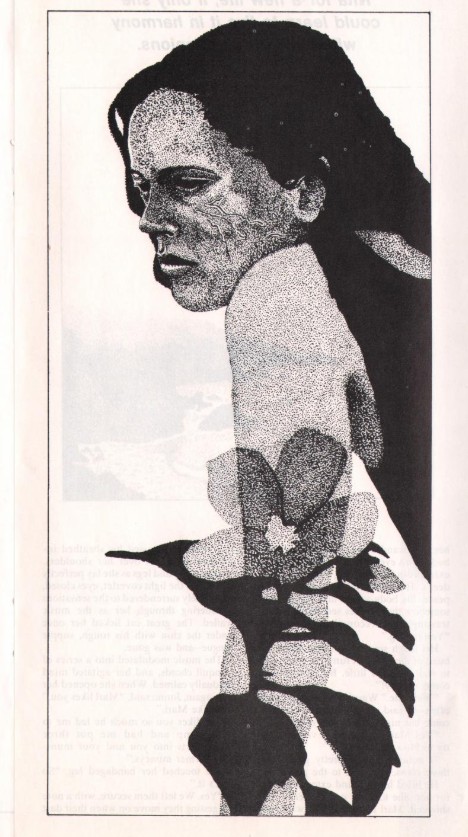
MacGowan’s interior art for part one of William K. Carlson’s “Sunrise West” in Vertex: The Magazine of Science Fiction (October 1974)
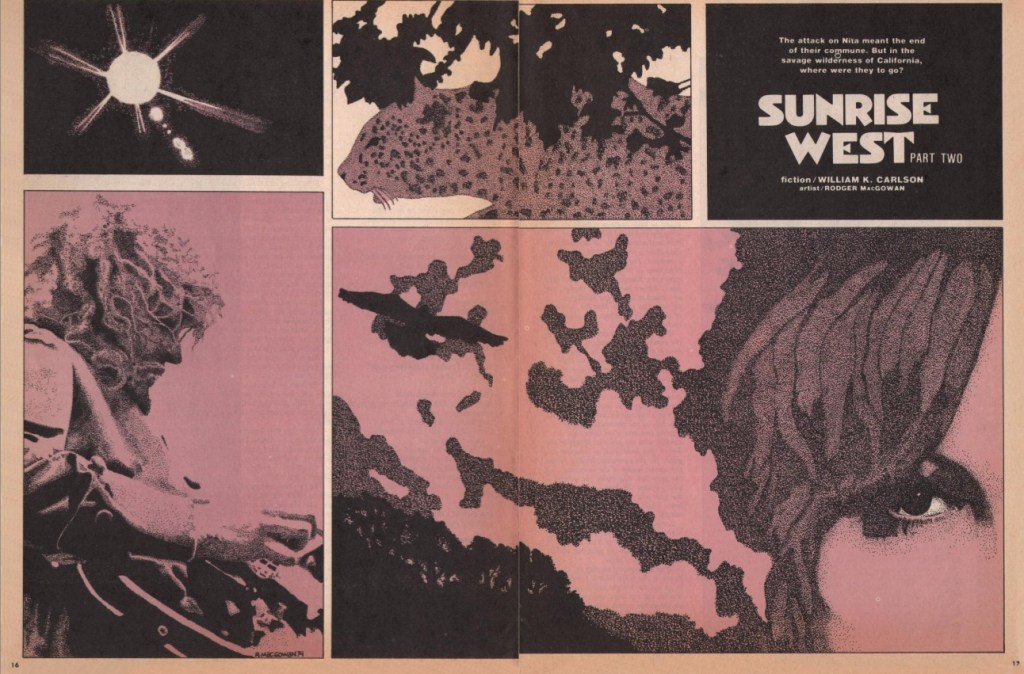
MacGowan’s interior art for part two of William K. Carlson’s “Sunrise West” in Vertex: The Magazine of Science Fiction (December 1974)

MacGowan’s interior art for part two of William K. Carlson’s “Sunrise West” in Vertex: The Magazine of Science Fiction (December 1974)

MacGowan’s interior art for part two of William K. Carlson’s “Sunrise West” in Vertex: The Magazine of Science Fiction (December 1974)

MacGowan’s interior art for part two of William K. Carlson’s “Sunrise West” in Vertex: The Magazine of Science Fiction (December 1974)

MacGowan’s illustrations for Neil Shapiro’s “Starman of Faraway Station” in Vertex (July 1975)
Notes
- See this post. ↩︎
- See MacGowan’s Wikipedia account for the broad strokes of his career and notable contributions. For a list of his SF-related art, see isfdb.org. ↩︎
- Mike Ashley’s Gateways to Forever: The Story of the Science-Fiction Magazines from 1970 to 1980 (2007) describes the failure that was Vertex on pages 103-108. ↩︎
- Ashley, 105. ↩︎
- That said, I do find some of Vertex‘s other artists a bit more to my liking — Alicia Austin, Stevan Arnold, and Monte Rogers come to mind. Perhaps I’ll feature them in the future. ↩︎
For book reviews consult the INDEX
For cover art posts consult the INDEX
For TV and film reviews consult the INDEX
 Science Fiction and Other Suspect Ruminations
Thank you for these. I hadn’t known of his SF work, and it’s always good to be aware of upcoming SF mags! He really was a talent.
No problem. Yeah, Vertex is a fascinating, if failed, experiment. Its art/non-fiction program was quite audacious.
Pingback: Pixel Scroll 2/23/25 Where Did The First Pixels Come From | File 770
Many thanks for this feature. I love SFF illustration, especially from the sixties and seventies.
Glad you enjoyed the post. Did you have a favorite illustration from the bunch?
Not really. I just like feasting my eyes. I think SFF illustration at its best is an art form in itself, comparable to the Surrealists, etc.
Vertex has some fascinating art. I plan on featuring a few more artists from its short run.
Looking forward to it!
Beautiful illustrations! Thank you for digging up them and their story! :O
No problem. Do you have a favorite?
Can’t recall if I’ve come across MacGowan’s work before but always a pleasure to see a master of the lost art of zip-a-tone ar work! Especially that Vertex magazine cover.
I think the only way is if you’ve picked up an issue of Vertex. He illustrated no other SF works according to his bibliography — he moved into the wargaming publishing/art/design niche after his work with Vertex.