
Alan Gutierrez’s cover for the 1985 edition
4.5/5 (Very Good)
Octavia E. Butler’s Clay’s Ark (1984) is the final published volume of her Patternist sequence (1976-1984).1 It is the third novel according to the internal chronology of the series. Clay’s Ark is, without doubt, the most horrifyingly bleak science fiction novel I have ever read.2 It’s stark. It’s sinister. It’s at turns deeply affective before descending into extreme violence and displaced morality. The moral conundrum that underpins the central problem, the spread of an extraterrestrial disease, unfurls with an unnerving alien logic. Butler’s characters are trapped by the demands of the alien microbes, scarred by the pervasive sense that their humanity is slipping away, and consumed by the fear of starting an epidemic. A true confrontation of the moment cannot lead to anything other than suicide or the first steps towards an apocalyptic transformation.
Note: This novel is not for readers seeking happy adventure or diverting escapism. It is an absolute bludgeon of the novel with a litany of unsettling themes, power dynamics, and disturbing scenes (rape, incest, a beheading, etc.). I apologize for the short review. Despite my appreciation of Clay’s Ark in particular, I struggle to write about Butler’s work.3
As always, there are spoilers below.
The Geography of the Wreckage
California, 2021 A.D. Across an almost “primordial” desert a few scattered “communities were dead or dying” (18). A few foolish, and well-armed, souls brave the distances between urban “enclaves” in armored vehicles. In the cities, the enclaves are “islands” surrounded by “vast, crowded, vulnerable residential areas through which ran sewers of utter lawlessness” (32).
Blake Jason Maslin, a doctor of internal medicine, travels across the expanse with his twin sixteen-year-old daughters (Keira and Rane), both “naive, and sheltered” (32), on a final trip to see a relative. Keira suffers from an untreatable leukemia. She confides that she sees “herself fading away” (6). On the way they’re abducted by Eli, Meda, and their strange, unusually thin, ill-looking, followers. They take Blake and his daughters to an isolated homestead with gardens, solar panels, and strange children that seem to run on all four limbs. “Everybody here looks like me, sooner or later” Meda confesses (23). Under duress, Blake is paired off with Meda, who scratches his face. Rane with Eli. And Keira with Stephen Kaneshiro. The ritualized infection commences.
A few years earlier, an injured Eli, possessed by an extra-human will to survive, happened across the homestead and its original inhabitants, followers of an “angry God” (56). Despite comments about his race, they took him in and cared for him. We soon learn Eli, a geologist, was the sole survivor of a sabotaged spaceship, the titular Clay’s Ark. On their voyage, the crew encountered an alien pathogen that develops a parasitical relationship with those that survive the infection. In return for heightened senses, the infected must infect and impregnate others or bear offspring of the infected. After impregnating the three surviving women of the homestead, Eli plans his first abduction (101). He promises, as if to convince himself that he’s still a human with a moral code, to only spread the disease as much as necessary to satiate the new biological urge. He’ll gather his new “family” at the homestead. They’ll develop a strategy to convince the infected to stay. If someone escapes, the world will be transformed. But everyone knows that isolation will only last so long. Someone will escape.
Both the narrative of Blake and his family and Eli’s simultaneously map the new nature of the wreckage and presage the future apocalyptic transformation that looms.
New Families in the Wasteland
As academic study of Butler’s science fiction abounds, I will only briefly discuss an element that I personally found fascinating–in this instance the unnerving new sense of family and connection Eli and his followers create.4 Butler explains that the works in the Patternist sequence sought to write a good story about a “strange community of people.”5 Butler’s careful world building creates a pervasive sense of social and moral disconnect. The wealthy and privileged, like Blake and his children, rarely travel outside of their urban oasis. The world outside can barely be described as human: “what the rat packs did to each other and to unprotected city-dwellers was not something [Blake] wanted to expose his daughters to” (137). Thus, inside the oases they attempt to “recreate the safe world of […] sixty years past for [their] children” (32). Blake’s trip is an attempt to reaffirm the ties that bind: Keira’s illness, and the fear of imminent death, made her want to visit her grandparents “one last time” (4).
Eli’s arrival in the past at the homestead and his abduction of Blake and his children reveal the strange new family in the wasteland. These are connections formed by “guilt and grief” (87). These are connections compelled through violence and an alien biology. While the children of the infected appear inhuman, they are still children. These are connections welded by the desire to make some semblance of normality in the abnormality of it all. Even Gabriel Boyd, the patriarch of the religious community that took Eli in, must push away the knowledge that Eli caused the devastation, and begs him to take care of Meda, his daughter (85). Rane must confront her desire for Eli. Keira must confront her feelings for Stephen: “You’ve sacrificed my family to spare yours” (93), yet when he puts her arm around her, “she was surprised that the gesture did not offend her” (91). Both girls are underage. How much is the alien microbe responsible for their actions? Blake must juggle his parental responsibility to protect his children with the need to alert the world to the illness. And Keira, in the final calculus of it all, attempts to forge a connection. The effective rendering of the moral landscape, and its networks of power, of the new age is the novel’s most unsettling, and brilliant, element.
Final Thoughts
As with Mind of My Mind (1977), I found Butler’s brutal view of power–and its interplay with relationships, gender, and race–a heady mixture. Perhaps due to the vividly realized dystopian backdrop of the community surrounded by the dry desert air and looming hyper-violent doom, I struggled less with Butler’s deliberately stark, clipped, and direct prose than in the past. I even found a metaphor tucked in here and there that accentuated the horror of it all. Simultaneously, Butler’s use of the two parallel narratives creates a simple but effective way to reveal backstory and the horrifying dichotomy of Eli’s position as bringer of the plague and community builder.
Clay’s Ark (1984) supplants Mind of My Mind (1977) as my favorite in the Patternist sequence. I am including both Wild Seed (1980) and Patternmaster (1976) despite abandoning both (I’ll try one of them again next year). I even think Clay’s Ark challenges Kindred (1979), which I never managed to review, as my favorite Butler novel so far.6
If my earlier caveat did not scare you off, go find a copy.
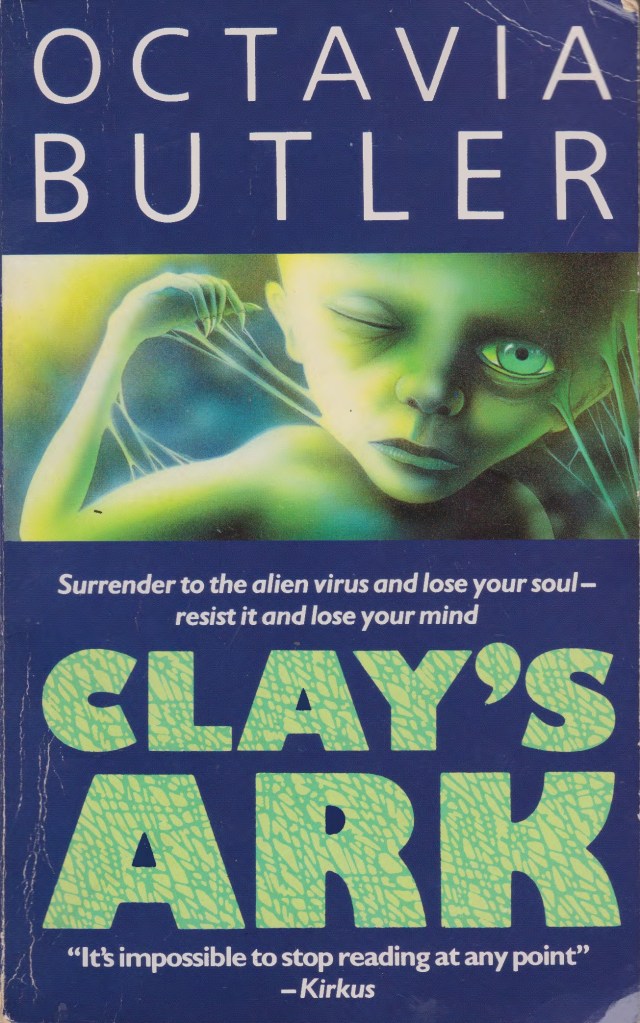
Danny Flynn’s cover for the 1991 edition
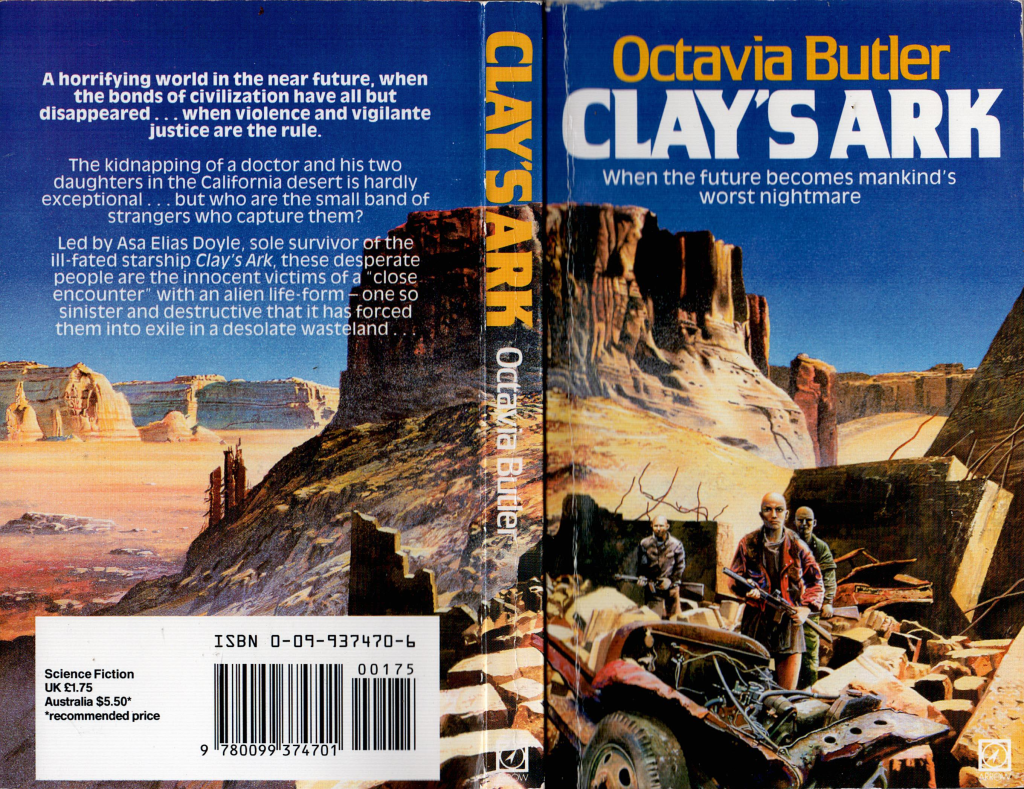
Geoff Taylor’s cover for the 1985 edition
Notes
- A short story “A Necessary Being” was posthumously published in 2014. It takes place after Clay’s Ark (1984) but before her disowned Survivor (1978). I highly recommend Gerry Canavan’s monograph Octavia E. Butler (2016). As I’ve mentioned on the site before, Canavan explores Butler’s frequent rewrites, reconceptualization(s) of earlier material, and abandoned projects via her surviving papers. ↩︎
- P. C. Jersilds’ After the Flood (1982, trans. 1986) and The Genocides, Thomas M. Disch (1965) might give Butler a run for her money. That said, I found both Disch and Jersild’s novels more grotesques in a Boschian sort of way than an relentlessly bleak moral conundrum. Russ’ We Who Are About To… (1976) also came to mind — but I found humor in her way of telling, not so much with Butler. ↩︎
- Probably due to the spectacular range of scholarship written about her work. ↩︎
- A brief search reveals a lot of academic scholarship on the nature of “family” in the novel. I have not read it before writing the review for fear of being dissuaded from writing anything. ↩︎
- Referenced nabbed from Wikipedia. The article on the sequence cites “An interview with Octavia E. Butler” from 1997 in Callaloo, 20 (1), 47–66. ↩︎
- I’ve also read and wrote a short review for Dawn (1987). ↩︎
For book reviews consult the INDEX
For cover art posts consult the INDEX
For TV and film reviews consult the INDEX
 Science Fiction and Other Suspect Ruminations
Could this be read as a standalone?
Yes! All the books in the sequence are standalone narratives. Note that the last book according to internal chronology was the first book that she ever managed to get published — Patternmaster in 1976. The books fit into a loose chronological framework but each illustrate a different community or historical moment. There can be connection — for example, Wild Seed (1980) tells the origin story of Doro, who appears in Mind of My Mind (1977).
Have you covered any of her work on your site? I can’t remember.
Just a short story collection, that didn´t fully convince me to check out one of her novels. But your review here did, I´ll try this.
Ah, I’d also check out Kindred (1979). I am focusing on her earlier pre-1985 work on my site. I know people adore her later novels like Parable of the Sower (1993). Despite the 1987 publication date, I did review Dawn, the first book in the Xenogenesis sequence. Some people describe that sequence as her best work.
Yes I´ve read high praise of Dawn too, but somehow I think it´s not for me, I have the feeling it´s too obviously political.
I love overtly political. That said, it’s not the dominant vibe I took from Dawn. Regardless, I preferred the earthly, dystopian, setting of Clay’s Ark — it meshed more effectively with her often clipped, direct, prose. There’s a similar dominating moral conundrum in both works.
I might be wrong, it has been years since I read reviews of Dawn. I´ll check ´m out again after I´ve read Clay´s Ark.
There are obviously many lenses through which to analyze her work. Maybe I’ll re-look at Gerry Canavan’s amazing volume Octavia E. Butler (2016), published in the U. Illinois Masters of Science Fiction series. I also acquired Morris’ Positive Obsession: The Life and Times of Octavia E. Butler (2025) a few weeks ago.
That´s a deep dive…
And that’s just a fraction of the Butler scholarship. She’s definitely, and rightly, the subject of a lot of analysis. As you know, I read more history than science fiction — and this year I might have read more history of science fiction than science fiction. I love a deep dive. I wish I had more time to write my own. For example, like my article last year that you might have seen: “We Must Start Over Again and Find Some Other Way of Life”: The Role of Organized Labor in the 1940s and ’50s Science Fiction of Clifford D. Simak.
Cool, somehow I hadn´t seen that…
I hope it makes you look at Simak a bit differently!
Yeah, Clay’s Ark is so bleak! Butler was so good at exploring family and romantic relationships with extreme power differentials and emotionally, sometimes instinctually-driven behavior. I read a lot of old-fashioned sci-fi when I was a teen, and Butler was a revelation in her accurate diagnosis of human behavior.
Patternmaster was difficult to get through. I’ve been reading some early novels by sf/f authors, and many of them have this same oddly compressed quality that makes them hard to read, like they haven’t quite learned to fill out their prose at novel-length yet. Le Guin’s Rocannon’s World really has it, and if even she started out that way, I guess everyone else has an excuse.
I just read Butler’s Fledgling this week. It’s another of her stories about forming a family, and using power ethically, but the extreme squick factor derailed it for me.(Shori is 53 years old, but she looks 9, and she has been injured so badly that she doesn’t remember her former life.)
Kindred and Dawn have themes that echo dynamics in life, but Fledgling didn’t map onto much of anything for me, it just feels like an exploration of the vampire trope, Butler-style. Nothing wrong with that, except it’s so squicky. (Though there is some overt commentary on racism.)
So I’m down to one last novel I haven’t read, Parable of the Talents — I’m looking forward to it (and kind of glad it’s the last one rather than Fledgling!)
Hello Hestia,
Yeah, I was not entirely satisfied with the first 30 pages of Patternmaster and Wild Seed, I put both back in the unread books pile. But then again, I tried to read Clay’s Ark twice as well. I’ll try one of them next year.
Did you track down the posthumous collection Unexpected Stories (2014) of unpublished stories? One of them is from the Patternist sequence. The other was scheduled to appear in Last Dangerous Visions — she sold it to Ellison in 1970.
I have the ebook, but I haven’t read it yet. I didn’t realize she had sold a story to The Last Dangerous Visions — it doesn’t look like it was picked up for The Last Dangerous Visions anthology they published last year.
I always wondered what happened that Ellison didn’t complete the that anthology originally. For some reason, he bought a lot of stories, then flaked on it.
I think it was the first story she sold. I’ll have to look back at Gerry Canavan’s wonderful 2016 book on Butler.
Yeah, when I saw that the anthology was uninterested in representing the diversity of Ellison’s original vision, I did not pay any attention to its release. Did not include the Native American (Kiowa) voice either — Russell Bates. I’ve reviewed all of Bates’ genre magazine stories on my site.
To the best of my knowledge the Bates story, unlike other authors in the anthology, has not seen the light of day. Alas.
I really must revisit this work. I attempted Patternmaster years ago (when I was fairly new to the reviewing game and my critical acumen was not especially well developed), and while I admired much of it, the cruel edge to the violence put me off. I’m interested what older me will now think, and if I can cut through my visceral reaction to a deeper understanding.
I’m pretty sure this is the bleakest of the sequence! I have not read all of Patternmaster. I got through 30 pages and found I wasn’t in the mood. I picked up Clay’s Ark twice before I finally read it on the third go. I’m glad I did.
When I read all of Butler’s then available work in the early ’90s Clay’s Ark was my favorite.
I reread Patternmaster recently and found it somewhat disappointing.
Did you write a review of Patternmaster?
I also tried to read it last year. I gave up. I was not sucked in after the first 30 pages and I also found it not up to the quality of her later work. I will eventually read it. Maybe next year.
Oh man, this sounds pretty good. I need to try one of her novels sooner rather than later. Thanks for this review !
Thanks for stopping by! Let me know if you snag a copy and thoughts after a read.
I’ve been meaning to read the Patternist series, how does Clay’s Ark compare to the other books in terms of tone? 🤔
As I mentioned, I’ve only read parts of Wild Seed (did not finish) and I finished (and reviewed) Mind of My Mind (1977). Mind of My Mind is similar in tone to Clay’s Ark. They are unrelenting novels. All of her work strikes me as brutal, real, horrifying. Her thought experiments place people in desperate and forced control over others. Her characters try to make due in the most systematically unjust systems. Dark stuff.
Pingback: CLAY’S ARK – Octavia E. Butler (1984) | Weighing a pig doesn't fatten it.