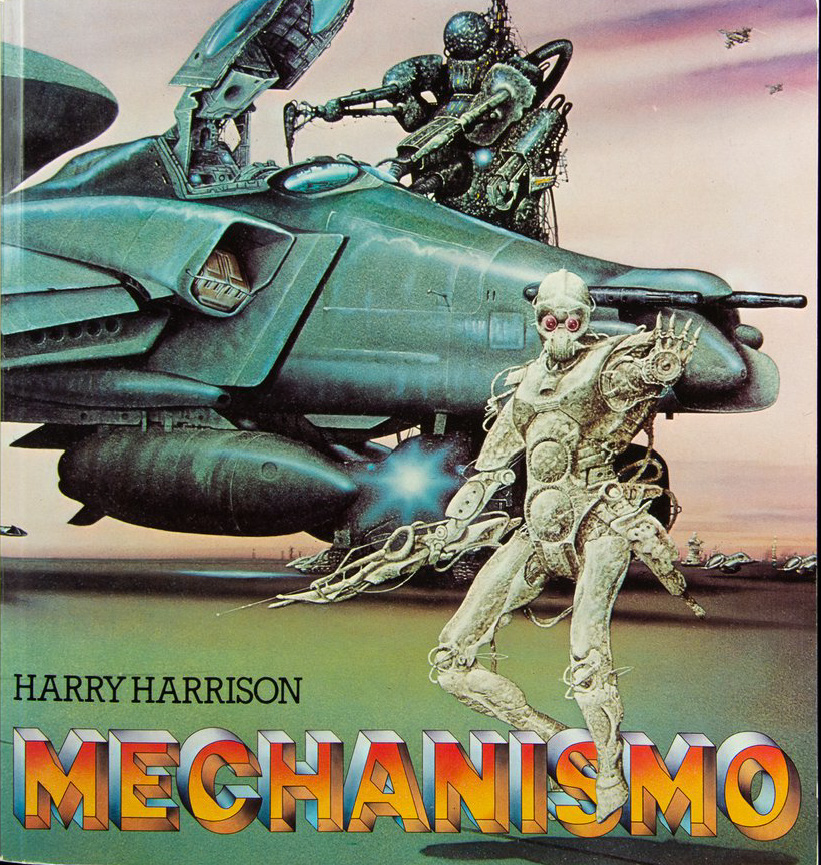
Jim Burns’ cover for the 1st edition of Mechanismo (1978)
I would like to welcome Adam Rowe again to Science Fiction and Other Suspect Ruminations. Back in 2023, I interviewed him about his lovely book Worlds Beyond Time: Sci-Fi Art of the 1970s (2023)–on 70s science fiction cover art with a foreword by SF artist Vincent Di Fate. You can buy Worlds Beyond Time on Amazon and Barnes and Noble. You can follow Adam’s art account on Bluesky and Tumblr. I also recommend subscribing to his free 70s SF art newsletter.
Adam Rowe is a writer who has been collecting retro science fiction art online since 2013. He covers technology at Tech.co and has been a Forbes contributor on publishing and the business of storytelling. He has also written for iO9, Popular Mechanics, Reactormag.com (previously Tor.com), and the Barnes & Noble Sci-Fi & Fantasy Blog. Worlds Beyond Time: Sci-Fi Art of the 1970s (2023) is his first book.

Graphic created by my father
Your Guide to the Best Retro Science Fiction Art Collections
Adam Rowe
I’ve read a lot of art books covering science fiction in the 20th century. This likely isn’t a big surprise, given that I sunk more than a few years into compiling my own retrospective art collection, Worlds Beyond Time: Sci-Fi Art of the 1970s.
These types of collections come in two basic categories. First, collections that are dedicated to exploring every facet of one single artist and, second, collections that encompass dozens of artists, intentionally (or inadvertently) capturing a slice of a specific era.
The former collections are often beautiful – I’d recommend just about every book focused on Chris Foss, John Harris, or Jeffrey Catherine Jones for the art alone. But single-serving art collections aren’t designed to deliver something that I tend to crave: The context that exists around any given artist. Some of them do have this. One great example is Jane Frank’s incisive 2001 book The Art of Richard Powers, which explores the artist’s deep influence on 1950s and ‘60s surrealist paperback covers while delivering a flaws-and-all portrait of the artist’s colorful personality. I’d also recommend Stephen D. Korshak’s Frank R. Paul: Father of Science Fiction Art (2010), Luis Ortiz’s Outermost: The Art + Life of Jack Gaughan (2010), and Frank Kelly Freas: The Art of Science Fiction, the latter of which was written in 1977 by the endearingly self-deprecating Freas himself.
But in my experience, the best entry points for the average sci-fi enthusiast are collections that package up a big selection of artists. You’ll get a new curious vision on every page, and by the time you close the cover, you have all you need to piece together a mosaic-like celebration of the style.
Here’s my take on the best and most influential science fiction art collections from the 70s, 80s, and beyond. I hope it can serve as a meta version of what all these books themselves do, and provide the context you need to identify this snapshot of art history.
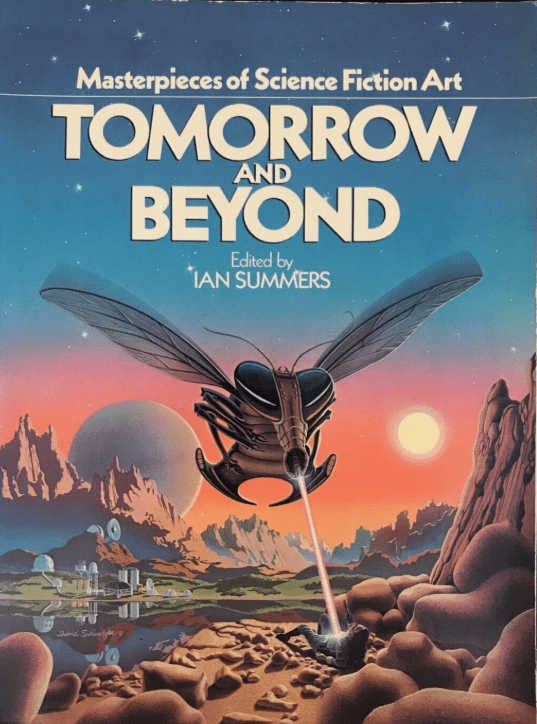
David Schleinkofer’s cover for Ian Summers’ Tomorrow and Beyond (1978)
Ian Summers’ Tomorrow and Beyond (1978)
Multiple artists I interviewed for my book cited this 1978 art collection as a big influence. Bob Eggleton called it a “watershed,” since it included many then-newcomers – Michael Whelan, Rowena Morrill, Carl Lundgren, Don Maitz – who went on to reshape the world of science fiction and fantasy illustration. It was a jolt of fresh air at the time, and in retrospect it captured a wide range of styles that defined the era.
You’ll be able to enjoy the art easily, since there’s very little text or even captions across most of the book after the introduction, although you can skip to the index in the back for a little more information about each illustration. That text-lite approach to art compilations would change quickly in the wake of another big title that debuted in the same year: Spacecraft 2000 to 2100 AD, the first of the Terran Trade Authority books.

Angus McKie’s cover for Stewart Cowley’s Spacecraft 2000 to 2100 AD (1978)
Stewart Cowley’s Terran Trade Authority series (1978-1980)
These books were a huge influence on Gen X kids, thanks to author Stewart Cowley’s decision to create his own fictional world as the framing device for his four in-universe handbooks: Spacecraft 2000 to 2100 AD (1978), Great Space Battles (1979), Spacewreck: Ghostships and Derelicts of Space (1979), and Starliners: Commercial Spacetravel in 2200 AD (1980).
The TTA series packages up the best mid- to late-’70s science fiction cover art that the UK had to offer: Cowley worked with the London-based Young Artists illustration agency, and was able to recycle existing art from their stable of illustrators, including Chris Foss, Angus McKie, Jim Burns, Bob Layzell, and many others. The series is probably the most popular out of all the titles in this guide, so good luck nabbing second-hand copies.
Honestly, I think Cowley’s masterstroke was writing a bunch of nerdy details into his world – I honestly don’t think the 12-year-olds cared that the “ACM 128 Stingray” had a “broad speed range” or whatever, but they definitely loved being trusted with a lot of adult information that could be safely ignored while they flipped through looking at pictures. But maybe that’s my ADHD talking.
Keep an eye out for Cowley’s other series, the six Galactic Encounters books, which are fun but generally considered to be second-fiddle to the TTA books – Cowley even distanced himself from them with the pen name “Steven Caldwell.”
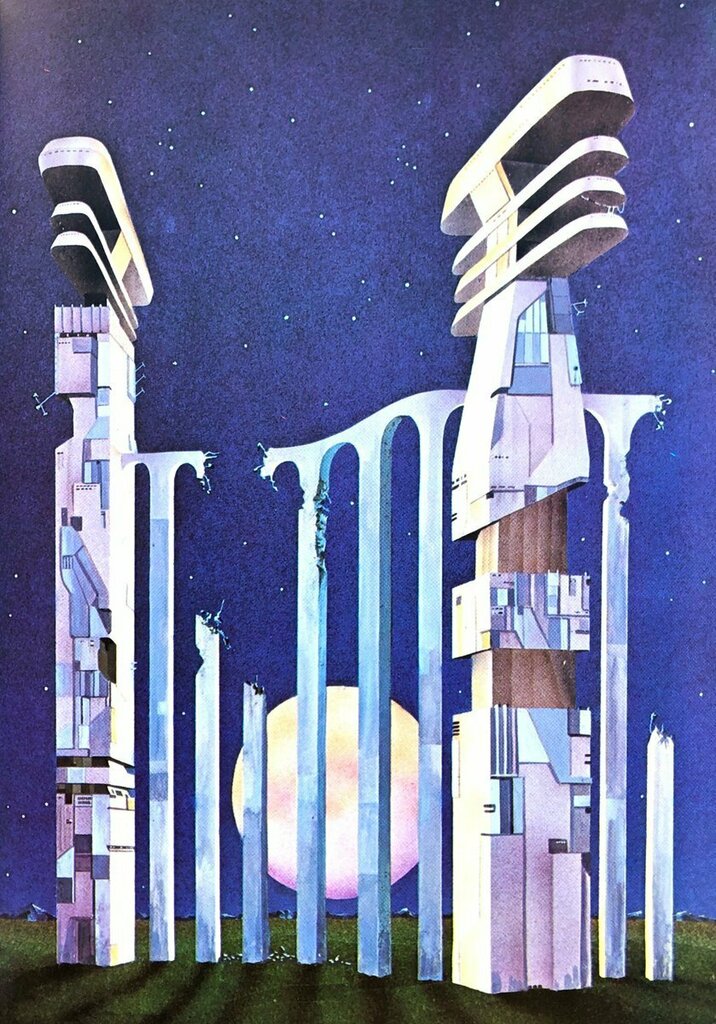
Colin Hay’s art from Janet Sacks’ Visions of the Future (1976)
And a lot more…
Cowley didn’t invent the “fictional text paired with reused art” format.
But most other prefabricated art books that hit the market around this time were often larded with not-so-great artists or packed with full-page images in order to stretch out the art. I’d still recommend them all to the aspiring collector.
An early example is Janet Sacks’ Visions of the Future (1976), which repurposes art from the New English Library’s Science Fiction Monthly magazine. Alan Frank’s Galactic Aliens (1979) lists the artists but doesn’t match the names to individual works of art, while David Wingrove’s The Immortals of Science Fiction (1980) merely cites everything to “Young Artists” on the copyright page.
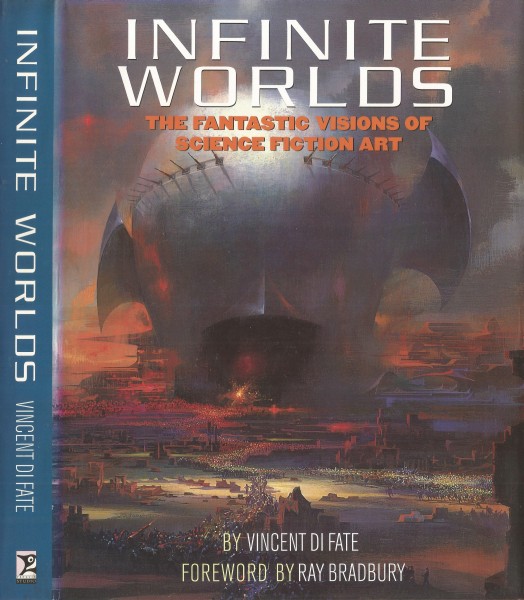
Paul Lehr’s cover for Vincent Di Fate’s Infinite Worlds (1997)
Vincent Di Fate’s Infinite Worlds (1997)
Pick this one up if you get the chance: It’s the most comprehensive tome of 20th century science fiction art I’ve come across.
Di Fate is an impressive genre artist himself, and he’s tracked the big names in the business since he was writing ‘70s magazine columns interviewing greats like John Schoenherr and Paul Lehr. He brings those decades of lived experience to bear with his writing, detailing each artists’ strengths so that the reader can more easily grasp their place in history. It’s an approach I highly appreciate and it’s what makes this collection my personal favorite of those in this guide.
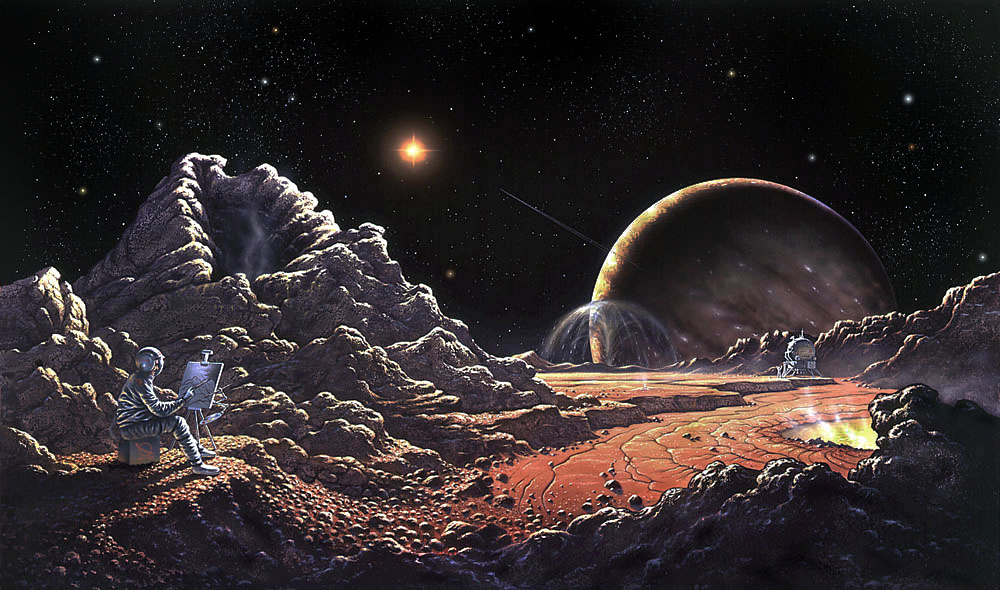
David A. Hardy’s jacket painting for his book Visions of Space (1989)
David A. Hardy’s Visions of Space (1989)
Visions is focused almost entirely on space art – the nonfiction, scientifically guided scenes of planets, pulsars, and any interstellar bodies in between.
Technically, that means this isn’t a science fiction collection, but anyone who enjoys one is likely to enjoy the other. Plus, the two categories of illustration were very intertwined by the 1970s, due in large part to the legacy of space artist Chesley Bonestell, whose ’40s and ’50s-era solar system landscapes inspired the next generation of science fiction artists.
Visions is a great companion to Infinite Worlds: Like Di Fate, Hardy has a long history as a successful illustrator in the same genre that the book covers. His wide-ranging exploration of the subject covers fascinating details about the history of our understanding of the universe.
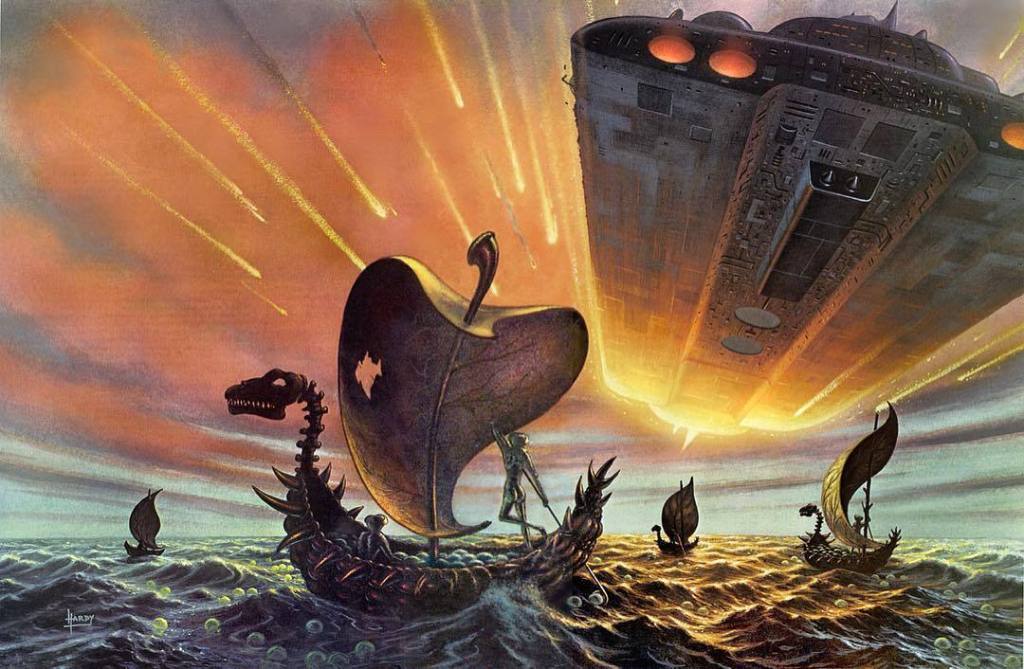
David A Hardy “Ocean Planet” (1979) from his book Galactic Tours: Thomas Cook Out of This World Vacations (1981)
Bob Shaw and David A. Hardy‘s Galactic Tours: Thomas Cook Out of This World Vacations (1981)
A primitive ship crafted from an alien skeleton with a single giant leaf for a sail. A metal planet with a shimmering city grid across its entire surface. These are just a few of the alien visions you’ll find in Galactic Tours.
Billing itself as a travel information guide covering a range of outer space vacation spots, Tours is a fun example of an art collection built around a Terran Trade Authority-style fictional narrative. The big difference is that none of the art here was repurposed and it doesn’t come from a wide swath of artists, either: It’s all from the mind of David A Hardy.
Granted, this does mean that Tours violates my self-imposed restriction to focus on multi-artist collections in this post. But this title is too innovative and strange to fit in anywhere else, and that level of creativity should be celebrated. Besides, I’m trying not to overthink this guide – I told Joachim I’d finish writing it two years ago!
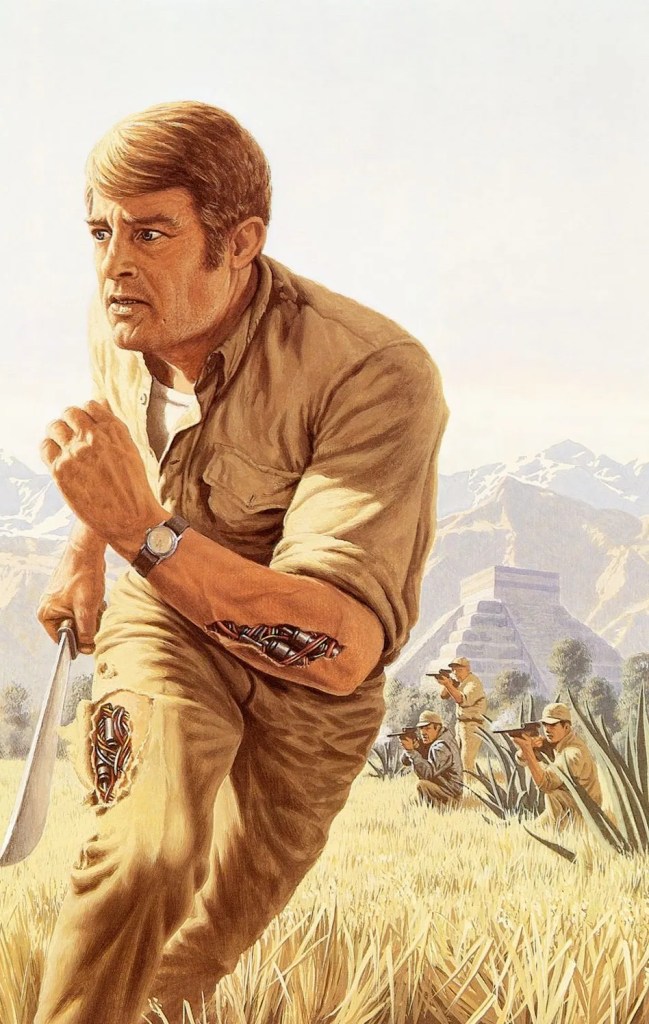
Richard Clifton-Dey’s cover art for Martin Caidin’s High Crystal (1974), included in Harry Harrison’s Mechanismo (1978)
Harry Harrison’s Mechanismo (1978)
This collection is a true oddity: Not only does the broad range of art have plenty of re-used book cover illustrations, but Mechanismo even throws film concept artworks and NASA-produced space art into the mix. It’s all held together with prose that covers real-life history alongside fictionalized futures.
This book is pure stylistic whiplash, in other words. My favorite part is when we see a pulpy Richard Clifton-Dey illustration of Lee Majors as the Six Million Dollar Man (although the text refuses to identify him as such), followed by an HR Giger artwork spread on the very next page.
The title’s worth picking up for this mish-mash of art, but Harrison’s fun prose also includes some delightful science fiction art history jokes and opinions – we learn, for example, “giantism in spaceship design was on the scene pretty early, since an author can type one mile as easily as he can one foot.”
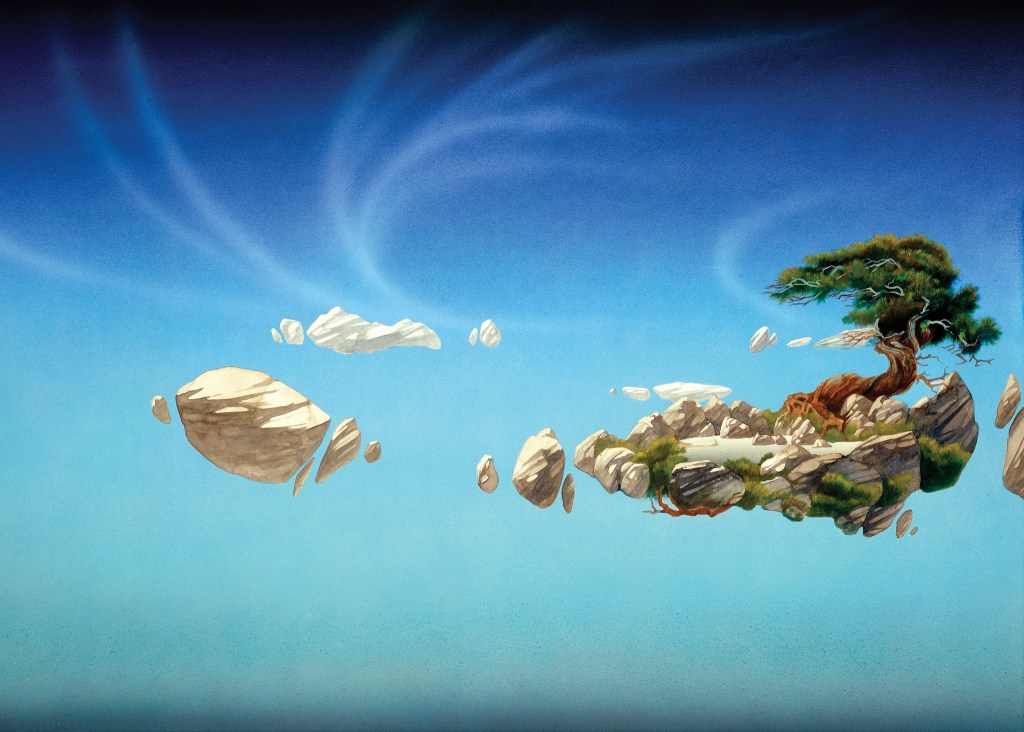
Roger Dean’s painting used as the cover for The Flights of Icarus (1977) with Martyn Dean and Donald Lehmkuhl
That’s my list, and I’ll be the first to admit that it’s far from definitive. I’d also particularly recommend Martyn Dean, Roger Dean, and Donald Lehmkuhl’s The Flights of Icarus (1977) and Malcolm Edwards and Robert Holdstock’s Alien Landscapes (1979). Plus, if you’re interested in great art collections published in this century, check out Cathy and Arnie Fenner’s contemporary fantastic art annuals, Spectrum. The series ran 20 volumes from 1994-2013, so you should be busy for a while.
Please, let me know in the comments if there are any more art collections that are particularly important to you and that would make sense alongside all the others I’ve mentioned here. Chances are high that I’ll track them down and review them on my own science fiction art blog.
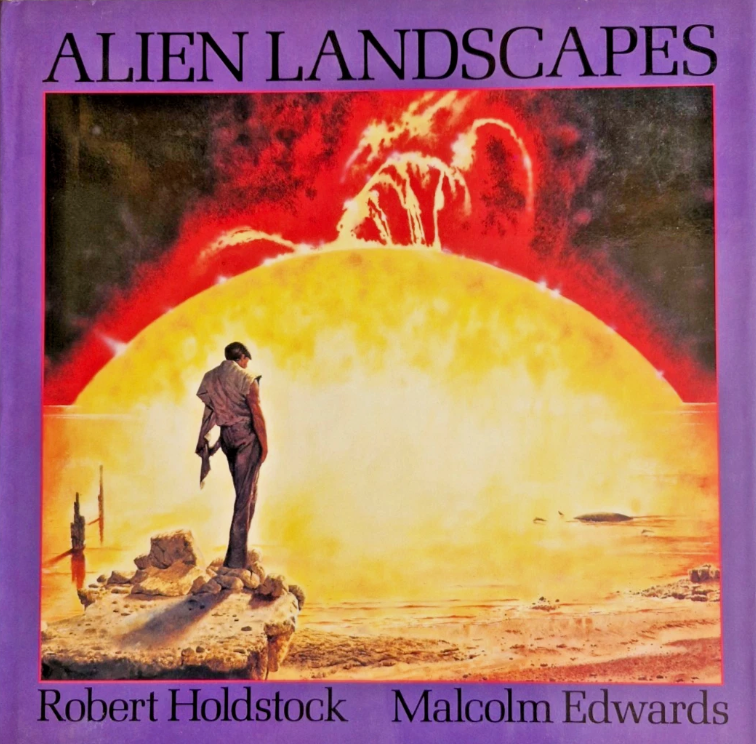
Les Edwards’ cover art for Malcolm Edwards and Robert Holdstock’s Alien Landscapes (1979)
For book reviews consult the INDEX
For cover art posts consult the INDEX
For TV and film reviews consult the INDEX
 Science Fiction and Other Suspect Ruminations
Thanks Adam for the post! As you know, the art book that came to my mind is The Art of Leo & Diane Dillon (1981). Unfortunately, I haven’t looked through it but it seems to contain a lot of their best covers.
It also has a lovely cover:
https://www.isfdb.org/wiki/images/c/ce/THRTFLDNDL1981.jpg
I have a collection of these sorts of books, although they’re currently all in storage. I’m always getting Mechanismo confused with Planet Story, which was also written by Harry Harrison but illustrated solely by Jim Burns.
See https://iansales.com/2012/03/18/galactic-encounters-of-the-1970s/
Ah, I remember that post — even if it is quite old. Thank you for the link.
I love this stuff (and Rowe’s book), nice overview. I admit I am baffled by the prospect of a random collection of preexisting sf art that’s accompanied by some manufactured narrative/framing device, not something I would bother reading at all. Would love to get my hands on a copy of the Di Fate, will put that on my want list.
I’m with you in finding those narrative/framing device art collections using previously existing art bizarre. Those Cowley books were incredibly popular! They are UK SF touchstones — and translated into tons of European languages (someone on Bluesky shared their Swedish editions). Unfortunately, I am not a big fan of that style of spaceship art (Elson, Chris Moore, etc.) — unlike Adam.
I can testify to Stewart Cowley’s Terran Trade Authority series being “a huge influence on Gen X kids”. I had three of them sometime between the late 1970s and early 1980s: Spacecraft 2000 to 2100 AD, Great Space Battles, and Spacewreck. And sure, it was the pictures that were the real deal rather than Cowley’s “future history”. But… I drew a lot of inspiration from these, particularly the idea that one could fashion a future history. Maybe it was Cowley that set me up for Olaf Stapeldon a few years later…
Re: the “Richard Clifton-Dey illustration of Lee Majors as the Six Million Dollar Man (although the text refuses to identify him as such)”
This cover was for a 1976 paperback reprint of the 1974 novel “High Crystal” by Martin Caidin. The novel was a sequel to the novel “Cyborg” (1972) that spawned the Six Million Dollar Man movies and TV series. I imagine that because the novel was a sequel to the original novel, rather than being a TV tie-in, the illustrator was given the unenviable task of making Steve Austin look sort of like Lee Majors, while maintain plausible deniability.
Hello Anthony, It’s good to hear from you.
I’m glad the post got those lovely nostalgic feelings going! I imagine that if I had access as a kid to a SF art book of any sort I would have loved them. I had access to various collections of fantasy maps and illustrations that transfixed me.
Hi Joachim! Recently I found a second hand copy of Cowley’s “Spacecraft 2000 to 2100 AD” and it is as enticing as the first time I set upon some many years ago. The one I really want to find is “Spacewrecks”. Now that set my mind spinning as a kid. The idea that not only would we have space travel, but we would have the ruins of space travel too!
As I might have mentioned before, I think I remember seeing the cover of Spacewrecks at a used book store in Philadelphia, PA (visiting my grandparents). However, my parents did not acquire it for me. The Fred Gambino cover was super memorable.
Pingback: Pixel Scroll 1/24/26 What Happens Inside The Event Horizon Stays Inside The Event Horizon | File 770
Enjoyed this post, especially when I saw 3 of my own, including Mechanismo bought back in the late 1970s. Thanks, and I’ve followed you.
Thanks for stopping by! Make sure to follow Adam’s newsletter (linked in the post). He’s the big art guy. I’m more about the texts behind the covers 🙂
Here’s my 2025 site rundown that illustrates what I covered last year: https://sciencefictionruminations.com/2026/01/02/my-2025-in-review-best-science-fiction-novels-and-short-fiction-reading-initiatives-and-bonus-categories/
Wow, that “Tomorrow and Beyond” cover instantly transported this 60-something to his 15 year-old self, huddled with his brother paging through the wild, mind-expanding art. Now THAT’S time travel! (H.G. Wells, eat yer heart out.). Thanks, Joachim and Adam, for your truly fantastic blogs and newsletters.
Thank you for the kind words!
If you want a recent snapshot of my site, definitely check out my 2025 in review! https://sciencefictionruminations.com/2026/01/02/my-2025-in-review-best-science-fiction-novels-and-short-fiction-reading-initiatives-and-bonus-categories/