Note: My read but “waiting to be reviewed pile” is growing. Short rumination/tangents/impressions are a way to get through the stack before my memory and will fades. My website partially serves as a record of what I have read and a memory palace for future projects. Stay tuned for more detailed and analytical reviews.
1. Fritz Leiber’s Gather, Darkness! (1943, novelized 1950)
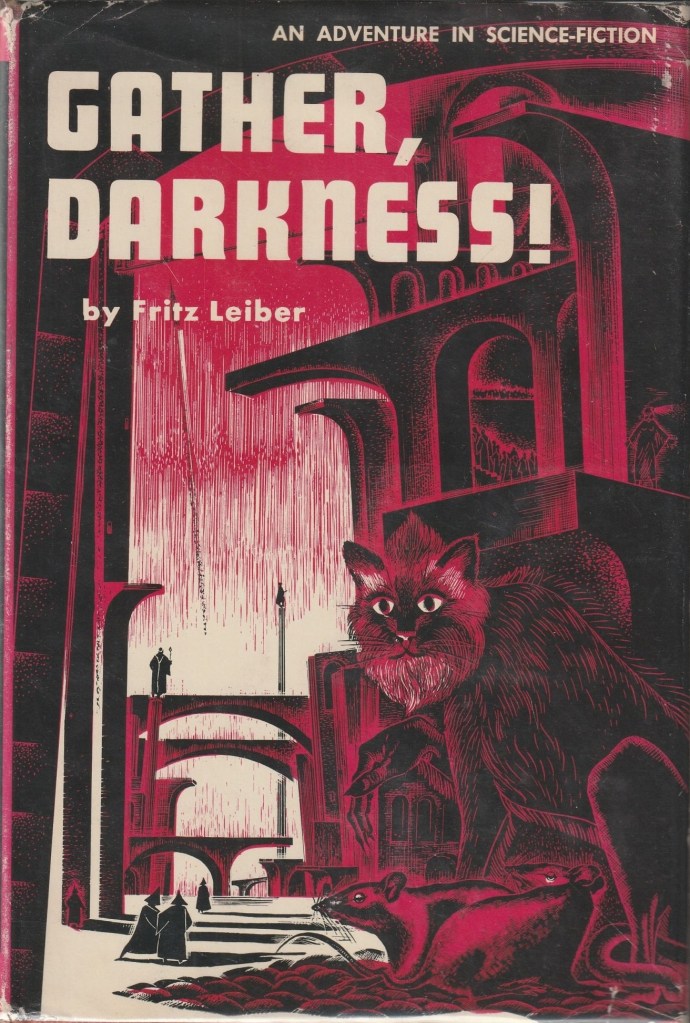
Uncredited cover for the 1950 1st hardback edition
3.25/5 (Above Average)
Frtiz Leiber’s Gather, Darkness! first appeared across the May, June, and July 1943 issues of Astounding Science-Fiction, ed. John W. Campbell, Jr. It was novelized in 1950. Written in the midst of WWII, Gather, Darkness! is a product of an important moment in Leiber’s life. The previous year he abandoned his profession as a speech and drama instructor at Occidental College (1941-1942) and decided that “the struggle against fascism mattered more than his long-held pacifist convictions.” He joined Douglas Aircraft as a quality inspector and continued to publish science fiction.1
Gather, Darkness! likewise imagines a just war, in this case against an all-encompassing technocracy. This technocracy birthed from cataclysm dolls up their technologies—including a looming “Almighty Automation” (17) that literally smites those who defy from above–as a religion. It’s here where Leiber fascinates. While the scientists theoretically know that there is no cosmic power behind their inventions and manipulations of the masses, they can’t resist interpreting their own actions as either some part of a divine plan or spiritual vision or secretly believing their own religious invocations meant to control and manage the crowds.2 The scientists fall victim to their own invented religion. The story, told from a variety of viewpoints within and outside the technocracy, follows Brother Jarles, an idealistic young man, who attempts to convince others of the Great God’s sham. Jarles is an appealing character. Resistance isn’t enough. There must be a believable moral stratum supporting all actions. Simultaneously, another force appears to be at work—using similar technological tricks to manipulate and subvert. The population, and even those within the Apex Council, view the rebellion through a religious lens. There’s witchcraft afoot!
It’s all told with an exciting visual and textual exuberance. There’s brainwashing, a half-hearted love story, escapes through the tunnels of the old civilization, strange new technologies, plots and plots and plots, and an endless sequence of holographic permutations. However, it reads as a grandiose pulp adventure that never pauses long enough to consider its own ruminative implications. I imagine it was still one of the better works to appear in those early days of Campbell, Jr.’s Astounding. If you’re new to Leiber’s work, I recommend starting with his Hugo-winning The Big Time (1958) or spectacular short stories like “Coming Attraction” (1950), “The Moon is Green” (1952), “The Girl with the Hungry Eyes” (1949), and “A Bad Day for Sales” (1953). He certainly hit his stride in the 1950s.
Somewhat recommended for fans of 40s science fiction and Fritz Leiber completists.
2. Gillian Freeman’s The Leader (1965)
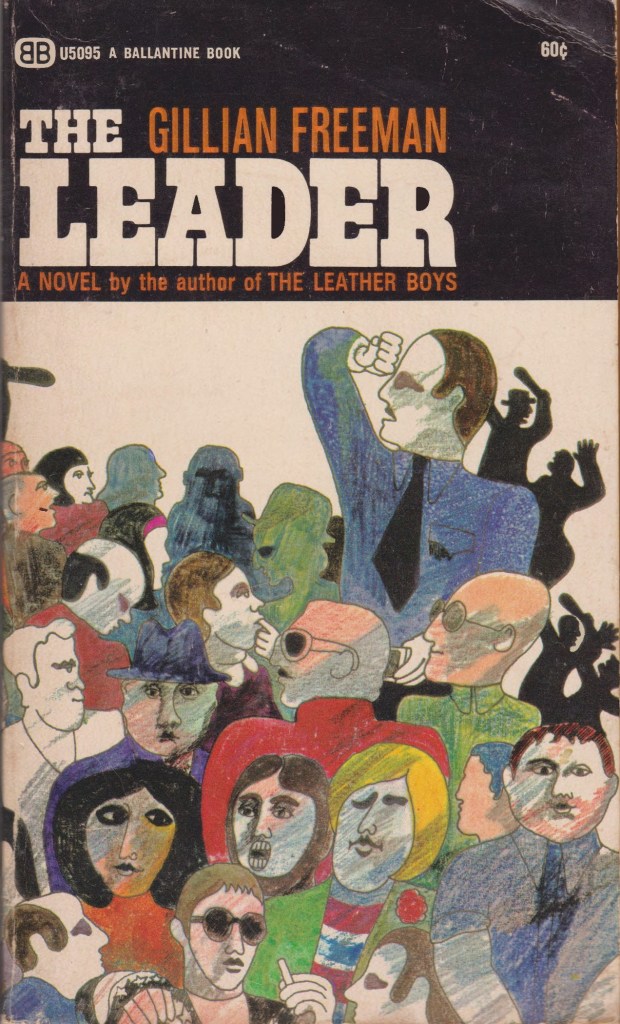
Uncredited cover for the 1st edition
3.5/5 (Good)
First, the inevitable “is this genre” question: maybe? SF Encyclopedia suggests, and this time I support John Clute’s entry, that The Leader (1965) is set in a “kind of near future dystopian UK” that charts the emergence of Britain First, a fascist, anti-Semitic, and nativist political party.3 Gillian Freeman (1929-2019) does not directly indicate a date. If it’s near-future, it’s the sense that it was moments from her now. Freeman strikes an interesting figure. She was a Jewish author who wrote an important early novel of gay love, The Leather Boys (1961). She turned her novel into a screenplay for the 1964 film of the same name and even wrote the screenplay to Robert Altman’s early psychological thriller The Cold Day in the Park (1969). To the best of my knowledge, The Leader is her only work that could be described as science fiction.
There’s an effective incremental terror to the proceedings. The novel builds step-by-step through its relentless logic made all the more uncomfortable by historical parallels and references. Freeman deliberately positions the origin of the native fascism within the “respectable” middle classes of Britain–the bankers, the office workers, the veterans, and the educated youth. She elides contemporary fetishization of Nazi artifacts and memorabilia with far more sinister obsessions. As a visitor pointed out two years ago when I purchased the book, Freeman’s text harkens to earlier manifestations of that “fragmented-but-organized neo-Nazi contingent in the UK that’s never really gone away and continues to work its way into various subcultural spaces.”4 It’s a hard read made all the more chilling due to the rise in right-wing nationalist groups in the US that openly espouse anti-Semitic views.5
If you’re a sucker for British near-future dystopias then check this one out. It’s of the unsettlingly real variety that will get under your skin and horrify.6
Notes
- See the Wikipedia entry on Leiber. I’m still waiting for a volume on his work from the U. Illinois Modern Masters of Science Fiction series! ↩︎
- I’d love to procure a copy of William E. Akin’s Technocracy and the American Dream: The Technocrat Movement, 1900-1941 (1977). I imagine that Leiber’s satire is a bit more targeted than I can ascertain at the moment. Thankfully there’s a copy online here. ↩︎
- See SF Encyclopedia. Clute does incorrectly state the publication date as 1966 instead of 1965. I can’t help but think of all of Trump’s “America First” proclamations. ↩︎
- Jim J here. ↩︎
- This chart lists the anti-Semitic incidents in the US by year from 1979 to the present. While only 2% of the American population is Jewish, they’re the target of almost 70% of the reported religiously motivated hate crimes. Of course, I don’t have to remind you of incidents outside the US either — the 2025 Bondi Beach shooting in Sydney, Australia should immediately come to mind. ↩︎
- I recently acquired a copy of Andrew Hammond’s Cold War Stories: British Dystopian Fiction, 1945-1990 (2017). While Freeman is not mentioned, I’ve added many more exemplars of this subgenre to my list to purchase and cover. ↩︎
For book reviews consult the INDEX
For cover art posts consult the INDEX
For TV and film reviews consult the INDEX
 Science Fiction and Other Suspect Ruminations
This review makes me want to re-read “Gather, Darkness.” I have good memories of it, but that is from many decades ago. I am fond of Leiber, so this is a good prompt for me. I just finished “A Different Drummer” by William Melvin Kelley from your recommendation last month on BlueSky. Your advice was solid, as it was really good. I am going to seek out “The Leader” on the strength of your recommendation and also because I recently watched “That Cold Day in the Park.” It was an interesting character study that shaded into a psychological suspense film that eventually ended up in outright horror. It is of a piece with John Fowles “The Collector.”
Oh, I haven’t read the Kelly! But I’m glad you like it. I need to read it soon. If anything, I posted it as a reminder to myself! I write at a glacial pace. I wanted to cover A Different Drummer for Black History month but never got around to it. I’m working on another much larger project related to an African American author at the moment (and have been for the last four months or so). I hope to finally finish it over my Spring Break.
The Leader was super bleak, that sort of under-you-skin realism made all the more horrifying due to the moment in which we live….
I am fond of novels in different voices (Faulkner’s “As I Lay Dying,” William’s “Augustus,” and Sturgeon’s “Godbody”, to name a few) so this one hit me in a sweet spot. The last two chapters are really powerful and open up the novel and take it in different directions, to it’s great benefit. I took a course in African American literature in the late eighties (yes, I am getting to be old) and it is disappointing that his work was never mentioned. I will try to find more by Kelley.
I read “Gather, Darkness” in 1993 (having a record is helpful!) and have fond memories of it. I have the idea that it was inspired by Campbell’s “All” (aka Heinlein’s “Sixth Column”) but maybe I’m wrong – the idea that a rebellion could cover itself with a religious cloak is not so unique that it could only be copied. The scene I remember most clearly is the brainwashing scene, in which the hero’s moral motivations are undercut and reversed.
Hello Andrew, You’re right — that scene is really disturbing. I hope you also remember how he escapes his conditioning. His innate goodness and idealism wins out.
This also prompted me to look up Freeman in Wikipedia. She has a remarkable bibliography!
I agree. I wish her screenplay version of David Wallis’ fascinating dystopia Only Lovers Left Alive (1964) was actually turned into a film!
I reviewed Wallis’ novel: https://sciencefictionruminations.com/2021/10/14/book-review-only-lovers-left-alive-dave-wallis-1964/
Perhaps I’m indulging myself because this isn’t, strictly speaking, relevant in a literary sense, but I knew Gillian Freeman when I was a kid in North London — though more her two daughters, who were about my age then, 6-8. They had a house a couple of doors down on the same street in Highgate as my family’s, whose backyard opened, as did ours, onto the same shared private gardens, though ‘gardens’ is too grand a word (it was nothing like the cultivated gardens in the squares in central London where I am now, more just a shared playground for the neighborhood kids).
She’d started as a newspaper journalist — as a lot of UK writers did then, like Tom Stoppard — and The Leather Boys had put her over commercially. It was common knowledge in the neighborhood — my mother certainly mentioned it — that her husband Ted Thorpe (Thorpe was her married surname) was gay and he was where much of the material for that novel had come from.
Freeman was a jobbing professional writer and considered more a popular sensationalist novelist rather than literary — at that time, anyway, I don’t know about her books in later decades — unlike some other UK novelists in the 1960s who also did a lot of journalism e.g. the likes of Anthony Burgess, Michael Frayn, Penelope Mortimer. She certainly had an admirably long professional career.
Hello Mark,
Thank you for the story. It’s always interesting a special little window into someone’s life. Have you read any of her work?
Only The Leather Boys decades ago, out of curiosity. It was a surprise to me that she managed to go upmarket after that and, as I say, maintained such a long career.
re Gather Darkness, I guess by “novelized” you mean published in book form? Or were some kind of changes made?
Yes, published in book form. I do not know if any changes were made. As you probably know, novels in genre science fiction became more popular (and paid more) in the 1950s. Authors frequently went back to their older works and republished them — sometimes with substantial changes.
I’d have to disagree that ‘The Leader’ is dystopian or science fiction(to me it reads like the (then) present), but it’s an outstanding look into the twisted psychology of the people who fill the first ranks of fascism/racialism etc. The middle-aged losers. The young sociopaths. The bitter junior officers. I found the ending unsatisfying but the book as a whole is definitely worth reading.
The ending somewhat undercut the narrative in more ways than one. She seems to almost back off the idea that it’s possible to see a Neo-Nazi movement in Britain.
Pearman/Wright’s collapse is too sudden in the story.
I agree.
Thank you for this article. Gather Darkness! is one of those stories that’s always been in my background, but I’ve never gotten around to reading it so it’s nice to know the premise.
Thanks for stopping by. It’s not top tier Leiber but it’s still worth the read — if a pulpy, baroque, action-packed, somewhat silly adventure with some nice ideas is your thing.
The Leiber sounds really interesting. I find science fiction stories that feature some sort of technology before it really breaks into public consciousness. I may be wrong, but I’d always seen brainwashing as something that became a thing in the culture with the Korean War, so I’d be interested in how the brainwashing is handled. I’m also a sucker for a technocracy that goes horribly awry.
I enjoyed The Leader, except for the ending, an abrupt anti-climax which seemed to shy away from the darker logic of the novel. I highly recommend The Leather Boys, which is very realistic, much better than the vast majority of gay novels nowadays.
Thanks for stopping by! I agree that the ending is a bit abrupt. It’s the main reason I docked my general rating.