
A selection of read volumes from my shelves
What pre-1985 science fiction are you reading or planning to read next month? Here’s the June installment of this column.
I adore teaching American History for college credit. Every summer I ponder what to change and improve. And this year, I want to integrate a few science fiction stories!
My 1950s unit in the spring semester could be modified with a few science fiction short stories. Considering my ongoing fascination with media landscapes of the future, I want to integrate one story on fears over television and one on nuclear horror (which would fit nicely with a group of assignments I have using song lyrics about atomic panic). Feel free to suggest a story that you would include or wish was included in your own US college course (or advanced high school course). No novels unfortunately. I have access to a range of syllabi and a TON of ideas but I always love to hear your selections.
Before we get to the photograph above and the curated birthdays, let me know what pre-1985 SF you’re currently reading or planning to read!
The Photograph (with links to reviews and brief thoughts)
- Arthur C. Clarke’s The City and the Stars (1956) was a childhood favorite of mine. I think it was on the shelf of SF my dad had in his teens. There’s something relentlessly compelling about the conceptual breakthrough premise — i.e. child discovers the true nature of the world.
- Despite the miserable cover to my edition, the Robert Silverberg edited The New Atlantis (1975) is a nearly perfect anthology with three hard hitters by Ursula K. Le Guin, James Tiptree, Jr., and Gene Wolfe. Highly recommended!
- John Christopher’s The Death of Grass (1956). I bounced off this one. I only managed a short review.
- Anders Bodelsen’s Freezing Down (1969, trans. 1971) is a harrowing collision of SF tropes and the emotional landscape of Scandinavian noir. I particularly adored Bodelsen’s use of an increasingly restrictive space in which the characters interact. Highly recommended.
What am I writing about?
I posted an extensive interview with Chukwunonso Ezeiyoke, author of Nigerian Speculative Fiction: The Evolution (2025). His book, the first ever on Nigerian speculative fiction, argues that the forces of canon creation in Nigeria (often with the soft power of the CIA) simultaneously obfuscated awareness of speculative voices and also prevented their popularity.
I will be continuing my interviews with authors of recent SF scholarship for two primary reasons: 1) I read a ton of SF scholarship and would like to share some of it with you 2) While I will not only cover books published recently, I would like to see more academic works received Hugo Award nods for Best Related Work. Jordan S. Carroll, whom I interviewed back in January, received a Hugo nomination for Speculative Whiteness: Science Fiction and the Alt-Right (2024).
Continuing the big project I started this summer: I reviewed the second of 116 issues I plan on cover in my Galaxy Science Fiction magazine read-through. The second issue contained the magazine’s first masterpiece (in my opinion).
Finishing out my productive month, I posted full reviews of two novels: Zoë Fairbairns’ Benefits (1979) and George Hay’s Flight of the “Hesper” (1952) (for my generation ship series).
And a rare Adventures in Science Fiction Cover Art post as well — The Flowering Bodies of Attilio Uzzo.
What am I reading?

After reading Chukwunonso Ezeiyoke’s Nigerian Speculative Fiction: The Evolution (2025) (above), browsed through the rest of the volumes in the Studies in Global Genre Fiction series out from Routledge Press. Agnieszka Gajewska’s Holocaust and the Stars: The Past in the Prose of Stanisław Lem (2012) jumped out at me. I plan on reading it soon.
I plan on a Galaxy issue this month as well. Beyond that, I’ll keep it under wraps. My fall semester stars tomorrow and all plans will be contingent on early semester exhaustion and stress.
A Curated List of SF Birthdays from the Last Two Weeks [names link to The Internet Speculative Fiction Database for bibliographical info]
July 13th: Monique Wittig (1935-2003). Known for her feminist SF novel Les Guérillères (1969)
July 14th: Christopher Priest (1943-2024). A favorite of mine — if he’s new to you check out the wonderful short stories in An Infinite Summer (1979). And if you want to read a novel instead, Inverted World (1974) ranks amongst my 70s favorites.
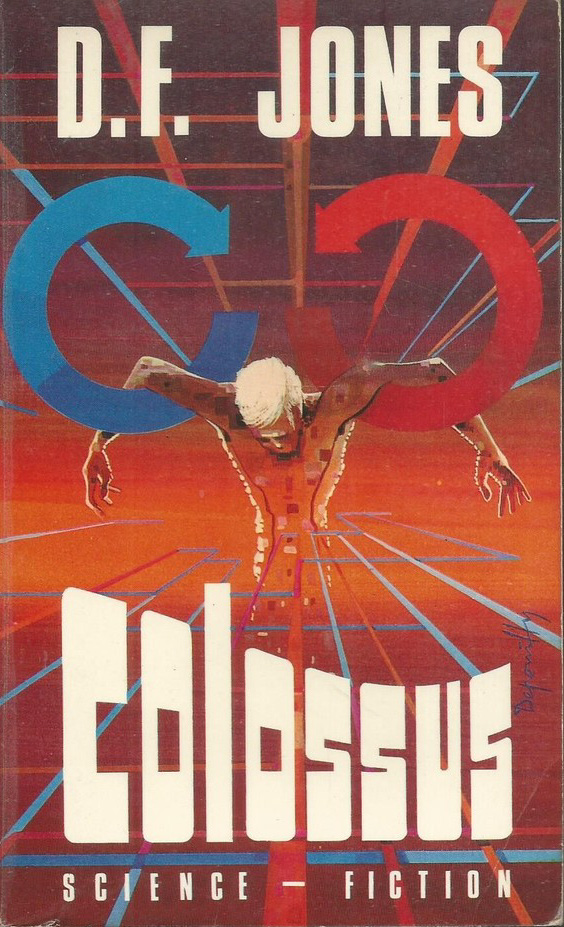
Depouilly’s cover for the 1968 French edition of D. F. Jones’ Colossus (1966)
July 15th: D. F. Jones (1918-1981). I went ahead and put Colossus (1966) on my to acquire list. Adapted as Colossus: The Forbin Project (1970).
July 16th: Sheri S. Tepper (1929-2016).
July 16th: Robert Sheckley (1928-2005).
July 16th: Joseph P. Martino (1931-2022).
July 17th: Italian SF author Vittorio Catani (1940-2020). Other than one late story from 2014, everything he wrote remains untranslated into English.
July 17th: Influential French SF editor and author Michel Demuth (1939-2006). None of his fiction has been translated into English. He edited the French SF magazine Galaxie from 1970-1977.
July 18th: Editor Charles G. Waugh (1943).

Concept art by Syd Mead for Blade Runner (1982)
July 18th: Syd Mead (1933-2019).
July 18th: Artist Gerry Daly (1957).
July 19th: Richard E. Geis (1927-2013). Influential fan voice (and writer of erotic novels)… loved to rail against hi-brow SF. I don’t think we’d have been on the same critical side of things.
July 19th: SF Critic and scholar Darko Suvin (1934-).
July 20th: M. P. Shiel (1865-1947).
July 21st: Italian and editor Ugo Malaguti (1945-2021). All of his work remains untranslated — alas.
July 22nd: Dean McLaughlin (1931-).

Bodé’s cover for his graphic novel Sunpot (1971)
July 22nd: Artist Vaughn Bodé (1941-1975).
July 22nd: Eric C. Williams (1918-2010).
July 23rd: Katharine Burdekin (1896-1963). Known for Swastika Night (1937), which I acquired a few years back but have not read.
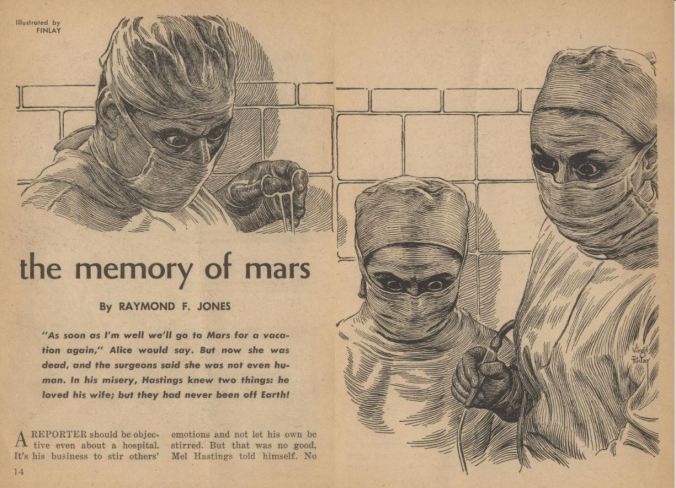
Finlay’s interior art for Raymond F. Jones’ “The Memory of Mars” in Amazing Stories, ed. Cele Goldsmith (December 1961)
July 23rd: Virgil Finlay (1914-1971). The master of interior art line work — love his stuff.
July 23rd: Editor and author Gardner Dozois (1947-2018). I can’t shake the horror of “Horse of Air” (1970).
July 23rd: Artist Eric Ladd (1949-).
July 24th: John D. MacDonald (1916-1986). New to his SF? Check out “Flaw” (1949) and “Spectator Sport” (1950).
July 24th: Barry N. Malzberg (1939-2024). A favorite of mine… For a sense of his fiction, check out my reviews of Revelations (1972) and The Gamesman (1975).
July 24th: Gordon Eklund (1945-).

Tom Barber’s cover for Amazing Stories (March 1976)
July 24th: Artist Tom Barber (1946-).
July 25th: Evelyn E. Smith (1922-2000). Still haven’t read any of her short fiction.
July 25th: Kendell Foster Crossen (1910-1981).
July 25th: Author and scholar Brian Stableford (1948-2024). His research on early French SF is indispensable. Less a fan of his functionalist adventure-oriented science fiction, so far…
July 26th: Aldous Huxley (1894-1963).
July 26th: M. John Harrison (1945-). If you’re new to his fiction, check out my reviews of The Committed Men (1971) and The Pastel City (1971). He’s another favorite of mine.
July 27th: Artist Mel Hunter (1927-2004).
July 27th: Sydney J. Van Scyoc (1939-2023). I featured her first three published short fictions for my series on female authors I should know more about: “Shatter the Wall” (1962), “Bimmie Says” (1962), and “Pollony Undiverted” (1963). The final of the three was particularly interesting.
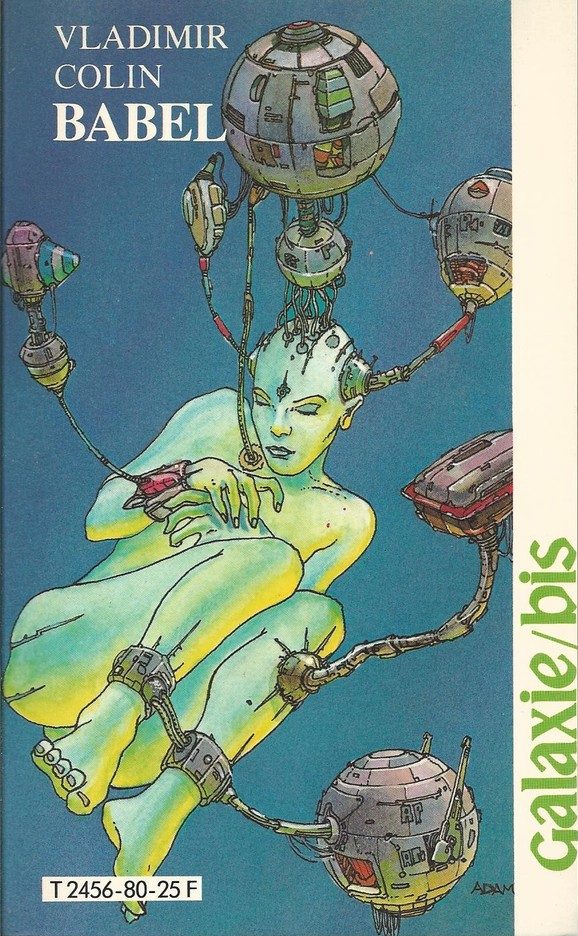
Adamov’s cover for the 1982 French edition of Vladimir Colin’s Babel (1978)
July 27th: French SF artist Philippe Adamov (1956-2020).
For book reviews consult the INDEX
For cover art posts consult the INDEX
For TV and film reviews consult the INDEX


In July I read a few pre-1985 SF.
Venus Plus X by Theodore Sturgeon which I loved.
The Female Man by Joanna Russ which I can see why its viewed as important but I didn’t enjoy as a reading experience.
Flow My Tears the Policeman Said by PKD which was not bad.
Alternate Worlds: The Illustrated History of Science Fiction by James Gunn which was decent as well.
Also finishing Niven and Pournelle’s Footfall before the end of the month which is exactly 1985 I believe. Its silly but fun.
I read Venus Plus X back in 2016. I remember vividly the paralleled narratives (I enjoyed the domestic scenes and how they interacted with the futuristic sequences). As with then, I am unsure what Sturgeon’s ultimate point was. I’d love to hear your thoughts. Here’s my very short review (couldn’t write a full one): https://sciencefictionruminations.com/2016/06/30/short-book-reviews-theodore-sturgeons-venus-plus-x-1960-christopher-priests-the-affirmation-1981-and-barry-n-malzbergs-screen-1968/
I read The Female Man more than a decade ago and enjoyed it. Was not able to write any form of review so my thoughts have faded a bit.
Flow My Tears the Policeman Said is one of a few PKD I haven’t tackled yet.
I struggled through Footfall as a teen. Can’t say I cared for it. But, it was a long long long time ago! I remember the cover vividly. My high school library had a copy.
Have you ever read the Gunn Alternate Worlds book? With your expertise in history I would be interested in what your view on it would be. I read the original one from the 70s. I believe it has been updated since.
Venus Plus X was a better read than Cosmic Rape (which I also thought was good though) but I just really thought his way of playing around with gender and riffing on religion and morality was refreshing (if of course imperfect) for the time. It also had some good twists and turns that kept me engaged and it provided me with a good combination of “Huh Interesting” with “Ooooh I didn’t see that coming!” that hit the sweet spot for me. Possibly ny favourite reas of the year.
I have not, yet. I have read some of Gunn’s other scholarship. His work is certainly pioneering in the study of SF.
I enjoyed The Cosmic Rape as well (despite the horrid title). That one I did manage to review back in 2011: https://sciencefictionruminations.com/2011/05/27/book-review-the-cosmic-rape-theodore-sturgeon-1958/
I guess my issue with the Sturgeon is that I know he’s playing around with gender and riffing on religion and morality (all things I enjoy in SF) but what is his position on it all? What is his point in paralleling the narratives? I think I would have a far better assessment if I were to reread it now as I’ve read quite a bit more of his work since then.
I’ve been reading and re-reading Nebula-winning short fiction in 5-year blocks more or less, and after finishing 2015-2019 and 2010-2014 I decided to go back to the beginning. In some cases I haven’t picked up these stories since 1990 (which was the first time I decided to read all the Nebula winners).
At the moment I’ve finished all the winning novelettes and short stories from 1965-1974; several that I especially liked were Kate Wilhelm’s “The Planners”, Samuel R. Delany’s “Time Considered as a Helix of Semi-Precious Stones”, Theodore Sturgeon’s “Slow Sculpture”, Poul Anderson’s “The Queen of Air and Darkness”, Vonda N. McIntyre’s “Of Mist, and Grass, and Sand”, and Gregory Benford & Gordon Eklund’s “If the Stars Are Gods”. I also re-read and enjoyed Gene Wolfe’s “The Island of Dr. Death and Other Stories”, which came in 2nd to “no award” for the 1970 Nebulas.
I got stuck in the middle of reading the novellas, but I’ve made it up to 1967 so far, with longtime favorite “The Saliva Tree” by Brian W. Aldiss being the one I liked most (again). Jack Vance’s “The Last Castle” was enjoyably Vanceian, Roger Zelazny’s “He Who Shapes” was a chore (I’ve never been much of a Zelazny fan, though I respect his wit and erudition), Michael Moorcock’s “Behold the Man” hit a bit differently from 35 years ago but retained most of its impact.
I also read Katherine MacLean’s “The Missing Man”, something of a hidden treasure despite its very Campbellian take on “psychic” powers. It was on interlibrary loan and I had to return it ASAP. I have since retrieved my copies of vols. 3 and 4 of The Science Fiction Hall of Fame, which should make reading the rest of the novellas up to 1974 easier. Especially looking forward to Fritz Leiber’s “Ill Met in Lankhmar”, and slightly dreading Harlan Ellison’s “A Boy and His Dog” (a former favorite, we’ll see if I still find it enjoyable….)
Oh, and I also read a bunch of Mark Clifton’s fiction for an upcoming Hugo History podcast. It’ll be at https://www.patreon.com/HugoHistory on August 14, check it out!
Thanks for stopping by Rob. Sounds like a fun project. Many of those are reviewed on my site. Here’s my general index: https://sciencefictionruminations.com/science-fiction-book-reviews-by-author/
I’ve also covered the novelized version of the MacLean story. I would also describe it as a hidden treasure. I think the Campbellian take makes sense as she was also affiliated with Dianetics for a bit (and of course published her first stories in his magazine).
Thank you for the podcast link. I don’t listen to podcasts unfortunately despite my best efforts. Written reviews and scholarship are more my thing.
@sciencefictionruminations.com I'm always ready for a Robert Silverberg edited Anthology! I will start looking for 'The New Atlantis', thank you.
Remote Reply
Original Comment URL
Your Profile
Why do I need to enter my profile?
This site is part of the ⁂ open social web, a network of interconnected social platforms (like Mastodon, Pixelfed, Friendica, and others). Unlike centralized social media, your account lives on a platform of your choice, and you can interact with people across different platforms.
By entering your profile, we can send you to your account where you can complete this action.
All three stories in it are top notch. The Wolfe is probably my favorite of his I’ve read so far.
What older SF have you been reading recently?
As for myself, I am still continuing to read the Perry Rodan saga. I am at number 46 and not sure when I will stop reading for a longer break. The series is hard to set aside when it is a great read. I wished I found the series when I was younger and I sure I would enjoy it as much as I do now. However, I still would like to read my 50s scifi for my podcast show.
Glad you’re enjoying it. I can’t say, from what I know about it, that it would resonate with me.
Two things: I re-read Swastika Night last month, and it is an astonishing work, especially when you recall it was written in 1937. And – The City and The Stars was one of the first SF novels I remember reading, and it blew me away, an example of what a great mind can do with an idea…
Re-Swastika Night: That’s what I’ve heard! Did you see my recent review of Zoë Fairbairns’ Benefits (1979)? I thought it might be something that would interest you. It is not entirely successful but certainly fascinating (and horrifying).
Yes, I read your review of Benefits, but was away on holiday so held off responding till I got back.
You certainly got me thinking about the book again, and your comments on trade unions were interesting and an eye-opener, making a lot of sense half a century later. I read the book back in the late 70s/early 80s when I was researching feminist SF, and I remember it as a very grim read, partly because it was so much of its time. The horrors of the Thatcher era were upon us, and women friends were genuinely worried about where the country was going.
Equally, I think that’s perhaps why the novel has – unjustly, I agree with you – faded from view. The world is far grimmer today but in different ways: climate change and AI weren’t on the horizon back then. Your piece also reminded me of Suzy McKee Charnas, who I also read back then; in some ways her picture was just as dark, even though not rooted in the here and now like Fairbairns…
Laid up with Covid atm so have taken your prompt and dug out The City and The Stars to re-read.
Get better soon! I thought it might have been something that made an appearance in your research. I made sure to mention Charnas in my review at the very end in a list of other worthwhile works from that era that explore a similar territory. I do think Walk to the End of the World is the better novel — although, detached, as you mentioned, in the here and now.
Let me know your thoughts on the Clarke! I haven’t returned to it since.
This month I finally wrapped up Asimov’s ‘Foundation and Empire’, which I found more engaging than the first volume (I gather ‘The Mule’ remained a favourite of the author).
After this I’ve dived into a plethora of short stories, including Ballard’s ‘Billennium’ and Alfred Bester’s ‘Time is the Traitor’. The next novel in line is definitely Priest’s ‘Inverted World’, which I see is an enduring favourite of yours (and I confess this is my first Priest story – rather remiss of me to overlook him all these years!). I also have the Silverberg edited ‘SF Hall of Fame’ arriving soon, which I imagine will prove quite the treasure trove 🙂
Hello,
I read the original Foundation trilogy very early in my SF reading adventures so my memories are spotty at best on that point.
As for Ballard, I reviewed that one on the site. He’s always been a favorite of mine. And I imagine I’ve covered quite a few of the SF Hall of Fame stories as well.
I wish I managed to write a review of Inverted World. I won’t give too much away but it has a lot of fun with the conceptual breakthrough plot point in a lot of generation ship stories (and of course, stuff like Clarke’s The City and the Stars).
Thank you – looking forward to this reading this a great deal (and will check out your Ballard review too 👍)
No problem.
Christopher Priest is also a favourite of mine, but for some reason I was completely oblivious to his short story collections. Maybe because I never used to read short stories, but all this is changing rapidly for me, and now I seem to read nothing but short stories (short attention span acquired?). An Infinite Summer sounds perfect, thanks. Being inside the world of Priest is uncanny, unforgettable experience.
I am also in a period in my reading life that I am relentlessly drawn to short stories. Due to my career, I find it incredibly hard to devote time to my site in part because of how long it takes me to write a proper review (I’m a religious notetaker and ruminator before I put a single word down). Short stories really help on that front!
But yes, An Infinite Summer contains a ton of (often creepy) gems. I think “The Watched” (1978), Nominated for the 1979 Hugo Award for Best Novella, is my favorite of the bunch.
The Watched? I will keep it in mind. Interesting, I have just compiled a list of books about anthropologists, and I see this novella is also about an anthropologist? A big plus for me already.
Yup, in the An Infinite Summer collection.
Speaking of anthropologists (or rather as it’s THE FUTURE “cultural xenologist”)– Michael Bishop’s Transfigurations (1979) is a must. If you don’t want to read the entire novel, check out his novella “Death and Designation Among the Asadi” (1973) (Nominated for both the Hugo and Nebula) that forms the first section of the novel.
Finished the two Izumi Suzuki collections (“Terminal Boredom” and “Hit Parade of Tears”), really fantastic, albeit often with a streak of blackly humorous nihilism. From my limited perspective she seems sui generis, makes me wonder if there was some Japanese sf scene she was part of that I am just completelu ignorant about? She creatively deploys sf tropes to cut deep on various subjects (gender, drugs, a general malaise of alienation/insanity).
Moved on to Judith Merrill’s “England Swings” anthology from 1968, which is basically her wildly waving her arms at America about New Worlds/British New Wave, and rightfully so. Being familiar with some of the entries (Ballard, Disch, Jones etc.) naturally I’ve been more keen on some of the lesser known names. Keith Roberts’ “Manscarer”, George Collyn’s “The Singular Quest of Martin Borg” (a successful humorous piece, a rarity!), Charles Platt’s “The Total Experience Kick”, and Michael Moorcock’s uncharacteristically, simple, straightforward and non-Eternal Champion related “The Mountain”.
Also picked up a Fritz Leiber “Selected Stories” anthology from 2010 based on your review of “Coming Attraction”. Great story, the best of the three I’ve read so far. Could do without the intro by Neil Gaiman (that guy has written so many tedious introductions lol).
I can’t really help you on how she fits into the larger Japanese SF scene. My knowledge is limited to Kobo Abe. I do own a copy of the anthology The Best Japanese Science Fiction Stories that might be worth tracking down. https://www.isfdb.org/cgi-bin/pl.cgi?35740
I skip intros most of the time! Hah.
I’ve read quite a few of the stories in the England Swings anthology but have not reviewed it cover to cover. I’ve reviewed the Platt and Collyn that you mention. Didn’t really care for the latter. Thought the Platt was okay. Platt swings wildly from brilliant to utter crud.
thanks for the Japanese sci-fi anthology tip, will keep an eye out for that. Interesting that Suzuki is not included. Like you, Kobo Abe is also my only other reference point, so I’m curious about the other authors.
The Collyn piece is definitely slight but it was amusing enough for me. Platt I don’t think I’d read before at all. What an odd guy, was surprised to learn he was responsible for cryo-freezing baseball star Ted Williams!
I find Platt very interesting. He swings wildly and unpredictable and completely misses with Garbage World (there’s a review on this site). But I found The City Dwellers (1970) transfixing if a New Wave look at urban malaise is your thing (didn’t manage to review that one). He also conducted a ton of great interviews with SF figures — the Dream Maker volumes. https://www.isfdb.org/cgi-bin/pe.cgi?28657
yeah I am on the lookout for those Dream Maker volumes, always interested in that type of thing.
I think I only own one of them… I’ve reminded myself that I need the rest!
I bought both Suzuki collections. Do you have a favorite explicitly SF story from either collection? I am restarting my SF stories in translation series with Rachel S. Cordasco and want to feature her soon. I’m all for the alienation and general malaise angle…
Reviewed “Terminal Boredom” (1984) with Rachel S. Cordasco of SF in Translation — posted moments ago.
Recently I’ve read all four of the novels by Margaret St. Clair which were published as part of Ace Doubles, between 1956 and 1964. I’ll be publishing an overview of them, and St. Clair, as my article and podcast episode for this week.
The only St. Clair novel I’ve read is Sign of the Labrys (1963). Was not the biggest fan. Her short story collection (I think it was also an Ace Double) Three Worlds of Futurity had its moments (there’s a review on my site).
More recently I read “Stawdust” (under her name Idris Seabright for one of my series) and it was really interesting! Did not write a review however…
My most recent St. Clair review was her post-apocalyptic short story “Quis Custodiet…?” (1948) which was okay: https://sciencefictionruminations.com/2023/03/14/short-story-reviews-richard-mathesons-pattern-for-survival-1955-and-margaret-st-clairs-quis-custodiet/
I’m struggling through Samuel R. Delany’s Dhalgren (published January 1975 by Bantam, edited by Fred Pohl) and having a much better time with Joanna Russ’s The Female Man (published February 1975 by Bantam, edited by Fred Pohl.)
The subtext there is Pohl — one of the greatest editors in SF history. Editor of Galaxy, If, and Worlds of Tomorrow in the ’60s. Rediscovered Cordwainer Smith. Critical to the careers of Silverberg, Delany, Tiptree. Rescued The Female Man which had been making publishers’ rounds since 1971. Good anthologist, too. (Of his shortish time at Ace, perhaps we need not worry.)
I struggled with Dhalgren as well. I read The Female Man in reading group I made with my friends in graduate school. Unfortunately it has faded from memory as I never managed to write a review. I really really enjoyed it at the time. Michael R. Page’s monograph Frederik Pohl (2015) certainly opened my eyes to his massive editorial contribution to the genre.
Are you rereading the Russ or is this your first time tackling it?
Both books are rereads — I read them first back in 1975 when they came out. I really remember very little from those first reads though. And I was too young for them.
As for Margaret St. Clair’s novels — I do think she’s much better at short fiction, based on those I’ve read. I haven’t read Sign of the Labrys, though I do remember it had terrible back cover text — not her fault of course.
I’m just about to finish the Tiptree collection 10.000 Light Years from Home. Hit and miss for me, there’s some really great ones, but also some that seems rather lightweight and/or dated. Mostly I’m enjoying it, though.
Before that I read Moorcocks The Final Programme. Very much of its time and very messy, but I guess that’s by design. Apparently the first Jerry Cornelius-story, so of historical interest, but not much more than that.
Definitely 10,000 Light Years from Home has some pretty minor stuff. But the peaks are fantastic.
I’ve read but never managed to review that collection. If I’m not mistaken, it’s quite early in her career — and you are right that some is lightweight.
I don’t think we can write books not of a particular time Jannik 😉 Hahaha, a pet peeve of mine. But yes, certainly a book that late 60s New Wave excess.
It was her first collection, although a couple of contents are reworkings of earlier stories.
Yup.
Been reading Ballard’s The Atrocity Exhibition, which I will write about… in like a couple weeks. I see you’ve reviewed a few of the stories contained here, but I will say reading the book is a radically different experience from reading each of the stories in isolation. It is a wild fucking trip of a book.
That I can imagine. I’m not sure I could read the entire collection from cover to cover… I like his 70s work primarily in short batches. I look forward to your review.
Just finished Under Heaven’s Bridge by Michael Bishop and Ian Watson, which reminded me more of Bishop’s fiction than it did Watson’s, although it did in places remind me of 1970s sf by the likes of Compton, Holdstock, Evans, Coney or Cowper…
I read half of the one. I thought it was simultaneously poor Ian Watson and poor Michael Bishop despite the interesting premise. I adore both authors.
didn’t think there was much Watson in it, other than the details about Japan.
According to Watson himself it was a bit more than that! From an interview: https://ansible.uk/writing/iwatson.html
“Langford: Speaking of differentiated individuality, I must say that literary collaboration has fascinated me ever since I first shared a bottle of plonk: how did the Bishop/Watson novel Under Heaven’s Bridge come about? The aliens in it are pure Bishop (from Catacomb Years and A Little Knowledge); their cybernetic God is pure Watson. I had visions of it starting with a phone call: “Hey, Ian, can you do me some metaphysics?” or “Hey, Mike, can I borrow some aliens till next Thursday?”
Watson: I was fascinated by Mike’s alien Cygnusians in CY and ALK and wrote – we write to each other frequently – asking if he was going to do a story set on their home world, since they certainly deserved it. He said he wasn’t planning such, but why didn’t I do it, or why didn’t we both do it together?
So I nipped out and did some research on 61 Cygni (separation of the binary stars, spectral classes, etc.) and discovered to my dismay that we couldn’t use 61 Cygni after all. So I invented the Gemini system instead, and wrote sections of the tale (which was going to be a novella at this stage) and mailed them to Mike. Looking at the sections I wrote, in retrospect, it doesn’t really seem to me as though I wrote them at all – as I was doing my best to think in Bishopese at the time. I’d say we can both do that for each other. Though we’ve never met, or even spoken on the phone, we can become a two-headed entity; so it isn’t all that easy to dissect out who did what.
Anyway, Mike expanded what I’d written, altering and mutating it; and I added in extra chapters (such as the Prologue, or Chapter 20 for example, where the Kybers try to scale the platform to escape; Mike thought this had surfaced from my unconscious memory of news footage of the last US troops scrambling for the last helicopter out of Saigon, and I think he might have been right. I arrived at the 2nd French SF Congress in Angouleme, after two days out of touch, to find everyone in the hotel lounge staring at the TV screen, just as the last helicopter was lifting off). We both polished the text, and it was all done, pretty speedily and without problems or disagreements. The book grew outwards organically from a centre, rather than being written chapter by chapter, turn by turn.”
the final section where the Kybers reveal what they are reads like pure Watson, as does a lot of their dialogue – and also the exchange of puns earlier in the novel
The whole concept of a transatlantic collaboration sans phone calls or Zoom (especially as they had never met at that point) is fascinating. As I mentioned, I thought the general concept was interesting but the delivery defeated the initial excitement I experienced.
If you post a review, let me know. The semester has started up and I’m holding on day-to-day until teaching gets into the flow and I struggle to keep up with my site AND checking other sites until September.
I’m finally reading some Mack Reynolds and quite enjoying it though those posts won’t be up for a while. If I would have actually read his late 1970s work when it came out, I would have become quite a fan I suspect.
I don’t have time to look, but did you ever reference a book called The Ethics of Space Exploration ed by James S.J. Schwartz and Tony Milligan (2016)? I haven’t had a chance to look through it all on Google books, but Stephen Baxter has an interesting chapter on O’Neill space colonies in science fiction including Mack Reynolds’ and Dean Ing’s sour take on the subject in Trojan Orbit. (Just out of your range with a 1985 publication date).
I recently finished the Space Merchants by Frederik Pohl and C. M. Kornbluth. This has been one of the more enjoyable of the vintage sf I’ve read over the past year or so (Delany excluded). I think perhaps because I enjoyed the criticism of advertising and consumerism. The world building was also really good. Story was an action narrative.
I was reading the revised 21st Century ed. with an intro by Pohl talking about how the action narrative was typical of the sf style at the time.
He didn’t say much else about what he revised but the two things that jumped off the page to me were a mention of Bollywood and of doctors who sold opiate derivatives to the public…
Highly recommended!
I remember enjoying it back in my teenage years. I imagine my appreciation would be even deeper now. I’m a sucker for criticisms of advertising and consumerism and focus on those themes frequently on the site.
If I were to reread it, I’d avoid the revised version. Not a big fan of revising long after publication date.
A light screwball romp by Kate Wilhelm, “Oh, Susannah!” (82) does have one satirical lurch into sf. A wife develops amnesia when she discovers her husband’s been having an affair and ends up on a fugue-tour of the US while he and his cronies attempt to trail her for contraband she has unwittingly taken with her. If it sounds a little like “Desperately Seeking Susan” Wilhelm thought so too and began legal proceedings.
With no identity of her own she has a quirk of instantaneously fabulating a pertinent new history whenever she meets someone new. When she wanders into a feminist consciousness-raising session she declares she’s an alien from a matriarchal planet where all but a few men (for breeding) are killed and she has come to Earth to spread the gospel; a revelation received with great feminist rapture.
One of only a few Wilhelm pre-1985 novels that I do not own. I really enjoy her work. I assume you saw my review of The Killer Thing? https://sciencefictionruminations.com/2024/01/15/book-review-kate-wilhelms-the-killer-thing-1967/
And Kate Wilhelm’s “Ladies and Gentlemen, This Is Your Crisis” (1976): https://sciencefictionruminations.com/2023/06/05/short-story-reviews-kate-wilhelms-ladies-and-gentlemen-this-is-your-crisis-1976-and-langdon-jones-the-empathy-machine-1965/
“Planet Story” (1975) is also excellent: https://sciencefictionruminations.com/2023/08/19/short-story-review-kate-wilhelms-planet-story-1975-and-clark-ashton-smiths-master-of-the-asteroid-1932/
Those are the three most recent works of hers I’ve covered.
Somehow I’ve fallen behind on these posts (or gotten unsubscribed). Just read Asimov’s “The End of Eternity” for the first time in a while; it’s still an interesting read, in part because what might seem like Asimov’s weaknesses (few woman characters, and a main character with limited emotional reactions) are in fact plot points.
I can’t seem to remember if I read that one or not. If I did it was in my late teenage years. The next Asimov on my slate, involuntarily, is The Stars, Like Dust as it is serialized in the fourth issue of Galaxy. And I’m currently working on the third issue at the moment.