Preliminary note: This review originally appeared in the inaugural issue of Rachel S. Cordasco’s new magazine Small Planet: The SF in Translation Magazine. You can read the entire issue for free here! I plan on contributing one review of pre-1985 SFF in translation for each issue. In addition to my review, there’s a fantastic range of other articles and interviews.
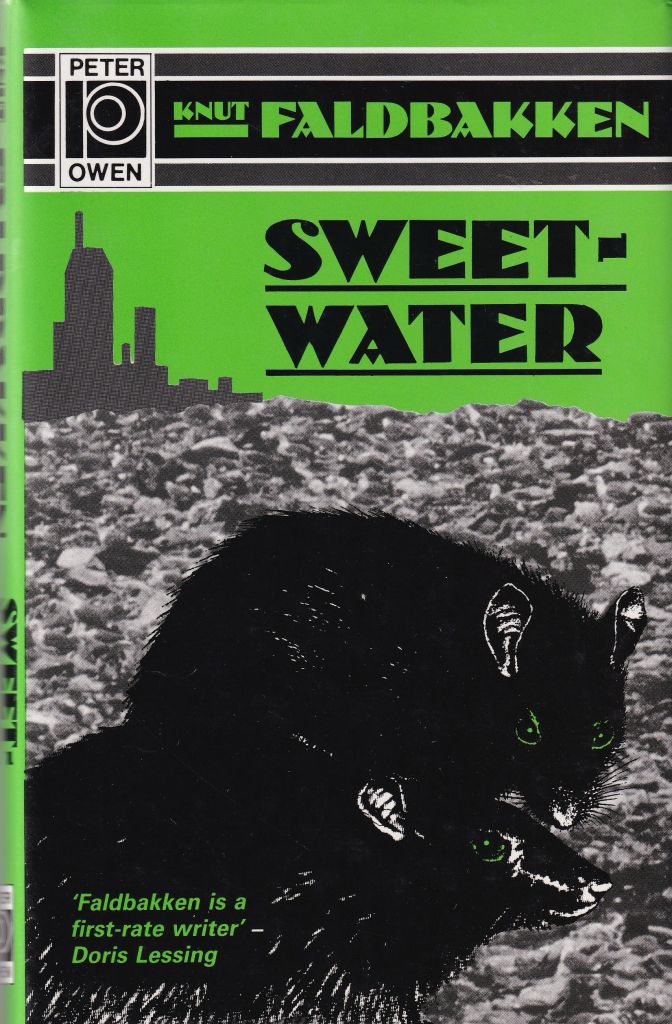
Iain Stuart’s cover for the 1994 edition
4.5/5 (Very Good)
Knut Faldbakken (1941-), a prolific Norwegian novelist, wrote a science-fictional duology titled Sweetwater early in his career. The first volume, Twilight Country (1974, trans. Joan Tate, 1993), followed an odd collection of refugees from a disintegrating urban metropolis, the titular Sweetwater, as they cast off the entangling membranes of lost paths and the weight of melancholy souls and attempt to chart a new beginning in the city Dump.
In volume two, Sweetwater (1976, trans. Joan Tate, 1994), a deathly equilibrium is reached. In an obliquely hinted at dystopia, the city slowly withers and depopulates due to the effects of global warming, industrialization, and malignant societal decay. As the city dies, less and less refuse enters the Dump. The community of outcasts, who inhabit a collection of huts around a camper and crumbling home with small garden plots surrounded by refuse, can no longer scavenge for supplies and food. They must abandon the uncertain topography of the Dump and return to the city.
Faldbakken sets up a series of conceptual clashes and processes that guide the brief fragments of narrative. As with the first volume, there’s a tangible sense of organic transformation within the characters who inhabit the Dump. The narrative first settles on Jonathan Bean, a member of Sweetwater’s Peacekeeping Force, who finally receives approval to search for his brother, who disappeared into the Dump in Twilight Country. As Bean shifts into the background as his previous ideological sense of self fades, the narrative returns to the leader of the community, Allan, a primitivist survivalist willing to dispense justice with his fist, the focus of volume one. But as the mechanisms of survival wear down any remaining delusions, Allan must abdicate his authority to others in the final calculus.
Antiseptic Memories of Sex and Ritual
Jonathan Bean represents an earlier generation, attempting to find order in the ruins. He considers “a degree of collective cleanliness an adequate aim for society’s level of civilization” (15). The evolution of his character forms the central character arc of the novel. He “detested the thought of decay” (8). He had joined the Peacekeeping Force to “counteract the tendency to decay in society” and “restore the dignity of human beings” (8). His quest to find his brother leads him to the Dump, a “nerve-racking” topography that “seems to resist every purposeful encroachment” (6). While overwhelmed by the Dump and the monstrous rats that scurry amongst the refuse, he sees and attacks Boy, the mute son of Allan, the leader of the Dump’s community. Bean’s captured and imprisoned. His illusions about collective cleanliness and order erode.
His memories of order and ritual in Sweetwater revolve around his lover Stella. They’re memories of antiseptic sex and sterile hotel rooms. He remembers the “smell of soap from her clean body” (23), his earlier resistance to sleep with her unless she was “newly powdered, newly oiled” (33), and their jaunts to the Laguna Hotel with its “ impersonal comfort and dry hygienic smell of disinfecting detergents” (163). Life (and erotic experience) in the Dump clashes in an extreme and disquieting manner.
After Bean’s capture, Faldbakken slowly breaks down each element of his self-conception. In one instance, his previous memories of “chemical wine” (13) stashed away for an evening of antiseptic lovemaking with Stella clash with his discovery of a “small curled foot” of a lizard in a meal provided by his captors (18). In another moment, he’s overcome by a horrifying arousal after a brief glimpse of the dirty body of Allan’s wife Lisa and her “toothless smile” while she’s comforted by Doc, her aged surrogate father-figure met in Twilight Country (33). While imprisoned, he’s forced to confront the thin layer of dirt that covers but does not erase his excrement (15) —the perfect metaphor for the new world. His “intense loathing” generated from the community’s “primitive existence” and the “simplicity of their lives” slowly dissipates after he discovers his brother’s fate and participates in the crippling collective daily rituals of acquiring sustenance (47). He sees a “new ‘order’ around him,” a “strange way of harmonizing with their environment of garbage, decay and wretchedness,” one centered on community (49). He wants to build his own ramshackle hut around Allan’s camper (49). But the inevitable shift between city and Dump arrives. Smiley, a one-time pimp and mouthpiece of pseudo-intellectual nihilism puts it best: “Living in other people’s muck like bloody tapeworms […]. And how long do you think that can go on?” (50).
“Paradise out here is singing its last verse” (50)
The novel’s fulcral narratological and conceptual moment revolves around the arrival of a cargo ship in Sweetwater’s port. Faldbakken indulges in a rare bit of political context. The city, starving due to “the Government’s inadequate supply program,” struggles under a dictatorship and police state (52). This totalitarian takeover transpired under the “pious exhortations” that chaos would end. As Smiley puts it, the people failed to realize that the “chaos they’re afraid of is already here” (51). And as the cargo ship runs aground in Sweetwater’s port, all the dreams of a better future coalesce around its metal mass. Does it contain food? Much needed supplies?
Crowds gather dreaming of “a better and fairer distribution” (60). While outside their isolated apartments and participating in discussions, the cocoon of government propaganda loosens. The “State-controlled mass media” proclaims that “all efforts were being made to access” the vital goods on board (68). Soon representatives of a “population subdued for years by an authoritarian political plot” find boats and head out towards the stranded vessel (69). There are no supplies. There are guns for the Peacekeeping Force. Cathartic violence erupts. A rebellion. A brutal suppression. An epidemic exasperated by starvation. A civil war between the militarized factions tasked with keeping peace. No more refuse enters the Dump. Allan, Bean, and Mary, Allan’s second wife and surrogate mother for Lisa’s child Rain, decide to return to Sweetwater.
City as Refuse, Refuse as City
In Twilight Country, Allan, fleeing the city’s entropic slide, notices that “the anarchy of the Dump was creeping in, showing itself in the cracks, consuming the city, slowly dissolving it into the individual basic elements” (45). For Allan, the Dump represents a new frontier, a place to make anew. In Sweetwater, both become identical — the interchanges between the two cease. The empty city, depopulated after revolt, civil war, famine, and epidemic, becomes the new frontier.
Allan, Mary, Rain, and Bean create a new home in an abandoned apartment building. Time in the Dump “hardened them physically and mentally, blunting their minds and imagination, making them capable of fighting on like rats in the ruins of this vast city” (138). They survive on abandoned pets, woodworms, and the encrusted patina of spilt pantries. They revel in the slaughter of a horse. Allan’s brutal brand of survivalism cannot last. His followers, malnourished and diseased, need something else. Like some sacrificial harvest ritual, those anchored by memories of the past will be cast off and some indefinable growth will propel the survivors forward.
Final Thoughts
I am fascinated by densely metaphoric SF “survival” stories within the urban expanse. The city becomes a typological landscape onto which humanity’s travails are inscribed and discerned. Knut Faldbakken’s Twilight Country (1974) and Sweetwater (1976) rate among the best. Both books form a cohesive thematic unit around the central metaphoric processes: the city decaying into the Dump, the Dump shifting back into the city, and the deathly stillness that besets equilibrium. Faldbakken’s prose and descriptions exude earthiness and violence. Unlike other Scandinavian post-apocalyptic nightmares I’ve read—for example, Sven Holm’s Termush (1967, trans. 1969), Anders Bodelsen’s Freezing Down (1969, trans. 1971), and P. C. Jersild’s After the Flood (1982, trans. 1986)—Faldbakken avoids the relentless logic of humanity’s death drive. He suggests, tentatively, a future led by Mary and Rain and informed by the profound trauma experienced: “the War’s over. People have to start again” (183).
For cover art posts consult the INDEX
For book reviews consult the INDEX
For TV and film reviews consult the INDEX
 Science Fiction and Other Suspect Ruminations
Impossible to find a copy without paying at least $22 in postage.
Yes, that’s partly why I wrote the review. People don’t know much about the book and there needs to be a reprint. The duology is great. Sven Holm’s Termush was recently reprinted in a cheaper paperback (after I wrote my review and tracked down an expensive original edition!).
And the first volume of Faldbakken’s sequence — Twilight Country — is far far far far more expensive. I imagine my original review sold the few remaining inexpensive copies. I saw one recently for 200+. The only available copy right now is $110+.
You could always try to ILL it! I dunno if you have a solid local library or access to a University ILL system. If you do, definitely start with volume 1 — Twilight Country — first. I also think it’s marginally the better novel.
I know these SF in Translation posts don’t seem to get a lot comments, but I for one am excited about the new magazine and am always fascinated by how non-English cultures handle the genre – Faldbakken’s chosen subject matter for his duology and Norway not really being a country I associate with urban decay being a good example! Would love to read these but sounds like I’ll have to wait for a reprint.
Glad you enjoyed the post! Those that cover SF in translation find themselves in a double-bind. Because the names are often unknown, it’s hard to pull in the clicks. But then names are often unknown due to the fact they are translated and seldom re-printed… In this instance, as you probably figured out, both volumes are prohibitively expensive! So it’s a lose lose situation trying to promote them. Alas. I’ll keep doing my thing.
But yes, there are a large corpus of Scandinavian dystopias. I’ve enjoyed every one I’ve read so far. It does not seem like Faldbakken set his dystopia in Norway. It’s a dry desert-like place. Albeit, that could be a feature of the ecological catastrophe.
Surprisingly my local library actually has a copy of this! Putting it in my to-read stack 🙂
Nice. In the UK there also appears to be a cheap paperback edition — maybe a print on demand. It, unfortunately, costs 45$ + in the US.
Both volumes? Make sure you start with the first one 🙂
weirdly it’s just the second one, Sweetwater. But whatever, I’ll take what I can get.
That’s a shame. The first one is the better novel. Albeit, the second is still good. They are directly linked with mostly the same characters. The novel could have been published as a single volume.
Pingback: Out This Month: May – Speculative Fiction in Translation