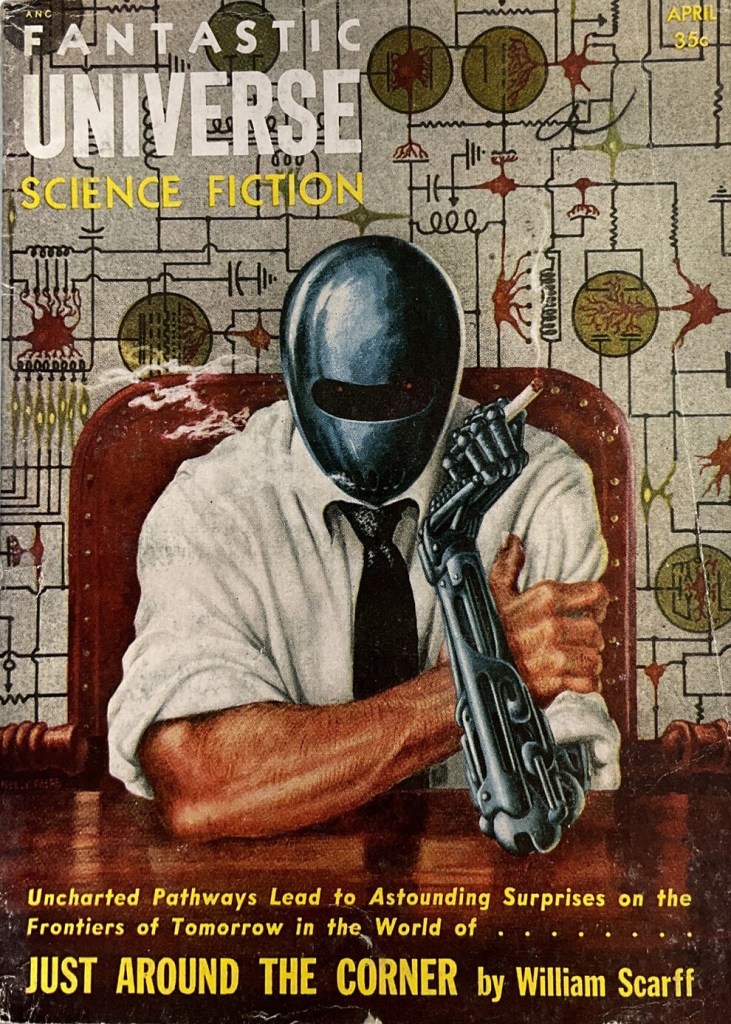
Book Review: Clash by Night and Other Stories, Henry Kuttner and C. L. Moore (1980)

3.5/5 (collated rating: Good)

From 1937 to 1958, the dynamic writing duo of Henry Kuttner (1915-1958) and his wife C. L. Moore (1911-1987) wrote countless stories together. As SF Encyclopedia puts it, “much of [Kuttner’s] later work is inextricably entwined” with that of Moore–often to the point of being unable to entangle who wrote what. While the cover of Clash by Night and Other Stories (1980) does not mention Moore, all the stories in the collection were co-written with her.1

Continue reading

Short Story Review: Kōbō Abe’s “The Flood” (1950, trans. 1989)

Today I’m joined by Rachel S. Cordasco, the creator of the indispensable website and resource Speculative Fiction in Translation, for something a bit different!

We will both offer our reviews of one of Kōbō Abe’s first published speculative short stories, “The Flood” (1950). Over the next few months, we’ll post reviews of speculative fiction in translation from Romania, Chile, Austria, Poland, France, and the Netherlands. Depending on the story and our thoughts, I might also include our responses to each other’s review.

Also if you haven’t checked out Rachel’s website, you must. Not only does she review the global phenomena of speculative fiction but gathers lists of translated fiction by language. Also check out her reference monograph Out of This World: Speculative Fiction in Translation from the Cold War to the New Millennium (2021). In 2016, she contributed to my site reviews of three French SF stories in translation.

We read Kōbō Abe’s “The Flood” (1950) in The Best Japanese Science Fiction Stories, ed. John L. Apostolou and Martin H. Greenberg (1989). Translated by Lane Dunlop. You can read it online here.

Now let’s get to our reviews!

Continue reading

Short Fiction Reviews: Alice Eleanor Jones’ “Life, Incorporated” (1955), “Miss Quatro” (1955), and “Recruiting Officer” (1955)

I ranked Alice Eleanor Jones’ apocalyptic slice-of-life nightmare “Created He Them” (1955) as my favorite SF short story of 2022. I also found Jones’ “The Happy Clown” (1955) a bleakly effective satire of television and consumerism. Unfortunately, Jones only published five short stories in 1955 before leaving science fiction altogether. It’s a shame she did not continue writing SF. With this post, I’ve covered her entire SF output.

Alice Eleanor Jones (1916-1981) received a PhD in English from University of Pennsylvania in 1944 on the seventeenth-century dramatist Shakerly Marmion. In the first year of her writing career, Jones “published five SF stories and two slick romance narratives.” Despite Anthony Boucher’s prediction that she’d be successful in both fields, Jones never returned to science fiction but continued to publish in the leading women’s magazines of the day and wrote a column for the trade magazine The Writer “well into the 1960s.”1 Lisa Yaszek argues that Jones’ “stories about housewife heroines and other domestic figures” do not reiterate conservative ideologues of the day but rather, through the construction of “offbeat” situations, examine how new scientific and social relations would impact women.2 Her two stories from the male perspective, “The Happy Clown” (1955) and “Life, Incorporated” (1955) are anti-consumerist satires.

This post fits–in conjunction with my earlier “Created He Them” (1955) review—in my series on the first three published short stories by female authors. So far I’ve featured Phyllis Gotlieb (1926-2009), Sydney J. Van Scyoc (1939-2023), Josephine Saxton (1935-), Carol Emshwiller (1921-2019), Wilmar H. Shiras (1908-1990), Nancy Kress (1948-), Melisa Michaels (1946-2019), Lee Killough (1942-), Betsy Curtis (1917-2002), and Eleanor Arnason (1942-).

Now let’s get to the stories!


Continue reading

Book Review: The Squares of the City, John Brunner (1965)

4/5 (Good)

Nominated for the 1966 Hugo Award for Best Novel

John Brunner’s The Squares of the City (1965) transposes the moves of a 1892 chess game between Wilhelm Steinitz (1836-1900) and Mikhail Chigorin (1850-1905) onto a near future landscape of political intrigue. Inspired by Brazil’s planned capital Brasília (founded in 1960), the action takes place in Ciudad de Vados, the capital city of the imaginary Latin American nation of Aguazul.1 Conjured out of a “barren, rocky stretch of land,” Ciudad de Vados contains all the homogenized trappings of an ultra-modern metropolis (170). It’s sterile. Planned. Mechanized. Quickly the monumental urban regularity fades into the background and the intricate game across its squares takes over.

Continue reading

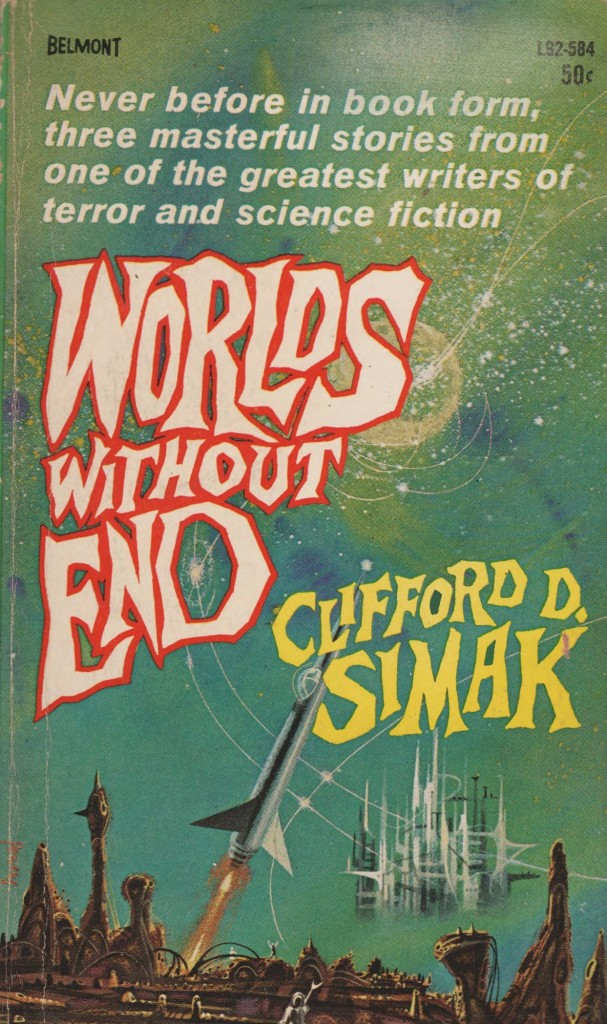
Book Review: Worlds Without End, Clifford D. Simak (1964)

3.5/5 (collated rating: Good)

I’m a compulsive list maker. In the past few years I’ve gathered and submitted older science fiction short stories that depict worker unions–from Robert Silverberg’s “Guardian Devil” (1959) to Mari Wolf’s “Robots of the World! Arise!” (1952)–to the Hugo Book Club’s fantastic index. It’s about time I finally get around to reviewing a few of my submissions!1

Clifford D. Simak’s collection Worlds Without End (1964) contains two novellas and one short story that appeared in Robert W. Lowndes’ magazines (second/third tier SF markets in the 50s). Two of three–“Worlds Without End” (1956) and “Full Cycle” (1955)–speculate on evolution of the trade union after the breakdown of the state.

Continue reading

Short Story Reviews: Howard Waldrop’s “Mary Margaret Road-Grader” (1976), David J. Skal’s “Chains” (1971), and Tom Purdom’s “Courting Time” (1966)

Howard Waldrop (1946-2024), David J. Skal (1952-2024), and Tom Purdom (1936-2024) all passed away since the beginning of the year. As I’ve only read Howard Waldrop’s “God’s Hooks!” (1982), “My Sweet Lady Jo” (1974), and “The Ugly Chickens” (1980) and Tom Purdom’s “Toys” (1967), I impulsively thought I’d stich together a post featuring a tale by each.

Please note that I have not read enough to identify their best work and a negative review is not intended to be a statement about their entire oeuvre and impact on the genre. If you have any fond memories, recommendations for stories, or other tangents related to the three authors, let me know in the comments.

Terry Bisson (1942-2014) also passed away this year but did not publish any short fiction until the 90s. I’ll make sure to review one of his 80s novels—Wyrldmaker (1981) or Talking Man (1986)–this year instead. I’ve also procured novels by Purdom and Skal to feature later this year.

Now let’s get to the stories!


4.5/5 (Very Good)

Howard Waldrop’s “Mary Margaret Road-Grader” first appeared in Orbit 18, ed. Damon Knight (1976). If you have an Internet Archive account, you can read it online here.

Nominated for the 1977 Nebula Award for Best Short Story. Lost to Charles L. Grant’s “A Crowd of Shadows” (1976).

Continue reading

Book Review: The Killer Thing, Kate Wilhelm (1967)

4/5 (Good)

On the last page of the March 1968 issue of The Magazine of Fantasy and Science Fiction, readers encountered an anti-Vietnam War petition, signed by science fiction authors, and organized by Kate Wilhelm and Judith Merril [1]. Both organizers incorrectly assumed that 95 percent of the field would sign due to the “global and anti-racist view” they believed guided SF [2]. Yet, on page 44 of the same issue, a pro-war petition organized by Robert Heinlein and Jack Williamson appeared with slightly less signatories. The June 1968 issue of Galaxy placed both lists next to each other for added effect.

Much ink has been spilt on the division lines between New Wave and Old Guard demonstrated by the two opposing advertisements [3] and in analysis of the canonical anti-Vietnam War science fiction novels, such as Joe Haldeman’s The Forever War (1975), partially compiled from stories that appeared as early as 1973, and Ursula K. Le Guin’s The Word for World is Forest (1972), written in 1968. Far less attention has been given to the Vietnam-inspired fiction of Kate Wilhelm, one of the organizers of the petition. Only her short story “The Village” (1973) receives occasional mention–it transposes a My Lai-esque massacre to the US. Little attention has been given to her third novel The Killer Thing (1967), written at a far earlier stage of the conflict [4].

Continue reading

Short Story Reviews: Michael Bishop’s “The Windows in Dante’s Hell” (1973), Barrington J. Bayley’s “Exit from City 5” (1971), and A. J. Deutsch’s “A Subway Named Mobius” (1950)

My first review of 2024!

To quote a much younger me: “I’ve always been fascinated by imaginary and historical cities: the utopian (Tommaso Campanella’s 1602 work The City of the Sun), the allegorical (Calvino’s Invisible Cities), the multi-layered (Ancient, Medieval, and Renaissance Rome), the planned (Palmanova), the [fantastically] decaying (Jeff VanderMeer’s Ambergris), the multi-tiered (Tolkein’s Minas Tirith)…”

The science-fictional examples–from the urban gestalt of San Francisco in John Shirley’s  City Come A-Walkin’ (1980) to the arcologies of an overpopulated world in Robert Silverberg’s The World Inside (1971)–hold special appeal. As manifestations of societal decadence and vice or vibrant communities of interaction and discovery, they often become characters—changing and evolving over the course of the narrative.

To inaugurate my brand new short story review series on The Urban Landscape in Science Fiction, I’ve selected one of my favorite SF short stories: Michael Bishop’s “The Windows in Dante’s Hell” (1973). Bishop adeptly renders a human drama in a future Atlanta, replete with soaring dome and nine subterranean levels. I’ve paired it with two stories entirely new to me: Barrington J. Bayley’s “Exit from City 5” (1971) and A. J. Deutsch’s “A Subway Named Mobius” (1953). Bayley depicts a city as generation ship. A. J. Deutsch imagines a mathematical mystery within a rapidly expanding metro system underneath a future Boston.

Let me know if you have any favorite city-centric short stories that I haven’t covered on the site published pre-1985 that I could include in this series.

Up Next: Robert Abernathy’s “Single Combat” (1955).


5/5 (Masterpiece)

Michael Bishop’s “The Windows in Dante’s Hell” first appeared in Orbit 12, ed. Damon Knight (1973). If you have an Internet Archive account, you can read it online here.

Continue reading

Short Fiction Reviews: Russell Bates’ “Hello, Walls and Fences” (1973), “Rite of Encounter” (1973), and “Warning: The Surgeon General Has Determined…:” (1977)

"There is a world of experience and culture that is exclusively Amerindian that has never been told. That I have set out to try to relate what I can of this world is audacious, perhaps. But there was simply no way I could have done otherwise, even if I had consciously tried" -- Russell Bates' intro to "Rite of Encounter" (May 1973)

With this post I complete my micro-series covering the short fiction of Kiowa author Russell Bates (1941-2018), one of a handful of Native American science fiction authors active in the 1970s. In Part I, I provided a short biography and what I could find about his writing career including contributing to Star Trek: The Animated Series (1973-1974), and reviewed his first three short stories.

In this post, I’ll cover his three remaining published non-franchise science fiction stories. He also wrote “The Patient Parasites” anthologized in Star Trek: The New Voyages 2, ed. Myrna Culbreath and Sondra Marshak (1978) that I won’t feature. Unfortunately, his submission–“Search Cycle: Beginning and Ending 1. The Last Quest; 2. Fifth and Last Horseman”–to Harlan Ellison’s infamous Last Dangerous Visions, slated for 1973, still has not seen the light of day.

“Hello, Walls and Fences” (1973) and “Warning: The Surgeon General Has Determined…:” (1977) also serve as the 32nd and 33rd story in my media landscapes of the future series.

Previously: Edmond Hamilton’s “Requiem” (1962) and John Anthony West’s “George” (1961)

Up Next: George H. Smith’s “In the Imagicon” (1966)


3.75/5 (Good)

“Hello, Walls and Fences” first appeared in Infinity Five, ed. Robert Hoskins (1973). You can read it online here.

A bleak allegory of the societal forces that compel the creative to sell their souls, “Hello, Walls and Fences” follows a nameless narrator attempting to find work from a mysterious tycoon named Thornton, who spends his days on a technologically advanced estate playing wickets and eating cheese. The work itself isn’t entirely clear: it might concern computer programing for massive one-time military “hologrammers” that Thornton places across his oasis (70).

Continue reading