Adventures in Science Fiction Cover Art: A Handful of Tufted Gumby Aliens and Mushroom People

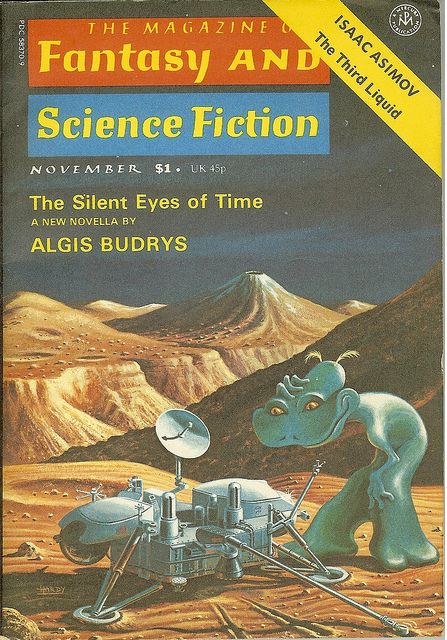
(David Hardy’s cover for the November 1975 issue of The Magazine of Fantasy and Science Fiction)

I couldn’t stop laughing while putting together this post from my collection of gleaned covers: gumby in space with two fuzzy tufts and three unsymmetrical eye ridges (or, his fingers) ogling at a space probe, mushroom people transfixed by a mysterious white tentacled orb hoisted aloft by man in a pink cape and a skimpy pink unitard, evil nosed caterpillars, scary monstrous mole monster, etc.  Did the editors KNOW precisely what the art looked like before it appeared on the covers evoking such throat hurting unintended (or perhaps intended) consequences?  But, I have to admit there’s nothing like a cool (and funny alien) to make me pick up a book or magazine.

As always, what are your favorite funny alien covers which I haven’t posted?

I’ve read a few of Vance’s novels so I’ll probably pick up The Eyes of the Overworld Continue reading

Adventures in Science Fiction Cover Art: A Selection of Bleak Alien Landscapes

(Alex Schomburg’s cover for the 1953 edition of Space, Space, Space (1953), ed. William Sloane)

Our science fiction heroes are often confronted by bleak alien landscapes adorned with rocks, vast deserts, adverse atmospheres — commonly these vistas are traversed, colonized, tamed…  Spaceships touch down on virgin surfaces, the explorers tentatively step forward, aliens peer from the distance.  When settlements are built the alien vista remains an ever present source of fear and fascination.  The depiction of a convincingly bleak alien landscape (think Arrakis in Frank Herbert’s Dune) can be of paramount importance in conveying not only  otherworldliness but the backdrop for human drama and the challenges our heroes must overcome (by technology or other Continue reading

Book Review: The Lifeship, Harry Harrison and Gordon R. Dickson (1976)

3.5/5 (Good)

Harry Harrison and Gordon R. Dickson’s The Lifeship (1976) is two parts tense and exciting adventure in the expanse of space and one part half-hearted “key differences between individuals are overcome in the end” attempts at social commentary.  I found the first two-thirds of the work riveting.  Sadly, the final third devolves into a ramshackle and unpleasant mixture of save the world formulae and endless exposition at gunpoint about all the nefarious nooks and crannies of each and every plan, counter-plan, potential plan, half-realized plan, and unrealized plan soon to be fomented in the liminal realm of coalescing Continue reading

Adventures in Science Fiction Cover Art: A Handful of Funny Robots

Unless those arms extend the robot's only use will be to run over people -- which it's about to do.

(Ed Valigursky’s cover for the the 1962 edition of Next Stop The Stars (1962), Robert Silverberg)

While browsing through my rapidly growing collection of cover images on my computer I couldn’t stop laughing at the hilarious robots that pop up every now and then.  From evil looking R2D2s (with legs) to multi-handed flying death robots with unfortunate double smiley faces!  Oh, and the crying rescue robot….

If I were in the robot designing business I’d conjure up a robot that could cry — a good use of time — as useful as Data with his emotion chip talking to his tricorder or finally understanding jokes: “Geordi: The Farpoint mission? Data, that was seven years ago. Data: I know! I just got it! Very Continue reading

Updates: Recent Science Fiction Acquisitions N. XIII

A few fellow History grad students and I (and two or three from various departments — Gender Studies, English) have cobbled together a science fiction reading group list for this fall and spring: mainly social sci-fi by female authors along with a few random gems by Ballard (The Drowned World), Silverberg (The World Inside), and Delany (Nova).  I wasn’t going to buy any sci-fi books this semester.  I promise.  That is before we formed our reading group!  So, I had to pick up the few works on our list that I didn’t already own.

What a haul!

1. The Drowned World (1962), J. G. Ballard

Continue reading

Adventures in Science Fiction Cover Art: A Selection of Elevated Cities Part I

(uncredited cover for the 1975 edition of Growing Up in Tier 3000 (1975), Felix C. Gotschalk)

“After a seven days’ march through woodland, the traveler directed towards Baucis cannot see the city and yet he has arrived.  The slender stilts that rise from the grown at a great distance from one another and are lost above the clouds that support the city […] There are three hypotheses about the inhabitants of Baucis: that they hate the earth; that they respect it to much they avoid all contact; that they love it as it was before they existed and with spyglasses and telescopes aimed downward they never tire of examining it, leaf by leaf, stone by stone, ant by ant, contemplating with fascination their own absence” — Italo Calvino (Invisible Cities, 1972, pg. 77)

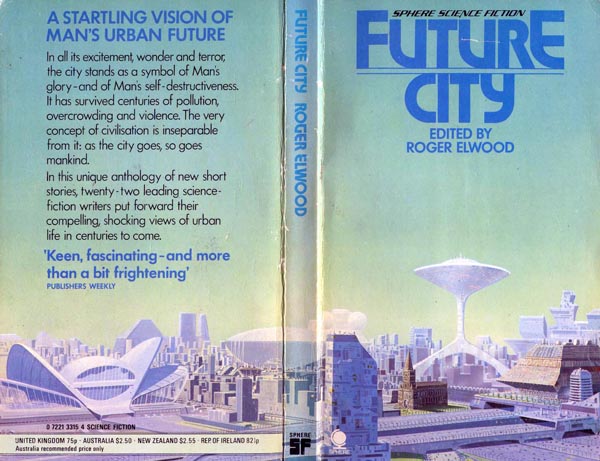
I’ve always been fascinated by imaginary and historical cities: the utopian (Tommaso Campanella’s 1602 work The City of the Sun), the allegorical (Calvino’s Invisible Cities), the multi-layered (Rome), the planned (16th century Palmanova), the decaying (Jeff VanderMeer’s Ambergris), the multi-tiered (Tolkein’s Minas Tirith)…   Continue reading

Book Review: Missing Man, Katherine MacLean (1975)

5/5 (Near Masterpiece)

Nominated for the 1976 Nebula Award for Best Novel

Katherine MacLean’s underrated and seldom read novel Missing Man (1975) was expanded from her 1971 Nebula Award winning novella by the same name.  I’ve not read the original version so I’m unsure about how much was added, subtracted, or completely re-conceptualized.

The novel version is a finely wrought vision of a future post-disaster Balkanized New York City comprised of innumerable communes, often at war with each other, inhabited by a small number of slightly telepathic people who are able to detect the emotions of others.  Archetype individuals unknowingly project emotions when they are in danger which could at any moment plunge society into intercommune Continue reading