Updates: Recent Science Fiction Acquisitions No. CCXXXIX (Jack Dann, Judith Merril, Anne McCaffrey, John Shirley)

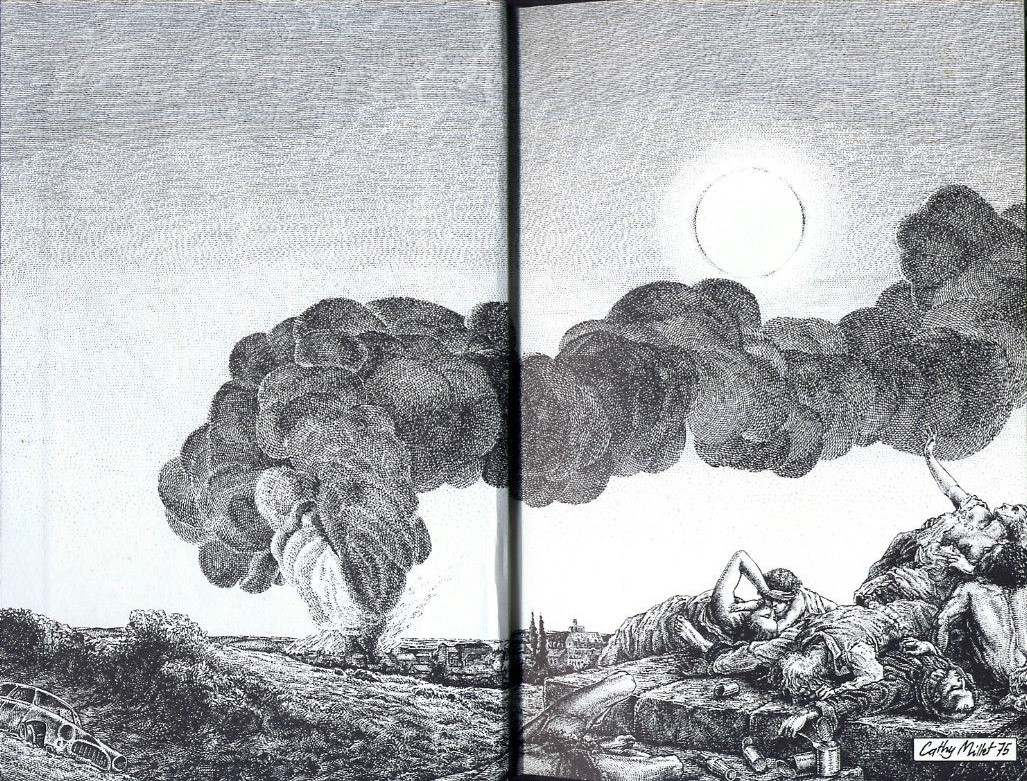
1. I have yet to read any of Jack Dann’s SF — this surreal (?) post-apocalyptical novel looks promising! And a strange Jim Burns cover to boot…

2. I recently reviewed Judith Merril’s “Wish Upon a Star” (1958) for my generation ship short story read-through (i’ll have a new installment soon). I decided to track down another one of her short fiction collections….

I’ve reviewed the following collections so far:

3. The title of Anne McCaffrey’s collection Get Off the Unicorn (1977) was derived from a humorous misprint. According to the collection’s introduction: “The title was derived by accident: McCaffrey’s working title had been “Get of the Unicorn” but this was misprinted as “Get Off the Unicorn” in Ballantine’s roster of unfilled contracts. After McCaffrey’s editor, Judy-Lynn del Rey, was repeatedly asked what “Get Off the Unicorn” was, del Rey asked McCaffrey what she could do about that theme.”

The collection itself contains a wide-range of her short fictions—from the Pern sequence (a childhood favorite) to the earliest story in the Catteni Sequence. I DEVOURED Freedom’s Landing (1995), Freedom’s Choice (1997), Freedom’s Challenge (1998), and Freedom’s Randsom (2002) as a kid! How to survive and thrive on an alien planet was my “go-to” SF device.

4. I’ve only read a handful of John Shirley’s short stories. It’s time for a novel. Eclipse (1985), set in a future a cyberpunk dystopia, tells the tale of anti-fascist resistance. We shall see!

Let me know what you think of the books and covers in the comments!

1. The Man Who Melted, Jack Dann (1984)

(Jim Burns’ cover for the 1986 edition) Continue reading

Adventures in Science Fiction Cover Art: The Spectral Visions of Terry James, Part I

(The 1967 edition of Mindswap (1966), Robert Sheckley)

A few weeks ago I reviewed Clifford D. Simak’s The Werewolf Principle (1967) and came across Terry James’ cover (below) for the 1969 Science Fiction Book Club (UK) edition. The spectral shedding/transforming of the human figure matched the uncanny vibe of the novel. And I headed immediately to isfdb.org to browse his ouvre (note: a few volumes in the pub. series are clearly his but remain uncredited)! And I decided to put together a series of posts showcasing his work.

His art, the entire catalog of SFBC editions between 1968 and the mid-way point of 1971, works with little Continue reading

Book Review: The Bleeding Man and Other Science Fiction Stories, Craig Strete (1977)

(Karl Stuecklen’s cover for the 1st edition)

4/5 (collated rating: Good)

In 2015, I read and reviewed Craig Strete’s collection If All Else Fails…. (1980) and found it to be a spectacular vision “filled with gorgeous lines, evocative images” and palpable “despair at the loss of Native-American culture.” Strete, one of the few Native-American SF authors I know of, picked up three Nebula Award nominations for short SF over the 70s and early 80s (“Time Deer” in 1976, “The Bleeding Man” in 1976, and “A Sunday Visit With Great-Grandfather” in 1981 although it was withdrawn). The latter two are in this collection. The former two can be found in If All Else Fails….

Recommended for fans of experimental 70s Continue reading

Updates: Recent Science Fiction Acquisitions No. CCXXXVIII (Poul Anderson, Kathleen M. Sidney, Barry B. Longyear, Philippe Curval)

1. I have yet to read anything by Barry B. Longyear, best known Enemy Mine (with David Gerrold) (1985) and Sea of Glass (1986). Circus World (1981) seems like a fun series of linked short stories published in 1978 and 1979 about the descendants of a crashed circus ship.

2. My Poul Anderson collections grows and grows. Sometimes I’m not sure why I bother procuring them… I mean, it was only $1. See the index for my extensive (and apparently contentious) reviews of his work i.e. Tau Zero (1971). And eww, a gauzy cover by Gene Szafran….

3. A complete unknown—and Kathleen M. Sidney’s only SF novel (she wrote three additional short stories according to isfdb.org).

4. Vintage French SF in translation! With a fantastic cover by Max Ernst. In addition to writing SF, Philippe Curval produced fascinating photo collage SF cover art. I’ve featured his art previously on the site: Part I and Part II.

Let me know what you think of the books and covers in the comments!

~

1. Circus World, Barry B. Longyear (1981)

(John Rush’s cover for the 1981 edition) Continue reading

Book Review: The Werewolf Principle, Clifford D. Simak (1967)

(Richard Powers’ cover for the 1st edition)

3.25/5 (Vaguely Good)

“Have you ever thought that I was frozen and thrown off the ship because they didn’t want me aboard, because I’d done something or they were afraid of me or something of the sort?” (49)

Andrew Blake, with memories of an earlier Earth, is discovered by asteroid miners frozen in a capsule. Is he the crew of a lost vessel? Was he the victim of a catastrophic accident? Or, something far more sinister? A claustrophobic and violent mission unfolds has Andrew Blake seeks to establish his identity, and the reason for the two alien voices in his head, while Continue reading

Updates: Recent Science Fiction Acquisitions No. CCXXXVII (Rex Gordon, Craig Strete, Graham Dunstan Martin, and an Anthology of European SF)

Clifford D. Simak, Tanith Lee, and M. A. Foster reviews are incoming. The first few weeks of every semester hit with a vengeance—teaching is an exhausting profession.

In the meantime get inspired to read vintage SF by ogling these gems!

1. In my youth I was obsessed with Victorian/Belle Epoque survivalist novels–Jules Verne’s The Mysterious Island (1874), Perseverance Island Or the Robinson Crusoe Of The Nineteenth Century(1885), et al. I judged them on their “realistic” portrayals of how man (and yes, the characters were always men) moved up the technological tree—from fire to steam engines—in a hostile world. Although I’ve utterly disavowed SF that adheres to such  naive technological triumphalism, occasionally nostalgia calls…. Here’s a SF Robinsonade along similar lines.

2. I adore Craig’s Strete unique brand of SF story. I reviewed, in abbreviated form, his spectacular collection If All Else Fails…. (1980). I’ll read this one soon! The Bleeding Man and Other Science Fiction Stories is also a well-designed volume as elements of the cover art are used at the beginning of each short story.

3. Another unknown commodity—seems to combine SF and fantasy tropes.

4. Back in November I acquired the second in the Terra SF series of anthologies edited by Richard D. Nolane of Western European SF in translation. I pointed out that the first volume online was prohibitively expensive. A follower on twitter discovered that a seller on Amazon incorrectly listed the collection under another title—at a radically reduced price. Now it’s a happy member of my collection.

Let me know what you think of the books and covers in the comments!

~

1. First on Mars (variant title: No Man Friday), Rex Gordon (1956)

(Kelly Freas’ cover for the 1976 edition) Continue reading

Updates: Recent Science Fiction Acquisitions No. CCXXXVI (Eric Frank Russell, Cherry Wilder, Tim Powers, and Kevin O’Donnell, Jr.)

1. I adore the SF Rediscovery series published by Avon (full listing with covers here): the large size, the font and formatting, the framing of the art, and the general feel of the volume in my hand. If there’s a downside it’s the so-so quality of the art itself. I own and have reviewed two in the series previously: Barry N. Malzberg’s brilliant Revelations (1972) and E. C. Tubb’s generation ship novel The Space-Born (1955).

I have yet to read any of Eric Frank Russell’s SF—The Great Explosion (1962) seems to fit the satirical anti-Imperialism mode… we shall see!

2. A book an author whom I know little about…. Tony Roberts’ cover and the back-cover blurb intrigue!

3. Tim Powers’ first two novels were science fiction for the Laser Books imprint. I do not have high hopes (the imprint was notoriously low quality) but always enjoy exploring the early visions of authors. Miserable cover aside, it has a fun (if silly) premise!

4. A generation ship novel! (with a few unusual twists?)

Let me know what you think of the books and covers in the comments!

1. The Great Explosion, Eric Frank Russell (1962) (MY REVIEW)

(Chris Foss’ cover for the 1975 edition) Continue reading

Generation Ship Short Story Review: A. E. van Vogt’s “Centaurus II” (1947)

Preliminary note: This is the sixth post in a series of vintage generation ship short fiction reviews. All of the stories I’ll review are available online (see links below). You are welcome to read and discuss along with me as I explore humanity’s visions of generational voyage. And thanks go out to all who have joined already.

Previously: J. G. Ballard’s “Thirteen to Centaurus” (1962)

Next up: Chad Oliver’s “Stardust” (1952)

I’ve compiled a helpful list on the theme with links to all my reviews.

(Charles Schneeman’s cover for the June 1947 issue of Astounding Science Fiction, ed. John W. Campbell, Jr.)

4/5 (Good)

A. E. van Vogt’s “Centaurus II” (1947)* (story link) first appeared in the June 1947 issue of Astounding Science Fiction edited by John W. Campbell, Jr. Together with two later stories—“Rogue Ship” Continue reading

Updates: Recent Science Fiction Acquisition No. CCXXXV (M. A. Foster, Garry Kilworth, Cary Neeper, and Anthology)

1. A fascinating, and disturbing, themed anthology edited by Thomas M. Disch. Of the stories in the anthology (see contents below), I look forward to Gene Wolfe’s “Three Million Square Miles” (1971) the most.

Richard Powers’ cover is gorgeous.

2. I recently read and enjoyed Garry Kilworth’s The Night of Kadar (1978) so I pulled the trigger and purchased a handful of his other early SF works. I’m also for ambivalent takes on revolutions…. In Solitary (1977) is Kilworth’s first published novel. According to  SF Encyclopedia, the novel “is set on an Earth whose few remaining humans have for over 400 years been dominated by birdlike Aliens, and deals with a human rebellion whose moral impact is ambiguous; the novel is the first of several combining generic adventurousness – indeed opportunism, for Kilworth seldom accords his full attention to the raw sf elements in his tales – and an identifiably English dubiety about the roots of human action. Consequences of such action in a Kilworth novel are seldom simple, rarely flattering, usually ironized.”

Will read this one soon.

3. I know little about M. A. Foster’s SF other than a few articles I’ve read here and there–The Gameplayers of Zan (1977) included. In 2009 Jo Walton wrote a positive article about the novel on tor.com.

4. A completely unknown author (Cary Neeper) and novel (A Place Beyond Man)…. I don’t have a lot to go on for this one!

Let me know what you think of the books and covers in the comments!

~

1. The Ruins of Earth: An Anthology of the Immediate Future, ed. Thomas M. Disch (1971)

(Richard Powers’ cover for the edition) Continue reading