Updates: Recent Science Fiction Acquisitions No. CXXXV (Delany + Wyndham + Budrys + McIntyre)

*preliminary note:  I am on something of a semi-hiatus—PhD writing and the like.  However, I have a Malzberg review of Scop (1976) nearly complete and might do a rundown of the SF I’ve been unable to review over the past few months in a more informal format (one paragraph reviews or something of that ilk)—Phillip Mann’s Wulfsyan (1990), M. John Harrison’s The Machine in Shaft Ten (1975), etc.

In my recent travels, I stopped in Nashville, Tennessee and picked up three of the four novels for under a dollar each.  McIntyre’s novel is the sole Hugo Award Winner for best Novel between the years 1953 to 1990 I’ve not read.  I should remedy that immediately as I’ve enjoyed her other work—for example, the novella “Screwtop” (1976).

Budrys’ novel actually sounds like I’d enjoy it despite my dislike of some of his work (and views)…. It certainly is my type of SF story concept-wise.  The last Delany novel missing from my collection and everyone loves Wyndham and immortality SF, right?

Thoughts?

1. Dreamsnake, Vonda N. McIntyre (1978)

DRMSNKA21978

(Stephen Alexander’s cover for the 1978 edition of Dreamsnake) Continue reading

Updates: Recent Science Fiction Acquisitions No. CXXXIV (Mann + Moorcock + Farmer + Adlard)

I bought and am in the process of reading a novel from the 90s… Look below to find out which one! (SHOCKING).

Also, more in line with my common (recent) reading patterns, a lesser known but supposedly brilliant 70s novel, Interface (1971) by Mark Adelard.  According to SF Encyclopedia: “The series is set in a city of the Near Future.[…] With a rich but sometimes sour irony, and a real if distanced sympathy for the problems and frustrations of both management and workers, Adlard plays a set of variations, often comic, on Automation, hierarchical systems, the Media Landscape, revolution, the difficulties of coping with Leisure, class distinction according to Intelligence, fantasies of Sex and the stultifying pressures of conformity.”  The banal back cover description indicates a rather lesser novel than Clute’s praise…

More Philip José Farmer—early work, early work only!

And, well, I’ve never Moorcock’s SF/F but, perhaps my first collection of his short fiction will indicate what people claim he is capable of.

All but the last novel came via Carl at Stainless Steel Droppings on his book store trip…. Thanks again!

Thoughts?

1. Interface, Mark Adlard (1971) (MY REVIEW)

NTRFCKRGSP1977

(Paul Alexander’s cover for the 1977 edition) Continue reading

Book Review: Garbage World, Charles Platt (serialized 1966)


NW_0168

(Keith Roberts’ cover for New Worlds SF, October 1966, ed. Michael Moorcock)

2/5 (Bad)

In 1980, 3,000 copies of Charles Platt’s SF novel The Gas (1968)—in which, the “eponymous gas, accidentally released over England, works as an irresistible aphrodisiac […]” and, according to John Clute at SF encyclopedia, contains “sex material” in “transgressively pornographic terms”—were seized by UK’s Director of Public Prosecutions in effect preventing a UK distribution [article].

Platt’s first novel, Garbage World (serialized 1966), feels like The Gas‘s SF juvenile little brother i.e. without the transgressive porn but all the intent to shock a 14 year old boy, although it’s never more than “the warmth of the mud mingled with the warmth of their lovemaking” (95).  So, what is this tidbit of effluvia all about?  First, the silliest part of the novel—the often scatalogical chapter titles: “Garbage Party” (21), “The Hole” ( 57), “The Yellow Rain” (81), “The Defecated Village” (100), “The Great Purgative Continue reading

Updates: Recent Science Fiction Acquisitions No. CXXXIII (Vance + Wolfe + Yarbro + Malzberg)

Two more novels via Carl V. Anderson over at Stainless Steel Droppings—thanks again!  … and two I’ve had laying around for a while.  My Malzberg solo SF novel (non-movie novelization) collection is complete!

Eventually I might read a select few works from the 80s, if I do Gene Wolfe will be at the top of the list. His short fiction from the 70s has wowed me so far (here and here).

Thoughts?

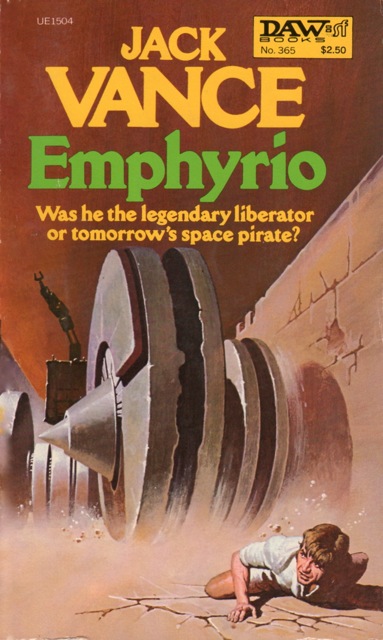
1. Emphyrio, Jack Vance (1969)

MPHRKNBHMQ1979

(Gino D’Achille’s cover for the 1979 edition) Continue reading

Book Review: Walk to the End of the World, Suzy McKee Charnas (1974)

5/5 (Masterpiece)

“The men heard, and they rejoiced to find an enemy they could conquer at last.  One night, as planned, they pulled all the women from sleep, herded them together, and harangued them, saying, remember, you caused the Wasting” (3).

Suzy McKee Charnas’ Walk to the End of the World (1974) is the first of four novels in The Holdfast Chronicles sequence (1974-1999) that charts the slow forces of change in a post-apocalyptical future where women (“fems”) are chattel.  Kate Macdonald, in her wonderful review of Ammonite (1993) characterized Nicola Griffith’s novel as “instantly […] feminist: not stealth, or muted, or sub-conscious.”  Walk to the End of the World falls squarely, and powerfully into this category.  Told with intensity and vigor, Charnas brands the reader with her vision, a searing and festering landscape where white men have either exterminated the remaining “unmen” (the “Dirties”) or subjugated them (the “fems”) after a manmade cataclysm.  Complex societal institutions maintain control in a mostly illiterate world via appeals to collective memory, intensive drug facilitated indoctrination, and the deconstruction of the family unit in favor of exclusively homosocial relationships.

Continue reading

Updates: Recent Science Fiction Acquisitions No. CXXXII (Longyear + Wilhelm + Anderson et al. + Raphael)

Carl V. Anderson over at Stainless Steel Droppings often picks up books for me when he peruses the used book stores in his region (I pay for them of course! haha).  Thanks again! Over the next few months or so I’ll be posting a range of the ones he acquired for me—three of the four here.

I always want more Kate Wilhelm….

Poul Anderson’s invented world “shared” by other SF authors…

A collection (masquerading as a fix-up novel?) by Barry B. Longyear—whose work I have never read…

And Rick Raphael’s most well known work—another “new” author…

Thoughts?

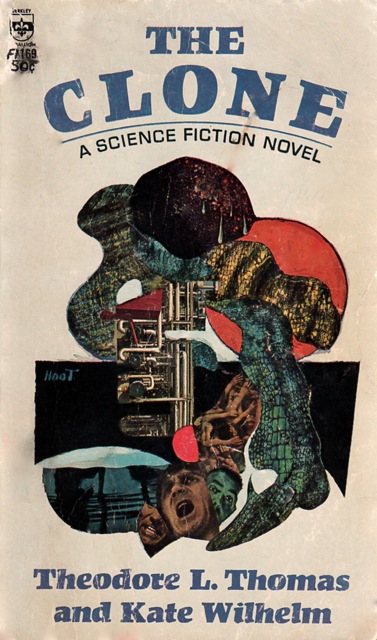
1. The Clone, Theodore L. Thomas and Kate Wilhelm (1965)

THECLONE1965

(Hoot von Zitzewitz’s cover for the 1965 edition) Continue reading

Book Review: The Custodians and Other Stories, Richard Cowper (1976)

IMG_0590

(Geoff Taylor’s cover for the 1978 edition)

3.25/5 (collated rating: Vaguely Good)

The Custodians and Other Stories contains Richard Cowper’s most famous short SF (both received Nebula nods): “The Custodians” (1975) and “Piper at the Gates of Dawn” (1976), later published side-by-side with his Nebula-nominated novel in the same sequence The Road to Corlay (1978).

My limited exposure to Cowper’s work so far—i.e. the hilarious post-apocalyptical black comedy on the British class system replete with intelligent dolphins and giant submarines,  Profundis (1979)—suggests an author who  can weave a solid story in a range of SF sub-genres from time travel Continue reading

Updates: Recent Science Fiction Acquisitions No. CXXXI (Cowper + Aldiss + McKenna + New Worlds Anthology)

While in Scotland a few weeks ago I could not help but peek into a few used book stores! As an American, I am intimately acquainted with the common US publishers (Ballantine + Signet + Avon + et al) but do not own very many 70s/80s UK editions (Pan + Grenada + Panther, etc).  Thus, there was something special about snatching a copy of Best SF Stories from New Worlds 8  (1974) as it was one of the few in the series never published in the US…

Enjoy the cover art!

[I am not sure what to make of the Jim Burns’ cover…  I have the feeling that it appeared on Good Show Sir a while back]

Thoughts?

[If you are in Edinburgh and want new SF/F stop by Transreal Fiction—and talk to the owner Mike!]

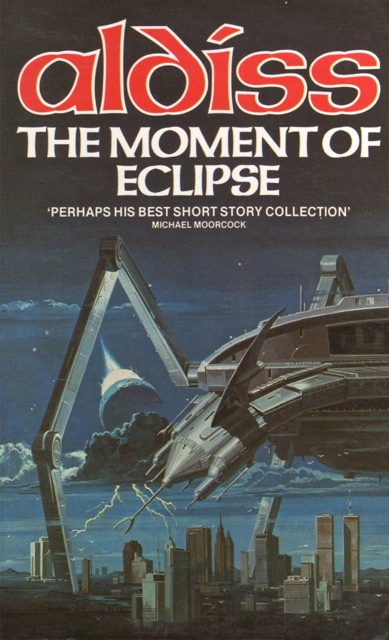
1. The Moment of Eclipse, Brian W. Aldiss (1970)

THMMNTFCLP1985

(Vincent Di Fate’s cover for the 1985 edition) Continue reading

Book Review: Out of Bounds, Judith Merril (1960)

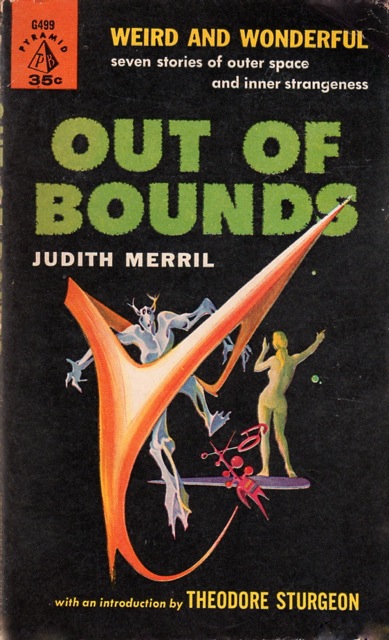
OTFBNDS1960

(Art Sussman’s cover for the 1960 edition)

3.25/5 (collated rating: Vaguely Good)

I have long been a fan of both Judith Merril’s fiction and edited volumes.   The eponymous novella in the collection Daughters of Earth (1968) is one of more delightful visions from the 1950s I have encountered. Merril reframes biblical patrilineal genealogy as matrilineal–i.e. humankind’s conquest of space is traced via the female descendants of an august progenitor.  The story is brilliant in part due to a remarkable metafictional twist, the story itself is compiled from historical documents to serve as an instructional template for future generations of women.  Despite substantial editorial control that forced Merril to include a rather hokey plot on two hokey planets, the story remains memorable for the well crafted feminist Continue reading