Short Story Review: Theodore Sturgeon’s “Memorial” (1946)

I recently finished David Dowling’s Fictions of Nuclear Disaster (1987) and thought I’d review a handful of the short stories discussed in the monograph. The first on my list is Theodore Sturgeon’s haunting “Memorial” which first appeared in the April 1946 issue of Astounding Science Fiction, ed. John W. Campbell, Jr. You can read it online here.


“Memorial” (1946), Theodore Sturgeon, 4/5 (Good): Grenfell has a plan to create a war memorial to end all memorials—The Pit. It will writhe with lava. It will shine forth with a ghastly glow. Created by nuclear explosion a thousand times as powerful as the Hiroshima bomb (161). Like some grotesque manifestation of the Darvaza gas crater, it will be a “living reminder of the devastation mankind has prepared for itself” (161). And the message will be the most “useful thing in the history of the race—a never-ending sermon, a warning, an example of the dreadful” possibilities of nuclear war (161).

Continue reading

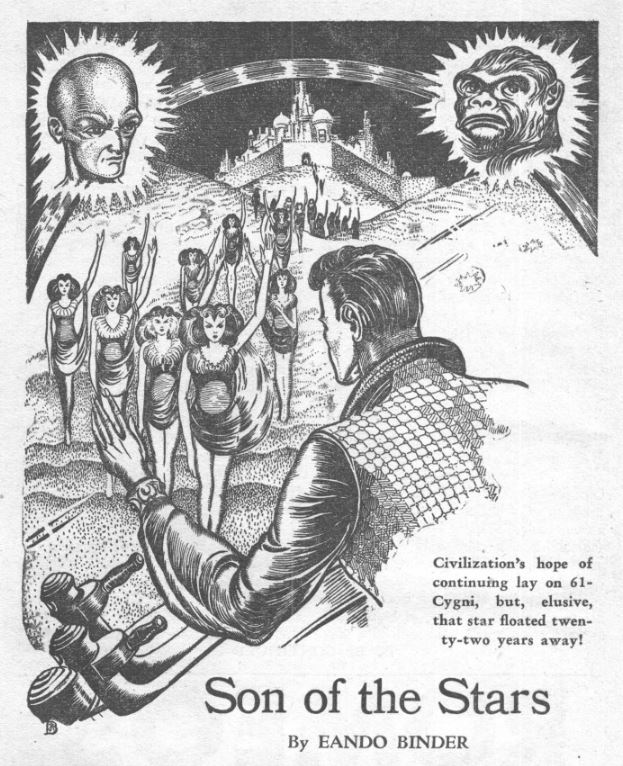
Generation Ship Short Story Review: Otto Binder’s “Son of the Stars” (1940)

This is the 8th post in my newly resurrected series of vintage generation ship short fiction reviews. As this series has a real chance to cover every pre-1985 generation ship short story available in English, I’ve bitten the bullet and stepped back to the pre-WWII SF landscape to track down a generation ship story by Otto Binder. I tend to be far more interested in post-WWII US and European SF history and have geared most of my site towards those decades.

As a reminder for anyone stopping by, all of the stories I’ll review in the series are available online via the link below in the review.

You are welcome to read and discuss along with me as I explore humanity’s visions of generational voyage. And thanks go out to all who have joined already. I also have compiled an extensive index of generation ship SF if you wish to track down my earlier reviews on the topic and any that you might want to read on your own.

Previously: Chad Oliver’s “Stardust” (1952) 

Next Up: Leigh Brackett’s “The Ark of Mars” (1953) 

Otto Binder’s “Son of the Stars” first appeared in the February 1940 issue of  Famous Fantastic Mysteries, ed. Mary Gnaedinger. 2.75/5 (Vaguely Average). You can read the story online here. As always, I will have spoilers.

First, a note about authorship and pseudonyms: According to The Internet Speculative Fiction Database, Otto Binder is the sole author of “Son of the Stars.” “Eando Binder” was a joint pseudonym used by American brothers Earl Andrew Binder (1904-1966) and Otto Oscar Binder (1911-1975). After 1934, the elder brother Earl stopped writing SF and Otto continued to sign his work under the shared name. For more on their SF, check out their SF Encyclopedia entry.

Continue reading

Short Story Review: Kris Neville’s “Cold War” (1949)

The following review is the 7th post in my series searching for “SF short stories that are critical in some capacity of space agencies, astronauts, and the culture which produced them.” Some stories I’ll review in this series might not fit. And that is okay! I relish the act of literary archaeology.

Thank you Antyphayes, “Friend of the Site,” for bringing this story to my attention!

Previously: Theodore L. Thomas’ “Broken Tool” (1959)

Up next: Philip K. Dick’s “A Little Something For Us Tempunauts” (1974)

“Cold War” (1949), 3.5/5 (Good). You can read it online here. I read it in First Step Outward, ed. Robert Hoskins (1969). Now let’s dive into the psychological hellscape that is militarized SPACE!

“The Government needs YOU!

Continue reading

Book Review: Survival Ship and Other Stories, Judith Merril (1974)

Derek Carter’s cover for the 1st edition

3.5/5 (collated rating: Good)

Ever since I read Judith Merril’s “Daughters of Earth” (1952), I’ve been fascinated by her subversive takes 1950s-60s gender roles and classic SF tropes. Survival Ship and Other Stories (1974) contains twelve short stories and a never-before-published poem selected by the author.

In addition to the merits of the tales within, I found Merril’s brief reflections on her early work fascinating. For example, she ruminates on the failure of her planned novel based on the generation ship launched by The Matriarchy in “Survival Ship” (1951), “Wish Upon a Star” (1958), and “The Lonely” (1963). She also describes a magazine “cover story” commission. The author would be provided with the cover art and asked to write a story containing its elements! The following three in this Continue reading

Generation Ship Short Story Review: A. E. van Vogt’s “Centaurus II” (1947)

Preliminary note: This is the sixth post in a series of vintage generation ship short fiction reviews. All of the stories I’ll review are available online (see links below). You are welcome to read and discuss along with me as I explore humanity’s visions of generational voyage. And thanks go out to all who have joined already.

Previously: J. G. Ballard’s “Thirteen to Centaurus” (1962)

Next up: Chad Oliver’s “Stardust” (1952)

I’ve compiled a helpful list on the theme with links to all my reviews.

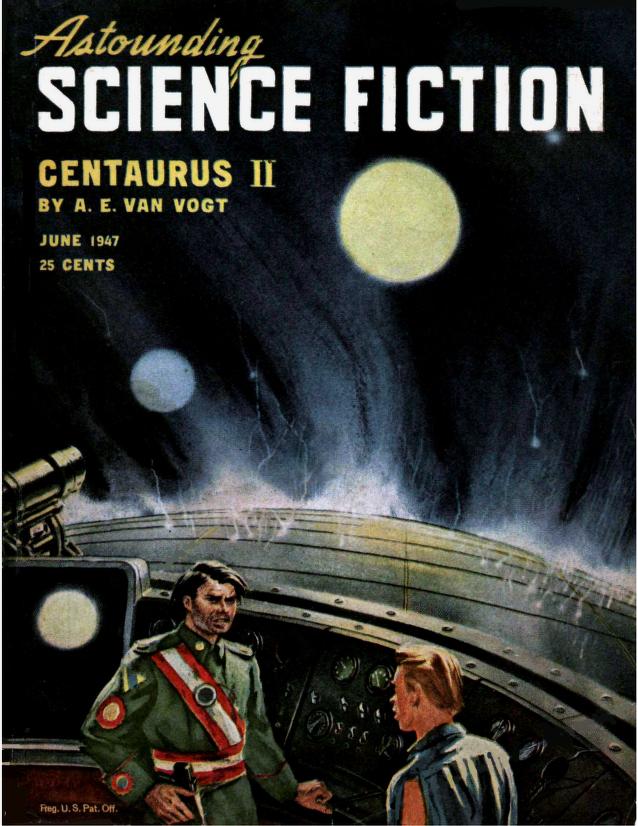
(Charles Schneeman’s cover for the June 1947 issue of Astounding Science Fiction, ed. John W. Campbell, Jr.)

4/5 (Good)

A. E. van Vogt’s “Centaurus II” (1947)* (story link) first appeared in the June 1947 issue of Astounding Science Fiction edited by John W. Campbell, Jr. Together with two later stories—“Rogue Ship” Continue reading

Updates: Recent Science Fiction Acquisitions No. CCIX (de Camp + Farren + Effinger + Silverberg Anthology)

1. Mick Farren, of the “protopunk” and rock band The Deviants fame, wrote SF: drug-addled SF about the cult of musicians in a post-apocalyptical England. At least it’ll be a crazy romp! And probably not very good….

2. I’ve been slowly posting all the New Dimensions anthologies edited by Robert Silverberg that I purchased a few months ago. Inspired by my enjoyment of New Dimensions 3 (1973).

3. A gift from a family friend… Definitely not a book I’d look for but, who knows, sometimes I get a hankering for pre-WW II science fiction of the pulp sort.

It comes with a solid Paul Lehr cover.

4. Huge fan of Geo. Alec Effinger (that should go without saying if you following this site). I want ALL his short story collections.

I’ve reviewed the following Effinger novels/collections:

As always, I look forward to your comments/tangents!

Note: Scans are of my personal copies. Click to enlarge.

~

1. The Texts of Festival, Mick Farren (1973)

(Peter Jones’ cover for the 1975 edition) Continue reading

Updates: Recent Book Acquisitions No. CLXXXVII (Burgess + Strugatsky + Fernández + Buzzati)

1. More Strugatsky? Of course. One can never have enough.

2. Anthony Burgess’ overpopulation novel… color me intrigued. Huge fan of overpopulation SF — > I’ve compiled a list here. And as diligent readers of my site might know, John Brunner’s Stand on Zanzibar (1968) is my favorite SF novel.

3. I recently read Dino Buzzati’s SF novel Larger than Life (1960) and decided to pick up his graphic novel… An enjoyable visual and textual experience. Not sure I’ll write a review but worth picking up!

4. I’d heard of Macedonio Fernández (1874 – 1952) only due to his relationship with Borges…. The Museum of Eterna’s Novel (The First Good Novel) (1967) is a fascinating experience (and experiment). Need a while to collect my thoughts….

1. Hard To Be a God, Arkady & Boris Strugatsky (1964)

(Eamon O’Donoghue’s cover for the 2015 edition) Continue reading

Updates: Recent Science Fiction Acquisitions No. CLXXXVI (Wyndham + Conway + Brown + Wright)

Post-PhD job takes over… and books are not reviewed. But reading and buying still happens!

1. A supposed cult classic republished by Picador Press….. Has anyone read Smallcreep’s Day (1965)? Near the top of my “to read” pile. And I love Barbara Costall’s cover.

2. Early in the year I reviewed Conway’s short story “Mindship” (1971) in Universe 1 (1971), ed. Terry Carr. It was pretty solid. I tracked down the novel version which included the short as the prologue.

3. I was obsessed with Austin Tappan Wright’s Islandia (1942) as a kid. Not with the novel per se, which I never owned, but the lengthy and descriptive entry in Alberto Manguel and Gianni Guadalupi’s spectacular (and wonder inducing) The Dictionary of Imaginary Places (1987). And of course, the idea of  Wright slowly creating an imaginary world that could exist within our own and only “discovered” after his death resonated with a young me…

I’ve included the map from the entry in The Dictionary of Imaginary Places.

4. And finally, another John Wyndham novel… although the premise sounds downright bland and trite. But then again, I still have not read a lot of his work and I know he was a formative voice in SF.

~

1. Smallcreep’s Day, Peter Currell Brown (1965)

(Barbara Costall’s cover for the 1973 edition) Continue reading

Updates: Evan Lampe’s Philip K. Dick Read-Through Podcast (and Cover Gallery)

(Ed Valigursky’s cover for the 1957 edition of Eye in the Sky (1957), Philip K. Dick)

As the mapmaker in Russell Hoban’s The Lion of Boaz-Jachin and Jachin-Boaz (1973) who creates a map that shows the places of inspiration, I too like to guide people towards voices that are worth the listen. I encountered the writings of Evan Lampe (@EvanLampe1) while perusing various SF articles on WordPress—his site gave an encyclopedic look at the stories and thought of Philip K. Dick. And now he’s following up with a podcast read-through (mostly chronological) of PKD’s fiction.

Evan described the podcast to me as follows:

“My main podcast is based on the idea of looking at American writers. I just wanted to podcast. I would have done it on Youtube but I do not really have the video editing skills to pull that off. Mostly, in that series I am driven to make a full-throated defense of America in these bizarre times. Perhaps its therapy. I guess you are more interested in my Philip Dick series. I think I talk about my motivations for that in my episode on “Stability”. It comes down to Dick being more culturally relevant than ever, with new TV series and a new Blade Runner film. I also never stopped believing that his writing is a useful tool in talking about many of our contemporary political and social dilemmas. The systematic approach will ensure that the stories and early novels will get the love that they deserve. There are a handful of aspects of Dick’s writing that need special attention (the frontier, post-scarcity, work, automation). I am trying to keep these most contemporary questions in mind as I re-read these works.”

Continue reading