Book Review: S.O.S. From Three Worlds, Murray Leinster (1967)

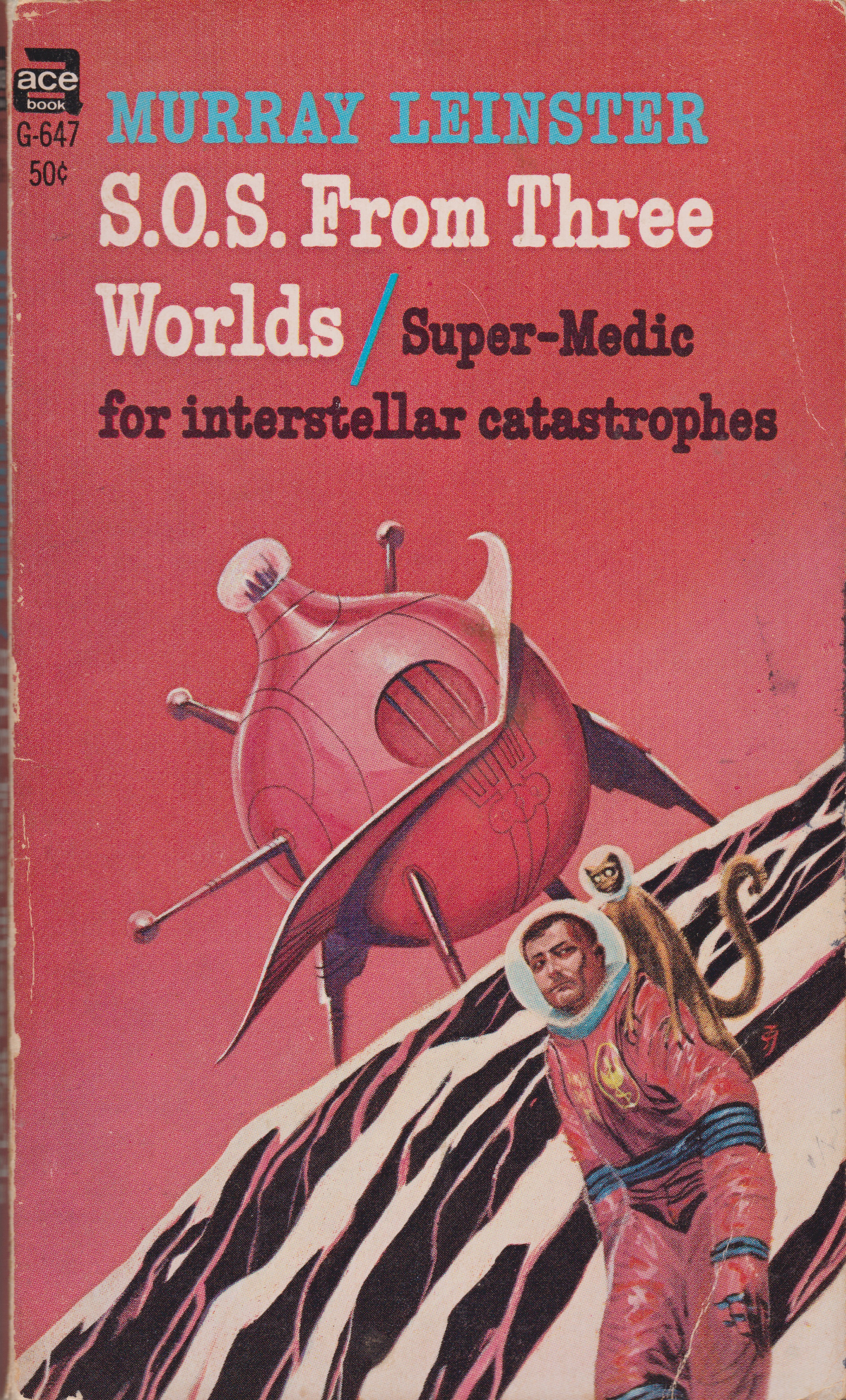
Jack Gaughan’s cover for the 1st edition

4/5 (collated rating: Good)

In times of stress, positivist stories about spacemen devoted to selfless service solving medical crises with their friendly tormals (think furry mobile petri dishes) bring a bit of warmth to my bitter heart. While a medical mystery to be solved with logic and resolve forms the core of each story, Murray Leinster hints at the future history of this decentralized spacescape–a product of chaotic often business-driven expansion.  As limited contact exists between distant colonies, The Interstellar Continue reading

Updates: Recent Science Fiction Purchases No. CCLXI (Algis Budrys, Gwyneth Jones, Russell M. Griffin, Dino Buzzati)

As always, which books/covers/authors intrigue you? Which have you read? Disliked? Enjoyed?

1. Some Will Not Die, Algis Budrys (1961, rev. 1978)

Frank Kelly Freas’ cover for the 1978 edition

My 1978 revised edition contains no inside flap or back cover blurb. Instead, here’s the brief description of the novel and its complex publication history from SF Encyclopedia: “Budrys’ first novel has a complex history. As False Night (March 1954 Galaxy as “Ironclad”; much exp. 1954) it was published in a form abridged from the manuscript version; this manuscript served as the basis for a reinstated text which, with additional new material, was published as Some Will Not Die (1961; rev 1978). In both versions a Post-Holocaust story is set in a plague-decimated Continue reading

Updates: Recent Science Fiction Purchases No. CCLIV (Melissa Scott, Murray Leinster, Ian MacMillan, Dick Morland)

As always which books/covers/authors intrigue you? Which have you read? Disliked? Enjoyed?

1. Blakely’s Ark, Ian MacMillan (1981)

Tom Hallman’s cover for the 1st edition

From the back cover: THE CEPH… A parasitic virus. Invariably lethal. In two generations, it had reduced the population of America to 10 million people.

New Jersey is populated by roving gangs of children, savage and insane. New York City is a sealed-off Dome.

America is a wasteland. And Dave Blakely just may be the last whole man in the world.”

Initial Thoughts: I’ve been in a post-apocalyptic mood for the last year or more. I’ve started (and much to my surprise, enjoyed) my watch through of Survivors (1975-1977). And devoured Leigh Brackett’s The Long Tomorrow (1955).

This is Ian MacMillan’s only SF novel. And SF Encyclopedia describes rather than appraises it… As I often Continue reading

Book Review: Doctor to the Stars, Murray Leinster (1964)

John Schoenherr’s cover for the 1964 edition

3.25/5 (Collated rating: Vaguely Good)

I am fascinated by medical-themed science fiction. While my tendencies gravitate towards  the more meta-fictional/experimental takes of this theme, for example William Kotzwinkle’s Doctor Rat (1976) and Elizabeth Baines’ The Birth Machine (1983), I wanted expand my horizons by reading earlier incarnations of the subgenre.

Murray Leinster’s Doctor to the Stars (1964) gathers three stories published in the late 50s and early 60s in the Med Series sequence. As a whole, the stories are positivist, pro-peace, anti-big business, pro-science, and pro-service. Our hero Calhoun, Continue reading

Updates: Recent Science Fiction Purchases No. CCLII (James White, Patricia A. McKillip, John Maddox Roberts, and an Original Anthology)

As always which books/covers intrigue you? Which have you read? Disliked? Enjoyed?

1. Fool’s Run, Patricia A. McKillip (1987)

Michael Whelan’s cover for the 1988 edition

From the back cover: “Terra Viridian is a young woman who obeyed a vision, took a laser assault rifle, and turned fifteen hundred innocents into light. She was captured, convicted, and sentences to the orbital prison called the Underworld. Forever.

Seven years later: a bar-band pianists Continue reading

Book Review: The Long Tomorrow, Leigh Brackett (1955)

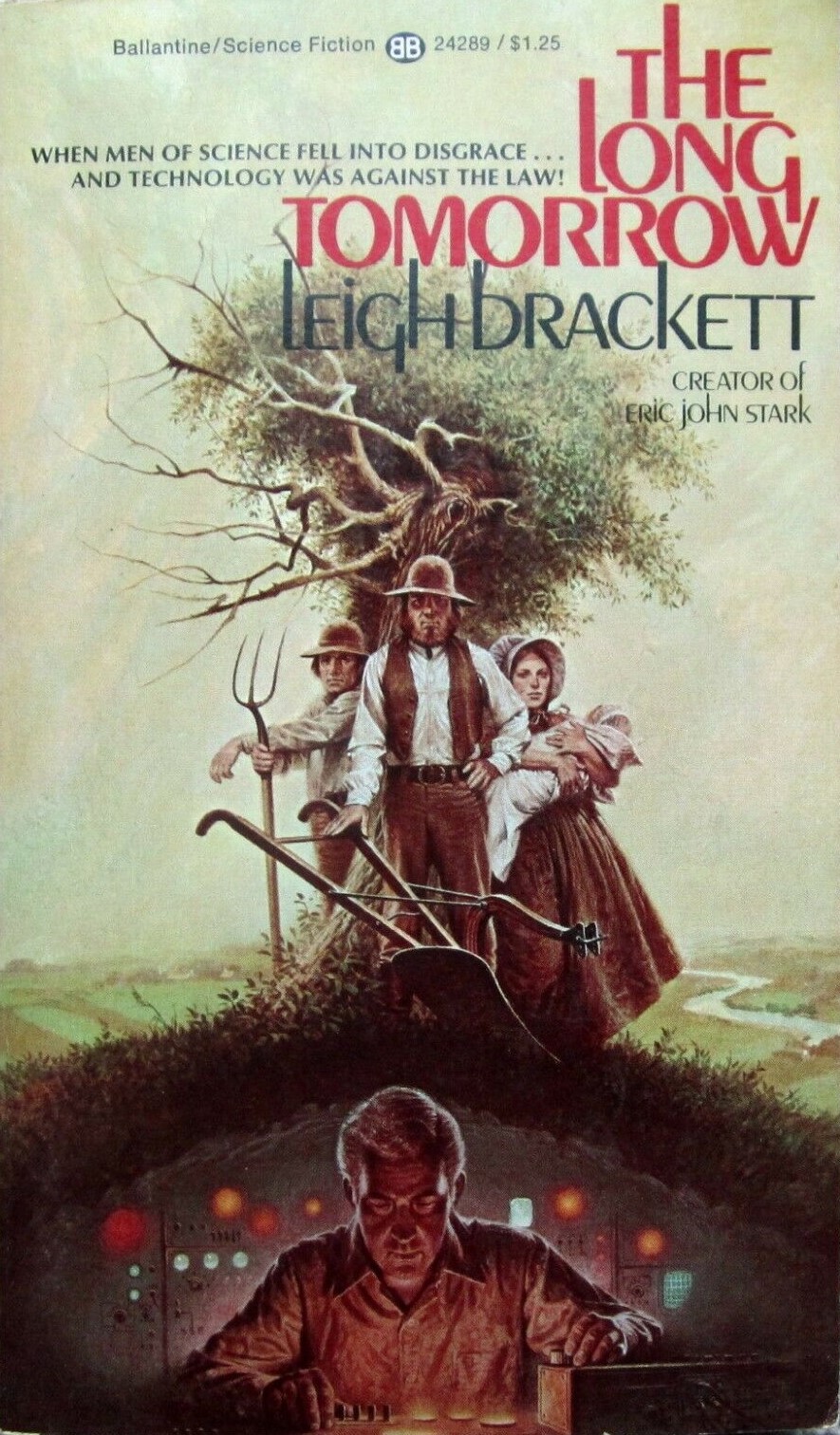
(Darrell K. Sweet’s cover for the 1974 edition)

4.5/5 (Very Good)

“No city, no town, no community of more than one thousand people or two hundred buildings to the square mile shall be built or permitted to exist anywhere in the United States of America” (Thirtieth Amendment of the United States Constitution) (1)

Nominated for the 1956 Hugo Award for Best Novel. Leigh Brackett’s The Long Tomorrow (1955) not only clocks in as the best of her work I’ve read so far but also joins my pantheon of favorite 50s SF visions (*).  At first glance Brackett’s novel appears to traverse standard SF juvenile territory where a teenage boy, in a religiously and socially oppressive society, encounters an object  and memories of the past that opens up a path to self-discovery. But memories are memories. And dreams are Continue reading

Book Review: The Dead Astronaut, ed. uncredited (1971) (J. G. Ballard, Ursula K. Le Guin, Arthur C. Clarke, et al.)

(Pompeo Posar’s cover for the 1st edition)

3/5 (collated rating: Average)

“The dead astronaut: The phrase is filled with anxiety, the words themselves evoking the tension and anguish that gripped the whole world in that fateful month of April 1970, when a technical malfunction came close to costing the lives of astronauts Lovell, Swigert and Haise” (5).

The Dead Astronaut (1971) contains a range of 50s and 60s SF stories—from Ursula K. Le Guin to J. G. Ballard—on the broad theme of astronauts, that appeared in Playboy Magazine. For a  reader of genre for only the last decade (and a bit), it’s shocking to consider that Playboy, at one point, contained top-notch science fiction! That aside, The Dead Astronaut contains a range of soft and hard science fictional accounts of astronauts Continue reading

Updates: Recent Science Fiction Acquisitions No. CCXLIX (Chelsea Quinn Yarbro, Alan Dean Foster, E. Everett Evans, Ron Montana)

(Back cover detail for the 1959 edition of E. Everett Evans’ Man of Many Minds)

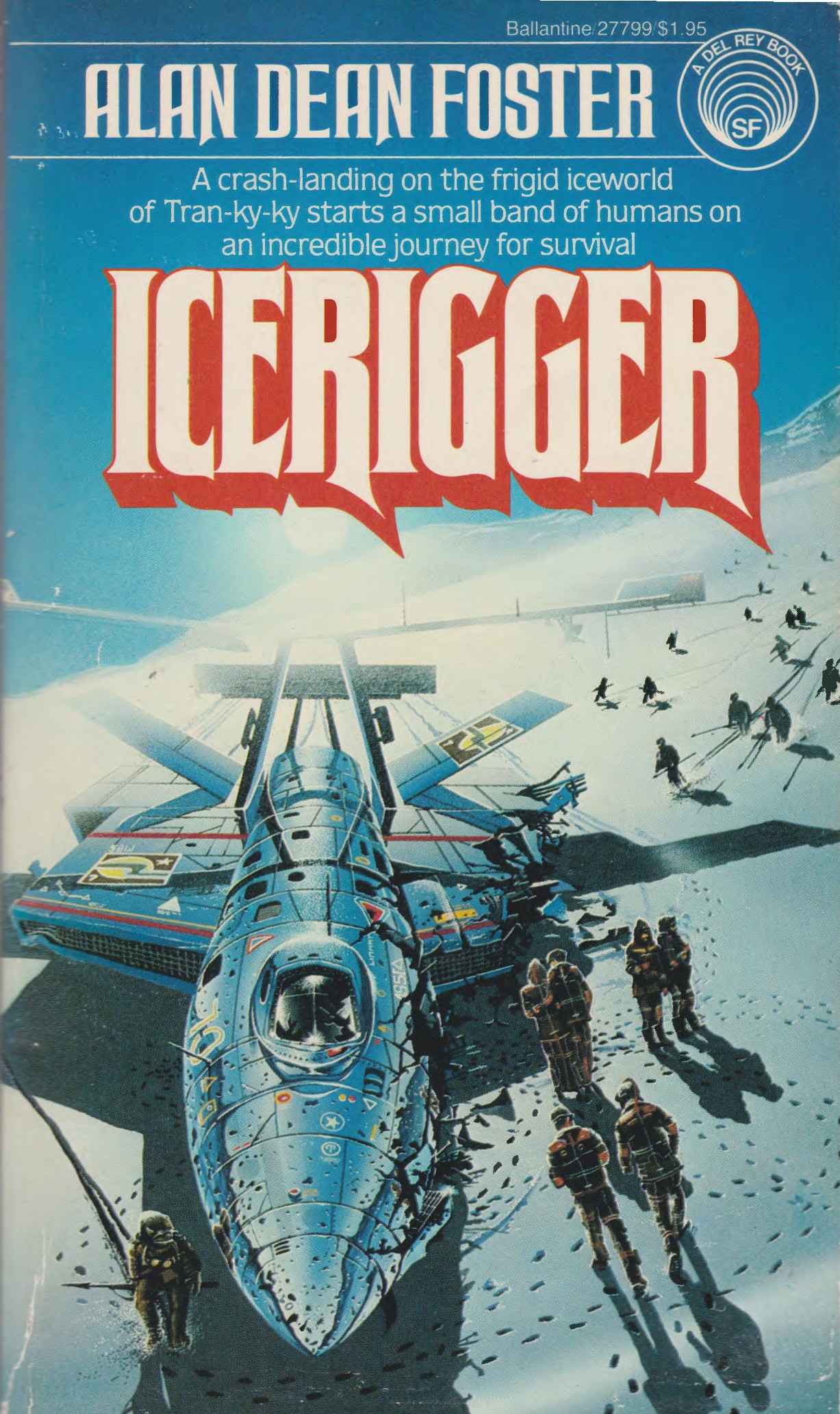
1. Looks like a fun adventure from Alan Dean Foster! And who can resist the crashed spaceship visual trope? I compiled three art posts on the topic: Part I, Part II, and Part III.

2. Of the bunch, Chelsea Quinn Yarbro’s Hyacinths (1983) appeals the most. I’m a sucker for SF stories about the dream state—i.e. Roger Zelazny’s The Dream Master (1966)—and commentaries on media and advertising. And of course, I’m fascinated Philip K. Dick’s dystopian formulations of the future of advertising which Hyacinths seems to expand on…..

I’ve previously reviewed Yarbro’s terrifying post-apocalyptic novel False Dawn (1978)

3. An alternate history where Native Americans defeat the colonizers? Intrigued but suspect it’s on the pulpy side of things. I wish I could find out more about Ron Montana. Was he of Native American descent? His first SF publication, “We the People” (1974), appeared in Craig Strete’s fanzine Red Planet Earth. Here’s his publication listing. Unfortunately, I assume he’s best known for his later copyright conflict with Craig Strete.

4. And finally, this one was hiding in a pile… I can’t remember how long I’ve had it or why I purchased it. Not an author I know and SF encyclopedia isn’t more than lukewarm in its assessment.

Let me know what books/covers intrigue you. Which have you read? Disliked? Enjoyed?

~

1. Icerigger, Alan Dean Foster (1974)

(Tim White’s art for the 1976 UK edition reused for the 1978 US edition) Continue reading

Guest Post: The Last Video Store on Earth

And now for something completely different… While an undergrad at The University of Texas (Austin) (2005-2009), my saved dollars went to Vulcan Video—a purveyor of cult films (science fictional, foreign, unusual). Between Vulcan Video and the university audio visual library, I spent the majority of my free time transported to unusual worlds. I asked a friend, Christopher Giles, who returned to Austin after college to work at the store to write a guest post on the intersection of science fiction cinema/fiction and Vulcan’s last days, a victim (at least partly) of Covid-19.

Enjoy!

And as always, I look forward to your thoughts.

~~~~~~~~~~~~~~~~~~~~~~~~~~~~~~~~~~~~~~~~~~~~~~~~~~~

The Last Video Store on Earth

Christopher Giles

Vulcan Video was an independently owned video rental store located in Austin, Texas. Enjoying a stock of literally thousands of titles, with a focus on classic, foreign, and rare genre oddities, Vulcan stood as a beloved cinematic hub in a town uniquely suited for such a space, one of the few remaining businesses of its kind left standing. Unfortunately, recent years dealt Vulcan with the twin blows of increased rent prices and decreased customer traffic in the age of digital streaming, and the unavoidable realities of COVID-19 forced the store to permanently shut its doors in early April 2020.

Working at a video store, one grows accustomed to seasonal rushes on particular genres: lots of romcom rentals in February; the Horror section picked dry by the end of October; frantic, last-minute requests for It’s A Wonderful Life (1946) the week before Christmas. It’s to be expected, and can often lead to opportunities for customers to discover overlooked gems. When all copies of John Carpenter’s Halloween (1978) are predictably checked out weeks prior to the titular holiday, a slasher-starved customer might instead leave the store with Mario Bava’s Bay of Blood (1971) in hand, none less the richer for the alternative. As video store clerks, we looked forward to these days on the calendar and prepared for them accordingly.

Even the occasional curveball of unexpected news could be met with quick action, like, say, the untimely death of a beloved actor; when Burt Reynolds passed in 2018, the Vulcan Video staff quickly put together a tribute section for the mustachioed icon. This allowed for grieving customers to easily locate and snatch up copies of tried and true favorites like White Lightning (1973) and Continue reading