Adventures in Science Fiction Cover Art: Max Ernst and his landscapes of decay (on SF/F covers)

barbarians-marching-to-the-west-1937.jpg!Blog

Max Ernst’s Barbarians Marching to the West

Max Ernst (1891-1976) has long been one of my favorite artists.  I had no idea, until browsing through the Penguin SF cover images from the 60s, that his art appeared on a variety of SF/F novels and related literature/nonfiction….  Yes, I had seen the memorable cover for J. G. Ballard’s The Crystal World (1966) [below] but I had not put the two together.

My favorite is without a doubt the use of Ernst’s awe-inspiring Europe After the Rain II (1940-42) for J. G. Ballard’s collection of stories, Memories of the Space Age (1988).  The malaise generated by his landscapes of decay combined with the sheer power of Ballard’s visions evoke are almost palpable shudders of joy…

There are a handful more but I have included most of the 50s to early 80s examples.

And today, April 2nd, is Max Ernst’s birthday!  So, share, if you are so inclined, your favorite of his works of art.  And, feel free to identify any that might appear on the covers below…  Too bad more publishers don’t latch onto the joy that are his collages (do a google search and you will understand).

Enjoy!

MMRSSPCG1988

(Max Ernst, Europe After the Rain, cover for the 1988 edition of J. G. Ballard’s Memories of the Space Age, 1988) Continue reading

Updates: Recent Science Fiction Acquisitions No. CXLIII (Two themed anthologies: Election Day 2084 and TV: 2000 + Harrison + Gary)

Two themed anthologies—one in “honor” of the election [*cough* I mean, well, I won’t go all political] year cycle…  Another on one of my favorite SF themes, television of the future!

That said, both Asimov edited collections (from the 80s but with stories from only earlier decades) have a serious fault: out of the combined 35 stories there is not a single story by a woman author.  I’ve read a vast number of 60s/70s collections which do not fall into this trap…. Orbit 1 (1966) almost manages gender parity!  I can think of numerous stories by women authors that fit both themes.  For example, Kit Reed’s wonderful “At Central” (1967) fits the TV anthology!

A hard to find for cheap early M. John Harrison novel…. Unfortunately I only found a much uglier edition that the one I show below as the rest were out of my price range….

And, a complete shot in the dark—a SF novel by the mainstream French/Lithuanian novelist/screenwriter Romain Gary, the author of White Dog (1970)..

As always, I’d love to hear your thoughts + comments.

1. The Committed Men, M. John Harrison (1971)

THCMMTTDMB1971-1

(Chris Yates’ cover for the 1971 edition) Continue reading

Book Review: Three Worlds of Futurity, Margaret St. Clair (1964)

P1080582

(Jack Gaughan’s cover for the 1964 edition)

3/5 (collated rating: Average)

Margaret St. Clair (1911-1995) was a mainstay of the major pulp magazines and maintained a prolific career from 1946 to the late 60s (between the 70s and early 80s she  produced only one novel and a handful of stories).  Previously, I found myself disenchanted with her work as I struggled through the Wicca-inspired ramblings of Sign of the Labrys (1963).  However, I thought I would give her short fiction a try and snagged a copy of the 1964 Ace Double #M-105 that contained her collection Three Worlds of Futurity (1964) and her best known novel Message from the Eocene (1964) (which I might read sometime in the future).

Three Worlds of Futurity contains five stories from her most prolific period—the late 40s-early 60s.  Although the majority do not rise above their fellow pulp ilk, “The Rages” (variant title “The Rations of Tantalus” 1954, revised 1964) shows a measured and incisive feminist inspired vision and the unusual subject matter of “Roberta” (1962) suggests St. Clair’s willingness to tackle controversial subjects.  Most of the stories contain evocative imagery although the delivery rarely transfixes.  Also, although most of the main characters in St. Clair’s stories are men, women scientists and pilots (etc) populate the pages.  I suspect Continue reading

Adventures in Science Fiction Cover Art: Jack Gaughan’s covers for Walker & Co. (1969-1970)

At last, inspired to make a cover art post! [list of art posts]

Thanks to my frequent commentator Peter S, I followed up on his suggestion to take a peek at Jack Gaughan’s 1969 cover for the Walker & Co. edition of James White’s All Judgement Fled (1968)—and was blown away by some of the other works in his art sequence for the press.

Jack Gaughan’s covers for Walker & Co. between 1969-1970 showcase some of his more surrealist inclinations.  Beautiful, often minimalistic, evocative…  Some famous novels are graced by his covers: James Blish’s A Case of Conscience (1958), Stanislaw Lem’s Solaris (1961), Silverberg’s Nightwings (1968), Ursula Le Guin’s The Left Hand of Darkness (1969), and Norman Spinrad’s Bug Jack Barron (1969).

Titles in this art sequence without suitable images online: A Gift from Earth (1968), Re-Birth (1955), All Judgement Fled (1968), Trouble with Lichen (1960), The Midwich Cuckoos (1957).  If you have any in your collection I’d love to see them!

Many of these covers have wrap-around illustrations.  If you have one at home I’d love to see a photo of what the back looks like! (post in comments).

Thoughts? Favorites?

THWNDRRCTS1969

(1969 edition of The Wanderer (1964), Fritz Leiber) Continue reading

Updates: Recent Science Fiction Acquisitions No. CXXXVIII (Matheson + Tenn + Priest)

Adored An Infinite Summer (1979), had to procure more Priest…

I want to give Matheson another chance—although some of the stories in Third From the Sun (1955) were worth reading…

William Tenn, great short story author—needed more! I had previously read both Of Men and Monsters (1968) and his collection The Human Angle (1956).

Thoughts?

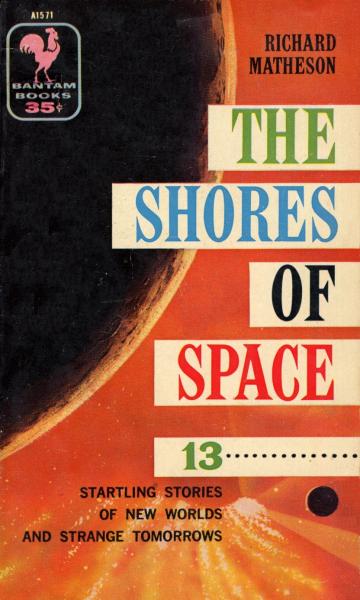
1. The Shores of Space, Richard Matheson (1957)

THSHRSFSPC631957

(Uncredited cover for the 1957 edition)

From the back cover: “Shocking— Startling — Incredible.  13 strange and unusual stories set against the background of new worlds and fantastic futures— Continue reading

Updates: Recent Science Fiction Acquisitions No. CXXXVI (Sheckley + Wilhelm + Pesek + Shaara)

Despite my incredible busyness my reading of SF has not slowed that heavily as I find it a relaxing activity before bed.  There is a chance (time permitting) that I will post (two paragraph?) mini-reviews of such gems as Disch’s Camp Concentration (1968) + Lafferty’s intriguing Past Master (1968) + Mann’s  Wulfsyarn (1990) et alii in the coming weeks in order to get caught up (I haven’t been in more than a year)…

That said, I am still working through my recent acquisition posts for a stack of books that have slowly come in over the last few months.  More psychological SF via Wilhelm, a Mars novel originally in German, a collection of 50s – 80s short SF by an unsung master (according to some), and Sheckley at his most bizarre…

Three of the following novels came via Carl at Stainless Steel Droppings on his book store trip…  Grateful as always for his book hunting skills on his travels and willingness to send me a large box (and paypal bill! — haha).

Thoughts?

1. The Earth is Near, Ludek Pesek (1970, English trans. 1973)

THRTHSNRSN1974

(Uncredited cover for the 1974 edition) Continue reading

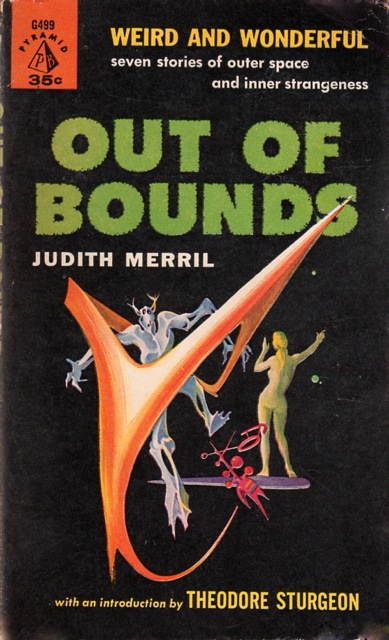
Book Review: Out of Bounds, Judith Merril (1960)

OTFBNDS1960

(Art Sussman’s cover for the 1960 edition)

3.25/5 (collated rating: Vaguely Good)

I have long been a fan of both Judith Merril’s fiction and edited volumes.   The eponymous novella in the collection Daughters of Earth (1968) is one of more delightful visions from the 1950s I have encountered. Merril reframes biblical patrilineal genealogy as matrilineal–i.e. humankind’s conquest of space is traced via the female descendants of an august progenitor.  The story is brilliant in part due to a remarkable metafictional twist, the story itself is compiled from historical documents to serve as an instructional template for future generations of women.  Despite substantial editorial control that forced Merril to include a rather hokey plot on two hokey planets, the story remains memorable for the well crafted feminist Continue reading

A question for my fellow SF fans: Which SF writer without a single author collection published within the last 10 years should receive a reprint?

THDPFNCY401962 FRFLDNDTHB1981

On twitter [my account here — please follow!  I post interesting things!] I posed the following question:

Which SF author—for the purposes of this site’s focus, an author starting pre-1980—deserves a new (or reprint) single author collection?

GUIDELINES (please read): Said author cannot have a single author collection published within the last 10 years (you can fudge this a bit).   It also should be noted that many eBooks aren’t available in the United States (SF Gateway for example).  If the recent eBook edition isn’t available in the US, I guess the author fits the bill (*cough* — John Sladek).

XNGNSS4D1969Note: If you are thinking about doing some checking before you make your choice (see guidelines) I recommend using isfdb.org as it has mostly up to date publication histories for all but self-published authors.

My vote: Miriam Allen deFord (active from — SF Encyclopedia LINK

Published collections: Xenogenesis (1969) and Elsewhere, Elsewhen, Elsehow (1971)

Reason: Miriam Allen deFord (1888-1975) was one of the major voices in SF magazines from 1946 – 1978.   She never made the transition to novels and thus might have lost some readership as a result.  The stories in Xenogenesis (1969) shows an often radical voice right from her first story in 1946.  Although they might not be as polished as some of her more Continue reading

Book Review: Starswarm, Brian W. Aldiss (1964)

STRSWRMPSJ1964

(William Hofmann’s cover for the 1964 edition)

4/5 (collated rating: Good)

Filth.  Decay.  Mud.  Transmutation.  Brian W. Aldiss’ SF is filled with such images:  Men—with limbs removed—who are slowly (and artificially) transmuted into fish, writhe around in the mud of their tanks grasping at the last shards of their humanity;  A powerful matriarch lords over a planet where her pets transform at will;  A tall tale about a planet filled with strange life and a human hero who cannot get over the fact that everything smells like garbage…. Aldiss’ novel The Dark Light-Years (1964), despite its poor delivery, is the best example of these themes—humans encounter sentient aliens who spend their days copulating, laying around, and eating in their own fifth.  And they are happy with their lot.

Starswarm (1964) is comprised of three novelettes and five short stories with conjoining explanatory material that links the previously published short fiction into a cohesive collection.  The modus operandi of such a conjoining concerns the “Theory of Multigrade Superannuation” where “the universe is similar to the cosmic clock; the civilizations of man are not mere cogs but infinitely smaller clocks, ticking in their own right” (7).  Thus, the inhabited solar systems of Starswarm—our galaxy—will exhibit all the characteristics through which a civilization can Continue reading