Updates: Recent Science Fiction Acquisitions No. CCVIII (Sargent + Kelley + Ely + Anthology ed. Harry Harrison)

1. Leo P. Kelley is an author whose work I’ve encountered in various used book stores but never acquired…. until now. Here’s the SF Encyclopedia entry on his work. Let me know if you’ve read any of them!

Note: The Kelley edition and cover are different than the one I own. I accidentally mutilated the cover by removing (by incorrect means) a large sticker. I own the 1971 Berkley Medallion first edition.

2. I adored David Ely’s Seconds (1962). I hope to have a review up soon! I went ahead and acquired his only other SF novel.

3. Although I’ve read and complained vehemently about Pamela Sargent’s Cloned Lives (1976), I’m  not a reader who gives up on an author after a single novel. Like Cloned LivesThe White Death (variant title: The Sudden Star) (1979), creates a tapestry of characters presented with a crisis. I’ll read this one sooner than later.

4. An original anthology on the year 2000. I couldn’t pass it up especially as it contains a SF short story by Naomi Mitchison. I remember Memoirs of a Spacewoman (1962) fondly….

As always, let me know your thoughts on the books/covers/or tangents.

Enjoy!

~

1. The Coins of Murph, Leo P. Kelley (1971)

(Colin Hay’s cover for the 1974 edition) Continue reading

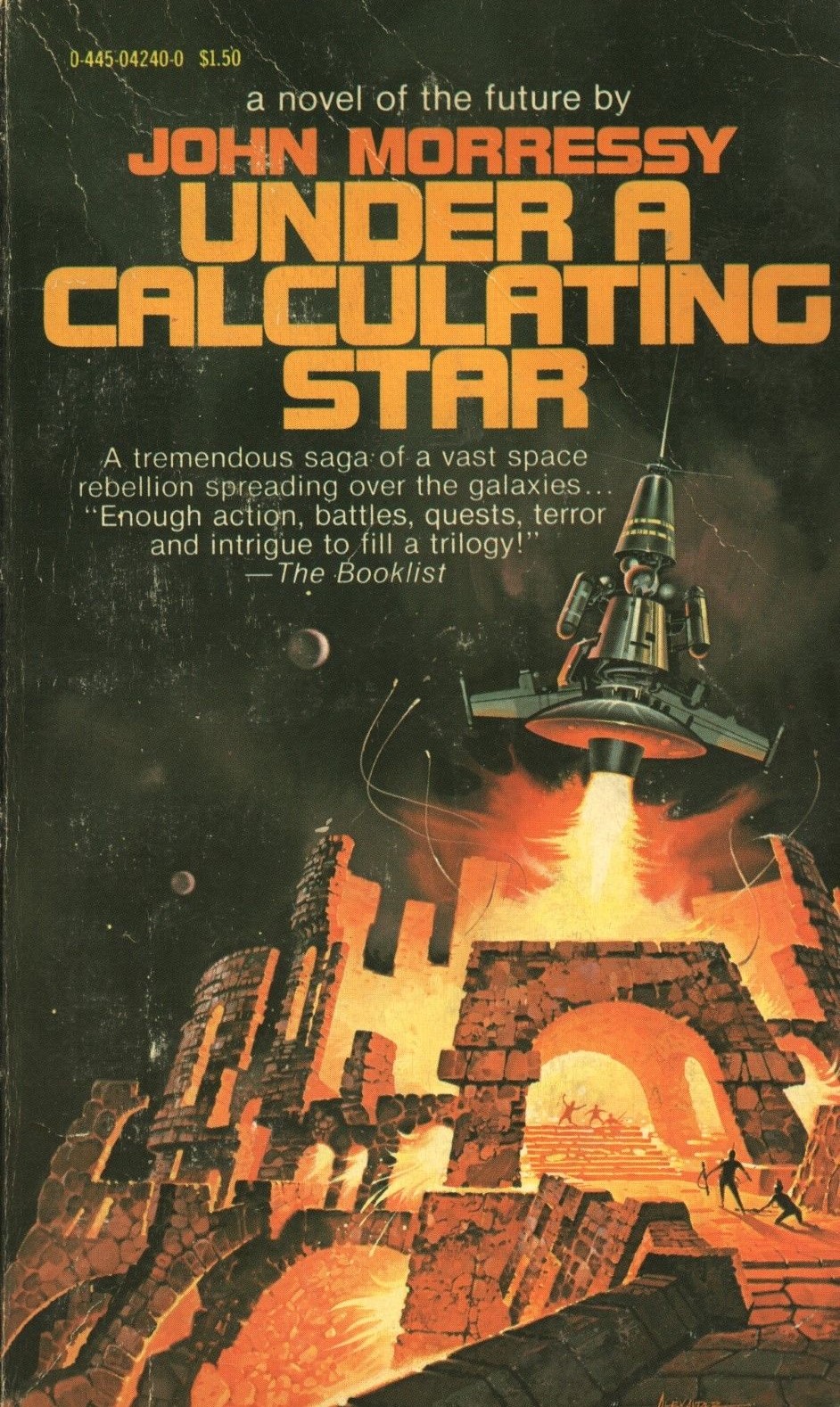
Book Review: Under a Calculating Star, John Morressy (1975)

(Paul Alexander’s cover for the 1978 edition)

3/5 (Average)

After finishing John Morressy’s Frostworld and Dreamfire (1977), I tracked down another volume of his Del Whitby sequence. Although far from as engaging and emotionally affective as the former, Under a Calculating Star (1975) provides the historical background to the Morressy’s weirdly primitive far future world: the origins of the Sternverein (the dominant business polity), the explanation of why swords and knives are the weapons of choice while high-tech spaceships roam the interstellar expanses, and the role of Old Earth in the colonization of the far flung reaches. Historical content aside, Under a Calculating Star‘s plot and characters fail to engage and the worlds and societies are one-dimensional in comparison to Frostworld and Dreamfire‘s metamorphic Onhla and the planet Hraggellon, locked in its unusual orbit. Continue reading

Updates: Recent Science Fiction Acquisitions No. CCVII (Moorcock + Pohl + Leinster + Morressy)

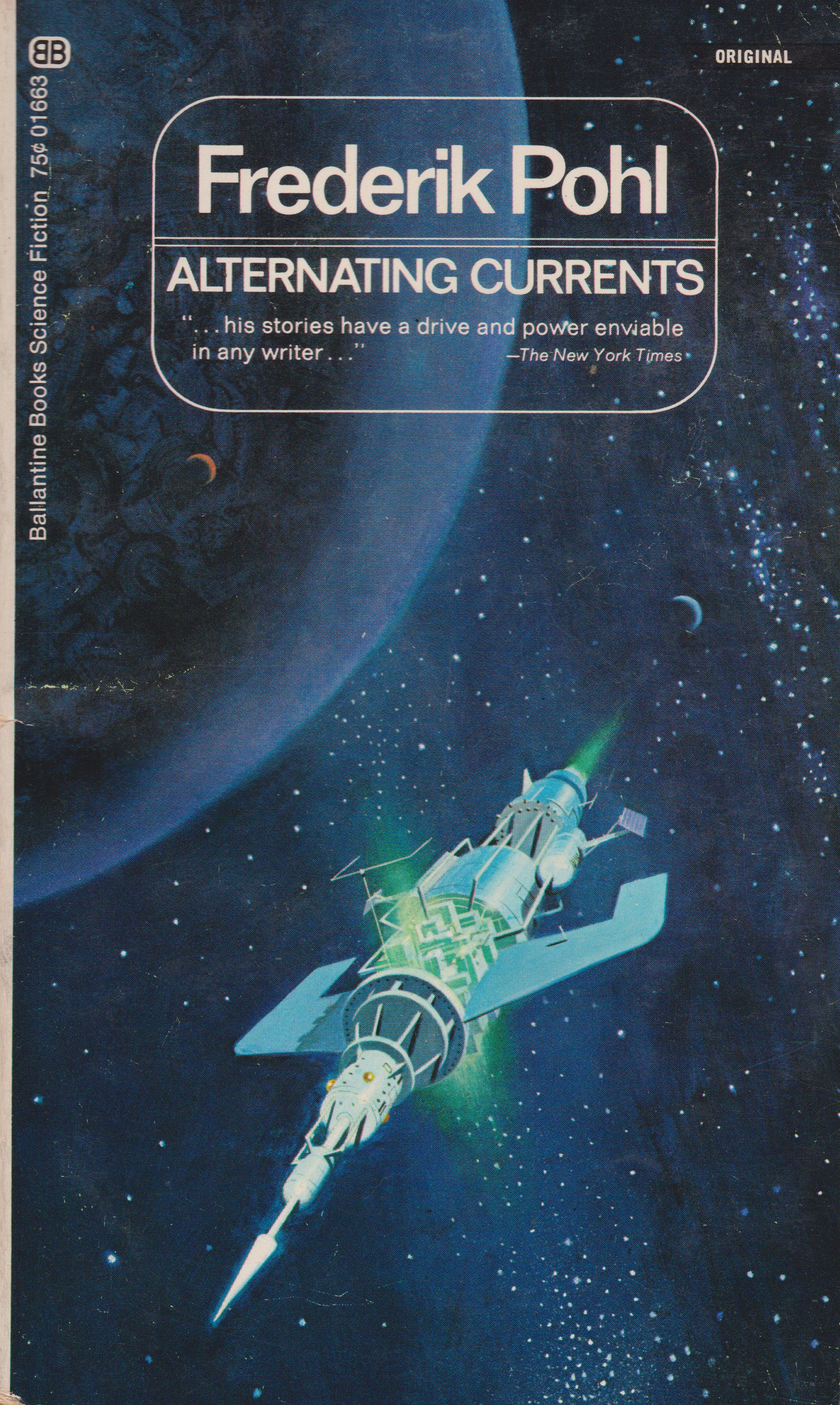
1. Frederik Pohl short stories? I’ve collected volumes and volumes and volumes for years—I suspect I should get around to reading one!

An effective Dean Ellis cover….

2. I acquired the second volume in Michael Moorcock’s Dancers at the End of Time sequence at my local used bookstore down the street. I read An Alien Heat (1972) in 2016.

3. A few days ago I reviewed John Morressy’s wonderful Frostworld and Dreamfire (1977) — I was intrigued enough that I tracked down another volume in the Del Whitby sequence—Under a Calculating Star (1975). I’ll have a review up in the next few days.

4. The second Murray Leinster Med Service collection I’ve acquired–as a huge fan of medical-themed SF…. I should put together a list.

Other lists: Immortality in SF, Generation Ships, and Overpopulation in SF.

Do you have a favorite cover?

As always, I look forward to your comments!

~

1.  Alternating  Currents,  Frederik  Pohl  (1956)

(Dean Ellis’ cover for the 1969 edition) Continue reading

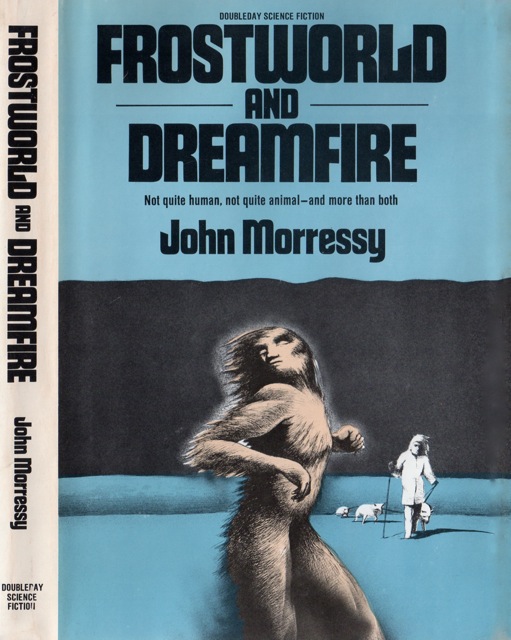
Book Review: Frostworld and Dreamfire, John Morressy (1977)

(David Wilhelmsen’s cover for the 1977 edition)

4.25/5 (Very Good)

John Morressy’s moving SF epic Frostworld and Dreamfire (1977) is set in the Del Whitby sequence (1972-1983) of novels which explore conflict and colonialism (humans and humanoid aliens) within the loose human Sternverein polity.  Conceptually the sequence, which does not have to be read in order, fascinates: the first three novels–Starbrat (1972), Nail Down the Stars (1973), and Under a Calculating Star (1975)–analyze the same conflict from three different perspectives (SF Encyclopedia entry). Continue reading

Updates: Vonda N. McIntyre (August 28, 1948 – April 1, 2019)

Vonda N. McIntyre (August 28, 1948 – April 1, 2019) passed away yesterday from pancreatic cancer. McIntyre, best known for her Hugo and Nebula-winning SF novel Dreamsnake (1978) and her Star Trek Novels and film adaptations (1981-2004) (bibliography), published her first SF story “Breaking Point” in in the February 1970 issue of Venture Science Fiction Magazine. John Clute in SF Encyclopedia describes her two best-known SF novels: Continue reading

Book Review: Secret Rendezvous, Kobo Abe (1977, trans. 1979)

(Tadanoi Yokoo’s cover for the 1979 edition)

5/5 (Masterpiece)

In Kobo Abe’s Secret Rendezvous (1977, trans. 1979) the hospital stretches like a recumbent body, leaking fluids through its membranes and undefined in its expansiveness, across the urban landscape. Within its labyrinthine interior, humans (agents of “disease”) animate various functions of the hospital for their own purposes–some sinister, some scientific, some sinisterly scientific. The hospital body lurches and vibrates with the sounds of its doctors and orderlies as they rewire the building’s organs and nerves in order to experiment on themselves and their patients. Within this veritable entity lacking a functional guiding agent, a harrowing, existential, and surreal Freudian mystery unfolds. Continue reading

Adventures in Science Fiction Cover Art: Crashed Spaceships, Part III

(Detail from Alan Daniels’ cover for the 1980 German edition of Open Prison (1964), James White)

The crashed spaceship — a wrecked hulk spinning in the emptiness of space, shattered metal struts strewn across an alien landscape…. I find few SF scenarios more nostalgic than this one as a younger me was obsessed with books about the societies formed from the survivors of such cataclysms (Anne McCaffrey’s Acorna Universe sequence, of dubious quality now, was a cornerstone of my youth).

I have selected a range of fascinating covers which add to a series I made in 2012 (Part I) and 2013 (Part II). My favorite of the bunch is Tibor Csernus’ cover for the 1973 French edition of Clifford D. Simak’s Time and Again (1951) due to the verdant and wet landscape the spaceship finds itself in. My second favorite is Dean Ellis’ “descriptive” cover for the 1974 edition of Alan Dean Foster Icerigger (1974). It doesn’t try to be surreal but rather depicts a scene straight from novel. I usually prefer when the artist takes a more unusual approach but in this case Ellis narrows in on the wonder of the premise. Continue reading

Updates: Recent Science Fiction Acquisitions No. CCV (Farmer + Simak + Effinger + New Dimensions Anthology)

1. I recently read and reviewed enthusiastically New Dimensions 3, ed. Robert Silverberg (1973). Inspired, I procured quite a few more in the series… Here is number 1. Looks like an absolutely spectacular lineup — Le Guin, Ellison, Malzberg, Lafferty, etc.

2. One always needs more Clifford D. Simak, right?

3. Huge fan of George Alec Effinger’s novels and short stories. Here’s what I’ve reviewed so far…. Heroics (1979), Irrational Numbers (1976), and What Entropy Means to Me (1972).

4.  Philip José Farmer, despite multiple masterpieces, churned out a lot of crud… I expect this will fall in that category.

Note: The hi-res scans are of my personal copies — click to enlarge.

Let me know what you think in the comments!

Enjoy!

~

1. New Dimensions 1, ed. Robert Silverberg (1971)

(Uncredited cover for the 1973 edition) Continue reading

[Short] Diaristic Fragments on Czech Experimental Film: The Ear (1970), dir. Karel Kachyna

8/10 (Very Good)

On the night of 20-21st of August 1968, the Warsaw Pact countries (led by the USSR) invaded Czechoslovakia ending the period of liberalization known as Prague Spring. And with it, the Czech New Wave film movement “ended.” Regardless, Karel Kachyna filmed The Ear (1970), a paranoid psychological thriller redolent with New Wave stylings, that brandishes a proverbial middle finger in the direction of the Communist Party. Unsurprisingly, the film was promptly banned until 1989, and Kachyna Continue reading