Book Review: The Bright Phoenix, Harold Mead (1955)

(Richard Powers’ cover for the 1956 edition)

3/5 (Average)

Harold Mead’s The Bright Phoenix is a readable future ultra-regulated “perfect” State themed science fiction novel with a time-worn but proven plot. Unfortunately, the end product, despite moments of intriguing characterization and oppressive gloom, sinks into forgettable melodrama and the conclusion resorts to frustratingly obvious references to a “second coming” (of sorts).  Mead is less interested in describing the mechanisms of the “perfect” state and more interested in the slow evolution of a character coming to grips with the deficiencies of the system.  This is an admirable program that falls woefully short in part due to the paltry descriptions of the before mentioned system.  This causes our hero’s evolution to occasionally ring hollow.  The primitive but somehow “truer” pseudo-Christian civilization contacted by our hero, the fulcrum of his transformation, lacks any seductive qualities that would facilitate Continue reading
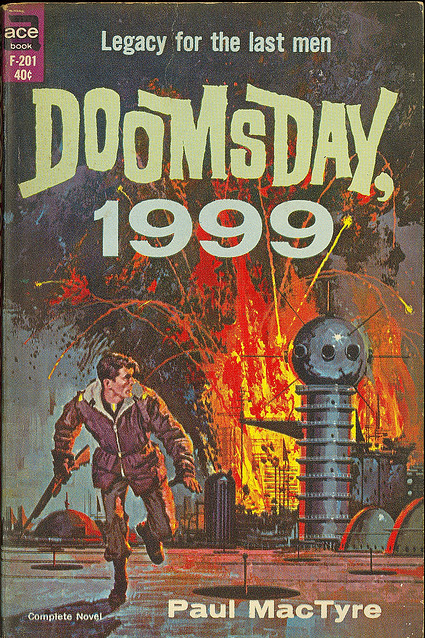
Adventures in Science Fiction Art: Doomed Cities Part II (migrating icebergs, firestorms, the horsemen of the apocalypse)

(Uncredited cover for the 1963 edition of Doomsday, 1999 (variant title: Midge), Paul MacTyre)

Behold Part II of my popular series on the doomed city in science fiction cover art (see Part I).  A doomsday that never happened, a tank and a skeletal reminder of a past battle — a ruined city, colliding stars, colliding planets…

Behold the august ruins of our people, our cities, our achievements.  If there’s anyone still left.

As always, are the books/authors worth reading? Continue reading

Adventures in (Bad) Science Fiction Cover Art: Miserable Monday No. 1, (pink/yellow striped cat aliens)

Inspired by C. M. Kornbluth’s dark/satirical tales in The Explorer (1954) that uncover the underbelly of the normally glamorous 50s portrayals of space travel and alien contact, I seek to expose (well, re-expose) the darker side of science fiction cover art.  I’ll try to post every monday, one bad science fiction cover — if possible, I’ll pair it with a much better cover of the same book from another edition if one exists.

My reasons:

1). The hilarious website ‘Good Day Sir’ doesn’t post the images I come across fast enough despite getting routine ratings from 7.5-9.5…    This is probably due to the fact that I don’t own the books and don’t follow the submission rules — i.e. posting an image of me physically holding a book in hand — alas, too bad.

2).  If a reader came across certain editions (posted below) the true nature of a book would be hopelessly confused (a great cover on a terrible book does the same thing) — Yes, there really are cat-like aliens in this book.  But, the  work’s overarching theme is much more mature (societal reaction to natural disaster, etc). Continue reading

Updates: Recent Science Fiction Acquisitions N. XIX (Herbert + Aldiss + et al.)

Christmas = gift cards = more science fiction books, and a few my dad had procured for himself appeared miraculously in my pile — I’ve decided to break down the clump into manageable four book posts.

And of course, I wish you all a good sci-fi book hunting/reading year!

Enjoy!

1. The Santaroga Barrier, Frank Herbert (1968)

(Paul Lehr’s cover for the 1968 edition)

I’ve read a substantial number of Frank Herbert’s non-Dune Continue reading

Update: 2011 in review, best books, movies, etc

Here are my favorite films and science fiction novels I’ve reviewed this year (and some other interesting categories) with links to my reviews….

Watch them! Read them! Gaze at them!  (the array below….)

Best Science Fiction Novel (tie: The World Inside, The Unsleeping Eye, Hawksbill Station)

The World Inside (1971), Robert Silverberg (REVIEW) 5/5 (Masterpiece)

Silverberg’s The World Inside is a fascinating take on the theme of overpopulation — what if society was organized towards a single goal, propagation?  What would society look like?  What position in society would women occupy?  Men? What would cities look like? Hallways? Rooms? Institutions?  What happens to those who don’t fit in?  Or, can’t have children?

The Unsleeping Eye (variant title: Continue reading

Adventures in Science Fiction Cover Art: Reusing Cover Art

(Jack Gaughn’s cover for the 1964 edition of Three Worlds to Conquer (1964), Poul Anderson)

I spend a substantial amount of time looking through the sci-fi publisher catalogues of Ace, Pyramid Books, Dell, Doubleday, Signet, Ballantine, etc for both books to read and interesting covers that fit into various themes for my Adventures in Science Fiction Cover Art posts (INDEX).

While perusing I’m occasionally baffled by covers that I’ve sworn I’ve seen on other books — and lo and behold, publishers sold art to different publishers, often lesser-known and unable to commission their own Continue reading

Adventures in Science Fiction Cover Art: Doomed Cities (post-apocalyptical ruins, war-wrecked landscapes, burning winds)

(Richard Powers’ cover for the 1959 edition of The Rest Must Die (1959), Kendell Foster Crossen)

The electricity turns off in a futuristic city and people turn into animals and everyone slowly kills each other, mysterious winds sweep through cities killing everyone, large machine minds take over, nuclear bombs destroy everything, intelligent dogs take over, the sun expands drying all the oceans, the sun expands (but not as much) and water floods over all the cities, aliens come with large guns and blow everything up, aliens come with brain probes and make others blow everything up, aliens pretend to be humans and annoy the humans enough so they blow each other up with nuclear bombs, people from the past go back in time and see that humans have blown everything up and they try to prevent the aliens from making the humans blow everything up, a bacterial agent from an alien kills everyone, Continue reading

Book Review: The Watch Below, James White (1966)

(George Ziel’s cover for 1966 Ballantine edition)

4/5 (Good)

James White, famous for his Sector General series, spins a disturbing tale of two isolated and decaying societies — one alien, one human.  Without doubt the work demands a certain suspension of disbelief.  The isolated human society half of the premise comes off as highly artificial/improbably/impossible (and, well, bluntly put, hokey).  I found the alien half of the story line a more “realistic” situation but less emotionally involving as the human half.  White has difficultly meshing the trans-generational nature of both story lines — and the inevitable intersection at the end is predictable, anti-climactic, and dents the great appeal of the central portion of the work.

Lest this dissuade you, White’s dark vision is a transfixing take on the generation ship (literally) — how would a society descended from five individuals evolve for a hundred years trapped Continue reading

Updates: Recent Science Fiction Acquisitions N. XVI (Kornbluth + Compton + et al.)

It’s not every day that a signed D. G. Compton novel arrives free in the mail.  About half a year or so ago Ian Sales (check out his amazing blog) hooked me on D. G. Compton’s works and ever since I’ve grabbed as many as I can find on used book stores shelves and I’ve written a slew of reviews (The Unsleeping Eye, The Quality of Mercy, The Steel Crocodile, Synthajoy, The Missionaries).  I made a comment on one of his D. G. Compton posts — a few days later a SIGNED copy of Compton’s Scudder’s Game (1988) (below) arrived in the mail!!  Ian, thanks again and keep up the uncovering of underrated 60s/70s sci-fi authors!

The others, well, the covers are gorgeous!  Two Richard Powers covers (the C. M. Kornbluth short story collection and the Conklin edited anthology).  I must confess that the Hunt Collins purchase was impulsive — in part due to the vibrant 50s cover by Bob Lavin.

I apologize for the recent absence of book reviews — due to the approaching end of my last semester of graduate course work I’ve been pressed for time.  I have reviews for Joanna Russ’ The Female Man (1975), James White’s The Watch Below (1966), and Samuel R. Delany’s Nova (1968) in preparation.

Enjoy!

1. The Explorers, C. M. Kornbluth (1954) (MY REVIEW)

Continue reading