Atelier Heinrichs & Bachmann’s cover for the 1970 edition of J. T. McIntosh’s One in Three Hundred (1954)
In 2021, I posted Part I of my Adventures in Science Fiction Cover Art series on the Atelier Heinrichs & Bachmann. Between 1966 and 1971, they created a kaleidoscopic array of psychedelic visions for the German press Heyne Bücher. I described their art as follows: “Pop surrealism? Lowbrow art? The Andy Warhol effect? However you classify Atelier Heinrichs & Bachmann’s covers […] they’re gleeful and sarcastic.” And despite a few readers who disliked their exuberant/chaotic hilarity (someone described them as the “very nadir in SF cover art”), I stand by my positive assessment. And I bring you Part II of my series!
Note: My read but “waiting to be reviewed pile” is growing. Short rumination/tangents are a way to get through the stack before the new year and my memory/will fades. Unfortunately, I left two of my favorite reads of the year for last. Stay tuned for more detailed and analytical reviews.
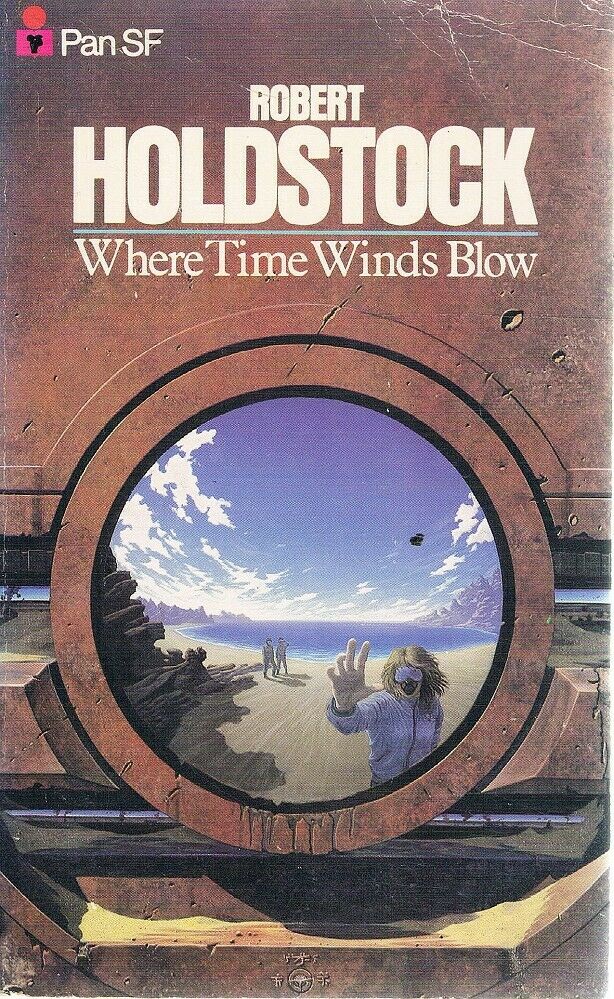
1. Where Time Winds Blow, Robert Holdstock (1981)
Mick Van Houten’s cover for the 1982 edition
5/5 (Masterpiece)
I cannot properly review Where Time Winds Blow (1981). Sometimes, while perambulating the interwebs, I encounter a singular encapsulation of a text’s brilliance that defeats all my own attempts to write constructively about a book. I blame Andrew Darlington’s brilliant review/article on Robert Holdstock contextualizing the novel within his early oeuvre. The short paragraph below–an attempt to convince you to procure a copy–is indebted to his review. Please read his review! There are fan writers and then there are fan writers. Darlington should receive a Hugo nod.
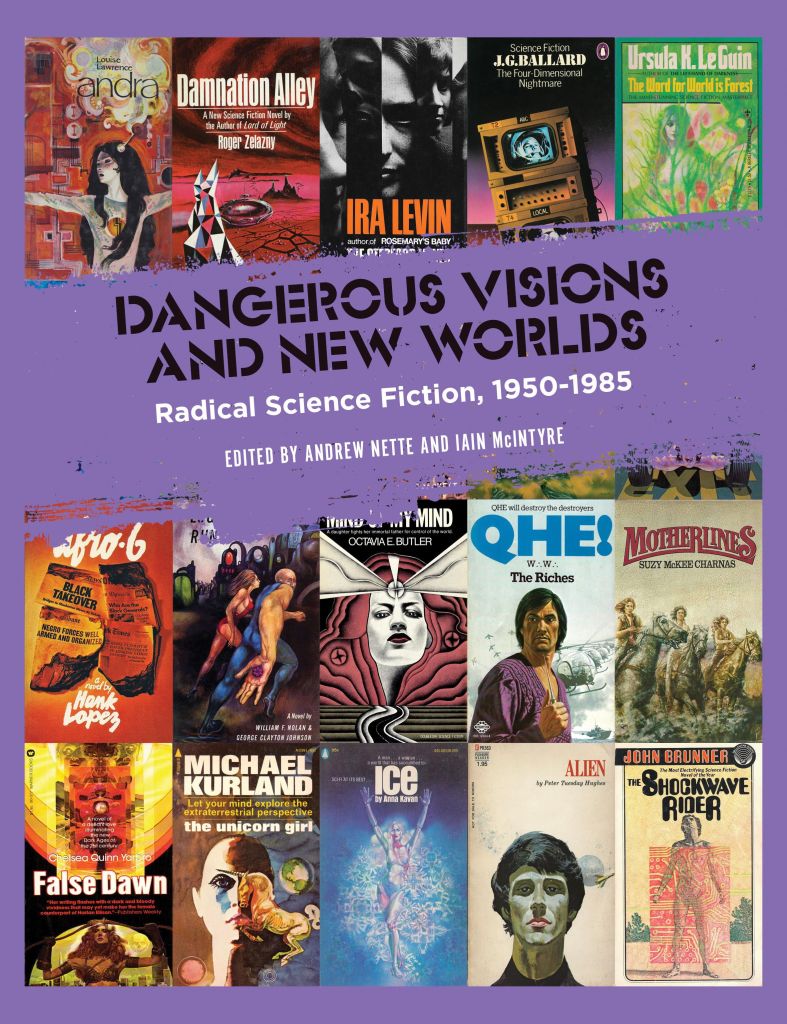
I’ve recently conducted a binge read of my ARC of Dangerous Visions and New Worlds: Radical Science Fiction, 1950-1985, ed. Andrew Nette and Iain McIntyre (2021). It is a must buy for any SF fan of the era interested in exploring the larger world behind the texts. Considering the focus of my website and most of my reading adventures over the last decade, I can unabashedly proclaim myself a fan of the New Wave SF movement–and this edited volume is the perfect compliment to my collection and interests.
The editors and PM Press have graciously provided me with the introduction to the volume. Perhaps it’ll convince you to purchase your own copy!
The “long sixties,” an era which began in the late 1950s and extended into the 1970s, has become shorthand for a period of trenchant social change, most explicitly demonstrated through a host of liberatory and resistance movements focused on class, racial, gender, sexual, and other inequalities. These were as much about cultural expression and social recognition as economic redistribution and formal politics. While the degree to which often youthful insurgents achieved their goals varied greatly, the global challenge they presented was a major shock to the status quo.
Along with Octavia E. Butler (1947-2005), Samuel R. Delany (1942-), John M. Faucette (1943-2003), John A. Williams (1925-2015), and Steven Barnes (1952-), Jesse Miller (1945-) was one of a handful of African American science fiction authors active in the 1970s (note). I have confirmed with Jesse Miller’s relatives that he is still alive. I initially, before confirmation, extrapolated his birthday from a quote in his author blurb in Orbit 16, ed. Damon Knight (1975): “I am black. I am twenty-nine, and I have a good sweet woman, whose name is Jean, and I am slowly going blind.”
Soon after his honorable discharge from the United States Airforce at 21 (after service in Vietnam?), he published four short stories between 1972 and 1979 and then left science fiction altogether. One of a legion of authors first published by the late Ben Bova, he was a finalist for the John W. Campbell Award for Best New Writer (renamed the Astounding Award) for his first published science fiction story “Pigeon City” (1972). He lost to Spider Robinson and Lisa Tuttle. He wrote his first story (published later in 1975) while in a VA hospital bed. For a bit about his life, his brief experience at SF conferences, reflections on losing the Campbell Award, and various humorous and serious interactions with other authors (he smoked a pernicious strain of weed with Joe Haldeman), check out his article “Obnoxia” (c. 2001). I’ve also included George R. R. Martin’s recollections, as recorded in his intro to “Twilight Lives” (1979), in the review of the story below.
Theodore Sturgeon penned the following about Miller in his intro to New Voices II, ed. George R. R. Martin (1979): “[Miller] has that rather rare gift of writing “there,” of giving the reader the feeling that the writer is on location and not operating on a built-up set. Jesse Miller will go flap-jappering up to a high place or he will disappear.” It’s a loss to the field that the latter happened. Three of the four short stories are worth the read! And “Pigeon City” is a near masterpiece that should be anthologized more widely.
If you happen to know any more about him, please let me know!
Note: I think this is complete but I could be missing someone. Steven Barnes published his first three short stories in the 70s. I know Charles R. Saunders’ early work appeared in 70s genre fanzines. Did he write any SF or was it all sword and sorcery? I considered leaving John A. Williams off this list as he’s known as a mainstream author. His wonderful novel Captain Blackman (1972) could be classified as a speculative fiction involving time-travel (whether or not its entirely metaphorical). Williams’ Sons of Darkness, Sons of Light (1969), which I purchased recently, tells of near-future race violence in New York City. I think he qualifies.
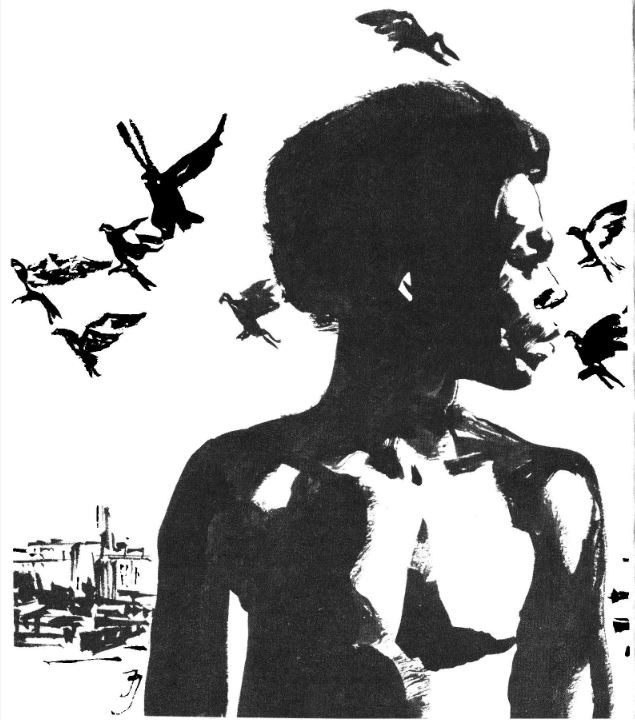
Jack Gaughan’s interior art for Jesse Miller’s “Pigeon City” in Analog Science Fiction (November 1972)
“Pigeon City” (1972), 4.5/5 (Very Good): First appeared in Analog Science Fiction (November 1972), ed. Ben Bova. You can read it online here.
In the 1950s and 1960s, white Americans propelled by racism and economic reasons fled the urban centers for the suburbs. According to Leah Boustan, for every “black arrival, two whites left the central city” in Northern and Western metropolitan areas. An insidious cultural iconography of middle-class white suburbia, replete with lawn and single-family houses, perpetuated inequality and excluded others from the American Dream. In this period, major race riots broke out across the United States–New York City (Harlem Riots, 1964), Los Angeles (Watts Riot, 1965), Newark (1967), and Detroit (1967)–in protest of poverty, racism, and unemployment exacerbated by the departure of businesses from the city centers.
Which books/covers/authors intrigue you? Which have you read? Disliked? Enjoyed?
1. In the Drift, Michael Swanwick (1985)
Ron Lieberman’s cover for the 1st edition
From the back cover: “The meltdown at Three Mile Island created the death zone known as the Drift, where the sky burned dark blue and pink and where boneseekers destroyed bodies within.
Which books/covers/authors intrigue you? Which have you read? Disliked? Enjoyed?
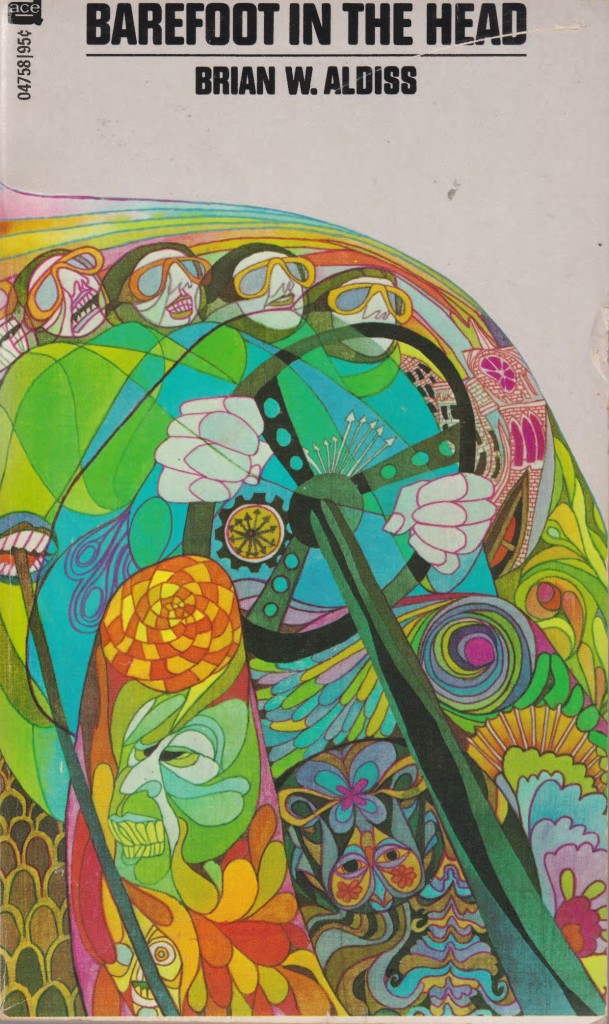
1. Barefoot In the Head, Brian W. Adliss (1969)
Diane and Leo Dillon’s cover for the 1972 edition
From the back cover: “AFTER THE ACID WAR…. Rising from the dust and ashes of a Europe still reeling from the effects of the great Acid War comes Colin Charteris, a futuristic Don Quixote riding the mechanized brontosaurus of the times.
Charteris tries desperately to make sense of the drugged, chaotic world he lives in, and finds himself hailed as the new Messiah. Stranger still, Charteris himself comes to believe this.
His adventures as he tries to save the world from its insanity are brilliantly told, a satiric science fiction comment on the future of mankind.”
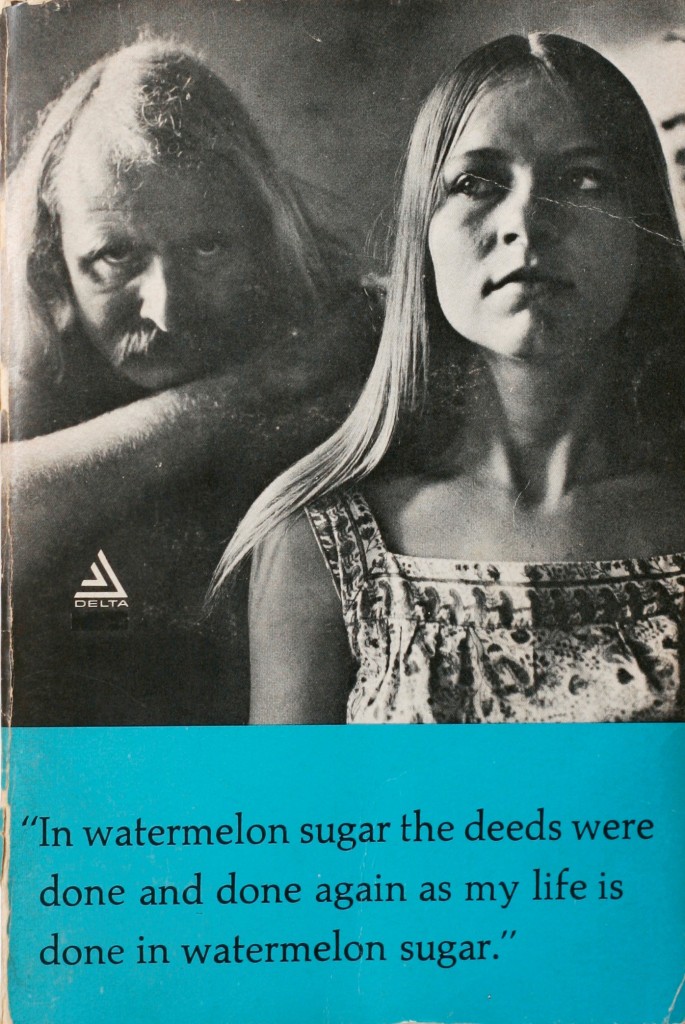
Desperate for something unlike any other New Wave SF experiment, I came across Richard Brautigan’s surreal post-catastrophe novel In Watermelon Sugar (1968). Brautigan, best known as a Counterculture poet and the author of Trout Fishing in America (1967), spins a poetic thread simultaneously elegiac and nightmarish. More a sequence of short linked scenes, In Watermelon Sugar charts the memories of a nameless narrator (N) attempting to write a book about the community and inhabitants of iDEATH. Brautigan juxtaposes the terrifying calamities of N’s past–including his memories of his parents consumed before his eyes by the human-like Tigers and the violent rhetoric and self-immolation of inBOIL–with N’s tender memories of his blossoming love for Pauline.
As always, which books/covers/authors intrigue you? Which have you read? Disliked? Enjoyed?
1. Strength of Stones, Greg Bear (1981)
John Harris’ cover for the 1st edition
From the back cover: “Ages ago this world was named God-Does-Battle. No one remembers wh. It was colonized in the most up-to-date way possible, supplied with the best Cities ever built by Robert Kahn. Huge laboratories labored for decades to produce the right combinations of plant, animal, and machine, and to fit them into the right design. The result was magnificent; living Cities, able to regenerate broken parts, to produce food on demand, and medicine, and clothing. so careful, so advanced was Robert Kahn that he even built into his Cities the ability to protect their inhabitants; to sense the presence of the occasional person whose potential for violence or cruelty made him a threat to society, to remove him from the City, and to erect walls of needle-sharp crystal to be sure he did not return.
Cover for Galassia #122 (1970). Contains Samuel R. Delany’s The Ballad of Beta-2 (1965) and three short stories by Italian authors (Sergio Ostuni, Ivo Silvestri, and Lorenzo Iacobellis)
Italian artist, author, translator, and comic book critic Ferruccio Alessandri (1935-) created twenty-two covers for the Italian SF magazine Galassia (most of the issues between #109-132) in 1970. Galassia magazine was instrumental in introducing Italian audiences to the New Wave movement. Issues often contained both translations of popular English language authors and original Italian short stories and experimental visions.
As a unit, Alessandri’s covers convey a terrifying hellscape of insectoid visages (#122, #110, #128, #130), encounters with the surreal (#115), the oddly humanoid shapes (#119, #114, #116, #127), etc. Like searing flashes of a planet bathed under neon light, they are micro windows into the wonderscape of science fiction. While his Galassia covers are unconnected to the contents of the issues (to the best of my knowledge), I find their cumulative effect unsettling and alien.