Book Review: S.O.S. From Three Worlds, Murray Leinster (1967)

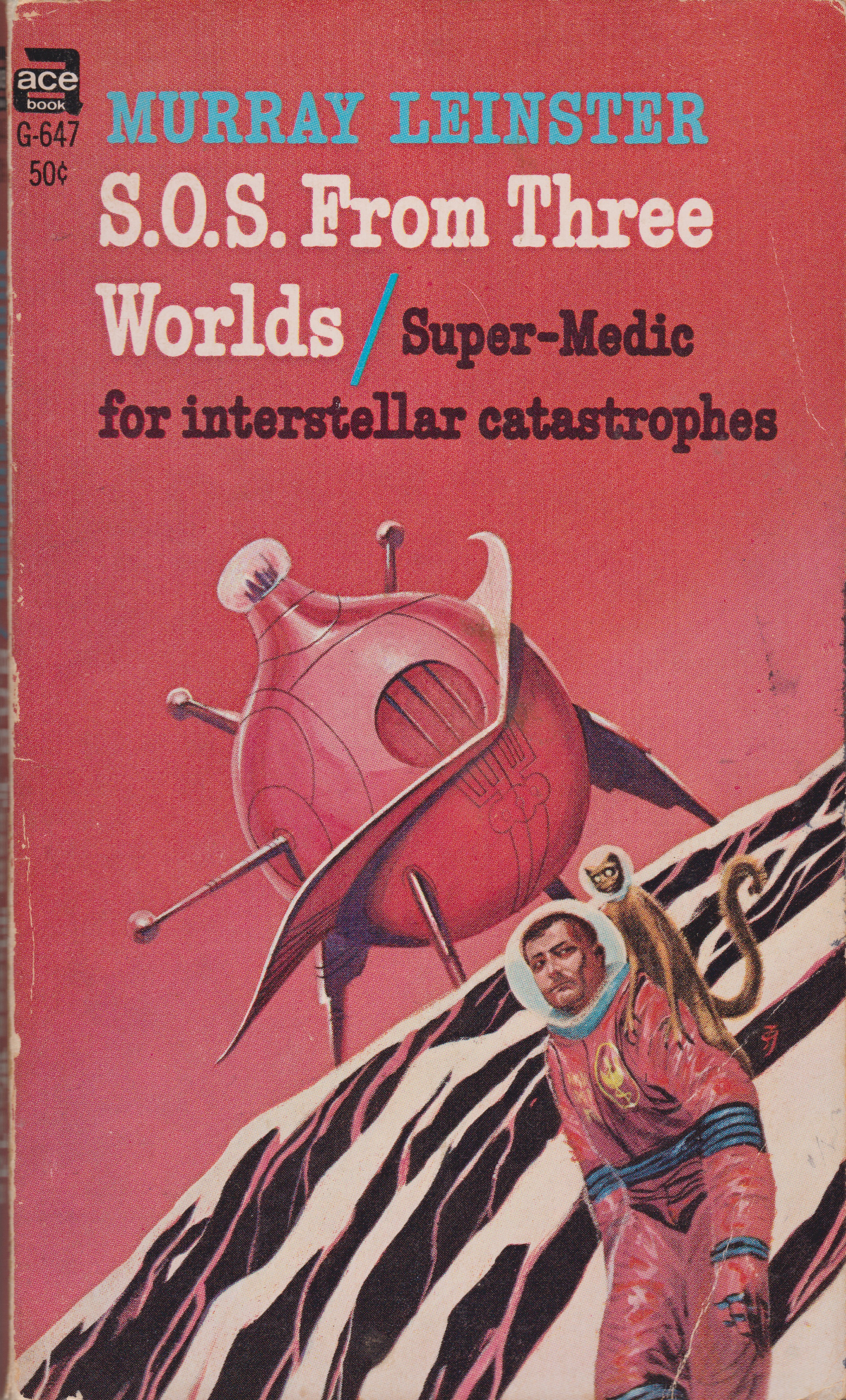
Jack Gaughan’s cover for the 1st edition

4/5 (collated rating: Good)

In times of stress, positivist stories about spacemen devoted to selfless service solving medical crises with their friendly tormals (think furry mobile petri dishes) bring a bit of warmth to my bitter heart. While a medical mystery to be solved with logic and resolve forms the core of each story, Murray Leinster hints at the future history of this decentralized spacescape–a product of chaotic often business-driven expansion.  As limited contact exists between distant colonies, The Interstellar Continue reading
Short Story Reviews: Phyllis MacLennan’s “A Contract in Karasthan” (1963), “Thus Love Betrays Us” (1972), and “A Day in the Apotheosis of the Welfare State” (1975)

Between 1963 and 1980, American SFF author Phyllis MacLennan (1920-1912) published one novel and seven short stories (bibliography and obituary). She served as a translator and linguist in Military Intelligence during WWII.  As I can find little about her work online, I decided to review three of her SFF short fictions. Perhaps they’ll inspire me to pick up her sole novel Turned Loose on Idra (1970), which I bought in 2014.


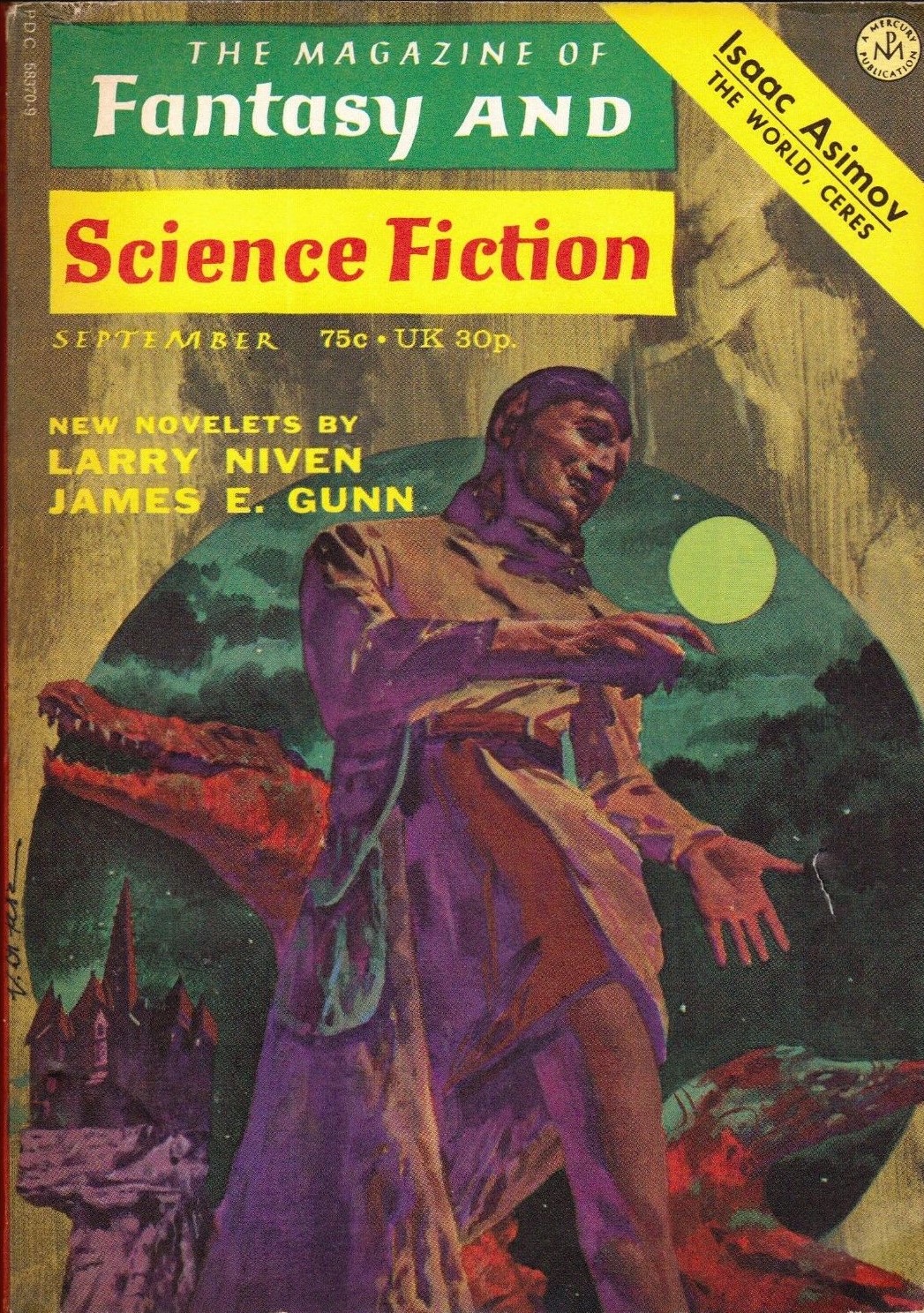
Vincent Di Fate’s cover for The Magazine of Fantasy and Science Fiction, September 1972

“Thus Love Betrays Us” (1972), 4.5/5 (Very Good): First appeared in the September 1972 issue of The Magazine of Fantasy and Science Fiction, ed. Edward L. Ferman. Read the story here.

Deirdre, a night-less and oppressive world filled with thick mists and layers of moss, had only just been Continue reading

Updates: Recent Science Fiction Purchases No. CCLXII (John Shirley, Sheila Finch, Hank Lopez, David Ohle)

As always, which books/covers/authors intrigue you? Which have you read? Disliked? Enjoyed?

1. Motorman, David Ohle (1972)

Matt Tracy’s cover for the 2008 edition

There is no cover or interior blurb for the 2008 reprint edition. From the back cover of the 1972 1st edition: “MOTORMAN is Moldenke, a man living in the City of one possible future—a man of little strength, few feelings, four implanted sheep’s hearts ticking away inside his chest, and a need to seek out the point where the square of existence becomes round. Of course it can’t be done, but his imagination sets out anyway on a Continue reading

Updates: Recent Science Fiction Purchases No. CCLXI (Algis Budrys, Gwyneth Jones, Russell M. Griffin, Dino Buzzati)

As always, which books/covers/authors intrigue you? Which have you read? Disliked? Enjoyed?

1. Some Will Not Die, Algis Budrys (1961, rev. 1978)

Frank Kelly Freas’ cover for the 1978 edition

My 1978 revised edition contains no inside flap or back cover blurb. Instead, here’s the brief description of the novel and its complex publication history from SF Encyclopedia: “Budrys’ first novel has a complex history. As False Night (March 1954 Galaxy as “Ironclad”; much exp. 1954) it was published in a form abridged from the manuscript version; this manuscript served as the basis for a reinstated text which, with additional new material, was published as Some Will Not Die (1961; rev 1978). In both versions a Post-Holocaust story is set in a plague-decimated Continue reading

Book Review: The Wind From Nowhere, J. G. Ballard (1962)

Richard Powers’ cover for the 1st edition

3/5 (Average)

In J. G. Ballard’s The Wind From Nowhere (1962), cosmic radiation creates an immense natural disaster. Ever-increasing winds threaten to tear buildings out by their foundations and force the survivors into subterranean caverns. With the winds comes dust, a manifestation of erasure, that lacerates skin and engulfs all.

John Carnell serialized Ballard’s first novel in New Worlds in 1961 (issues 110 and 111). Continue reading

Updates: Recent Science Fiction Purchases No. CCLVI (Joan Slonczewski, Barrington J. Bayley, James E. Gunn, Per Wahlöö)

As always which books/covers/authors intrigue you? Which have you read? Disliked? Enjoyed?

1. The Mind Master (variant title: The Dreamers), James E. Gunn (1981)

Lisa Falkenstern’s cover for the 1982 edition

From the back cover: “IT IS THE 22ND CENTURY… IT IS THE AGE OF ECSTASY… Man has perfected the chemical transfer of information. Pop a pill and experience the Garden of Eden, the knowledge of centuries, or the vicarious thrill of someone else’s life. And in this world, one man—The Mnemonist—holds the task of keeping society Continue reading

Book Review: Hyacinths, Chelsea Quinn Yarbro (1983)

Al Nagy’s cover for the 1st edition

4.25/5 (Very Good)

Chelsea Quinn Yarbro’s Hyacinths (1983) is an unsettling dystopian tale of a future where even the unregulated creative world of dreams is harnessed and controlled. On another level, Hyacinths lays bare the dangers of unregulated industry and the ingrained sexism within western capitalism. There’s a deep sadness within these pages, a sadness at the lack of progress for equal rights in the workplace, a sadness at our collective inability to help those who need Continue reading

Book Review: The Heirs of Babylon, Glen Cook (1972)

Detail from Dean Ellis’ (?) cover for the the 1st edition

3/5 (Average)

Glen Cook’s first novel, The Heirs of Babylon (1972), is one of a handful of science fiction works in his extensive catalog. He’s best known for two fantasy sequences, Chronicles of the Black Company and Dread Empire. Operating in standard post-apocalyptic territory (wrecked landscapes created by nuclear and chemical warfare), Cook weaves a disturbing tale of the power of militaristic fantasies and traditions. While suffering from diminishing narrative impetus as the ancient warship Jäger steams towards its inevitable end, The Heirs of Babylon transpires within a well-wrought Earth hellscape with a deeply flawed main Continue reading

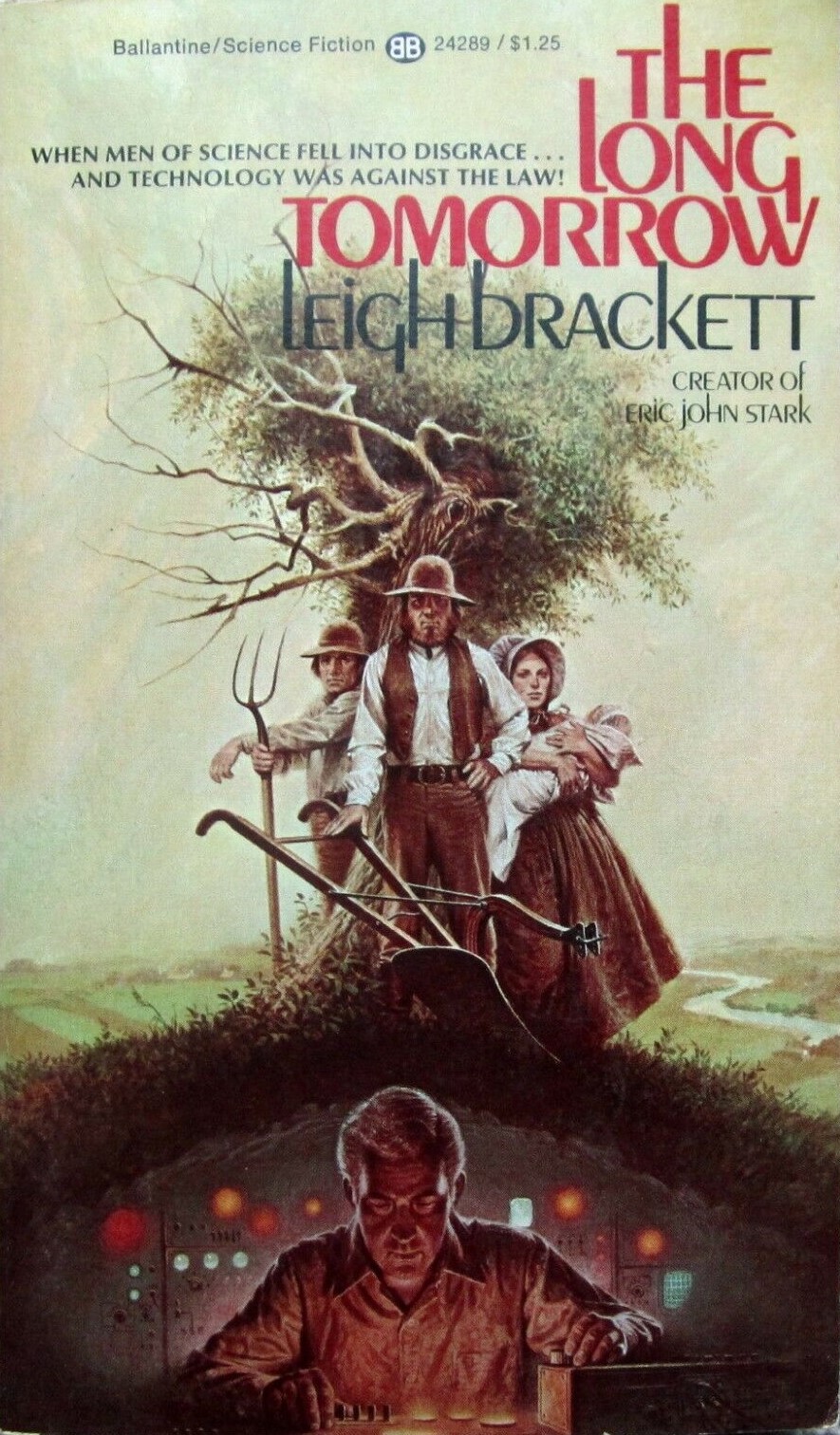
Book Review: The Long Tomorrow, Leigh Brackett (1955)

(Darrell K. Sweet’s cover for the 1974 edition)

4.5/5 (Very Good)

“No city, no town, no community of more than one thousand people or two hundred buildings to the square mile shall be built or permitted to exist anywhere in the United States of America” (Thirtieth Amendment of the United States Constitution) (1)

Nominated for the 1956 Hugo Award for Best Novel. Leigh Brackett’s The Long Tomorrow (1955) not only clocks in as the best of her work I’ve read so far but also joins my pantheon of favorite 50s SF visions (*).  At first glance Brackett’s novel appears to traverse standard SF juvenile territory where a teenage boy, in a religiously and socially oppressive society, encounters an object  and memories of the past that opens up a path to self-discovery. But memories are memories. And dreams are Continue reading