Book Review: Termush, Sven Holm (1967, trans. 1969)

(Uncredited cover for the 1969 edition)

4.5/5 (Very Good)

“[He] maintained that it was in fact essential to conceal what could be concealed; indeed, an inspired lie could be preferred to a malignant truth” (24).

Sven Holm’s Termush (1967, trans. 1969) depicts, with stark minimalism, the psychological state of wealthy survivors holed up in a hotel shelter after an apocalyptic nuclear event. This brief work, a mere 110 pages, is not an adventure story. It is not an exercise in nightmarish brutality like The Road (2006) or an account of humanity’s turn towards evil as the gauze of “civilization” falls away like The Death of Grass(1956).

Rather, Sven Holm (1940-2019) (SF Encyclopedia entry), a Danish author of mainstream literature, delves into the psyche of the survivors, their isolation and inability to grasp the immensity of the changes beyond their walls, and their Continue reading

Book Review: The Dead Astronaut, ed. uncredited (1971) (J. G. Ballard, Ursula K. Le Guin, Arthur C. Clarke, et al.)

(Pompeo Posar’s cover for the 1st edition)

3/5 (collated rating: Average)

“The dead astronaut: The phrase is filled with anxiety, the words themselves evoking the tension and anguish that gripped the whole world in that fateful month of April 1970, when a technical malfunction came close to costing the lives of astronauts Lovell, Swigert and Haise” (5).

The Dead Astronaut (1971) contains a range of 50s and 60s SF stories—from Ursula K. Le Guin to J. G. Ballard—on the broad theme of astronauts, that appeared in Playboy Magazine. For a  reader of genre for only the last decade (and a bit), it’s shocking to consider that Playboy, at one point, contained top-notch science fiction! That aside, The Dead Astronaut contains a range of soft and hard science fictional accounts of astronauts Continue reading

Updates: Recent Science Fiction Acquisitions No. CCXLIX (Chelsea Quinn Yarbro, Alan Dean Foster, E. Everett Evans, Ron Montana)

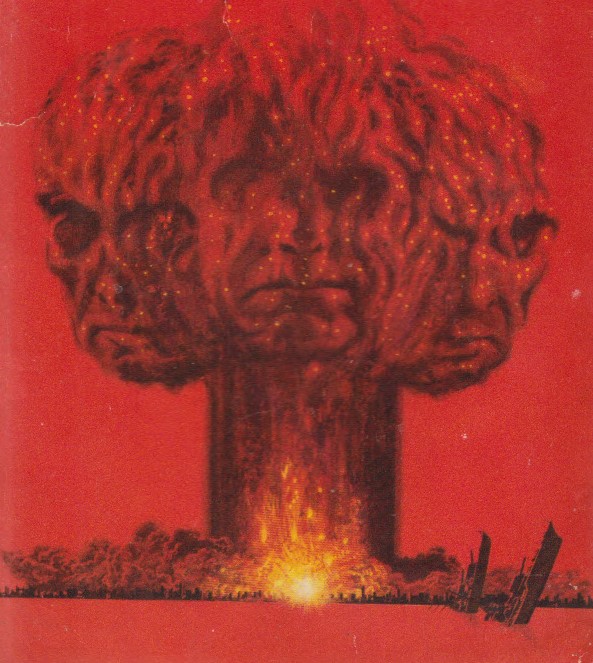
(Back cover detail for the 1959 edition of E. Everett Evans’ Man of Many Minds)

1. Looks like a fun adventure from Alan Dean Foster! And who can resist the crashed spaceship visual trope? I compiled three art posts on the topic: Part I, Part II, and Part III.

2. Of the bunch, Chelsea Quinn Yarbro’s Hyacinths (1983) appeals the most. I’m a sucker for SF stories about the dream state—i.e. Roger Zelazny’s The Dream Master (1966)—and commentaries on media and advertising. And of course, I’m fascinated Philip K. Dick’s dystopian formulations of the future of advertising which Hyacinths seems to expand on…..

I’ve previously reviewed Yarbro’s terrifying post-apocalyptic novel False Dawn (1978)

3. An alternate history where Native Americans defeat the colonizers? Intrigued but suspect it’s on the pulpy side of things. I wish I could find out more about Ron Montana. Was he of Native American descent? His first SF publication, “We the People” (1974), appeared in Craig Strete’s fanzine Red Planet Earth. Here’s his publication listing. Unfortunately, I assume he’s best known for his later copyright conflict with Craig Strete.

4. And finally, this one was hiding in a pile… I can’t remember how long I’ve had it or why I purchased it. Not an author I know and SF encyclopedia isn’t more than lukewarm in its assessment.

Let me know what books/covers intrigue you. Which have you read? Disliked? Enjoyed?

~

1. Icerigger, Alan Dean Foster (1974)

(Tim White’s art for the 1976 UK edition reused for the 1978 US edition) Continue reading

Book Review: The Black Corridor, Michael Moorcock and Hilary Bailey (1969)

(Detail from Bob Haberfield’s cover for the 1973 edition)

4.25/5 (Very Good)

In the Star Trek: Voyager episode “One” (1998), Seven of Nine, unaffected by a nebula’s subatomic radiation, must care for the crew while they’re placed in stasis. Alone on the ship, Seven experiences the prolonged effects of isolation including disturbing dreams and hallucinations. Ever since I saw “One” as a child, I’ve become fascinated with the strategies that humans might use in space to cope with isolation and the rituals they might enact to preserve sanity. Michael Moorcock and Hilary Bailey’s The Black Corridor (1969) (see note below), explores Continue reading

Updates: Recent Science Fiction Acquisitions No. CCXLVIII (Mary Gentle, Philip Wylie, Bruce Sterling, and a New Dimensions anthology)

1. More post-apocalyptic fictions…. I dunno about exclamation points in titles! More seriously, I’ve yet to read any of Philip Wylie’s novels—this one is at the top of the list.

2. Before I explore an author’s best known fictions, I enjoy nosing about the periphery first. Here’s Mary Gentle’s first collection of short fiction (I’m most interested in the SF stories).

3. I might have read Bruce Sterling’s Islands in the Net (1988) in my late teens. I know I had a copy that I gave away. I can’t remember anything about it other than the cover–if there’s a cover that screams 80s cyberpunk it’s that one!

I’ve previously reviewed Sterling’s Involution Ocean (1977).

A little research reveals the female figure was repurposed (sans the original spaceship background) from an earlier Luis Royo cover—Mike Resnick’s The Dark Lady: A Romance of the Far Future (1988) (cover link).

4. I adored Robert Silverberg’s original anthology New Dimensions 2 (1973) — I’m a bit closer to owning the entire series.

Let me know what books/covers intrigue you. Which have you read? Disliked? Enjoyed?

~

1. Tomorrow!, Philip Wylie (1954)

(Uncredited cover for the 1954 edition) Continue reading

Book Review: Dance The Eagle To Sleep, Marge Piercy (1970)

(Uncredited cover for the 1st edition)

4.5/5 (Very Good)

In the turbulent 1960s, the radical socialist Students for a Democratic Society (1960-1974) were one of the most influential organizations in the nascent New Left. SDS’s 1962 political manifesto, the Port Huron Statement, proclaimed in idealized terms the importance of egalitarianism, participatory democracy, labor rights, Civil Rights, and nuclear disarmament.  Marge Piercy (1935-) wrote her first SF novel Dance The Eagle to Sleep (1970) while working as an organizer with the SDS regional office in New York (biography). In the last years of the 60s, while she was writing the novel, she describes SDS devolving into “warring factions” and her own personal disillusionment as  the Vietnam War raged on.

In this context, Dance The Eagle To Sleep (1970) can be read as the rise and fall—intense, ecstatic, meaningful, tempestuous—of an SDS-esque student-driven movement (The Indians) in a near-future totalitarian America. Piercy follows a cast of characters whose paths, visions, and routes to revolutionary activity differ. As the movement is beset by external and internal Continue reading

Short Book Reviews: Samuel R. Delany’s The Ballad of Beta-2 (1965), Barry N. Malzberg’s The Last Transaction (1977), and Philip McCutchan’s A Time for Survival (1966)

My “to review” pile is growing and my memory of them is fading… hence short—far less analytical—reviews.

1. The Ballad of Beta-2, Samuel R. Delany (1965)

(Vincent Di Fate’s cover for the 1982 edition)

3.25/5 (Vaguely Good)

As I’ve been on a generation ship kick as of late, I was excited to pull out my copy of Samuel R. Delany’s early novel The Ballad of Beta-2 (1965). Delany subverts the standard (and infuriating) trope of cultural stasis—for the sake of societal stability—that authors suggest will occur between the colony ship’s departure and arrival. Instead, Delany explores the intermediary generations by examining a series of ballads Continue reading

Updates: Recent Science Fiction Acquisitions No. CCXLVI (Michel Jeury, Sheila MacLeod, Vietnam War anthology, The Year 2000 anthology)

1. I’m a sucker for themed anthologies! Especially of original stories… This one is on the top of my list to read!

2. The lengths the cover blurb goes to proclaim Sheila MacLeod’s Circuit-Breaker (1978) not SF is humorous. The blurb writer ends up describing the aim of New Wave science fiction (interior vs. exterior space). So many of these arguments demonstrate a lack of knowledge of genre and depends on dismissive stereotypes. As it my practice, I try to avoid these exclusionary/gate-keeping arguments. I recently picked up a copy of her only other SF novel Xanthe and the Robots (1977).

Curious about this one — and all SF about potentially insane astronauts.

A handful of favorite stories of (possibly) insane astronauts

Barry N. Malzberg’s Beyond Apollo (1972), The Falling Astronauts(1971), and Revelations (1972)

Gene Wolfe’s “Silhouette” (1975)

3. Another themed anthology! The topic here is the Vietnam War. Huge fan of Vietnam War inspired SF — especially Ursula Le Guin’s The Word for World is Forest (1972) and Kit Reed’s Armed Camps (1969).

What are your favorite Vietnam War-themed SF works? I’m thinking of putting together a resource on the topic.

4. French SF in translation. Here’s Michel Jeury’s bibliography. This appears to be the only one of his MANY SF novels to be translated into English. Alas.

Let me know what books/covers intrigue you. Which have you read? Disliked? Enjoyed?

~

1. The Year 2000, ed. Harry Harrison (1970)

(Pat Steir’s cover for the 1st edition) Continue reading

Book Review: Candy Man, Vincent King (1971)

(Patrick Woodroffe’s cover art for the 1973 edition)

3.5/5 (Good)

The Candy Man wanders from place to place in a crumbling mega-city with his sole companion, a mechanical dog named Wolf who comes with a handy handle. Candy Man instigates the lobotomized, with primal speeches and drugged sugar floss tinted with pulverized beetles, to revolution. His reward for turning in those he encouraged deviate from the will of the Deep Machine and their Teachers? Vials of drugs. Enter the hypnagogic world of Vincent King’s Candy Man (1971), an unsettled landscape inhabited by the degenerate remnants of humankind and the arcane workings of a computer program that cannot escape its original perimeters.

Fresh off Vincent King’s short story “Defense Mechanism” (1966), I tracked down a copy of his second novel. Occupying a similar space as “Defense Mechanism” (conceptual breakthrough in a decaying world city), King pushes the narrative Continue reading