Updates: Recent Science Fiction Acquisitions No. CLXXVII (Piercy + Gotschalk + Bax + anthology edited by Haldeman)

1) Futuristic city? Yes! Is more needed? Okay, okay, I concede, more is needed. I hope Gotschalk’s novel with its fantastic Dean Ellis cover delivers. Among the least known of the Ace Science Fiction Special series…

Check out my older reviews of J. G. Ballard’s “Billennium” (1961)Future City, ed. Roger Elwood (1973), and The World Inside, Robert Silverberg (1971) for more SF on this theme of futuristic cities. If you delve through the archives you’ll find many more examples.

2) Ballard blurbs Martin Bax’s novel as “…the most exciting, stimulating and brilliantly conceived book I have read since Burroughs’ novels.” Hyperbole aside, the two reviews (here and here) I’ve read of Bax’s sole novel puts this at the top of my “to read” pile.

I have cheated a bit by including the cover for the first New Directions edition rather than the later Picador edition I own due to the cover quality.

3) Three acquisitions posts ago (here) I mentioned that the premise of Marge Piercy’s Dance the Eagle to Sleep (1970) did not inspire me to read it anytime soon. Thankfully I found a copy of what many consider her masterpiece Woman at the Edge of Time (1976) cheap at the local used book store.

4) I am not sure why I picked this collection up—I’ve heard good things about Joe Haldeman’s introduction which draws on his experience in the Vietnam War. As Isaac Asimov, Mack Reynolds, etc are not normally authors who intrigue me, I might do something I rarely do and read and review Effinger’s story only (and maybe Poul Anderson’s as he’s better in short form)…

As always thoughts and comments are welcome.

~

1. Growing up in Tier 3000, Felix C. Gotschalk (1976)
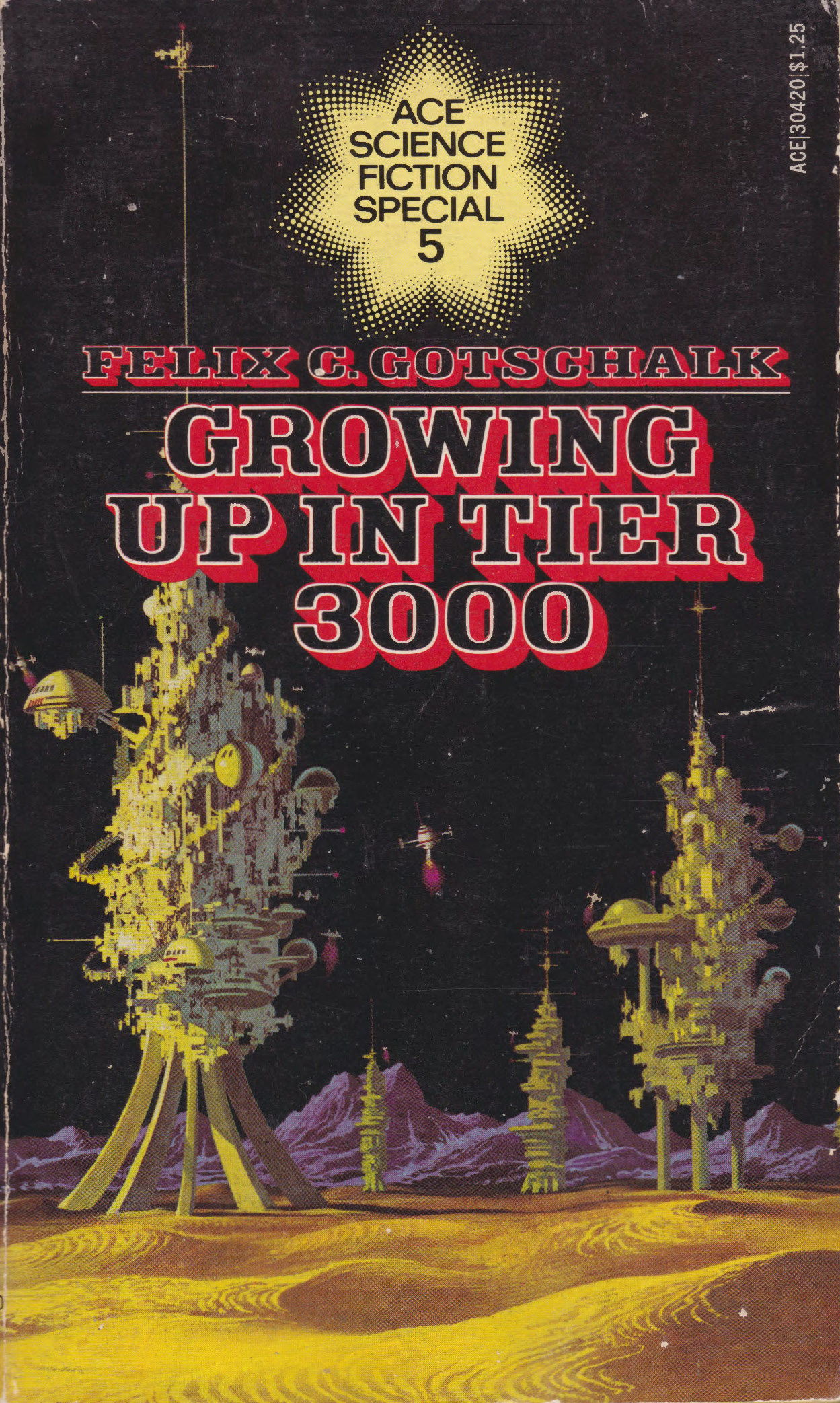
(Dean Ellis’ gorgeous cover for the 1976 edition) Continue reading
Book Review: Bedlam Planet, John Brunner (1968)

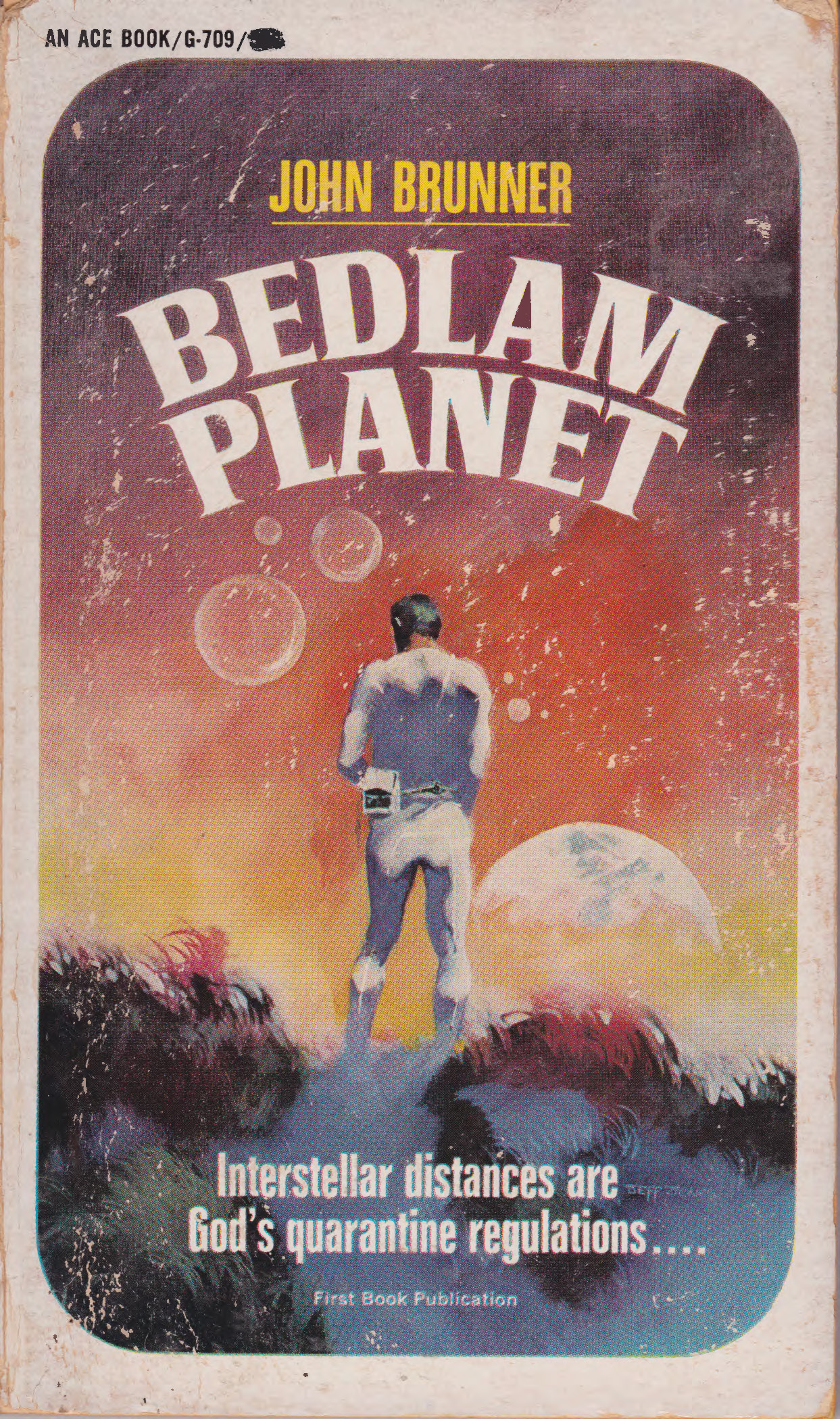
(Jeff Jones’ cover for the 1968 edition)

3.25/5 (Vaguely Good)

To move past my variegated obsessions regarding William Kotzwinkle’s Doctor Rat (1976) (review + list of imaginary scientific articles), I decided to reread a lesser known John Brunner novel. I cannot pinpoint exactly when I first read Bedlam Plant (1968), other than before I started my site, but it holds up as a moody biological mystery with mythological undertones as colonists confront their deceptive new world.

This isn’t Stand on Zanzibar (1968), Shockwave Rider (1975), The Sheep Look Up (1972), or The Jagged Orbit (1969), but it left me wishing that Brunner applied his Continue reading

Updates: Recent Science Fiction Acquisitions No. CLXXVI (Wolfe + Mendelson + Stableford + Tennant)

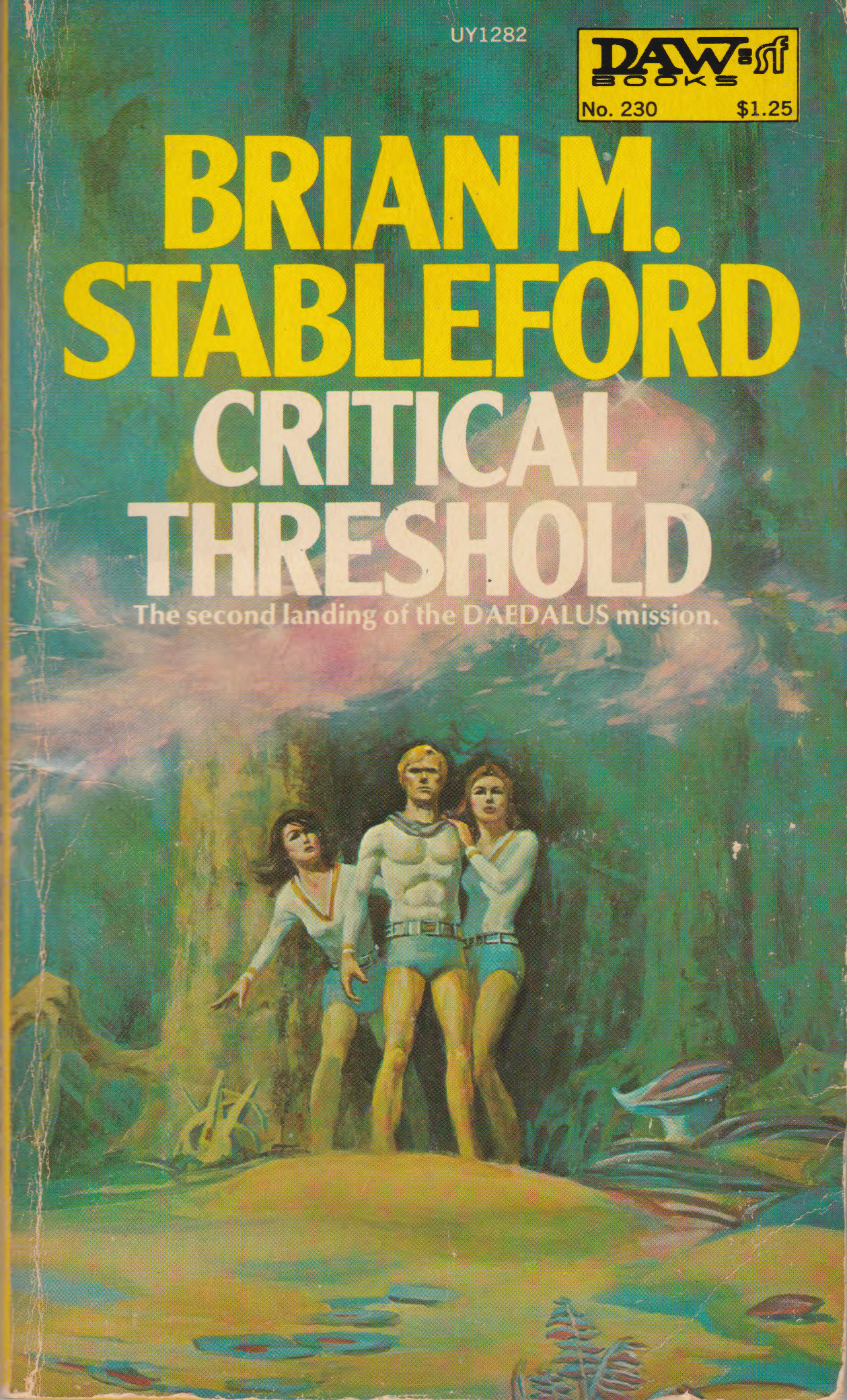
1) Brian M. Stableford has not faired particularly well on this site: I’ve reviewed The Florians (1976) and Journey to the Center (1982) (I apologize in advance for the rather slight reviews—they are years old). But I found a copy of the second volume of The Daedalus Mission series in a clearance bin, and depending on my mood, I have a soft spot for conflict-less “solve the biological mission” Star Trek-type SF. But The Florians (1976) was forgettable…

Jesse reviewed Stableford’s Man in a Cage (1975) and calls it an intelligent psychological exploration. I am more likely to read my copy before Critical Threshold (1977). Check out his review if you are interested in Stableford’s most mature work!

2) Emma Tennant’s The Crack (variant title: The Time of the Crack) (1973) was a compelling satire of the cozy apocalypse…. And I cannot resist snagging a copy of Hotel De Dream (1976), where residents of a seedy hotel start dreaming each other’s dreams.

3) A lesser known novel by Gene Wolfe… I don’t know when I’m going to get to his novel length work as I’m perfectly content exploring his short fiction in various anthologies at the present: “The Changeling” (1968), “Silhouette” (1975), “Sonya, Crane Wessleman, and Kittee” (1970), etc.

4) I now own one of the worst SF covers of all time! I purchased Pilgrimage (1981), Drew Mendelson’s only SF novel, due to SF Encyclopedia’s positive assessment and the fact I’m a sucker for futuristic cities, even if they’re heavily indebted to Christopher Priest’s Inverted World (1974): “[it] grippingly presents a vision of a bleak Ruined Earth environment, long abandoned by most humans except for those who inhabit the planet’s one remaining artefact, a vast City that moves slowly across the devastated land.” For more on the novel consult the entry here.

But the cover… Cringe!

As always thoughts/comments are welcome!

1. Critical Threshold, Brian M. Stableford (1977)

(Douglas Beekman’s cover for the 1977 edition) Continue reading

Updates: Recent Science Fiction Acquisitions No. CLXXV (Ballard + Strugatski + deFord + Baines)

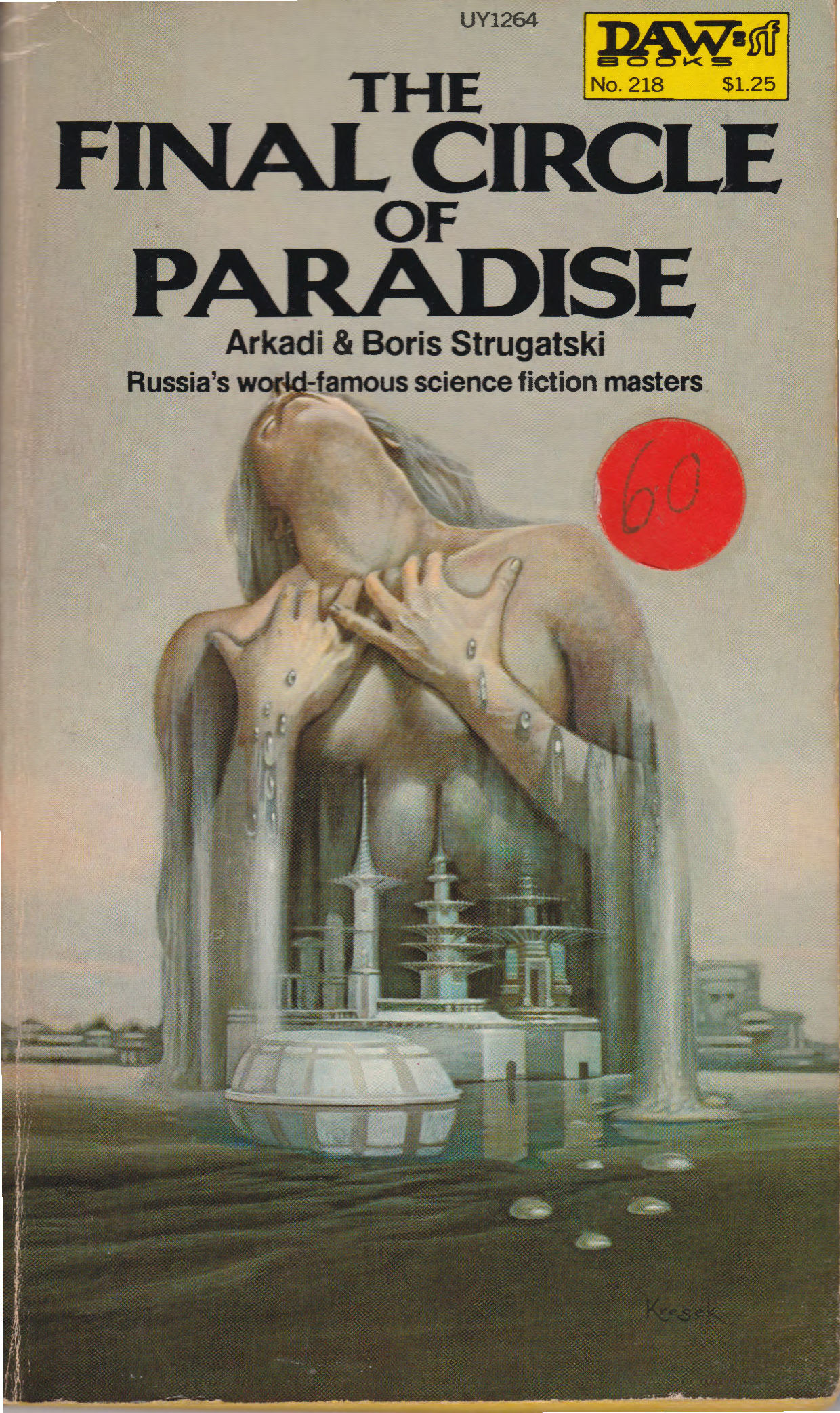
1) Blunt statement: I need to read more of the Strugatski brothers. I devoured the The Ugly Swans (written 1966-1967, published 1979 in the US, published in 1987 in the USSR) but did not review it.

2) A fascinating speculative feminist novel from The Women’s Press–birth, myth, delusions, dreams, terror.  Few reviews exist online so I will go in without much knowledge of the work.

3) I placed Miriam Allen deFord’s collection (filled with numerous gems) Xenogenesis (1969) on a list of SF Gollancz’s Masterwork series should acquire. Her only other published collection for the longest time was priced far out of my reach. This is why you have Amazon lists… scan them frequently, find the deals!

4) A Ballard novel with “pervading auroral gloom, broken by inward shifts of light”? Count me in! As a fierce advocate of Ballard’s early fiction and novels, I cannot wait to read this one…

Related reviews: Billenium (1962), High-Rise (1975), The Voice of Time and Other Stories (1962). The Drowned World (1962) and The Drought (1964) clock in as my favorite of his novels—although both remain unreviewed… Stay tuned for my upcoming review of The Terminal Beach (1964).

Scans are from my personal collection. Click to enlarge.

Thoughts/comments are welcome (as always)!

1. The Final Circle of Paradise, Arkadi and Boris Strugatski (1965, trans. 1976)

(Laurence Kresek’s cover for the 1976 edition) Continue reading
Short Book Reviews: Jeff VanderMeer’s Annihilation (2014), John Sladek’s The Müller-Fokker Effect (1970), Robert Sheckley’s Options (1975)

Yes (I see inquisitive phantom stares), I listened to an audiobook written in this decade. And it was good. Very good. Brilliant actually. As it was an audiobook, I’m unable to write an in-depth review. However there are plenty online for the curious–in part because it won the 2015 Nebula Award. I added two additional novels that have been waiting patiently in a “to review” pile that are more my standard territory…

Think of these short reviews as tantalizing fragments rather than my normal analysis. The books that reside in these short review posts often defeated my reviewing capabilities.

1. The Müller-Fokker Effect, John Sladek (1970)

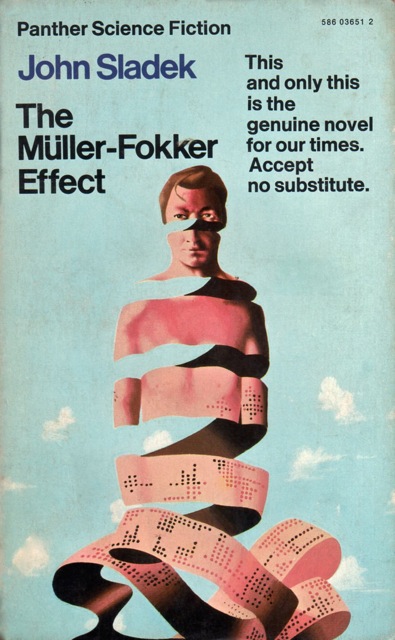
(McInnery’s cover for the 1972 edition)

4.25/5 (Very Good)

In my 2016 in review I promised to read more of Sladek’s work, and for once I’m holding true to my reading goals.

That said, I find Sladek’s novels notoriously difficult to parse into cohesive reviews—his SF (and my reviews by extension) stretch satirically in all directions, unfolding in fascinating experiments that jest with layered wordplay and (often) diagrammatic dalliances (see example below). There’s a humorous Continue reading

Adventures in Science Fiction Cover Art: The 50s/60s Surrealistic Stylings of Art Sussman

tfthslntpl1960

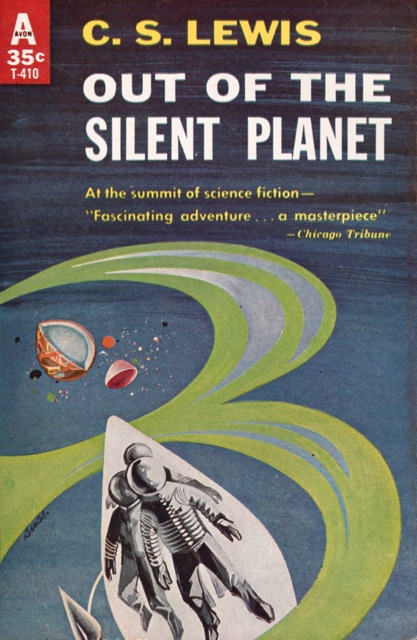
(Cover for the 1960 edition of Out of Silent Planet (1938), C. S. Lewis)

Art Sussman produced a remarkable corpus of SF and other pulp covers (mysteries, crime, etc). He could easily shift gears between Richard Powers-esque surrealism—although distinctly his own take—to covers that suited an Agatha Christie mystery (browse the range here). I would be wary comparing him to Powers until you skim through the latter’s late 50s early 60s art (definitely an enjoyable activity!). Although Powers is still far superior, both were part of the SF art movement increasingly experimented with surreal/metaphoric and experimental art (there are still spaceships lurking around the edges, and futuristic cities, and other pulpy moments).

There is a precision of vision with Sussman’s art—his cover for the 1960 edition of Out of Silent Planet (1938), C. S. Lewis places the astronauts in an outline of a vessel with strange hints at alien planets and experiences scattered gem-like in the distance. Sussman’s focus on the human form — often surrounded by surreal forms and humanlike membranes — showcases agony and despair. A great example (and my favorite of the bunch) pairs jagged black fields with a bloodied man, the 1960 Continue reading

Updates: Recent Science Fiction Acquisitions No. CLXXIII (Priest + Davidson + Scott + Tate)

1) Barry N. Malzberg’s back cover blurb for Jody Scott’s 1977 novel suggests a worthwhile, or at least intriguing (and satirical), read: “What Paganini did to four strings and three-and-a-half octaves, Jody Scott does for our dear, undead genre.”

My first The Women’s Press edition!

2) My Christopher Priest collection nears completion. Has anyone read his early novel Fugue for A Darkening Island (1972)? Although I adore the short fiction and novels of his I’ve read so far, this premise has the potential to be deeply problematic (racist, etc). That said, I discovered my copy is signed! Purchased it for $4 with shipping off of Abebooks — it’s a $50+ book with signature.

christopher priest_Page_2.jpg

For more on his work: The Affirmation (1981), Real-Time World (1974), An Infinite Summer (1979), and Indoctrinaire (1970).

3) A collection of Avram Davidson stories. The title story “Or All the Seas with Oysters” won the 1958 Hugo for Best Short Story. The two works of his I’ve read so far disappointed: The Enemy of My Enemy (1966) and “Rife of Spring” (1970).

4) Peter Tate’s stories mostly appeared in various New Worlds publications. Although hailing from the UK, his novels were almost entirely published by Doubleday Press in the US. In the past I read “The Post-Mortem People” (1966) and found it a functional New Wave experiment. As is my wont, I tracked down a collection of his short fictions.

As on all posts, thoughts and comments are welcome!

~

1. Passing for Human, Jody Scott (1977)

new books scott, davidson, tate_Page_2.jpg

(Miss Moss’ cover for the 1986 edition) Continue reading

Book Review: The Time of the Crack (variant title: The Crack), Emma Tennant (1973)

emma-tennant

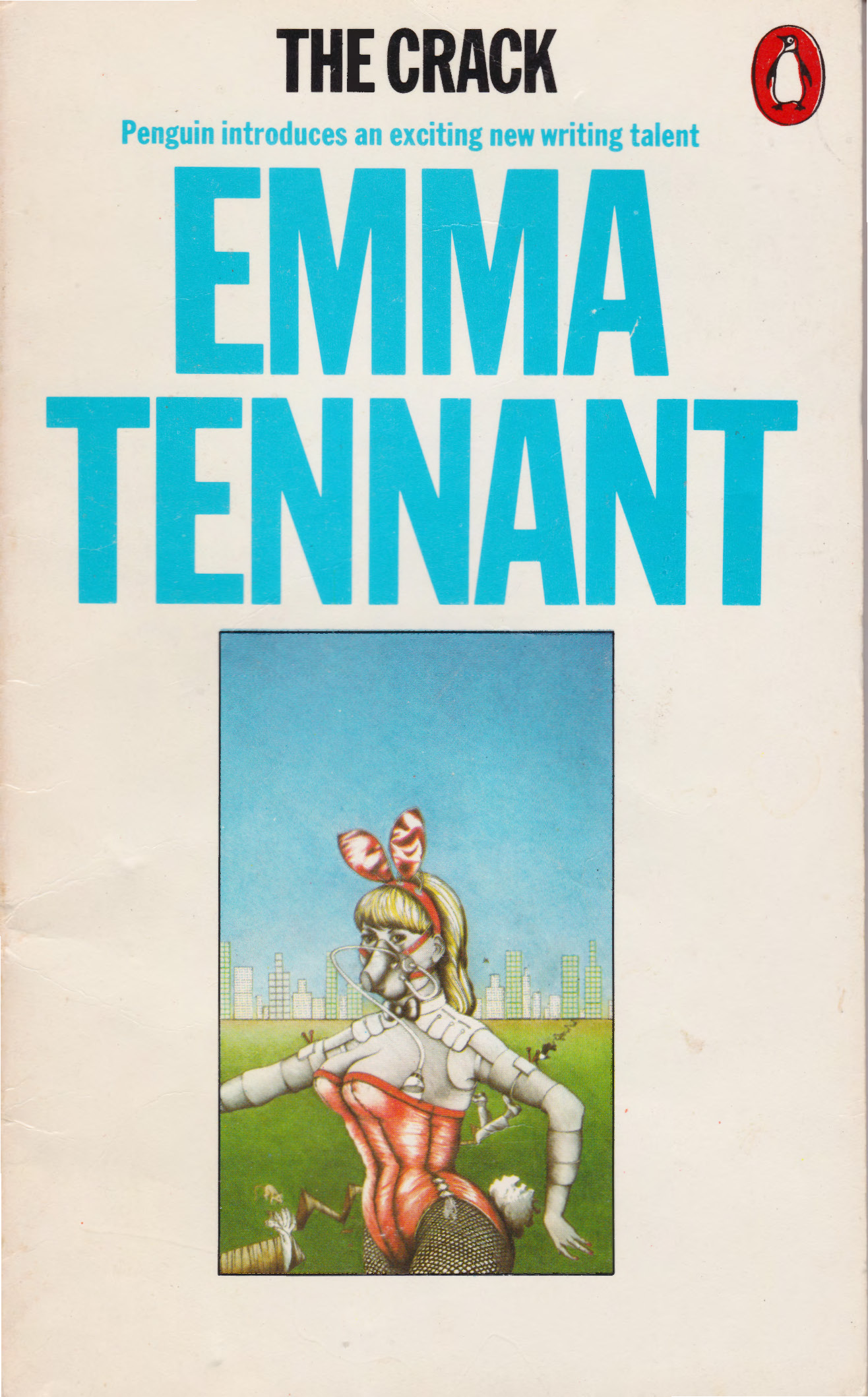
(Candy Amsden’s disturbing cover for the 1978 edition)

4/5 (Good)

Emma Tennant’s The Time of the Crack (variant title: The Crack) (1973) takes the form of a series of character vignettes in a transmogrified London. Despite Tennant’s wide-ranging societal critiques,  it’s a brief book–my 1978 Penguin edition clocks in at 112 pages–threaded loosely together by the occasional presence of Baba, a Playboy bunny. The cataclysm in question, the appearance of an expanding crack under the Thames, although causing devastation, doubles as a metaphoric birth moment. The landscape modified, buildings contorted by the severance… And in the wreckage of what remains the survivors make postures towards all manners of “New” English societies Continue reading

Career Highlights + Reminisce + Review: SF short story author Edward Bryant (1945-2017)

mngthddndt1973

(Gray Morrow’s cover for the 1973 edition of Among the Dead and Other Events Leading Up to the Apocalypse (1973), Edward Bryant)

On February 10th SF author and two-time Nebula Award winner Edward Bryant (1945-2017) passed away after a long illness. As the number of authors from my favorite era of SF is sadly dwindling as the years go by, I decided to briefly highlight his career and the stories of his I’ve read so far (too few!). Although primarily a short story author, Bryant co-wrote Phoenix in Ashes (1975) with Harlan Ellison. For more on his life and genre impact see the write-up posted after his death on Locus and his entry on SF Encyclopedia. I’ve decided to review two stories from his disturbing and powerful collection Among the Dead and Other Events Leading Up to the Apocalypse (1973).

_____

“The Hanged Man” (1972), short story, 4/5 (Good): “Shrikes were my playmates when I was about ten” (2). Two friends reminisce. But there’s a dark and sinister twist, one named Rockaway dangles, head downward tied by his feet to a tree branch and his friend refuses to cut him down…. Fragments of the world interjects into their unnerving conversion: family members have died, they survived by eating birds. Their conversation reflects Continue reading