Adventures in Science Fiction Cover Art: The Art of Robert Foster, Part II

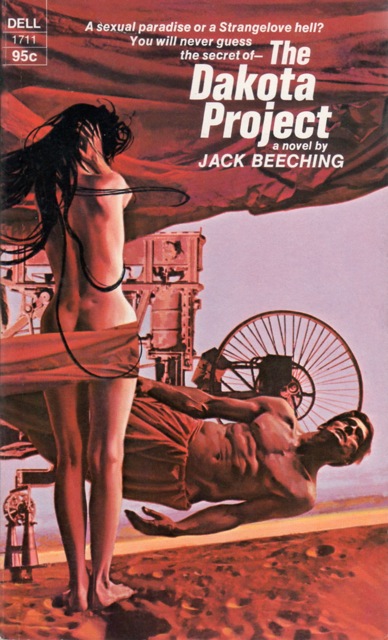
(Robert Foster’s cover for the 1971 edition of The Dakota Project (1968), Jack Beeching)

Unfortunately, science fiction covers from the 60s/70s are not always credited — Robert Foster’s covers are no exception.  Originally I assumed that Foster had only produced a handful (see my first post on his work, Part I), but after searching under Bob Foster and identifying covers by sight I’ve cobbled together another varied/intriguing/unusual collection of his work.

His work are often characterized by fascinating collaged, geared, industrial machinery paired with nudes and semi-nudes Continue reading →

Updates: Recent Science Fiction Acquisitions N. XXIII (Farmer, Malzberg + et al.)

A while back I slogged through Philip José Farmer’s dismal To Your Scattered Bodies Go (1971) (the worst novel ever to win the Hugo Award?) and all the increasingly terrible sequels and made a solemn vow to wait a few years before I returned to his extensive oeuvre — so, against my better judgement I picked up a copy of  Traitor to the Living (1973).  I don’t have high hopes (but I love the cover!).  I hope my two dollars were well spent.

Malzberg is shaping into my “under read/unjustly forgotten author of the year” whom I’ll showcase.  Last year’s winner was the brilliant D. G. Compton (see INDEX for reviews).  Fresh off Conversations (1975) and In The Enclosure (1973) I picked up a copy of Guernica Night (1975).  I can’t wait!

Harold Mead’s The Bright Phoenix (1955) is yet another against the oppressive state à la Orwell’s 1984… But, I’ve found that the premise generally holds up despite frequent re-interpretations…

Greenfield’s Waters of Death (1967) should be avoided — at all cost.  I’ve already written a scathing review (rant).

1. Traitor to the Living (1973), Philip José Farmer (MY REVIEW)

(Hans Ulrich Osterwalder and Ute Continue reading →

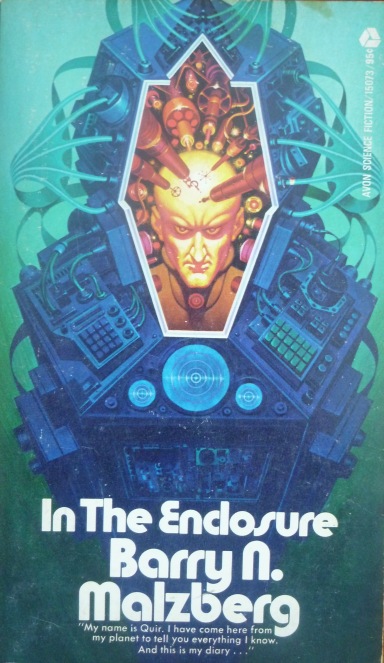
Book Review: In The Enclosure, Barry N. Malzberg (1973)

(Davis Meltzer’s cover for the 1973 edition)

4.5/5 (Very Good)

Fresh off Malzberg’s intriguing young adult novel, Conversations (1975), I picked up a copy of the altogether more disturbing, transfixing, unnervingly prescient, and at moments, brilliant In The Enclosure (1972).  As with many of Malzberg’s oeuvre, the work is infused with a steady dose of metafiction — our hero laments (and we writhe along with him in a malaise of unease), “I will never really know” (189).  Just as Quir is unsure of his own reality, his diaristic words — which the reader is desperate to hold on to — are admittedly, “an impression, a conception, nothing more” (190).

Combining the science fiction trope of implanted memories with the literary narrative mode of the unreliable narrator creates an overwhelmingly uncomfortable gulf between reality and constructed reality.  The result, the overpowering desire to pick up a piece of pulp science fiction where the future is rosy, technology = happiness, the kids smart, where rockets Continue reading →

Updates: Visit + Submit to the BSFA Award Nominated Review Site SF Mistressworks


Hello all,  Ian Sales’ wonderful SF Mistressworks (link), a review collating blog, has recently been nominated for the BSFA award (British Science Fiction Association) in the non-fiction category (link for the list).  I’ve submitted nine of my reviews of sci-fi works written by women over the last few months.  It was created in direct response to the absence of sci-fi masterpieces by women on a list by The Guardian, a lack of general knowledge in the sci-fi community about early female pioneers in the genre, and general lack of readership for their many award-winning works.

If you’ve written reviews of science fiction works by women (the novels/short story collections need to be written before 2000) please submit them as well (500 words or so is preferred)!  So, gather up any Russ, Norton, Cherryh, C. L. Moore, Merril, Brackett, Piserchia, Le Guin, MacLean, Butler, etc etc etc reviews you might have on your blog or anywhere else.  It’s a great resource for finding seldom read works/authors which deserve a greater readership. Continue reading →

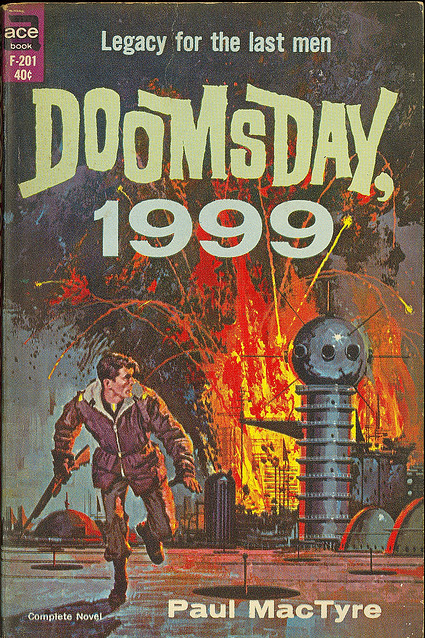
Adventures in Science Fiction Art: Doomed Cities Part II (migrating icebergs, firestorms, the horsemen of the apocalypse)

(Uncredited cover for the 1963 edition of Doomsday, 1999 (variant title: Midge), Paul MacTyre)

Behold Part II of my popular series on the doomed city in science fiction cover art (see Part I).  A doomsday that never happened, a tank and a skeletal reminder of a past battle — a ruined city, colliding stars, colliding planets…

Behold the august ruins of our people, our cities, our achievements.  If there’s anyone still left.

As always, are the books/authors worth reading? Continue reading →

Adventures in Science Fiction Cover Art: On the Doctor’s Table

(Ed Emshwiller’s cover for the 1962 edition of Recalled to Life (magazine publication 1958), Robert Silverberg)

The science fiction doctor’s table — a place of healing, a place of inhuman manipulation, unusual prosthetic limbs are attached, immortality conferred, brains are transfered, descending mechanical arms wield their scalpels, vast arenas expose the spectacle, a mad scientist’s altar for ritualistic modification/sacrifice in the name of science or personal gain (legions of super men, alien/human hybrids, etc)…

I LOVE Ed Emshwiller’s cover for the 1962 edition of Silverberg’s Recalled to Life (1958).  The book itself is suposed to be one of Silverberg’s weaker ones.  I have read Silverberg’s To Live Again (1969) — a work filled with interesting concepts which are sadly not sustained Continue reading →

Adventures in (Bad) Science Fiction Cover Art: Miserable Monday No. 1, (pink/yellow striped cat aliens)

Inspired by C. M. Kornbluth’s dark/satirical tales in The Explorer (1954) that uncover the underbelly of the normally glamorous 50s portrayals of space travel and alien contact, I seek to expose (well, re-expose) the darker side of science fiction cover art.  I’ll try to post every monday, one bad science fiction cover — if possible, I’ll pair it with a much better cover of the same book from another edition if one exists.

My reasons:

1). The hilarious website ‘Good Day Sir’ doesn’t post the images I come across fast enough despite getting routine ratings from 7.5-9.5…    This is probably due to the fact that I don’t own the books and don’t follow the submission rules — i.e. posting an image of me physically holding a book in hand — alas, too bad.

2).  If a reader came across certain editions (posted below) the true nature of a book would be hopelessly confused (a great cover on a terrible book does the same thing) — Yes, there really are cat-like aliens in this book.  But, the  work’s overarching theme is much more mature (societal reaction to natural disaster, etc). Continue reading →

Adventures in Science Fiction Cover Art: Superminds (giant brains, expanding minds, rampant imagination)

(Uncredited cover for the 1960 edition of The 22nd Century (1954), John Christopher)

There’s no better way to start off the new year than a gallery of science fiction covers depicting rampant imagination,  unlimited promise.  Some of us probably wish for mechanisms that conjure extraordinary feats of telepathy or the throbbing delights (avoiding all the pitfalls, of course) of a wisdom inundated supermind (well, I do at least).

Regardless, depicting extraordinary intelligence — whether harnessed for nefarious schemes or not — is a common trope: gigantic brains! unusual metal helmets! exploding heads replete with spectral fires! rays darting from eyes! otherworldly auras encircling heads, emanating symbols Continue reading →

Adventures in Science Fiction Cover Art: Reusing Cover Art

(Jack Gaughn’s cover for the 1964 edition of Three Worlds to Conquer (1964), Poul Anderson)

I spend a substantial amount of time looking through the sci-fi publisher catalogues of Ace, Pyramid Books, Dell, Doubleday, Signet, Ballantine, etc for both books to read and interesting covers that fit into various themes for my Adventures in Science Fiction Cover Art posts (INDEX).

While perusing I’m occasionally baffled by covers that I’ve sworn I’ve seen on other books — and lo and behold, publishers sold art to different publishers, often lesser-known and unable to commission their own Continue reading →