Updates: My Top 15 Science Fiction Novels from the 1960s

Everyone loves lists!

The 60s produced some of my favorite science fiction works.  Many authors moved away from the technologic naivete of pulp sci-fi and predicted less than positive futures (overpopulation, natural disaster, etc) and attempted to instill a more literary quality to their works.  I’ve cobbled together a top eleven list — I have probably forgotten a slew of amazing works that I read years ago.  Also, I read majority of them before I created my blog and hence do not have reviews — I’ve included a blurb for those without reviews.  I’ve linked those that do.  And, as I have promised before, a review of J. G. Ballard’s masterful The Drowned World (1962) is on the way!

EDIT: Over the course of reading the comments and glancing over my bookshelves I’ve discovered how much I’d forgotten had been written in the 60s (Vonnegut’s Cat’s Cradle, etc).  As a result, I’ll put together a more comprehensive top 20 or so in the near future.

EDIT: 06/26/2015: Because my post is receiving a substantial number of new visitors, I’ve decided to add a few novels I’ve read since I made the initial list three years ago.  Instead of a top 11 it’s now a top 15 in no particular order.

New additions:

Anna Kavan’s Ice (1967) — REVIEW LINK

Robert Sheckley’s Journey Beyond Tomorrow (1962) — REVIEW LINK

Josephine Saxton’s The Hieros Gamos of Sam and An Smith (1969) — REVIEW LINK

Naomi Mitchison’s Memoirs of a Spacewoman (1962) — REVIEW LINK

~

Feel free to list your top 11!

Original list:

1. Stand on Zanzibar, John Brunner (1968) — is by far the best of the overpopulated world genre (for additional works consult my index).  Brunner chronicles a dystopian future society in obsessive and awe-inspiring detail with shreds of newspapers, advertising jingles, quotations from invented books, and even current (60s) events.  Be warned: low on plot, heavy on world building, experimental structure…

(Steele Savage’s cover f Continue reading
Updates: Recent Science Fiction Acquisitions No. XXVI (Malzberg + Wells + Gunn +Pohl)

A nice (varied) selection of finds….

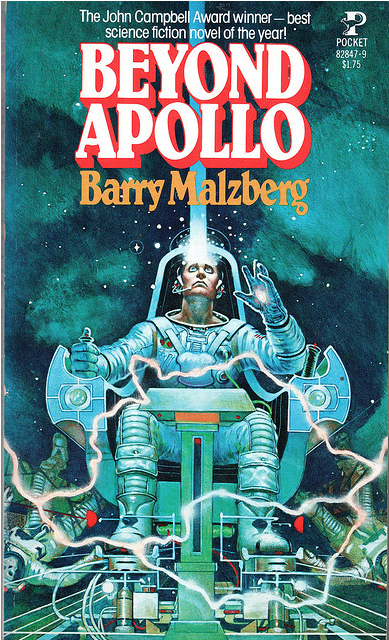
I’ve continued to be on the lookout for Malzberg’s novels and, due to the proliferation of comments by my readers about what is his best, I’ve acquiesced and picked up a copy of his acknowledged masterpiece, Beyond Apollo (1972).  I suspect it will be as good as In The Enclosure (1973).

If there is any area (besides sci-fi from the 21st century) that I haven’t read a good portion of the classics, it’s works from around the turn of the century.  I have read a large swathe of Verne’s works and from beginning of the 20th century  all of Edgar Rice Burroughs’ John Carter series — but, only a few of H. G. Wells’ oeuvre (The War of the Worlds and The Time Machine).  So, when I came across a 60s edition of The First Men in the Moon (1901) with a nostalgic looking cover I snatched it up!

The two short story collections are unknown commodities: Frederick Pohl’s In The Problem Pit (1976) and James Gunn’s Station in Space (1958).  I’ve never heard of Gunn and sort of dislike what I’ve read of Pohl so far.  Regardless, both works have intriguing covers!

Enjoy!

1. Beyond Apollo, Barry Malzberg (1972)

(Don Maitz’ cover for Continue reading

Book Review: The End of the World (1956), ed. Donald Wollheim

(Ed Emshwiller’s? cover for the 1956 edition)

3.75/5 (Good)

 The End of the World (1956) is a highly readable collection of short works by some of the leading figures of the 50s:  Robert Heinlein, Edmond Hamilton, Philip K. Dick,  and Arthur C. Clarke are the most notable contributors.  All the works, including the short by the virtually unknown author Amelia Reynolds Long, have appeared in other volumes but it’s nice to have them grouped according to theme with a quality Ace edition 50s Emshwiller cover.

Wollheim gathers together a fascinating range of accounts of the end of the world — seen through the eyes of aliens, humans from the present viewing the future, the last men on earth surveying the ruins, a robotic bomb who thinks it’s human and “accidentally” triggers the end of the Continue reading

Book Review: The Bright Phoenix, Harold Mead (1955)

(Richard Powers’ cover for the 1956 edition)

3/5 (Average)

Harold Mead’s The Bright Phoenix is a readable future ultra-regulated “perfect” State themed science fiction novel with a time-worn but proven plot. Unfortunately, the end product, despite moments of intriguing characterization and oppressive gloom, sinks into forgettable melodrama and the conclusion resorts to frustratingly obvious references to a “second coming” (of sorts).  Mead is less interested in describing the mechanisms of the “perfect” state and more interested in the slow evolution of a character coming to grips with the deficiencies of the system.  This is an admirable program that falls woefully short in part due to the paltry descriptions of the before mentioned system.  This causes our hero’s evolution to occasionally ring hollow.  The primitive but somehow “truer” pseudo-Christian civilization contacted by our hero, the fulcrum of his transformation, lacks any seductive qualities that would facilitate Continue reading

Adventures in Science Fiction Cover Art: Through the View Screen, Through the Window

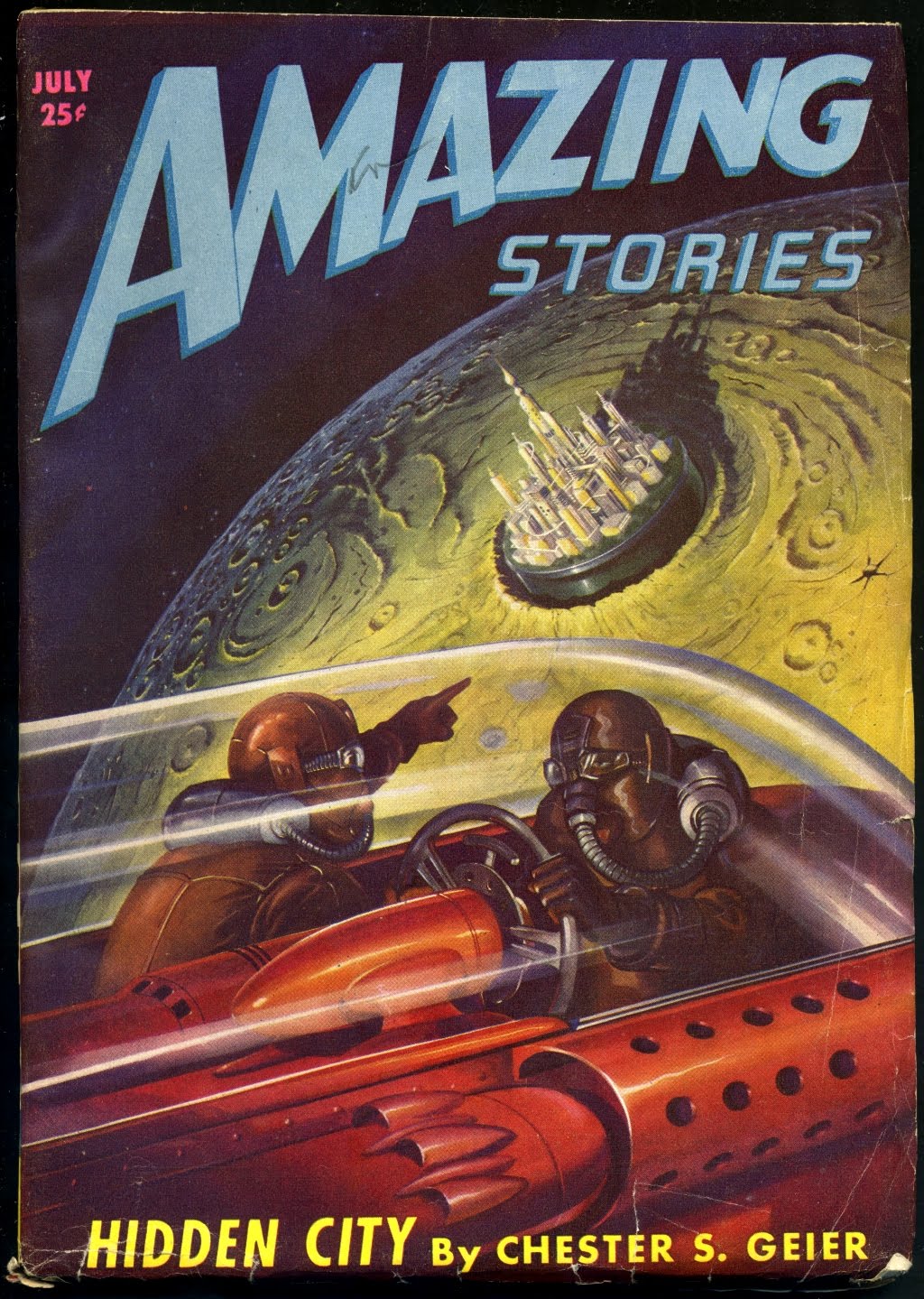
(Julian S. Krupa’s cover for the July 1947 issue of Amazing Stories)

Through the window, through the view screen cities are discovered, worlds end in searing flame,  vectors to unknown lands are plotted, the horrors of earth are left behind.  Alone in a space station an astronaut observes the fragile construction arrayed around him.  Through the window, through the view screen aliens observe our strife, loved ones watch in agony, and the culmination of our era’s scientific endeavors are arrayed in orderly rows.  

In short, the possibilities are endless.  The glass (or some scientifically advanced clear material) frames the story, we watch others watching or we see what they see while we stand among them… 

Definitely a delightful sci-fi cover art trope worth exploring.  Here are a broad selection of covers from juvenile science fiction novels, pulp magazines, edited Continue reading

Updates: Recent Science Fiction Acquisitions N. XXIII (Farmer, Malzberg + et al.)

A while back I slogged through Philip José Farmer’s dismal To Your Scattered Bodies Go (1971) (the worst novel ever to win the Hugo Award?) and all the increasingly terrible sequels and made a solemn vow to wait a few years before I returned to his extensive oeuvre — so, against my better judgement I picked up a copy of  Traitor to the Living (1973).  I don’t have high hopes (but I love the cover!).  I hope my two dollars were well spent.

Malzberg is shaping into my “under read/unjustly forgotten author of the year” whom I’ll showcase.  Last year’s winner was the brilliant D. G. Compton (see INDEX for reviews).  Fresh off Conversations (1975) and In The Enclosure (1973) I picked up a copy of Guernica Night (1975).  I can’t wait!

Harold Mead’s The Bright Phoenix (1955) is yet another against the oppressive state à la Orwell’s 1984… But, I’ve found that the premise generally holds up despite frequent re-interpretations…

Greenfield’s Waters of Death (1967) should be avoided — at all cost.  I’ve already written a scathing review (rant).

1. Traitor to the Living (1973), Philip José Farmer (MY REVIEW)

(Hans Ulrich Osterwalder and Ute Continue reading

Book Review: Conversations, Barry N. Malzberg (1975)

(Uncredited cover for the 1975 edition)

3.25/5 (Average)

“Here I live.  Twenty up, twenty down, me in the middle with the Group.  Twenty up, broken gray and movement to the distance, twenty down to the landing, farther out the arena.  Gray up, landing down, me forever in the middle (1).”

Malzberg’s novella (89 pages), Conversations (1975), distills the common future dystopia tropes into an occasionally poignant but unremarkable young adult novel.  By young adult I mean completely suitable for young readers interested in science fiction (Malzberg fans know his usual relentlessly dark fare often verges on crass/risque).  I was unable to glean any information from the web on the work — only two or three of Malzberg’s extensive canon (late 60s-early 80s) receive any attention — so I had no idea that it was for younger readers.  A shot in the dark…

The main downfall of the work is the overly simplistic setting Continue reading

Adventures in Science Fiction Art: Doomed Cities Part II (migrating icebergs, firestorms, the horsemen of the apocalypse)

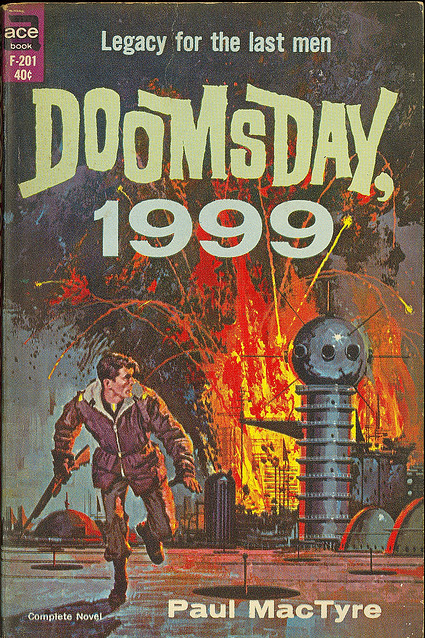
(Uncredited cover for the 1963 edition of Doomsday, 1999 (variant title: Midge), Paul MacTyre)

Behold Part II of my popular series on the doomed city in science fiction cover art (see Part I).  A doomsday that never happened, a tank and a skeletal reminder of a past battle — a ruined city, colliding stars, colliding planets…

Behold the august ruins of our people, our cities, our achievements.  If there’s anyone still left.

As always, are the books/authors worth reading? Continue reading

Book Review: Beyond the Sealed World, Rena Vale (1965*)

(Uncredited cover for the 1965 edition)

2/5 (Bad)

*Concerning the publication date: Rena Vale’s Beyond the Sealed World was written in the 50s and sold to Shasta press.  However, the press went bankrupt and the novel remained unpublished until 1965.  No wonder it took forever for another press to pick it up….

Before Rena Vale became a science fiction author she was a secretary for the California State Assembly Committee on Un-American activities.  In an affidavit she detailed her own experiences as a member of the Communist party and implicated famous individuals she worked with including Lucille Ball (of I Love Lucy fame), novelist John Steinbeck, actress Gale Sodergaard, and various others!  Wonderful.

I’m not going to lie but this piqued Continue reading