Updates: Recent Science Fiction Acquisitions No. CCXLVII (Candas Jane Dorsey, Michael Elder, Garry Kilworth, Sterling E. Lanier)

1. Sterling E. Lanier is best known for Hiero’s Journey (1973), which I procured in 2012 but haven’t yet read. Here’s the second of his singleton novels—Menace Under Marswood (1983). SF Encyclopedia describes it as “tamely repeat[ing]” (SF Encyclopedia) material from his earlier novels.

I’m a fan of the Darrell K. Sweet cover! Especially the mysterious creature decked out in scepter, robe, and hat.

darrell k. sweet Menace Under Marswood

(Darrell K. Sweet’s original canvas for the 1st edition)

2. A discussion on twitter about female authors of cyberpunk yielded a name unfamiliar to me — Candas Jane Dorsey. I procured a collection of her best known short fictions, which “polemically re-use and rework sf and fantasy tropes from a Feminist perspective, engaging most memorably, and fascinatedly [sic], in the title story of the first volume, “(Learning About) Machine Sex”, with the phallocentrism of much Cyberpunk” (SF Encyclopedia). Count me in!

3. My Garry K. Kilworth exploration series continues with Gemini God (1981). I must confess my enthusiasm has waned a bit after I read In Solitary (1977). See my review of The Night of Kadar (1978) for what he’s capable of.

4. This cover…. the gauze… the sheen…. the cheesiness. Explorations of media in SF is always something I gravitate towards—even when “graced” which such dismal artist failures.

Haven’t read anything by Michael Elder. I do not have high hopes!

Let me know what books/covers intrigue you. Which have you read? Disliked? Enjoyed?

~

1. Menace Under Marswood, Sterling E. Lanier (1983) Continue reading

Book Review: Candy Man, Vincent King (1971)

(Patrick Woodroffe’s cover art for the 1973 edition)

3.5/5 (Good)

The Candy Man wanders from place to place in a crumbling mega-city with his sole companion, a mechanical dog named Wolf who comes with a handy handle. Candy Man instigates the lobotomized, with primal speeches and drugged sugar floss tinted with pulverized beetles, to revolution. His reward for turning in those he encouraged deviate from the will of the Deep Machine and their Teachers? Vials of drugs. Enter the hypnagogic world of Vincent King’s Candy Man (1971), an unsettled landscape inhabited by the degenerate remnants of humankind and the arcane workings of a computer program that cannot escape its original perimeters.

Fresh off Vincent King’s short story “Defense Mechanism” (1966), I tracked down a copy of his second novel. Occupying a similar space as “Defense Mechanism” (conceptual breakthrough in a decaying world city), King pushes the narrative Continue reading

Updates: Recent Science Fiction Acquisitions No. CCXLIV (John Shirley, Carol Emshwiller, Daniel Walther, and Jacques Sternberg)

1. Few themes make me as excited as dystopic urbanism: the city or suburbia as an arena of all the malignancies of societal decay. The progressive SF symbol of progress, a lake of uplifting spires, tossed into anarchy and chaos….

John Shirley’s City Come A-Walking (1980) takes this premise to its extremes—the city of San Francisco, the “pulsing heart of urbanized madness” gains sentience. Definitely the Shirley novel I’ll read first (recently nabbed Shirley’s 1985 novel Eclipse).

Tarbandu read it and didn’t care for it over at The PorPor Books Blog. I hope my experience is different!

2. Back in 2017, I read and reviewed Carol Emshwiller’s masterful short story “Animal” (1968). It’s about time I read more of her short fictions.

3. I recently read and enjoyed Jacques Sternberg’s collection Future Without Future (1971, trans. 1973). He was a Belgian author who wrote in French. Unfortunately, the only other one of his SF works available in English is Sexualis ’95 (1965, trans. 1967). I’m not sure this erotic SF novel has any merit. We shall see.

Too bad his first SF novel La sortie est au fond de l’espace (1956) remains untranslated. Its premise seems like SF I could get behind: “a black comedy set in space and featuring the last human survivors of a bacterial Holocaust” (SF Encyclopedia).

4. Daniel Walther, a French SF author, positions The Book of Shai (1982, trans. C. J. Cherryh, 1984) as a deliberate anti-Ayn Rand novel. Considering the one man saves everything nature of so many post-apocalyptical and sword-and-sorcery adventures, I’m intrigued how it plays out! I don’t have high hopes.

Translated by fellow author C. J. Cherryh, who appeared to translate a bunch of the DAW French editions….  lists of translations should be a feature of her  isfdb.org listing — alas.

I also find it humorous that Cherryh gives the sequel, which she also translated, 1 star on Goodreads! The third volume of the trilogy remains untranslated.

~

1. City Come A-Walking, John Shirley (1980) (MY REVIEW)

(Catherine Huerta’s cover for the 1st edition) Continue reading

Updates: Recent Science Fiction Acquisitions No. CCXLIII (Mary Gentle, Robert Reed, Mike Resnick, and Jayge Carr)

1. As a historian, I am particularly fascinated by future histories—stories or novels chronologically organized to convey the historical scope of a society’s evolution. Mike Resnick, a new author to me, presents a future history in the form of linked original short stories. The format reminds me of Michael Bishop’s Catacomb Years (1979), although the stories in the latter volume were previously published.

Barry N. Malzberg also tried his hand at a future history (albeit, a distinctly Malzbergian take) in the underrated Universe Day (1971).

2. I’ve read extensively about Mary Gentle but I haven’t picked up one of her novels–until now. I’d love to know your thoughts on this one.

3. Jayge Carr is best known for Leviathan’s Deep (1979) which I bought a few years back but haven’t read. Here’s a lesser known work—it only received one printing—in a trilogy.

4. And finally, another complete unknown…. SF Encyclopedia describes Robert Reed’s first novel, The Leeshore (1987), as “a tale which combines adventure-sf plotting (a pair of twins, the sole humans left on the eponymous water-covered colony planet, must guide a task force in pursuit of the Computer-worshiping zealots who have killed everyone else) with an almost mystical sense for the genius of place, the intricacies of self-hood.”

Count me intrigued! I’m all for unusual planets…..

As always, let me know what you think of the books and covers in the comments!

~

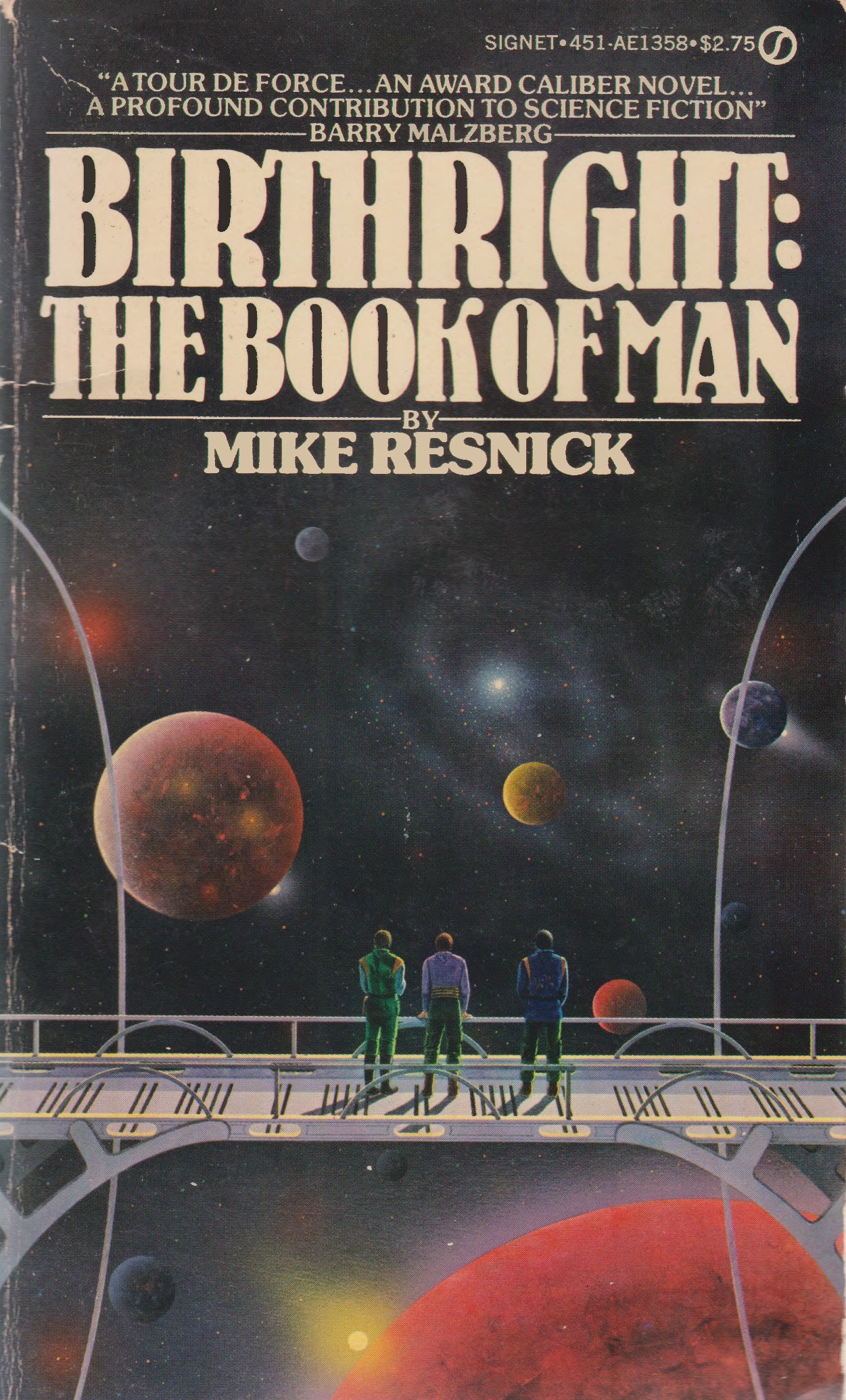
1. Birthright: The Book of Man, Mike Resnick (1982)

(Uncredited cover for the 1st edition) Continue reading

Book Review: In Solitary, Garry Kilworth (1977)

(Paul Alexander’s cover for the 1979 edition)

3/5 (Average)

Garry Kilworth’s first novel, In Solitary (1977),  attempts to present a morally complex take on human revolt against brutal alien conquest. A brief read, In Solitary piques interest but doesn’t manage to provide compelling backstories to beef up its analysis of the morality of revolt.

Ultimately, In Solitary (1977) does not live up to its compelling premise. Recommended for die Continue reading

Updates: Recent Science Fiction Acquisitions No. CCXXXIX (Jack Dann, Judith Merril, Anne McCaffrey, John Shirley)

1. I have yet to read any of Jack Dann’s SF — this surreal (?) post-apocalyptical novel looks promising! And a strange Jim Burns cover to boot…

2. I recently reviewed Judith Merril’s “Wish Upon a Star” (1958) for my generation ship short story read-through (i’ll have a new installment soon). I decided to track down another one of her short fiction collections….

I’ve reviewed the following collections so far:

3. The title of Anne McCaffrey’s collection Get Off the Unicorn (1977) was derived from a humorous misprint. According to the collection’s introduction: “The title was derived by accident: McCaffrey’s working title had been “Get of the Unicorn” but this was misprinted as “Get Off the Unicorn” in Ballantine’s roster of unfilled contracts. After McCaffrey’s editor, Judy-Lynn del Rey, was repeatedly asked what “Get Off the Unicorn” was, del Rey asked McCaffrey what she could do about that theme.”

The collection itself contains a wide-range of her short fictions—from the Pern sequence (a childhood favorite) to the earliest story in the Catteni Sequence. I DEVOURED Freedom’s Landing (1995), Freedom’s Choice (1997), Freedom’s Challenge (1998), and Freedom’s Randsom (2002) as a kid! How to survive and thrive on an alien planet was my “go-to” SF device.

4. I’ve only read a handful of John Shirley’s short stories. It’s time for a novel. Eclipse (1985), set in a future a cyberpunk dystopia, tells the tale of anti-fascist resistance. We shall see!

Let me know what you think of the books and covers in the comments!

1. The Man Who Melted, Jack Dann (1984)

(Jim Burns’ cover for the 1986 edition) Continue reading

Updates: Recent Science Fiction Acquisition No. CCXXXV (M. A. Foster, Garry Kilworth, Cary Neeper, and Anthology)

1. A fascinating, and disturbing, themed anthology edited by Thomas M. Disch. Of the stories in the anthology (see contents below), I look forward to Gene Wolfe’s “Three Million Square Miles” (1971) the most.

Richard Powers’ cover is gorgeous.

2. I recently read and enjoyed Garry Kilworth’s The Night of Kadar (1978) so I pulled the trigger and purchased a handful of his other early SF works. I’m also for ambivalent takes on revolutions…. In Solitary (1977) is Kilworth’s first published novel. According to  SF Encyclopedia, the novel “is set on an Earth whose few remaining humans have for over 400 years been dominated by birdlike Aliens, and deals with a human rebellion whose moral impact is ambiguous; the novel is the first of several combining generic adventurousness – indeed opportunism, for Kilworth seldom accords his full attention to the raw sf elements in his tales – and an identifiably English dubiety about the roots of human action. Consequences of such action in a Kilworth novel are seldom simple, rarely flattering, usually ironized.”

Will read this one soon.

3. I know little about M. A. Foster’s SF other than a few articles I’ve read here and there–The Gameplayers of Zan (1977) included. In 2009 Jo Walton wrote a positive article about the novel on tor.com.

4. A completely unknown author (Cary Neeper) and novel (A Place Beyond Man)…. I don’t have a lot to go on for this one!

Let me know what you think of the books and covers in the comments!

~

1. The Ruins of Earth: An Anthology of the Immediate Future, ed. Thomas M. Disch (1971)

(Richard Powers’ cover for the edition) Continue reading

Updates: Recent Science Fiction Acquisitions No. CCXXXIII (J. G. Ballard, Fred Saberhagen, Richard A. Lupoff, Garry Kilworth)

1. I have yet to read any of J. G. Ballard’s late 70s and early 80s short fiction.  Myths of the Near Future (1982) seems to contain some fascinating gems. I’ve previously reviewed two collections of his 50s and 60s fiction on the site—both are highly recommended!

2. My exploration of 60s/70s SF takes me to an another author I’ve only read about– Fred Saberhagen. I enjoy post-apocalyptical landscapes and balkanized and decayed far future societies–but, is there anything original in this take on the theme?

3. I’m proud owner (*cough*) of one of the worst vintage covers ever created. The premise was the sole reason I snatched up Kilworth’s The Night of Kadar (1978)—malfunctions create unusual growth in the seeded human colonists on an alien planet.

4. A fix-up novel (with substantial rewritten and added material) from Richard A. Lupoff…. not an author I’m too familiar with, but this one is endorsed by Harlan Ellison and definitely screams 70s!

~

1. Myths of the Near Future, J. G. Ballard (1982)

(James Marsh’s cover for the 1984 edition) Continue reading

Generation Spaceship Short Story Review: Chad Oliver’s “The Wind Blows Free” (1957)

Initial note: This is the inaugural post in a series of vintage generation ship short fiction reviews. You are welcome to read and discuss along with me–all of the stories I’ll review will be available online–as I explore humanity’s visions of generational voyage!

Next up: Clifford D. Simak’s “Spacebred Generations” (variant title: “Target Generation”) (1953).

I’ve compiled a helpful list on the theme.

(Bob Layzell’s cover for the 1980 edition of A Sea of Space (1970), ed. William F. Nolan)

4.5/5 (Very Good)

Chad Oliver’s “The Wind Blows Free” (1957) first appeared in the July 1957 issue of The Magazine of Fantasy and Science Fiction, ed. Anthony Boucher (Internet Archive link). Despite the simple premise, Oliver’s powerful delivery and imagery reaffirmed my love for generation ship stories and their common tropes: generational change, the science of survival, the architecture of arks Continue reading