Updates: Recent Science Fiction Acquisitions No. CCXLIII (Mary Gentle, Robert Reed, Mike Resnick, and Jayge Carr)

1. As a historian, I am particularly fascinated by future histories—stories or novels chronologically organized to convey the historical scope of a society’s evolution. Mike Resnick, a new author to me, presents a future history in the form of linked original short stories. The format reminds me of Michael Bishop’s Catacomb Years (1979), although the stories in the latter volume were previously published.

Barry N. Malzberg also tried his hand at a future history (albeit, a distinctly Malzbergian take) in the underrated Universe Day (1971).

2. I’ve read extensively about Mary Gentle but I haven’t picked up one of her novels–until now. I’d love to know your thoughts on this one.

3. Jayge Carr is best known for Leviathan’s Deep (1979) which I bought a few years back but haven’t read. Here’s a lesser known work—it only received one printing—in a trilogy.

4. And finally, another complete unknown…. SF Encyclopedia describes Robert Reed’s first novel, The Leeshore (1987), as “a tale which combines adventure-sf plotting (a pair of twins, the sole humans left on the eponymous water-covered colony planet, must guide a task force in pursuit of the Computer-worshiping zealots who have killed everyone else) with an almost mystical sense for the genius of place, the intricacies of self-hood.”

Count me intrigued! I’m all for unusual planets…..

As always, let me know what you think of the books and covers in the comments!

~

1. Birthright: The Book of Man, Mike Resnick (1982)
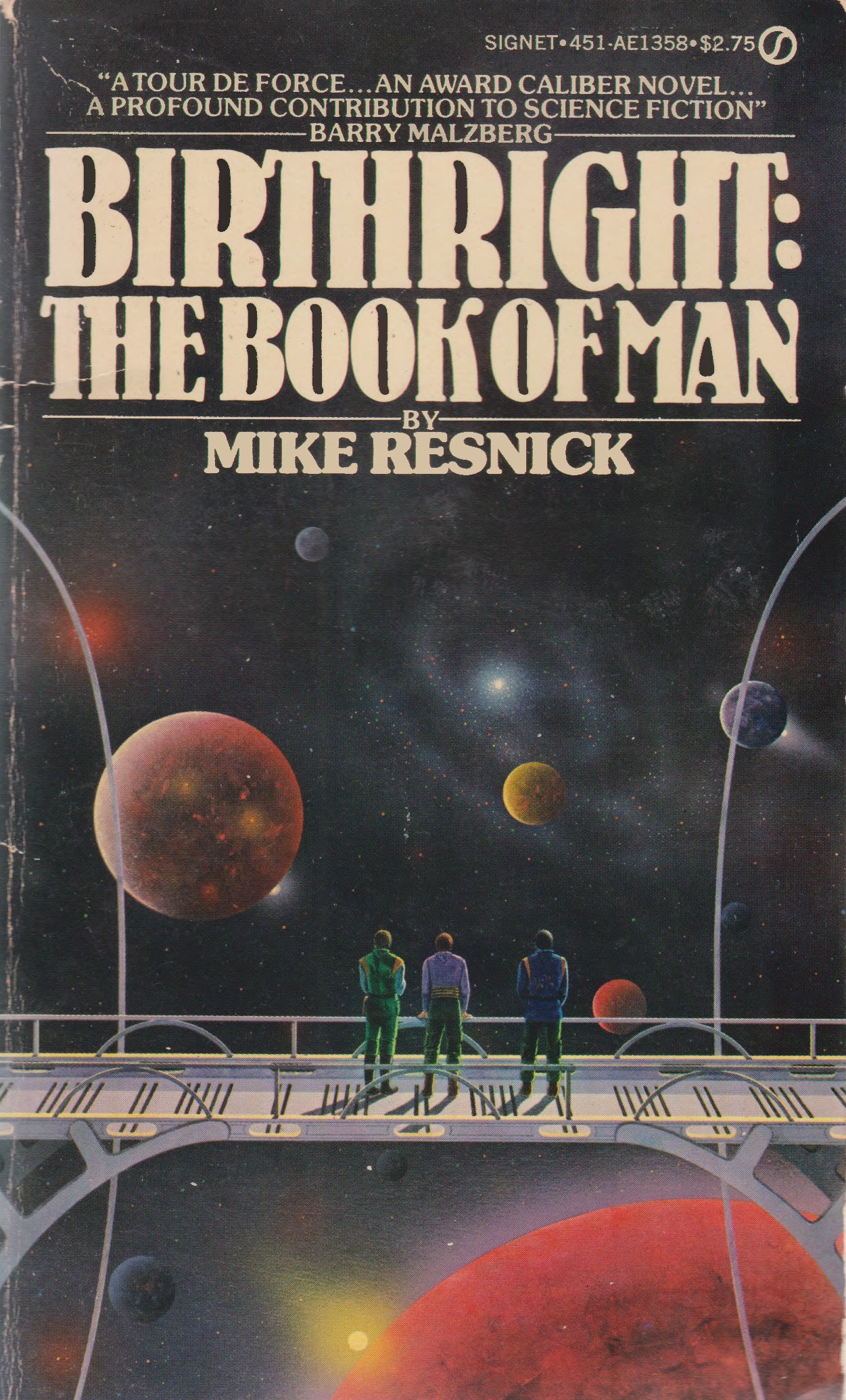
(Uncredited cover for the 1st edition) Continue reading

Adventures in Science Fiction Cover Art: The Strange Visages of Burt Shonberg (1933-1977)

(Burt Shonberg, 1964 Ibiza Spain)

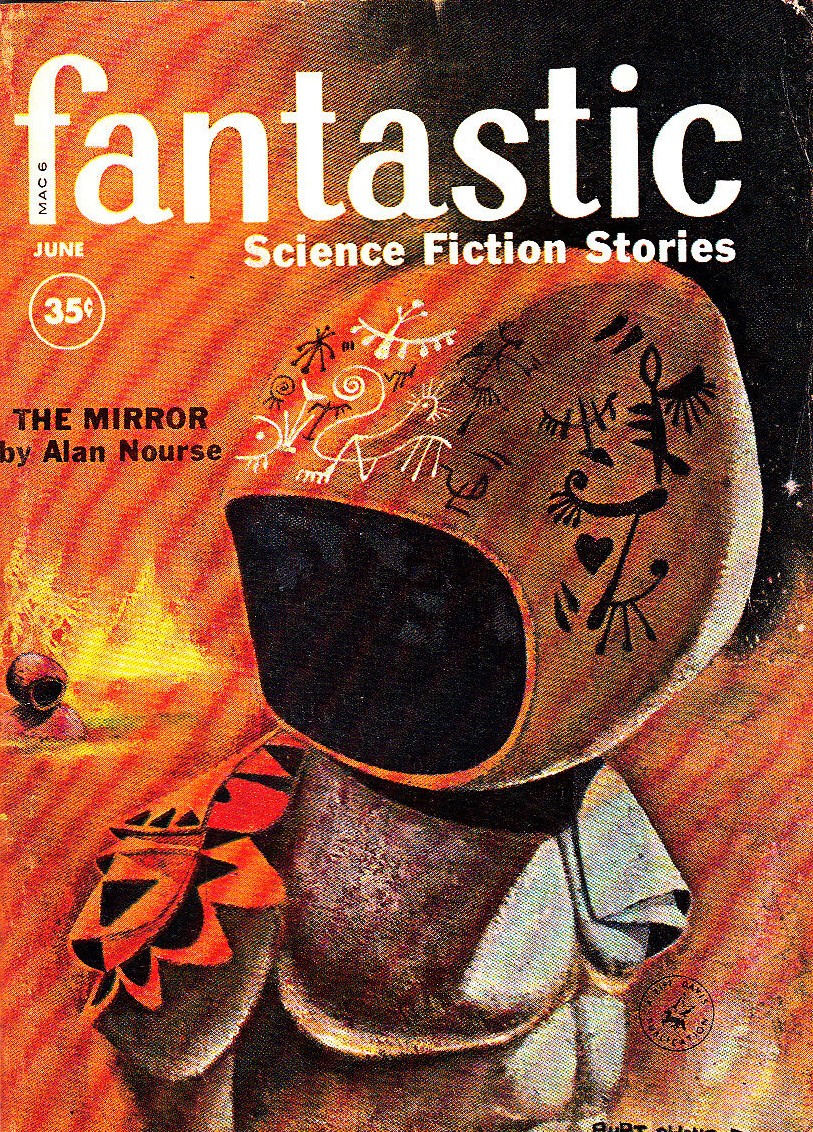
Burt Shonberg (1933-1977) produced only one SF cover for the Fantastic Science Fiction Stories (June 1960), ed. Cele Goldsmith. I adore the etched helmet, the lack of a distinct face, the looking backward at a similar form emerging…. I wish more magazines commissioned covers from him–he could have added a nice visual wrinkle to the fair of the day. Here’s the isfdb.org listing for the issue–do you know which story he’s illustrating?

(Fantastic Science Fiction Stories (June 1960), ed. Cele Goldsmith)

So who was he? His biography, which the following paragraph is based on, lays out an intriguing life. Born in Continue reading

Updates: Recent Science Fiction Acquisitions No. CCXLI (Ben Bova, Margaret Elphinstone, Christopher Evans, Lee Hoffman)

1. New author to me. Unknown book. Fascinating Peter Gudynas city-scape cover. Let the act of exploration carry me through!

2. My The Women’s Press collection of SF/F novels grows. This is probably one of the least known volumes.

But so was Elizabeth Baines’ The Birth Machine (1983) and it was fantastic!

3. I love the concept of an epic near-future space thriller involving weather manipulation! But me and Ben Bova never see eye-to-eye….

4. An unknown Doubleday SF edition. I have yet to read any of Lee Hoffman’s SF — she wrote a handful.

Let me know what you think of the books and covers in the comments!

1. Capella’s Golden Eyes, Christopher Evans (1980)

(Peter Gudynas’ cover for the 1982 edition) Continue reading

Short Book Reviews: Fredric Brown’s The Lights in the Sky Are Stars (variant title: Project Jupiter) (1953), M. A. Foster’s Waves (1980), Eric Frank Russell’s The Great Explosion (1962)

My “to review” pile is growing and my memory of them is fading… hence short—far less analytical—reviews.

1. The Lights in the Sky Are Stars, Fredric Brown (1953)

(Mitchell Hooks’ cover for the 1955 edition)

3/5 (Average)

Frederic Brown’s The Lights in the Sky are Stars (1953)  is a slick 1950s vision of the fanatical men and women who take America by the scruff of the neck and yank it, without letting the law get in the way, towards space and the deep beyond. As a rumination on radicalism,  The Lights in the Sky are Stars succeeds—I’m not entirely sure if it was entirely intentional as Continue reading

Book Review: In Solitary, Garry Kilworth (1977)

(Paul Alexander’s cover for the 1979 edition)

3/5 (Average)

Garry Kilworth’s first novel, In Solitary (1977),  attempts to present a morally complex take on human revolt against brutal alien conquest. A brief read, In Solitary piques interest but doesn’t manage to provide compelling backstories to beef up its analysis of the morality of revolt.

Ultimately, In Solitary (1977) does not live up to its compelling premise. Recommended for die Continue reading

Updates: Recent Science Fiction Acquisitions No. CCXXXIX (Jack Dann, Judith Merril, Anne McCaffrey, John Shirley)

1. I have yet to read any of Jack Dann’s SF — this surreal (?) post-apocalyptical novel looks promising! And a strange Jim Burns cover to boot…

2. I recently reviewed Judith Merril’s “Wish Upon a Star” (1958) for my generation ship short story read-through (i’ll have a new installment soon). I decided to track down another one of her short fiction collections….

I’ve reviewed the following collections so far:

3. The title of Anne McCaffrey’s collection Get Off the Unicorn (1977) was derived from a humorous misprint. According to the collection’s introduction: “The title was derived by accident: McCaffrey’s working title had been “Get of the Unicorn” but this was misprinted as “Get Off the Unicorn” in Ballantine’s roster of unfilled contracts. After McCaffrey’s editor, Judy-Lynn del Rey, was repeatedly asked what “Get Off the Unicorn” was, del Rey asked McCaffrey what she could do about that theme.”

The collection itself contains a wide-range of her short fictions—from the Pern sequence (a childhood favorite) to the earliest story in the Catteni Sequence. I DEVOURED Freedom’s Landing (1995), Freedom’s Choice (1997), Freedom’s Challenge (1998), and Freedom’s Randsom (2002) as a kid! How to survive and thrive on an alien planet was my “go-to” SF device.

4. I’ve only read a handful of John Shirley’s short stories. It’s time for a novel. Eclipse (1985), set in a future a cyberpunk dystopia, tells the tale of anti-fascist resistance. We shall see!

Let me know what you think of the books and covers in the comments!

1. The Man Who Melted, Jack Dann (1984)

(Jim Burns’ cover for the 1986 edition) Continue reading

Updates: Recent Science Fiction Acquisitions No. CCXXXVIII (Poul Anderson, Kathleen M. Sidney, Barry B. Longyear, Philippe Curval)

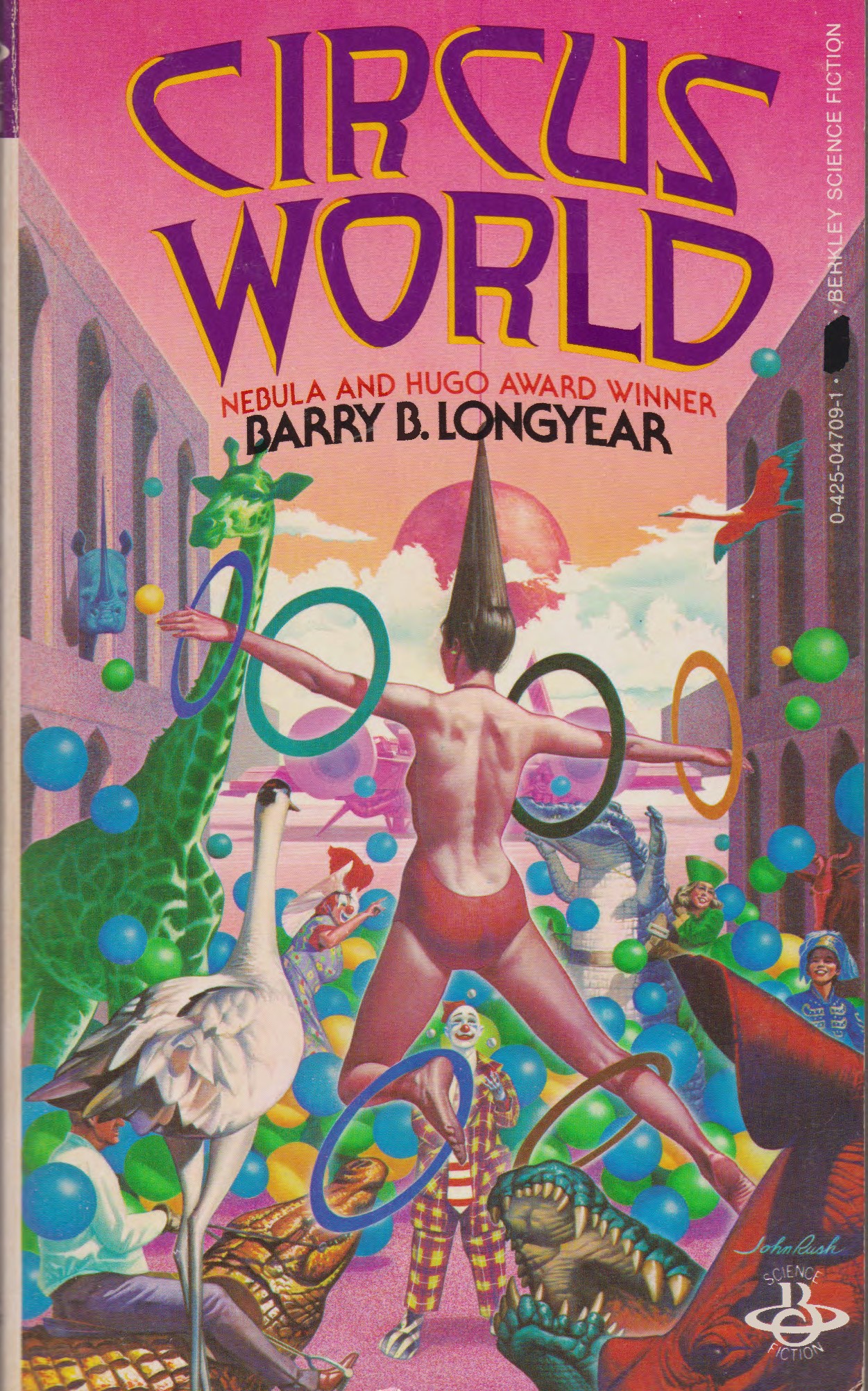
1. I have yet to read anything by Barry B. Longyear, best known Enemy Mine (with David Gerrold) (1985) and Sea of Glass (1986). Circus World (1981) seems like a fun series of linked short stories published in 1978 and 1979 about the descendants of a crashed circus ship.

2. My Poul Anderson collections grows and grows. Sometimes I’m not sure why I bother procuring them… I mean, it was only $1. See the index for my extensive (and apparently contentious) reviews of his work i.e. Tau Zero (1971). And eww, a gauzy cover by Gene Szafran….

3. A complete unknown—and Kathleen M. Sidney’s only SF novel (she wrote three additional short stories according to isfdb.org).

4. Vintage French SF in translation! With a fantastic cover by Max Ernst. In addition to writing SF, Philippe Curval produced fascinating photo collage SF cover art. I’ve featured his art previously on the site: Part I and Part II.

Let me know what you think of the books and covers in the comments!

~

1. Circus World, Barry B. Longyear (1981)

(John Rush’s cover for the 1981 edition) Continue reading

Updates: Recent Science Fiction Acquisitions No. CCXXXVII (Rex Gordon, Craig Strete, Graham Dunstan Martin, and an Anthology of European SF)

Clifford D. Simak, Tanith Lee, and M. A. Foster reviews are incoming. The first few weeks of every semester hit with a vengeance—teaching is an exhausting profession.

In the meantime get inspired to read vintage SF by ogling these gems!

1. In my youth I was obsessed with Victorian/Belle Epoque survivalist novels–Jules Verne’s The Mysterious Island (1874), Perseverance Island Or the Robinson Crusoe Of The Nineteenth Century(1885), et al. I judged them on their “realistic” portrayals of how man (and yes, the characters were always men) moved up the technological tree—from fire to steam engines—in a hostile world. Although I’ve utterly disavowed SF that adheres to such  naive technological triumphalism, occasionally nostalgia calls…. Here’s a SF Robinsonade along similar lines.

2. I adore Craig’s Strete unique brand of SF story. I reviewed, in abbreviated form, his spectacular collection If All Else Fails…. (1980). I’ll read this one soon! The Bleeding Man and Other Science Fiction Stories is also a well-designed volume as elements of the cover art are used at the beginning of each short story.

3. Another unknown commodity—seems to combine SF and fantasy tropes.

4. Back in November I acquired the second in the Terra SF series of anthologies edited by Richard D. Nolane of Western European SF in translation. I pointed out that the first volume online was prohibitively expensive. A follower on twitter discovered that a seller on Amazon incorrectly listed the collection under another title—at a radically reduced price. Now it’s a happy member of my collection.

Let me know what you think of the books and covers in the comments!

~

1. First on Mars (variant title: No Man Friday), Rex Gordon (1956)

(Kelly Freas’ cover for the 1976 edition) Continue reading

Generation Ship Short Story Review: A. E. van Vogt’s “Centaurus II” (1947)

Preliminary note: This is the sixth post in a series of vintage generation ship short fiction reviews. All of the stories I’ll review are available online (see links below). You are welcome to read and discuss along with me as I explore humanity’s visions of generational voyage. And thanks go out to all who have joined already.

Previously: J. G. Ballard’s “Thirteen to Centaurus” (1962)

Next up: Chad Oliver’s “Stardust” (1952)

I’ve compiled a helpful list on the theme with links to all my reviews.

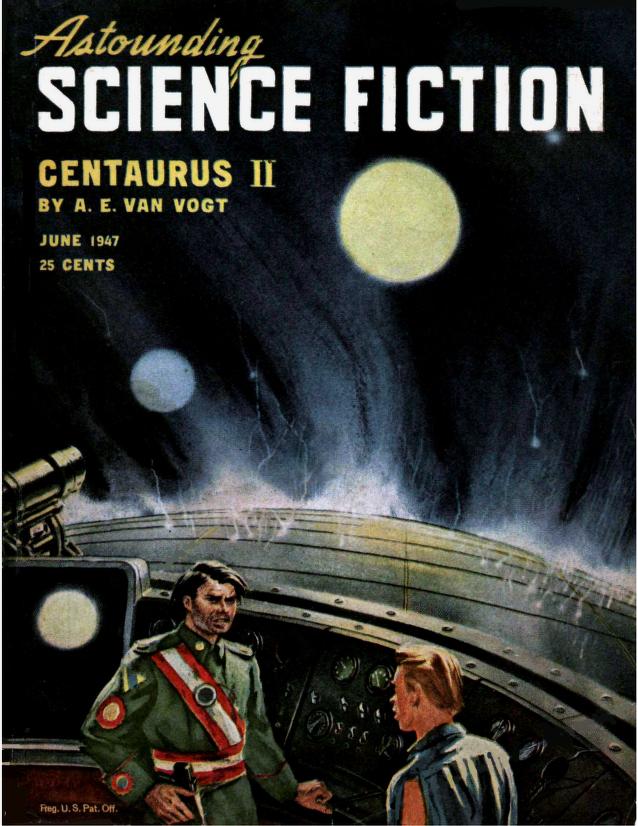
(Charles Schneeman’s cover for the June 1947 issue of Astounding Science Fiction, ed. John W. Campbell, Jr.)

4/5 (Good)

A. E. van Vogt’s “Centaurus II” (1947)* (story link) first appeared in the June 1947 issue of Astounding Science Fiction edited by John W. Campbell, Jr. Together with two later stories—“Rogue Ship” Continue reading