Updates: Recent Science Fiction Acquisition No. CCXXXV (M. A. Foster, Garry Kilworth, Cary Neeper, and Anthology)

1. A fascinating, and disturbing, themed anthology edited by Thomas M. Disch. Of the stories in the anthology (see contents below), I look forward to Gene Wolfe’s “Three Million Square Miles” (1971) the most.

Richard Powers’ cover is gorgeous.

2. I recently read and enjoyed Garry Kilworth’s The Night of Kadar (1978) so I pulled the trigger and purchased a handful of his other early SF works. I’m also for ambivalent takes on revolutions…. In Solitary (1977) is Kilworth’s first published novel. According to  SF Encyclopedia, the novel “is set on an Earth whose few remaining humans have for over 400 years been dominated by birdlike Aliens, and deals with a human rebellion whose moral impact is ambiguous; the novel is the first of several combining generic adventurousness – indeed opportunism, for Kilworth seldom accords his full attention to the raw sf elements in his tales – and an identifiably English dubiety about the roots of human action. Consequences of such action in a Kilworth novel are seldom simple, rarely flattering, usually ironized.”

Will read this one soon.

3. I know little about M. A. Foster’s SF other than a few articles I’ve read here and there–The Gameplayers of Zan (1977) included. In 2009 Jo Walton wrote a positive article about the novel on tor.com.

4. A completely unknown author (Cary Neeper) and novel (A Place Beyond Man)…. I don’t have a lot to go on for this one!

Let me know what you think of the books and covers in the comments!

~

1. The Ruins of Earth: An Anthology of the Immediate Future, ed. Thomas M. Disch (1971)

(Richard Powers’ cover for the edition) Continue reading

Book Review: The Texts of Festival, Mick Farren (1973)

(Peter Jones’ cover for the 1975 edition)

2.5/5 (Bad)

Mick Farren (1943-2013)—science fiction author, counterculture musician, underground newspaper journalist—spins a wild drug-tinged adventure, replete with innumerable musical references, across a devastated, decadent, and depopulated future United Kingdom. The Texts of Festival (1973), dolled up with half-baked attempts at philosophy (counterculture becomes mainstream and loses its radical and society-transforming meaning), careens forth  with extensive sequences of action-packed exploitative sleaze. A sword-and-fantasy plot unfolds Continue reading

Generation Ship Short Story Review: Clifford D. Simak’s “Spacebred Generations” (variant title: “Target Generation”) (1953)

Preliminary note: This is the second post in a series of vintage generation ship short fiction reviews. You are welcome to read and discuss along with me–all of the stories I’ll review will be available online–as I explore humanity’s visions of generational voyage!

Previously: Chad Oliver’s fantastic “The Wind Blows Free” (1957).

Next up: Judith Merril’s “Wish Upon a Star” (1958).

I’ve compiled a helpful list on the theme.

(Tom O’Reilly’s interior art for the Science-Fiction Plus, August 1953)

3.5/5 (Good)

Clifford D. Simak’s “Spacebred Generations” (variant title: “Target Generation”) appeared in the August 1953 issue of Science-Fiction Plus, ed. Hugo Gernsback (Internet Archive link). The story is lavishly illustrated with evocative art by Tom O’Reilly. The story itself posits that religion is required to satiate the Continue reading

Updates: Recent Science Fiction Acquisitions No. CCXXXI (Sheri S. Tepper + Paul H. Cook + Robert Merle + Anthology)

1. I bought this themeless hodgepodge anthology for two reasons–the UK 1980 edition has a cool spaceship! And second, it contains Chad Oliver’s generation ship short story “The Wind Blows Free” (1957). MPorcius calls it one of Oliver’s best. As I’ve not been enamored with his brand of SF, I’m eager to try a short story on a favorite theme far outside of his normal anthropological-focused oeuvre.

I’ve previously reviewed Oliver’s The Shores of Another Sea (1971).

2. Sheri S. Tepper is a glaring hole in my SF knowledge. I often explore the back catalog before plunging into the best known novels of an author—The Revenants, her first published novel, is “a long, complex work of SF” according to SF Encyclopedia. I wish it would be a tad more descriptive…. the novel has a fun map which I’ll feature in a Monday Maps and Diagrams post.

3. French post-apocalyptic SF in translation! With an awful cover…

4. Paul Cook is another unknown author to me. His first novel, Tintangel (1981) has a bizarre premise (see blurb below). This might be my next SF read.

Let me know what books/covers intrigue you. Which have you read? Disliked? Enjoyed?

~

1. A Sea of Space, ed. William F. Nolan (1970)

(Bob Layzell’s cover for the 1980 edition) Continue reading

Updates: Recent Science Fiction Acquisitions No. CCXVII (Bear + Elgin + Lee + Clingerman)

1. Years ago I read and reviewed Suzette Haden Elgin’s provocative At the Seventh Level (1972)–I praised the use of linguistics, the formulation of societal ideologies, and critiqued the ramshackle plot and Orientalism. Native Tongue (1984) is supposedly her strongest work. I look forward to reading it.

2. I have yet to ready any of Greg Bear’s work. This late 70s novel was signed so I snatched it up. I don’t track down signed copies–all the ones I owned were accidentally mislabeled or inexpensive volumes I wanted anyway. Bear’s signature joins the ranks of Christopher Priest, D. G. Compton, Karen Joy Fowler, and Norman Spinrad.

Hegira itself draws inspiration from the Ringworld and Riverworld-style SF novel.

3. My Tanith Lee collection grows and grows. This one more fantasy than SF (although SF elements crop up at the end). In case you missed it, I reviewed Don’t Bite the Sun (1976) recently and procured a copy of Electric Forest (1979).

4. Mildred Clingerman was regularly featured in The Magazine of Fantasy and Science Fiction in the 50s and early 60s. I have finally found an inexpensive copy of her only collection published during her life (an omnibus edition with never before seen stories was recently self-published by her descendants). As it’s a Ballantine Books volume, it has a wonderful Powers cover.

Let me know what books/covers intrigue you. Which have you read? Enjoyed? Hated?

1. Native Tongue, Suzette Haden Elgin (1984)

(Jill Bauman’s cover for the 1st edition) Continue reading

Updates: Recent Science Fiction Acquisitions No. CCXVI (Le Guin + Leiber + Laumer + Martin)

1. Keith Laumer is an author I’ve only dabbled in—a few short stories in an anthology here and there. Another (one of twenty?) Laumer volume joins my collection. With a solid Richard Powers’ cover!

2. I finally picked up a copy of Ursula Le Guin’s The Lathe of Heaven (1971)—one of her few early works lacking from my collection. I recently read and enjoyed The Word for World is Forest (1972).

3. According to a goodreads review, Justin Leiber’s novel “a hard sci-fi take on gender dysphoria.” SF Encyclopedia emphasizes how Justin Leiber, Fritz Leiber’s son, “used sf as a medium  for speculation in his field of interest, the philosophy of the mind.” Call me intrigued about Beyond Rejection (1980)….. and suspicious.

4. The unknown quantity of this post. Have you read any of his work? Or heard of his most “famous” novel Time-Slip (1986)? Joachim Boaz, taking risks since the birth of this abomination (website).

1. Nine by Laumer, Keith Laumer (1967)

(Richard Powers’ cover for the 1969 edition) Continue reading

Book Review: Seeklight, K. W. Jeter (1975)

(Kelly Freas’ cover for the 1975 edition)

3.5/5 (Good)

K.W. Jeter’s first published novel is a promising one (*). On a nameless colony world, entropic forces influence all. Humankind speaks less and less and resorts to animistic grunts. Robotic priests go mad. Speculation abounds of a “Dark Seed” (52) implanted by the eugenicists on Earth in the colonist gene pool creating an increasingly crude and lazy population, “wretched and fearful of any change or effort” (46). The landscape itself  is inscribed with the entropic effects: most of the population seems to be engage in quarrying, hillsides are covered with the Continue reading

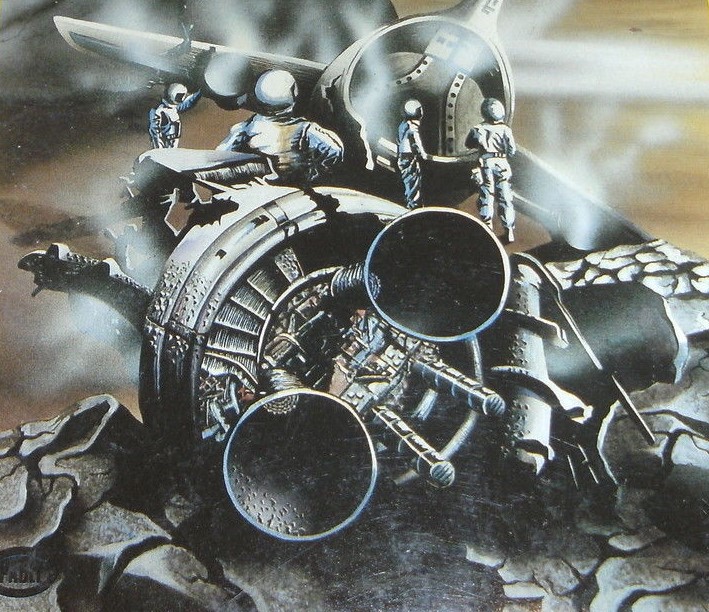
Adventures in Science Fiction Cover Art: Crashed Spaceships, Part III

(Detail from Alan Daniels’ cover for the 1980 German edition of Open Prison (1964), James White)

The crashed spaceship — a wrecked hulk spinning in the emptiness of space, shattered metal struts strewn across an alien landscape…. I find few SF scenarios more nostalgic than this one as a younger me was obsessed with books about the societies formed from the survivors of such cataclysms (Anne McCaffrey’s Acorna Universe sequence, of dubious quality now, was a cornerstone of my youth).

I have selected a range of fascinating covers which add to a series I made in 2012 (Part I) and 2013 (Part II). My favorite of the bunch is Tibor Csernus’ cover for the 1973 French edition of Clifford D. Simak’s Time and Again (1951) due to the verdant and wet landscape the spaceship finds itself in. My second favorite is Dean Ellis’ “descriptive” cover for the 1974 edition of Alan Dean Foster Icerigger (1974). It doesn’t try to be surreal but rather depicts a scene straight from novel. I usually prefer when the artist takes a more unusual approach but in this case Ellis narrows in on the wonder of the premise. Continue reading

Short Story Reviews: Four Stories from New Worlds Science Fiction (April 1964), ed. John Carnell

To mix things up a bit I decided to review four stories in John Carnell’s last issue of New Worlds Science Fiction (April 1964) before he handed over the reins of the dying publication to Michael Moorcock, who would elevate it to New Wave greatness. Other than the James White serial Open Prison, which I plan on reading in book form when I procure a copy, three of the four authors reviewed below owed much of their careers to John Carnell, and would see few stories in print after his departure (see the individual story reviews for details). Only Barrington J. Bayley, writing as P. F. Woods, would see continued publication (and growing popularity) in New Worlds under Moorcock.

Of the stories I recommend reading William Spencer’s rumination on overpopulation and urban life,  “Megapolitan Underground.” The others are worthwhile only for die-hard fans of Carnell’s New Worlds and other editorial projects. Continue reading