I’ve returned from my expedition abroad. It’s time to get back to writing about science fiction! But first, there are always new books that have accumulated at my doorstep…
Which books/covers/authors intrigue you? Which have you read? Disliked? Enjoyed?
1. The Productions of Time, John Brunner (serialized 1966)
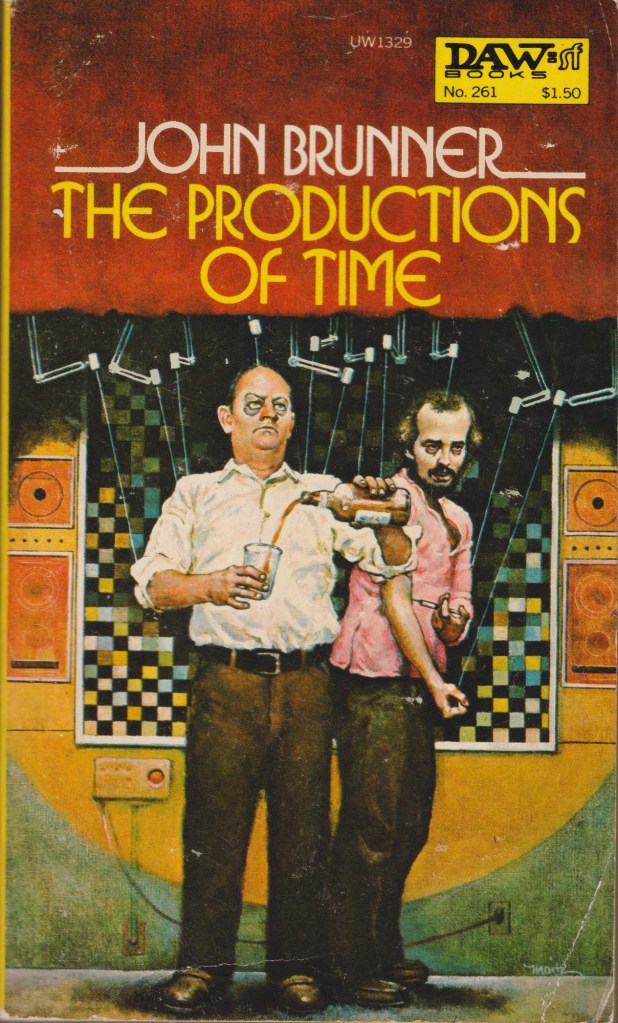
Don Maitz’s cover for the 1977 edition
From the back cover: “Murray Douglas had been a theatrical star until he’d hit the bottle once too often. But now he had broken the habit, and, handsome and fit, was ready for a comeback. The most challenging opening available was an avant-garde play where the actors themselves would make up the drama as they went along.
But out at an isolated country estate where the rehearsals were going on, Murray found himself trapped on a real-life day-and-night stage in which nothing was as it seemed, in which inexplicable devices monitored everything and eerie lures attracted each actor’s psychological weakness.
Who then was the real sponsor of this terrifying play–and to what alien audience was it to be presented?
By the Hugo-winning author of STAND ON ZANZIBAR, this is the first unabridged American edition of this John Brunner classic.”
Initial Thoughts: Years ago I acquired the 1967 Signet edition of Brunner’s novel, which was “cut and changed without the author’s permission” according to The Internet Speculative Fiction Database. Apparently the 1977 DAW Books edition is the first unabridged American edition. While Brunner notoriously rewrote and republished his works in periods of financial stress (for example, after spending far too long writing Stand on Zanzibar), I thought it would be worth tracking down the complete edition.
2. Faces, Leigh Kennedy (1986)

Karen Caldicott’s cover for the 1st edition
From the inside flap: “In this remarkable collection of fantasy fiction, Leigh Kennedy illuminates the twilight reaches of human perception. Her psychological insight opens up worlds of peculiar vision and power: a primatologist carries his devotion to apes a step too far; in a not-too-distant irradiated future, a ravenous wild child views her rescuers as sustenance rather than succor; a couple discovers, and comes to believe in, signs of an invisible infant living in their home. The characters inhabiting these worlds make up a portrait gallery with aspects of a fun-house mirror. In “Max Hunting” a middle-age hippie, preserved almost intact from the sixties, makes a pilgrimage to friends and lovers who have moved with the times; in “Window Jesus” a loving husband takes it upon himself to manufacture a miracle for his deeply religious–and credulous–wife; and in “River Baby” a young mother who was herself an abused child explodes into violence at once terrifying and recognizable as a distortion of wounded self-love.
Leigh Kennedy renders the bizarre convincing and affecting, as she captures an almost unimaginable range of human–and inhuman–emotions.”
Contents: “The Silent Cradle” (1983), “Max Haunting” (1986), “Tuning” (1986), “The Window Jesus” (1985), “River Baby” (1986), “The Fisherman” (1986), “Belling Martha” (!983), “Greek” (1983), “Petit Mal” (1986), “Her Furry Face” (1983)
Initial Thoughts: I’ve only read Kennedy’s “Helen, Whose Face Launched Twenty-Eight Conestoga Hovercraft” (1982). I plan on featuring her soon in my series on the first three published works by female authors that aren’t well-known to me. See my last installment on Phyllis Gotlieb.
3. Grimus, Salman Rushdie (1975)
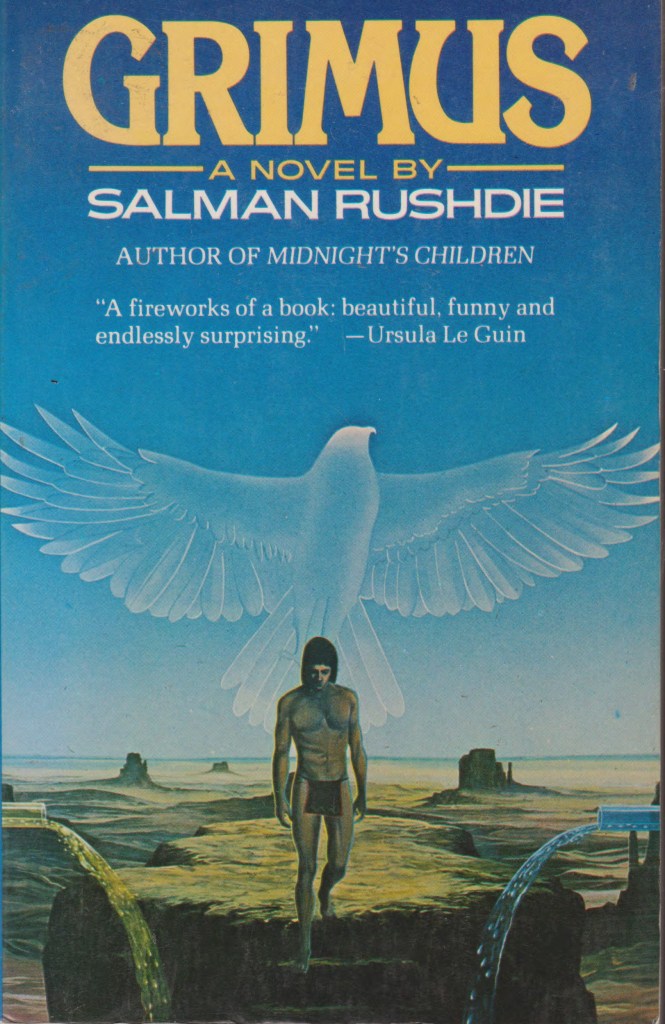
Peter Goodfellow’s cover for the 1979 US edition
From the back cover: “The hero of this intricately plotted first novel is Flapping Eagle, an outcast Indian weary of the immortality conferred on him some 700 years ago by a mysterious elixir. There is, he is told, one haven where he can shed the burden of changelessness: calf Island. But once there, he finds that the denizens of the island–also recruits to immortality–have retreated into frozen and change-denying obsession in an attempt to stave off the disintegrating influence of the ‘Grimus Effect’ emanating from the cloudy summit of Calf Mountain, home of the island’s maker [From the Kirkus Reviews blurb].”
Initial Thoughts: I know little about this one. According to SF Encyclopedia, Grimus, “complex and witty” and “legend-like,” is a “fabulation (like all his novels see also magic realism) which makes marginal use of sf material in its invoking of Immortality themes and in the conflicts in a sea of Dimensions that its eternally young Native American protagonist must undergo in his search, through an emblematic World-Island, for the moment of death.”
4. Twilight World, Poul Anderson (1961)
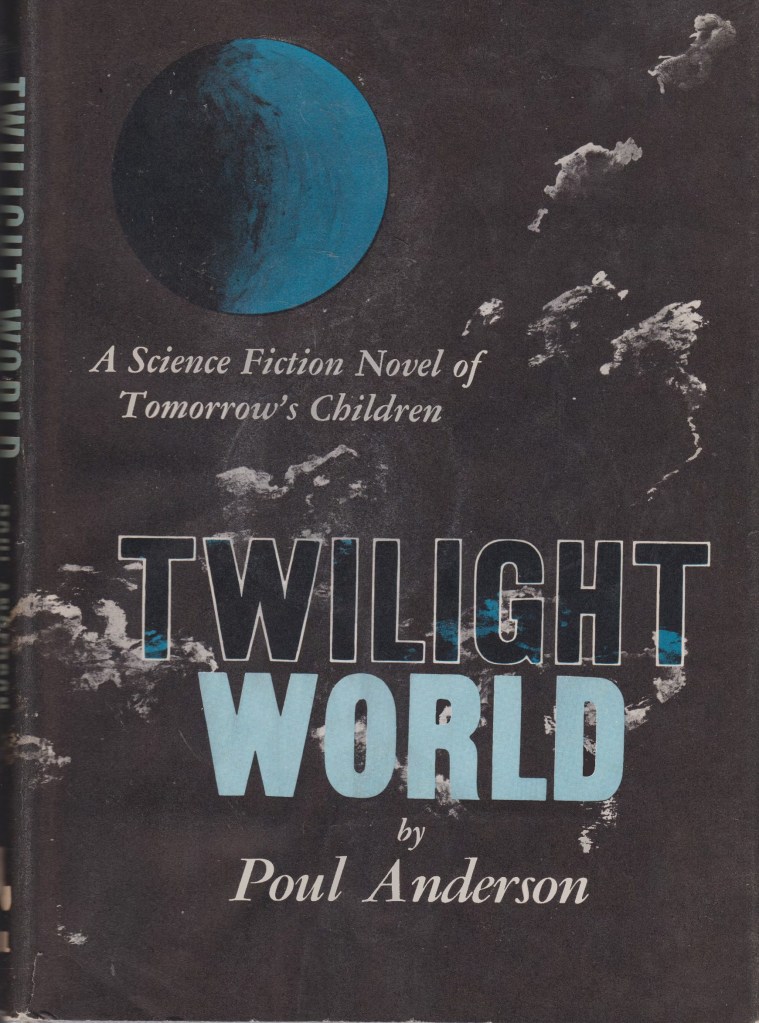
Uncredited cover for the 1st edition
From the inside flap: “The time is shortly after World War Three. Hugh Drummond, jet pilot, has been sent by the remnant United States Government to make a sweeping survey of a devastated planet. He returns with a a report even grimmer than expected, a story of ruin, famine, and barbarism. Here and there a few strongholds of civilization struggle to survive, but even in America they are isolated and feeble. Worst of all is the rising tide of abnormal births. The radiation which now pervades every part of the world is not strong enough to destroy life directly; but it bids fair to end the human race more slowly and horribly, with each future generation more crippled by mutation run wild.
During the long-drawn effort to restore order, a child is born named Alaric Wayne. He grows up as a sort of village idiot–until the day when the savage raiders come and only his peculiar powers can defend his people. Then it is seen that he is not really abnormal. Nor is he truly human. But one chance in a billion has given him a gift which goes beyond humanity.
With so many mutations each year, the real chance of actual improvement, of powers which man never had before, appears certain to be realized. Somewhere in a chaotic world are a few supermen, who don’t know that they are! But how to find them? How to use their unique talents? Above all, how to outrace the galloping disintegration of life in the vast majority?
And meanwhile other nations than America are groping their way back to power. Philosophies emerge which cannot be reconciled. Man drifts closer to a fourth global war, which may destroy him even sooner than his own genetic deterioration.
The quest for an answer to these problems carries Alaric Wayne and his unwilling supermen beyond Earth itself, out to Mars and a final battle with an enemy who has followed them. Yet an even greater enemy remains–man’s own fears and weakness and ignorance.
TWILIGHT WORLD presents a harsh, detailed picture of a world that our own children may have to live in. And yet is is not a chronicle of despair. While man lives, so does hope.”
Initial Thoughts: Twilight World is a fix-up novel of containing two previously published short stories: “Tomorrow’s Children” (1947) (with F. N. Waldrop) and “Chain of Logic” (1947). Two new sections were added to the novel. This is a post-apocalyptic tale of the longue durée. I am relentlessly drawn to such things. That said, I expect little from this one! I am also intrigued by what I assume will be a confused take on nuclear war as sections were written before and after the Hydrogen bomb. We shall see!
For book reviews consult the INDEX
For cover art posts consult the INDEX
For TV and film reviews consult the INDEX
 Science Fiction and Other Suspect Ruminations
I have been meaning to read “The Productions of Time” in its F&SF serialization. I wonder if it was differently cut (or not cut at all?) than the first US book?
I was very impressed by Leigh Kennedy’s “Her Furry Face”. I don’t remember any of the other stories but I am optimistic that they will also be good.
I too don’t have much optimism for TWILIGHT WORLD. I haven’t read the novel, but I have read those early stories (the first being his first published story — as I understand it, Waldrop’s contribution was negligible.) They were … OK, I guess.
I’m not sure about the status of the F&SF serialization. I should check if Jad Smith said anything about it in his book on Brunner…
I look forward to the Kennedy collection.
I expect the Anderson to be complete crap. But historically interesting due to my general interests.
Leigh Kennedy was married to Christopher Priest for many years. Not to judge one by the other, but it might show in their respective work! In any case, I’ll be seeking out Faces as it sounds fascinating.
If you get to her stories before me, let me know your thoughts! I’ve only read one Kennedy work so far and it was quite different from Priest.
What are your favorite Priest short fictions and novels?
I adore his work. I really should read more of his short fiction in particular. An Infinite Summer (1979) is a nearly perfect short story collection: https://sciencefictionruminations.com/2015/11/18/book-review-an-infinite-summer-christopher-priest-1979/
Yes, he’s probably my favourite writer overall. I’ve read just about everything he’s written and it’s all definitely worth your time, although there are stronger works amongst them all. I’d go for The Affirmation, A Dream of Wessex, The Dream Archipelago collection and The Islanders as his very best. They are up there with Borges and Lem in terms of importance.
Well, I’ve reviewed on the site some of what you’ve listed — The Affirmation and many stories in the Dream Archipelago sequence (including some in the collection I linked).
What I’ve covered on the site. For the review links, here’s the index.
The Affirmation (1981)
An Infinite Summer (1979)
“An Infinite Summer” (1976)
“Whores” (1978)
“Palely Loitering” (1979)
“The Negation” (1978)
“The Watched” (1978)
“The Ersatz Wine” (1967)
Indoctrinaire (1970)
Real-Time World (1974)
“The Head and the Hand” (1972)
“Fire Storm” (1970)
“Double Consummation” (1970)
“A Woman Naked” (1974)
“Transplant” (1974)
“Breeding Ground” (1970)
“Sentence in Binary Code” (1971)
“The Perihelion Man” (1969)
“The Run” (1966)
“Real-Time World” (1971)
I like those early 70s stories too but for me his best work comes from the mid 80s onwards. The Separation is another favourite I forgot to mention. It often gets overlooked in discussions of his oeuvre for some reason but it might be his masterpiece.
I will get to Leigh Kennedy but for the time being I am reading Lavondyss by Robert Holdstock – an author I discovered here following your excellent write up on The Time Winds a couple of years back!
The mid-1980s is my cutoff point. As a historian, I am interested in what SF tells us about mentalities and views between 1945-1985. I’m not really on the hunt for the “best” although I find a ton of great stuff along the way. The fact that he was writing what he was writing in the 1970s is what makes it so fascinating.
I don’t think my write-up on Where Time Winds Blow was much of anything. I essentially told people to go read someone else’s review because I couldn’t write my own! hahaha.
I’m assuming you enjoyed Holdstock’s Where Time Winds Blow? I really need to get to Mythago Wood.
“I’m assuming you enjoyed Holdstock’s Where Time Winds Blow? I really need to get to Mythago Wood.”
For some reason I don’t see a reply button under your latest posts so I’ll reply here.
Yes, I really enjoyed Time Winds – one of the best straight SF books I’d read for a few years with a charged atmosphere and good characters. I remember now your ‘review’ was more of a discussion on another review, but it still lead me to discover Holdstock. Since then I’ve read Mythago Wood and am just finishing Lavondyss, both excellent, richly detailed books. In the photos of Robert Holdstock he looks like such a great guy, what a shame he died comparatively young.
The stories in Faces were written before Leigh married Chris, possibly even before their relationship began. She lived with Howard Waldrop for several years previously. I don’t think there’s any obvious signs of her work taking from either.
Faces was put together as a collection for a non-genre prize and published by a mainstream publisher. As such several of the stories are only asymptotically SF. A couple allow a fantastic reading but don’t force it. But there are some that are SFF.
One thing Leigh does a lot is imply, there are stories here told in the gaps as much as in the texts. I like that. There are also some very dark spaces.
She’s a writer who hasn’t written anything like enough.
Hello Kev,
For some reason your comment got flagged as spam. I make sure to check the filter occasionally. Sorry!
I look forward to exploring the collection — and her novel The Journal of Nicholas the American (1986).
Do you have a favorite short fiction of hers?
My favourite in Faces? “Her Furry Face” is a classic, quite nasty in a way. One of those charming stories that turns on you. The thing I like that she does best is telling the real story in the bits she leaves out. There’s a story in Faces called “Max Haunting” that circles around without quite coming clean.
Hello again Kev, moments away from posting my reviews of four more Kennedy short fictions — although, not “Her Furry Face,” yet.
Re. Leigh Kennedy, I’ve only read a couple of couple of her short stories — one being ‘Her Furry Face’ — and a novel, THE JOURNAL OF NICHOLAS THE AMERICAN, which was published in 1986 — very near your historical cutoff point . Still, on the basis of my memory of reading the latter when it came out, I’d say she was/is a very talented writer.
More so than her former husband, C. Priest, whose work I can appreciate but in most cases mostly take or leave because it’s cool and a little labored, so the precis of a Priest novel’s concept is sometimes more interesting than the actual experience of reading it. (Forex, THE PRESTIGE is the identity problem in ROGUE MOON in Edwardian/Victorian drag! Though to Priest’s great credit, he absolutely pulls off the page by page experience of that and it’s one of his best.)
Kennedy, by contrast, was great at making the reader feel her characters’ sometimes unbearable inner experiences. Concept-wise, for me NICHOLAS THE AMERICAN should have been absolutely unpromising : its main character has a problem with his telepathy that he deals with by living out in the backwoods and being an alcoholic, FFS. Nevertheless, I finished the book in one sitting. It’s a great pity Kennedy didn’t continue writing after one more novel and a few short stories.
Re. the Brunner, you can also finish this in one sitting, but only because it’s utterly lightweight: one of his 1960s productions, and very much in the bottom twenty-percent of that, so even deliberately commercial Brunner product done for Donald Wollheim’s Ace, like THE ATLANTIC ABOMINATION or MEETING AT INFINITY, is more adept. Inoffensive, though, and not actively annoying.
Re. the Anderson, the two stories it’s based on were the kind of thing he was selling to Campbell’s ASTOUNDING in the very early 1950s. Over the course of a long, immensely prolific career, Anderson occasionally produced a few arguably great or near-great stories or books to surprise a contemporary reader. Not here. Unlike the Brunner, this one is offensively and annoyingly bad.
Re. Rushdie ‘s GRIMUS. I haven’t read it and I should. The novel Rushdie wrote after this, SHAME, is an amazing piece of work that his publisher shelved to publish as his third novel after MIDNIGHT’S CHILDREN, which was deemed the better bet to break Rushdie with the public.
Hello Mark,
Kennedy — I look forward to exploring more of her work! I’ve put off featuring her in my first three published authors by female authors I want to learn about series for whatever reason. I’m in the mood to read Faces so I might get to it soon.
Priest — He’s one of my favorites. I’d argue that The Affirmation does a brilliant job getting into the mind of a tormented writer, and creating an external landscape, like Ballard, that parallels interior ones. It’s brilliant. Everything I’ve read of his is reviewed on the site. 2 novels and 16 short stories.
Brunner — Yup, that’s what I expected. My father told me there are a few good ideas in The Productions of Time, so we shall see. I’ve reviewed (and enjoyed for his early works) Meeting at Infinity on the site.
Anderson — I know what I’m getting into. I’ve reviewed 11 of his novels and 25 of his short stories on my site and I’ve fallen afoul of the silly denizens of the Poul Anderson Fan Club that desire to defend even his most atrocious of works from the hint of a bad word… haha.
“Though to Priest’s great credit, he absolutely pulls off the page by page experience of that and it’s one of his best.”
For me this is the thing with any Priest book – I find them absolute page-turners. Not in that gratuitous and unfulfilling way an airport thriller will lead you on a highway to nothing, but because every word in every sentence seems considered (maybe that’s why you find them ‘labored’) and has a purpose greater than just the obvious. You almost never know what is around the corner but there always seem to be clues scattered everywhere. Of course, there are the writerly tricks such as obfuscation and misleading narrators too, but Priest is an absolute master of those.