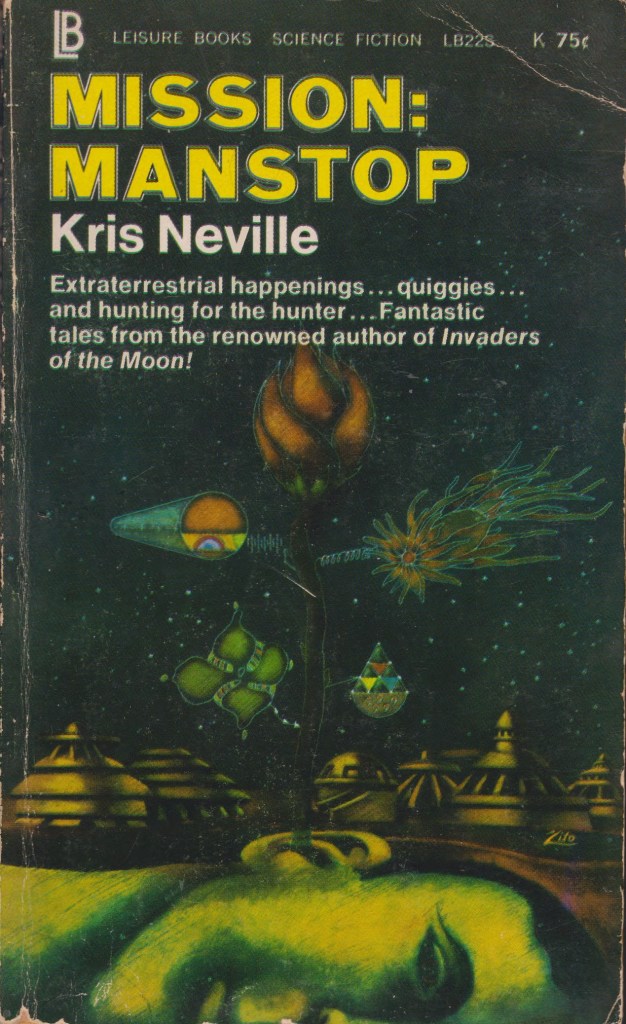
Andy Zito’s cover for the 1st edition
3.25/5 (Collated Rating: Above Average)
The career of Kris Neville (1925-1980) can be divided broadly into two parts. In his most productive period (1949-1957), Neville’s SF appeared in all the major magazines of the day, The Magazine of Fantasy and Science Fiction in particular. Afterwards, while he continued to publish short stories at a far reduced clip until his death, he wrote a handful of fix-up novels between 1964-1970. This trajectory neatly maps onto the restriction of magazine markets in the late 50s and the growing importance of the SF novel.
Fellow science fiction author (and Boaz favorite) Barry N. Malzberg (1939-) has positioned himself as an ardent Neville defender. They collaborated, but never met, on a few stories before Neville’s death in 1980 and corresponded regularly. Malzberg, in the preface to The Science Fiction of Kris Neville (1984), describes him as follows: “He liked wine, hated Nixon, deplored mass media, missed Tony Boucher […] had a deep suspicion of American industry and its products […] found conventions, finally, wearying and had a deep and abiding love for the science fiction community” (ix). Malzberg suggests that Neville, “if given half a chance [I assume, by editors],” would have been one of the best science fiction authors (x).
I’ve previously read and reviewed Neville’s best-known fix-up Bettyann (1970), “Cold War” (1949) for my critical accounts of space travel series, and one of his collabs with Malzberg, “Pacem Est” (1970). Often Neville’s fictions read as traditional pulp plots–time travel, strange alien animals, telepathy, colonies on alien worlds–before devolving into critical views of technology, nightmarish existential terror, violence, and decay. No wonder Malzberg found his fiction appealing!
While none of the stories in the collection are clear-cut masterpieces, I am fascinated enough to track down more. What are your favorite Neville fictions?
Note: Two of the stories in the collection were revised for the 1971 publication. I discuss the revisions in more detail below. If anyone has Internet Speculative Fiction Database administrative access, the original and revised short stories in the Neville listing should be compressed, with revision notes, into single entries.

Ed Emshwiller’s cover for the The Magazine of Fantasy and Science Fiction, ed. Anthony Boucher and J. Francis McCormas (April 1953)
“Mission: Manstop” (variant title: “Mission”) (1953, rev. 1971), 3.25/5 (Above Average): First appeared in The Magazine of Fantasy and Science Fiction, ed. Anthony Boucher and J. Francis McCormas (April 1953). You can read the original version online here.
On the surface “Mission: Manstop” reads as a straight-laced time-travel short story. A 1928 model Ford appears on a highway outside Washington, D.C. The driver, Gene Martin, travelling imprecisely into the past, hopes it’s before 1940 but instead arrives years late. The reason for the trip? Humanity’s survival is at stake. Gene approaches a journalist, and friend, Ray Levos with an unbelievable story. The task? Convince Ray that he is an older version of his friend. But physical toll on Gene is immense. And there isn’t time. Levos struggles with the possibility of Gene’s delusion of saving the world: “are you a savior or a demagog?” (33). As the dust settles, a bleak indecision takes over. There will be further violence regardless of the choices they make.
Neville’s revision takes the form of historical references–LBJ’s presidency, the Vietnam War, etc. (24)–inserted into the narrative, a deeper sense of despair as the Cold War extended into the 70s, and a few literary touches here and there. There’s a heightened sense of desperation in the later version due to the continued post-WWII conflict in Vietnam that will subsume America: “You have no idea of the realignment of powers that will take place because of what happens in China” (26). The revisions effectively update the original.
“Mission: Manstop” complicates the narrative of the time-traveling hero who sets out to save the world with a bleak interior tableau performed by the damaged and dying. Somewhat recommended.
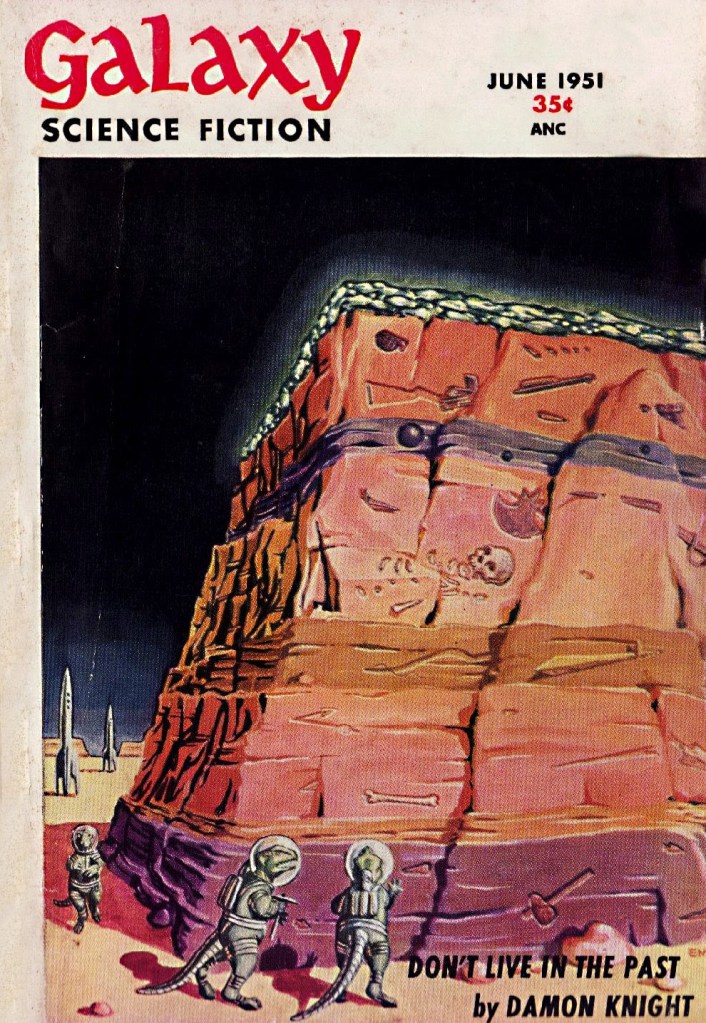
Ed Emshwiller’s cover for Galaxy Science Fiction, ed. H. L. Gold (June 1951)
“Hunt the Hunter” (1951), 4/5 (Good): First appeared in Galaxy Science Fiction, ed. H. L. Gold (June 1951). You can read it online here.
Two wealthy businessmen, Ri and Mia, are drafted by a violent autocrat, Extrone to hunt an alien “farn beast” (37). Tensions thrive beneath the surface. Out of Extrone’s sight Mia mutters to Ri, “what hurts most, he pays us for it. I could buy half this planet, and he makes me his guide–at less than I pay my secretary” (38). Like a British aristocrat trekking into the Bushveld to slaughter a rare black rhino (Extrone reads as a Cecil Rhodes-esque figure), Extrone treats everyone around him as a tool for his own ambitions. He plays them off against each other, preying on their fears, twisting them like string on a finger, reveling in their terror, yearning for the kill. But someone else is playing a game–and it might be too late to escape.
The best story in the collection reads as a study on the mechanisms of power and control. In a few brief pages, Neville effectively paints Extrone as a truly horrifying figure able to infiltrate and subdue the minds of powerful men like Ri and Mia. Adding to the unease, Neville’s crafts a future that reeks of a second wave of colonial mentalities and actions and a deep inability to understand the new worlds we’ll encounter.
Recommended for fans of sinister 50s visions.

Chelsey Bonestell’s cover for The Magazine of Fantasy and Science Fiction, ed. Anthony Boucher and J. Francis McComas (December 1950)
“Take Two Quiggies” (1950), 3/5 (Average): First appeared in The Magazine of Fantasy and Science Fiction, ed. Anthony Boucher and J. Francis McComas (December 1950). You can read it online here.
“Take Two Quiggies” places humans too eager to speak for others in a pickle of their own making. The Culture Team leverages a deal out of the people of Dobu despite an official quarantine, that threatens to ruin the planet, after the accidental destruction of the human spaceship Starflight. Of course, the deal allows humans to exploit the native people in violation of their own quarantine. But the cute yet awkward alien pets the humans want from the Dobu end up being far more than they asked for.
A somewhat sinister yet whimsical satire of colonialism and commercialism told in Neville’s curt and punchy style. Regardless of their staying power, I always find stories written during the explosive growth of post-colonial movements after WWII interesting for what they say about the mechanisms of empire and views of “the other.” The story funniest moments concern the media deluge required to sell the Quiggies to Americans as the next hot “must have” product.
I’m not sure I will remember this story for long but it has its humorous moments.

Ed Emshwiller’s cover for The Magazine of Fantasy and Science Fiction, ed. Anthony Boucher and J. Francis McComas (June 1952).
“Underground Movement” (1952), 3.25/5 (Above Average): First appeared in The Magazine of Fantasy and Science Fiction, ed. Anthony Boucher and J. Francis McComas (June 1952). You can read it online here.
Telepathy! Wait, we’re reading a Neville story. Telepathy, with a horrible catch…. Howard Wilson, a mutant cursed with a cancerous growth taking over his head that grants telepathy, works for a government agency tracking down other mutants. He craves a vacation in a place far from those who speak his language, at least he won’t entirely understand the thoughts around him. The “emblem of a telepath” on his forehead would “destroy him, eating inward to his mind and shooting malignant cells into his blood for impartial distribution to lungs and stomach and bones” (90). The origin of the mutation isn’t clear. Wilson doesn’t believe it came from the bomb. A deeper conspiratorial tone dominates the proceedings.
A new form of fear lances through Wilson. For he, and the “two dozen other telepaths,” will soon experience death in the near future in a way unlike any other human (90). They will hear each other’s thoughts. He worries for humanity caught up in the hysteria that he will unleash when news gets out of new mutations. He feels kinship with the non-telepathic humanity as well. But even the telepaths can’t divine what is to come.
Conspiracies and paranoia. Telepathy as an inevitable danse macabre. What a sinister story!
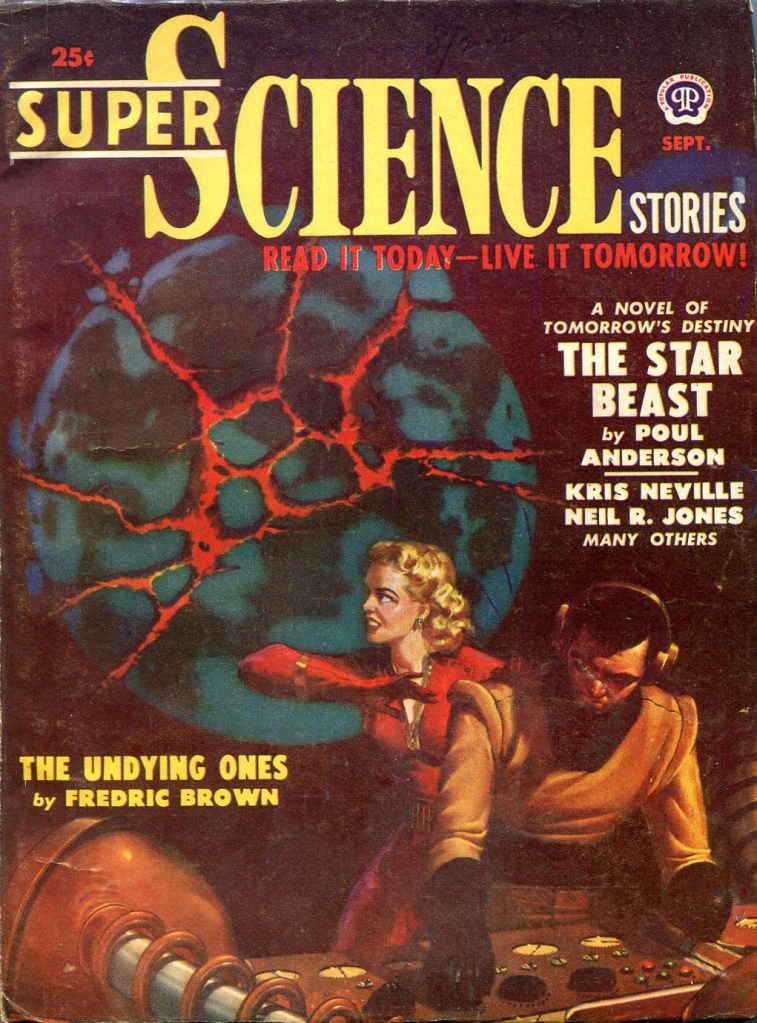
H. R. Van Dongen’s cover for Super Science Stories, ed. Ejler Jakobsson (September 1950)
“Experimental Station” (variant title: “The First”) (1950, rev. 1971), 3.25/5 (Above Average): First appeared in Super Science Stories, ed. Ejler Jakobsson (September 1950). You can read it online here.
A cursory comparison between the 1971 revised edition and the original reveals superficial additions and subtractions. The one substantial addition is the added final sentence that adds a deeper sense of emotional crisis to the narrative.
Sam escapes from his room. But it is not an ordinary room. It’s an observation chamber under a dome on an alien world. Sam feels the pull of the external world: “often he looked out from behind his barrier and felt the patch call to him, call to him in a silent voice that made his blood tingle, call to him, say, You belong here, say, Tis is your home, your place is here, away from them” (106). Who are they? Sam views his observers as abnormal “ugly” things “with only two arms and only two legs and only two eyes” (107).
I found this story the most effective use of Neville’s punchy and curt prose style. And, as with most of the stories in the collection, the landscape of the future lacks basic morality. It repeats the horrors and culture of secrecy of Neville’s own day. Future exploration will be an extension of the hatreds of the Cold War present, not the arrival of a new beginning. And the new generation will be unable to navigate the paths left for them.
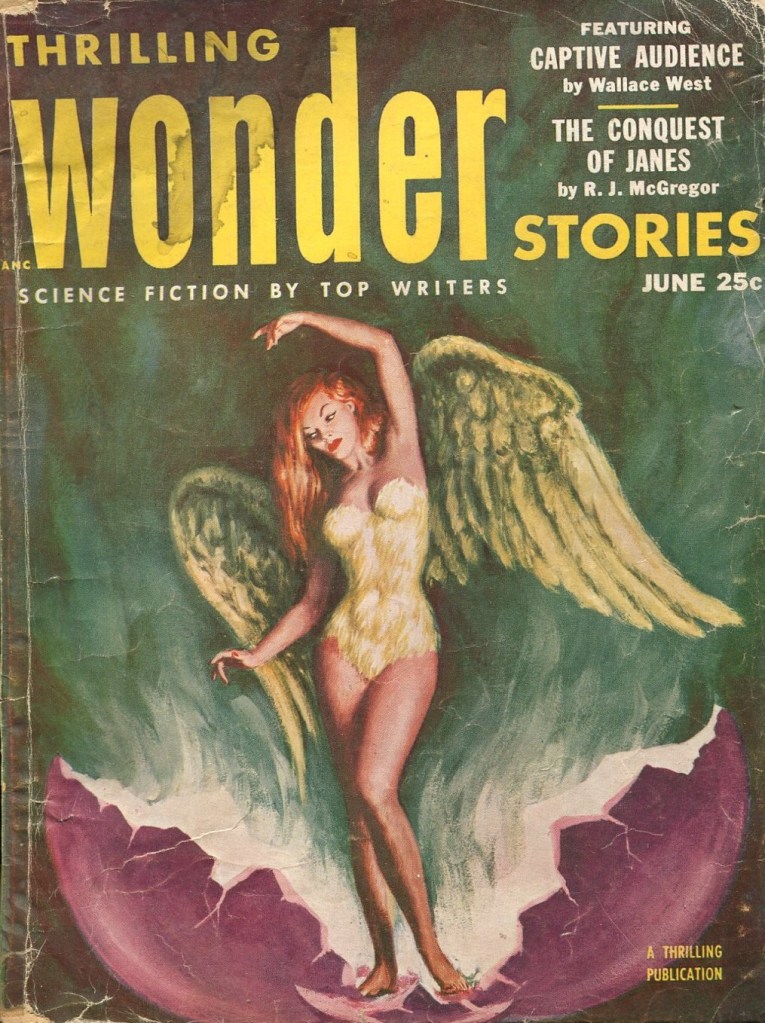
Walter Popp’s cover for Thrilling Wonder Stories, ed. Samuel Mines (June 1953)
“Marginal Error” (1953), 3/5 (Average): First appeared in Thrilling Wonder Stories, ed. Samuel Mines (June 1953). You can read it online here.
Ralph McCord spends his days inputting speeches into a supercomputer. Multiple information gathering departments add to the collated and storied knowledge of the Machine on Knob Hill. The Machine calculates whether you will become radical and turn on its looming ever-accumulating existence. It also calculates who will commit suicide and who would die of natural causes by sixty-five (125). At home Ralph’s wife Ivy grows bored with life and blots out the experiences and counsel of those around her. She begins to believe the words of an anti-Machine radical named Chinwell and his fellow prophets who argue against the further mechanization of life.
And Ralph isn’t immune from Chinwell’s views either. The Machine audits his work for input errors and grows increasingly suspicious. Ivy suggests that “the Machine is beginning to get you, too!” (138). Neville doesn’t create a neat ending. The Machine becomes a new object of devotion and it mechanical intent marches inexorably on through the minds of its followers.
I can imagine a young Barry N. Mazlberg, who would craft his own dire nightmares of an increasingly technological age, salivating over “Marginal Error” (1953). According to Neville, abdicating responsibility and decisions to a machine creates a new religion in the place of the old, and removes our ability to think critically along the way.
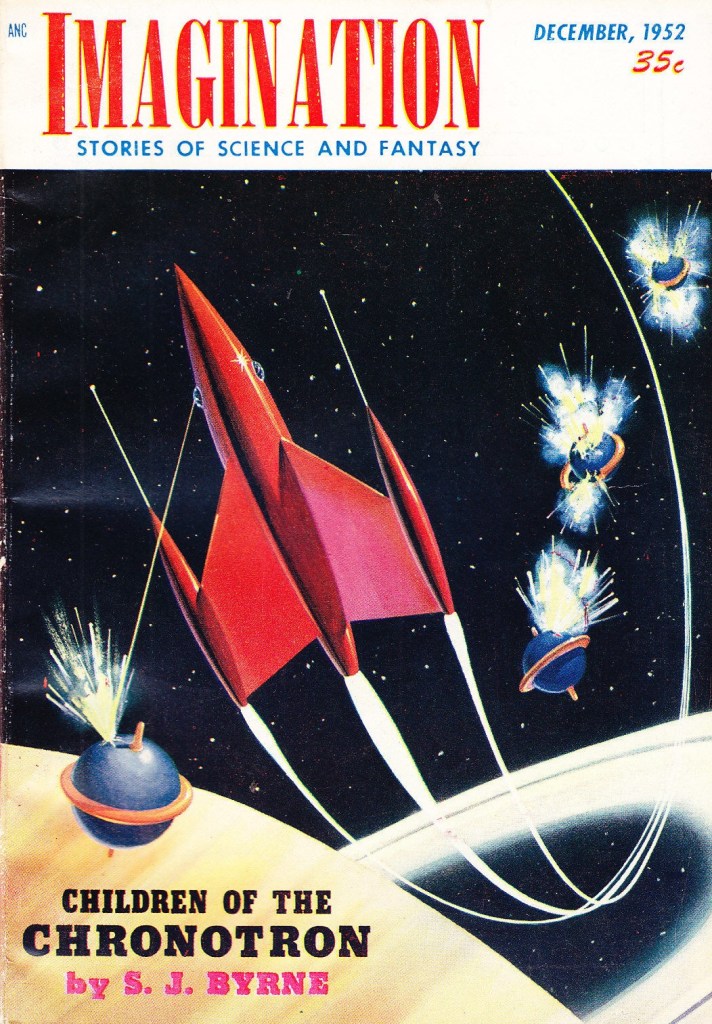
Malcolm Smith’s cover for Imagination, ed. William L. Hamling (December 1952)
“The Toy” (1952), 3.5/5 (Good): First appeared in Imagination, ed. William L. Hamling (December 1952). You can read it online here.
On a planet colonized by humans, a group of natives attempt to liberate humanity from their destructive machines. The dead bodies of their compatriots litter the human encampments. The survivors recount their attack to their Chieftain and ruminate on the nature of the conquerors: “there was something about the new gods who had come down from the sky; but they brought a demon with them. The howling demon uprooted and stripped trees in a way not to be believed” (153). The natives resolve to continue their crusade: “we must kill the demon and free the god-men from its evil power” (155) for which they believe they will be thanked by humanity. But there’s a twist!
The twist adds another fascinating layer. First, the natives are far from “primitive.” Second, they have chosen to free themselves from the machines of their ancestors. “The Toy” reads as an effective early environmental-themed SF story about the exploitation of colonial worlds that breaks down simplistic dichotomies of primitive vs. civilized.
For book reviews consult the INDEX
For cover art posts consult the INDEX
For TV and film reviews consult the INDEX
 Science Fiction and Other Suspect Ruminations
The only one of these stories that I’ve read is “Hunt the Hunter”, and I think your review is spot on.
He wrote three stories as by “Henderson St arke” — no idea why the pseudonym though Barry suggests it’s because they are all fantasy and he mostly wrote SF — and they are all actually pretty good .
One Henderson Starke story is “Dumb Supper” — my review is here: https://www.blackgate.com/2021/11/26/retro-review-emthe-magazine-of-fantasy-science-fictionem-summer-1950/
The other two Starke stories, plus several other Kris Neville stories, are covered here: https://rrhorton.blogspot.com/2020/06/very-belated-birthday-review-stories-of.html
I think the two late dark political satires, “The Reality Machine” and “Survival Problems”, might be of particular interest to you.
Hello Rich,
Thanks for the links. I seem to have missed your Neville review rundown birthday post. Do you think the “dark political satires” convey some of the hatred that he felt for Nixon mentioned by Malzberg?
Malzberg suggests that most of Neville’s best work came in the mid-ish 60s after a period of inactivity: “The Price of Simeryl” (1966), “Ballenger’s People” (1967), and “New Apples in the Garden (1963).
I definitely think the dark political satires convey his hatred of Nixon, though reading “The Reality Machine” when I did I naturally though of a much later, even (in my opinion) more evil, president, with the initials DJT.
I haven’t read those three stories Malzberg mentioned, but I will try to find them.
Hey, I thought the same when I read Malzberg’s The Last Transaction (1977). And because of DJT, The Last Transaction completely failed to shock as the horrible president wasn’t that horrible in comparison… as I imagine it did at the time (although few people seem to have read Malzberg’s novel).
“Ballenger’s People” also sounds like my cup of tea. Despite the dislike conveyed on Galactic Journey, the brief summary sounds right up my alley: “An insane fellow, whose fragmented mind is under the delusion that it is a polity of many parts rather than a single entity, becomes homicidal when threatened by “other nations” (i.e. other human individuals).”
I’ve read ‘Hunt the Hunter’ and ‘Underground Movement’ in the Malzberg/Greenberg edited ‘The Science Fiction of Kris Neville’. I’ve also read ‘Ballenger’s People’. I don’t recall them clearly, but I don’t clearly recall disliking any of them.
In any case I need to go off and read ‘Mission: Manstop’ immediately. I’ll hold of on further comments on the review above until I’ve read it.
Luckily, I have a copy having bought it back in 2015, partly in relation to reading about and discussing Neville on your blog. So thank you!
PS. Though I do recall liking ‘The Price of Simeryl’.
I put it on a list I’ve been compiling about drugs and science fiction.
I hope that Norman Spinrad’s “The Weed of Time” (1970) will make your list. I’m sure you’ll have included a number of Spinrad stories on such a compilation.
Yes, I reviewed it in the first installment of my series: https://sciencefictionruminations.com/2022/12/17/short-fiction-reviews-norman-spinrads-the-weed-of-time-1970-and-william-morrisons-the-addicts-1952/
There’s a handy index of all my reviews on the top bar of the site: https://sciencefictionruminations.com/science-fiction-book-reviews-by-author/
Thank you.
No problem.
I found almost all of the stories in the collection deeply strange. They often don’t have clear resolutions despite the very standard tropes deployed. More often than not, they revel in the human nightmare that unfolds.
Are you reading the two 70s revisions (discussed in the collection) or their 50s originals (in the magazines I linked)?
No problem!
I, of course, and curious about your thoughts.
I’m reading the 1971 paperback. Finished the story ‘Mission: Manstop’. The changes to take in the 1960s is subtle at first, before fully revealing that it is a rewrite. I feel it neither adds nor subtracts from the story as such.
It is a little crazy to think that sf writers once felt the need to update stories barely 20 years old because they mis-prognosticated the future!
“Manstop…’ felt more like an interesting vignette than a fully realized story. It’s abrupt end was both effective and a bit of a cop out.
You identified the primary reason for my rating. His stories often retreat inward to some narratively/morally ambiguous place despite all the pulp trappings that propelled the tale. Which is appealing as an idea but sometimes I would like a bit more resolution to make that retreat meaningful.
I did feel the rewrite added to the sense of despair at the post-WWII world’s inability to create peace and understanding. But yes, the rewrite was minor enough to not seem that necessary.
The rewrite in “Experimental Station” is also minor but quite impactful (it’s most substantial bit is the final sentence!).
It had all the makings of a great story, and then it just ended, even if this ending was a resolution of sorts.
I love Neville’s writing, I wish he had written more.
Harlan Ellison was also a fan of Kris Neville.
Neville had a story included in Dangerous Visions, “From the Government Printing Office”.
Did you enjoy it?
I believe that I did enjoy it at the time, but it has been about twenty years since I read Dangerous Visions. I cannot remember the plot.
It led to me being interested enough in Neville to want to read other Neville short fiction I have come across in anthologies, although if that was due to the one story or Ellison (and Malzberg’s) praise of Neville, I’m unsure.
I know I’ve also read his “Pacem Est” (w/Malzberg), “The Quality of the Product” (w/ Lil Neville), “Cold War”, and “New Apples in the Garden”.
I did enjoy all of them. I think “The Quality of the Product”, from the anthology Saving Worlds (1973), was the strongest story by Neville I have read. It certainly brings his criticism of technology and consumerism to the fore.
I’ve never read the anthology cover to cover but over the years I’ve certainly reviewed quite a few stories that appeared in it.
I’ve reviewed “Cold War” and “Pacem Est.” They were interesting enough to lead to me buying this collection.
I’m all for a criticism of technology and consumerism — I’ll put “The Quality of the Product” on my list.
And of course, if you know of any Neville stories that would fit my media landscapes of the future series…. let me know!
I read a lot of Neville’s stories many, many years ago but don’t remember much about them today except that I liked his style of writing. I did come across his story “General Max Shorter” about a year ago in an anthology and I thought it was very good. The best part of the story is Neville’s terrific writing style which is very apparent in the excerpt below. When was the last time you read about the operation of an interstellar spaceship this way:
The long ship lifted steadily and majestically through the battering storm and the driving rain of dust and crystals. Out beyond the dense space that surrounds all stars, the long ship probed the ever-shifting currents in the four-dimensional universe. The long ship found a low-density flaw, where space could hardly be said to exist at all. The long ship, described mathematically, was half as long as the continuum–the length being inversely proportional and related only to mass. Time was but a moth’s wing between twin cliffs of eternity.
The only other SF writer that can do this is Cordwainer Smith.
Hello Jim, glad you have fond memories of a Neville story. Considering what I’ve read so far, I’d argue that his most beautiful moments came in the stories that comprise Bettyann (1970). Here’s a highlight about the power of time:
““[Lewan’s] own thoughts reached back to childhood and beyond that, in a queer, yet valid way, to the childhood of his parents and their parents and their parents and their parents and their parents and their parents and their parents…. Spreading outward in the end to embrace everybody. For each of those distant, forgotten people had molded him and stamped themselves upon him and shaped him. He could never break out of that form he was cast in and think unthinkable thoughts” (29).
If you get to any of the stories in this collection or read any other fascinating Neville tales, let me know!
Someone gave me a copy of a Kindle edition of his “Collected Fiction” and it looks like it has most of the stuff he wrote. I’m not sure where it came from since I can’t find it in his bibliography. It says it was produced by “Jerry eBooks”. I hope it’s not an illegal copy!
I’m glad you’ve figured out how to convince yourself to read Kindle editions. Until I do, I want paper copies (of course, some of the individual short stories I review on the site I read online but it’s always torture).
Many years back when I started using a kindle I was also still buying paperbacks of stuff that wasn’t on kindle yet and I was also still getting stuff from the library which, at the time, was very close. After I moved the library was much further so I gradually stopped going there when ebook editions became much more common. I also bought a Kindle Paperwhite which is easier on the eyes than the original.
I completely understand why people enjoy the Kindle. When I’ve run out of space, I might give in. But as of now, if I buy an eBook edition it’s a guarantee I won’t read it. I have eBook collections of vintage Japanese translated SF, hard to find books that are too expensive online, etc. I haven’t even looked at them since I bought them unfortunately.