Which books/covers/authors in the post intrigue you? Which have you read? Disliked? Enjoyed?
1. Frank Herbert’s Destination: Void (1966, rev. 1978)
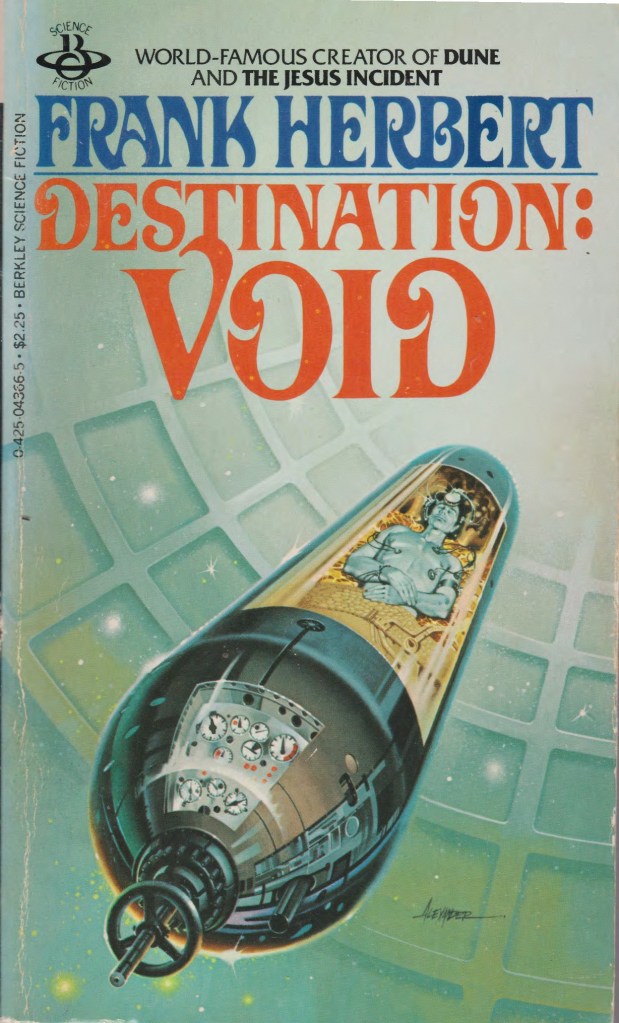
Paul Alexander’s cover for the 1978 edition
From the back cover: “DESTINATION: VOID
THE COMPLETELY REVISED AUTHOR’S EDITION OF THE CLASSIC DEEP-SPACE ADVENTURE!
‘When the publishers announced that they were going to bring out a new edition of DESTINATION: VOID, they offered me the opportunity to make any changes I felt were necessary. Because of the tightly interwoven scientific premises behind this story and rapid development in the fields related to these premises, it would be extraordinary if discoveries across thirteen years did not dictate certain revisions.
You will find, therefore, that this newly-published version of DESTINATION: VOID contains significant additions, rewritten portions, changes in character development and certain deletions.’ — Frank Herbert.”
Initial Thoughts: I read and enjoyed Destination: Void in my late teens. However, apparently my copy has gone missing. Impulsively a few years ago, I purchased the 1970 edition not realizing the novel’s publication history: Herbert revised the 1978 edition as he describes in the blurb. As I read the post-1978 edition as a kid, I thought I’d make sure to have both. I am not always a fan of authors updating their novels decades later. Two examples come to mind, Michael Bishop’ and his’s brilliant A Funeral for the Eyes of Fire (1975) and John Shirley’s Eclipse trilogy (1985-1990) come to mind. Not sure which Herbert edition I should reread when the whim strikes!
2. Alan E. Nourse’s Psi High and Others (1967)

Don Punchatz’s cover for the 1968 edition
From the back cover: “In PSI HIGH AND OTHERS, Nourse once again demonstrates his superb imagination in a trilogy of stories about a series of tests which Earthmen undergo while being observed by the Watchers, representatives of a Galactic Federation.
In THE MARTYR, Noruse examines the desirability of prolonging the lives of individuals who have positions of leadership and responsibility in a society.
PSI HIGH, set in the year 2177, dramatizes the plight of people who are ‘different,’ in this case, those who possess extrasensory perception
MIRROR, MIRROR, the last story, pits Earthmen in a psychological war against aliens…”
Contents: “Prologue” (1967), “The Martyr” (1957), “Psi High” (1967), “Mirror, Mirror” (1967), “Epilogue” (1967).
Initial Thoughts: I’ve only read Nourse’s average medical thriller The Mercy Men (variant title: The Man Obsessed) (1955). I look forward to trying some of his short fiction (in this instance, in fix-up novel form).
3. Ann Maxwell’s The Singer Enigma (1976)

Robert LoGrippo’s cover for the 1st edition
From the back cover: “Deadly Desire. Her name was Lyra. She was beautiful, unimaginably beautiful. She was dangerous, unspeakably dangerous. At her touch, Tarhn felt himself becoming the perfect man he had always dream of being. At the sound of her voice, Tarhn heard a message of doom for himself and all mankind.
He passionately loved this creature from the bottom of his heart. He viciously hated her from the darkest depths of his soul.
For Lyra was a Singer–a member of the outcast race that alone held for good of evil the elusive answer to — THE SINGER ENIGMA.”
Initial Thoughts: Ann Maxwell published nine SF novels (and zero short stories) between 1975-1986. I have yet to read any of them. I’d previously acquired Fire Dancer (1982) back in 2021.
4. Craig Harrison’s Broken October: New Zealand, 1985 (1976)

Uncredited cover for the 1st edition
From the inside flap: “October 1985
Who would have thought that aging, yellowing document could still be so potent?
But when Māori guerillas steal the Treaty of Waitangi, it lifts the lid off an explosive racial situation.
A weak Prime Minister resigns, and his power-hungry successor can’t cope with the internal and international problems which rapidly follow. Industrial unrest flares overnight into violent racial conflict. New Zealand splits into two colours. And then the dominoes begin to fall..
In one sense this novel is a straightforward narrative of violent revolt and savage repression–a 20th century Māori Land War fought with all the weaponry and psychological techniques so grimly familiar in the 1970s. fantastic? Or eerily credible…
At a deeper and even more disturbing level this credibility reminds us that only a thin line separates a smugly-cosy democracy from ruthless dictatorship and blood anarchy.”
Initial Thoughts: Craig Harrison (1942-), in New Zealand after 1966, wrote a handful of SF novels that, according to SF Encyclopedia, embody “anti-racist themes. Harrison is best known for his novel The Quiet Earth (1981), adapted as a rare New Zealand science fiction film in 1985. I decided to acquire Broken October (1976), Harrison’s first SF novel, as it’s a sympathetic look at the plight of Māori in a near future dystopia. I know little else about it. Not the easiest book to find!
For book reviews consult the INDEX
For cover art posts consult the INDEX
For TV and film reviews consult the INDEX
 Science Fiction and Other Suspect Ruminations
Psi High and Others was a book I really enjoyed in the 1970s as a teen. Hope you like it.
Yeah, I’ve only read one of his novels A Man Obsessed (variant title: The Mercy Men) (1955) — I was not super impressed. It’s probably why it’s taken me a while to get back to his work. I have a union-themed story of his (a very negative take) on the more immediate to-read list — “Meeting of the Board” (1955).
P.S. Back in the 1980s Nourse wrote a medical column for some magazine (Good Housekeeping, maybe?). I’d read it regularly on the off chance that he’d mention some SF (but I don’t think he ever did). I also liked his “The Universe Between” back in the day
I really can’t imagine being a doctor and having as much time as he apparently did for writing SF…
That ‘Psi High’ is creepy! Definitely makes me want to read it.
As does the Harrison! I love the idea of supplementing upcoming re-reads of Baldwin, Baraka, and Davis with some anti-racist fiction. Where did you find it?
Thanks for stopping by. As I haven’t read it, I don’t know how “anti-racist” the novel actually is — I’m going by the SF Encyclopedia entry’s general description of his work.
I purchased it online through ebay or abebooks, I don’t remember exactly.
Cool cover on the Herbert, never heard of that one!
I remember considering (back in my late teens) the revised version (the only one I’ve read) one of Herbert’s best non-Dune novels.
Herbert’s kinda like Asimov to me – I understand their importance to the development of the genre, and enjoyed/obsessed over them as a teen, but when I’ve returned to Foundation or Dune as an adult I find the prose an interminable slog. What were once novel or groundbreaking concepts and subjects seem buried under writing that just seems bad on a purely technical, formal level. Oh well.
Like I said, cool covers though! Haha
I have a far more positive response to Herbert over Asimov. As someone obsessed with encyclopedism (I mean, the topic of my PhD, haha), I find his immense and immersive attempts to create knowledge layers that interact with each other (quotations, references to historical events, different and rapidly shifting perspectives on a single conversation, etc.) a glorious bonus to his narratives. So yeah, the encyclopedism in the prose is why I continue to enjoy his work.
What a fascinating selection of books! Each offers a unique perspective and intriguing themes that make them worth exploring.
Frank Herbert’s Destination: Void stands out as a deep-space adventure with philosophical undertones. The fact that Herbert revised it after scientific advances adds an extra layer of interest, though it raises questions about how much those updates enhance the story. While I haven’t read it yet, as a fan of Dune, I’m eager to dive into Herbert’s other works.
Alan E. Nourse’s Psi High and Others intrigues me with its classic speculative fiction themes, such as ESP and psychological warfare against aliens. The exploration of those who are “different” feels especially relevant, and the mix of older and newer stories in a fix-up format makes it particularly appealing. I haven’t read it yet, but it’s definitely on my radar.
Ann Maxwell’s The Singer Enigma offers a compelling premise, blending romance, mystery, and existential stakes. The character of Lyra, with her dual nature as both alluring and dangerous, adds complexity to the story. Although I haven’t read Maxwell’s work, this novel makes me curious about her character-driven approach to science fiction.
Finally, Craig Harrison’s Broken October captures my attention with its near-future dystopian setting that tackles racial tensions in New Zealand. The focus on anti-racism and the fragility of democracy feels eerily relevant today. While I haven’t read it yet, this one would be a priority for me because of its impactful and thought-provoking themes.
Of the four, Broken October and Psi High and Others stand out as the most compelling to me, but they all offer something unique and intriguing. Thanks for sharing this lineup—it’s sparked a lot of curiosity!