Graphic created by my father
Here’s to a happy reading in 2025! I hope you had a successful reading year. Whether you are a lurker, occasional visitor, a regular commenter, a follower on Bluesky or Mastodon, thank you for your continued support. It’s hard to express how important (and encouraging) the discussions that occur in the comments, social media, and via email are to me. This was the third year running of record-breaking numbers of viewers and views in the 13-year history of my site. What were your favorite vintage SF reads–published pre-1985–of 2024? Let me know in the comments.
Clifford D. Simak defined my 2024. Starting with a February review of his collection Worlds Without End (1964), I embarked on a fiction and non-fiction reading extravaganza that culminated in my article for Journey Planet, which I spent most of the summer writing, titled “‘We Must Start Over Again and Find Some Other Way of Life’”’: The Role of Organized Labor in the 1940s and ’50s Science Fiction of Clifford D. Simak.” Despite his Grand Master status, there’s little scholarship on Simak’s work and so much more to be done. As expected, there was little response to the article outside of my website. I also wrote two Exploration Logs on six of his interviews and his 1971 Worldcon speech and contributed to a podcast on “The Huddling Place” (1944) (the second City story). Sometimes you find a little niche that you never expected to inhabit which you feel there’s so much more to explore and say. I hope my Simak focus continues into 2025.
Continuing a trend from years past due to job stress (which exponentially ramped up in the fall), I completed only a handful of novels in 2024. It’s simply easier for me to read short fiction and write in an in-depth manner about them. As a religious notetaker, the time commitment to reviewing a novel is massive. I will attempt to change that a bit this year.
Without further ado, here are my favorite novels and short stories I read in 2024 with bonus categories. I made sure to link my longer reviews where applicable if you want a deeper dive.
Check out my 2023, 2022, and 2021 rundowns if you haven’t already. I have archived all my annual rundowns on my article index page if you wanted to peruse earlier years.
My Top 5 Science Fiction Novels of 2024

Uncredited cover for the 1985 edition
1. Ignácio de Loyola Brandão’s And Still the Earth, (1981, trans. Ellen Watson, 1985), 5/5 (Masterpiece). Unfortunately, I’ve yet to review this one!
A brutal dystopia written during an era of military dictatorship in Brazil (1964-1985), And Still the Earth charts the strange movements of a man who wakes up with a painless hole in his hand. This is a Brazil intent on erasing the past. A Brazil that holds onto fragments of knowledge via a complex system of oral signifiers. A Brazil hurtling towards ecological, political, and social destruction. Not to be missed if you’re of the predisposition to enjoy a dense, intense, and surreal shuffle towards apocalypse.
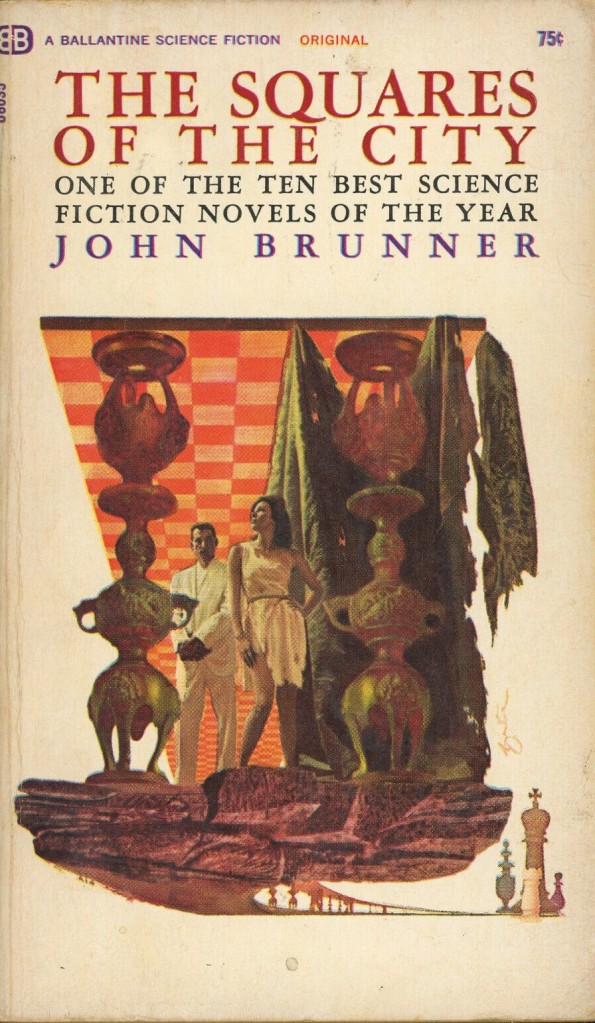
Robert Fosters’ cover for the 1st edition
2. John Brunner’s The Squares of the City (1965), 4/5 (Good). Full review.
Brunner transposes the moves of a 1892 chess game between Wilhelm Steinitz (1836-1900) and Mikhail Chigorin (1850-1905) onto a near future landscape of political intrigue. Inspired by Brazil’s planned capital Brasília (founded in 1960), the action takes place in Ciudad de Vados, the capital city of the imaginary Latin American nation of Aguazul. The Englishman Boyd Daniel Hakluyt arrives Ciudad de Vados under the impression that his skills as a traffic analyst will quickly solve a routine design flaw in the brand new metropolis. He finds himself caught up in complex conspiracy with unknown players.

Uncredited cover for the 1960 edition of Pat Frank’s Alas, Babylon (1959)
3. Pat Frank’s Alas, Babylon (1959), 4/5 (Good). Full review.
Alas, Babylon narrows in on the experiences of a diverse range of characters (White, Hispanic, and Black) in Fort Repose, an imaginary town in Northern Florida, after a nuclear attack that devastates all surrounding regions. Government calls for Civil Defense are not taken seriously. How will the community survive isolated from the rest of the nation? Who will emerge from the wreckage and guide the fractured community forward? What are the new values in the wasteland? Can they survive the effects of surrounding fallout?

Keith Scaife’s cover for the 1988 edition
4. Pat Murphy’s Shadow Hunter (1982), 3.75/5 (Good): Full review.
Pat Murphy’s first novel is an achingly beautiful tale of displacement. In the distant past, a young Neanderthal boy embarks on a hunt to claim his name and to learn the nature of the world. In the near future, a mogul named Roy Morgan wants to create a Pleistocene oasis (The Project) ensconced in a valley in an increasingly urban world. And Amanda, aiming to capture the bear, pulls the Neanderthal child, named Sam by his captors, into the subterranean bowels of The Project. He must learn the nature of the shadows that inhabit his new world: his own loneliness, the damaged souls that inhabit the streets and perpetuate Roy Morgan’s schemes, the men and women lost in the shadows of their parents, the fragments of his old world that still inhabit his new world, and the pattern that seems to tie everyone together across the eons.
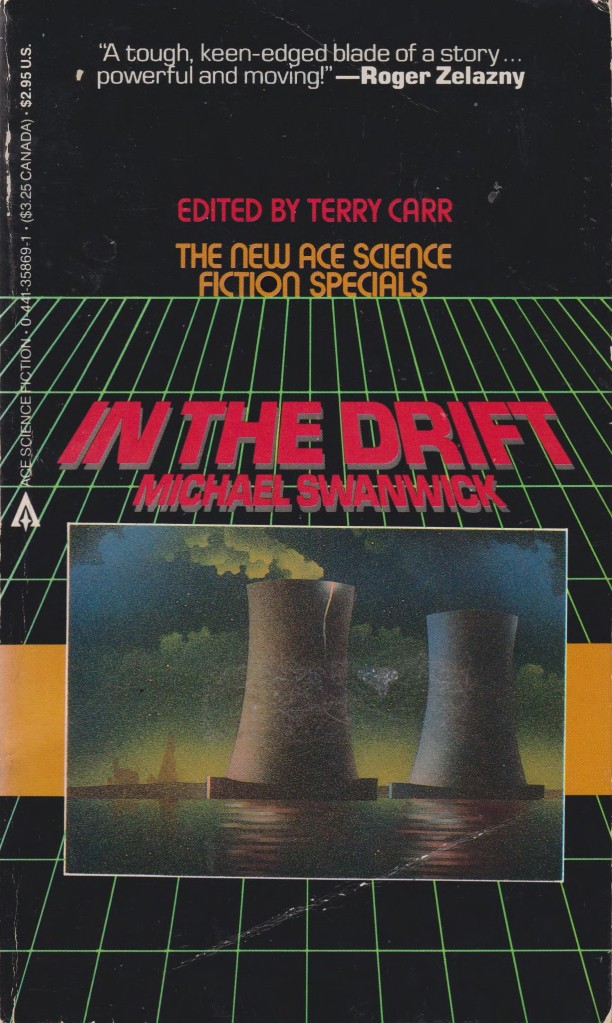
Rob Lieberman’s cover for the 1st edition
5. Michael Swanwick’s In the Drift (1985), 3.25/5 (Above Average): Full review.
A fix-up novel comprised of two Nebula-nominated short works–“Mummer Kiss” (1981) and “Marrow Death” (1984), In the Drift maps a new way forward in an ecologically and genetically ravaged post-apocalyptic age. The entire concoction decays with a sense of grim unease and cavorts around piles of dead that would make a triumvir from the Late Roman Republic proud. The majority of the novel transpires within an alternate history version of Philadelphia and its surrounding environs. The jonbar point? If the Three Mile Island partial meltdown (1979) hadn’t been contained. In the power vacuum created by the disaster, the Mummers take over and run a mafia-style government based on extortion and public mutant hunts (two-headed children, etc.). It’s a violent, erotic, and disquieting experience that can’t entirely hide its flaws behind the decadent panache.
My Top 20 Science Fiction Short Stories Reads of 2024 (click titles for my full review)
1. Michael Bishop’s “The Windows in Dante’s Hell” (1973), 5/5 (Masterpiece): Bishop’s magisterial Urban Nucleus sequence (1970-1979) charts the future history of an entombed/reborn Atlanta, Georgia from a diverse array of viewpoints–geriatric polyamorous couples, African American teenagers, etc. “The Windows in Dante’s Hell,” the second-published short story in the sequence, poignantly renders an old woman’s life-long attempt to survive within the dark subterranean reaches of an urban dystopia that alternatively serves as a metacommentary on the power of science fiction stories.
2. Henry Kuttner and C. L. Moore’s “Vintage Season” (1946), 5/5 (Masterpiece) reads as a fascinating glimpse into the immediate post-WWII America, and the underlying fear of cataclysmic conflict to come. Oliver Wilson rents rooms in his house to a group of strange foreigners–Omerie, Kleph, and Klia–who seem to embody perfection. However, their strange behavior, interactions, and fascinations fascinate him. But a horror awaits when he peers into Kleph’s three-dimensional screen that swirls with sound and motion.
3. Ursula K. Le Guin’s “The Diary of the Rose” (1976), 5/5 (Masterpiece): As an unabashed fan of the epistolary SF story, “The Diary of the Rose” hits on all levels. It tells the story of Dr. Rosa Sobel, who keeps a diary of her scopist readings of psychiatric patients. A scopist “reads” on multiple levels, a visual representation of the thoughts of the patient. One of her patients, Flores Sorde, supposedly admitted for violent psychopathic behavior, slowly changes Sobel’s perception of her role and the nature of the world.
4. Damon Knight’s “The Country of the Kind” (1956), 5/5 (Masterpiece): This is a smart and complex story. On one level it reads as a critique of 50s conformity. The jarring interactions between the psychopath and society of course call into question the psychological nature of of both the “normal” and aberrant.
5. A. K. Jorgensson’s “Coming-of-Age Day” (1965), 5/5 (Masterpiece) is an absolutely brilliant (and disquieting) analysis of a potential future backlash to loosening societal strictures on sex and sexuality that characterized the Swinging London of the 60s. The story, told retrospectively by a convertee to the new prudishness, recounts his youthful days attempting to learn about the nature of sex. This is a spectacular exercise in visceral unease all wrapped up in the childhood yearning to know and understand a world whose particulars and behaviors seem just out of reach.
6. Clifford D. Simak’s “Founding Father” (1957), 4.75/5 (Near Masterpiece) operates on the premise that space travel will be psychologically damaging to humans without technological assistance that can, in turn, generate its own trauma. Humanity’s drive to act, exploit, and expand proves psychologically damaging for the workers tasked with bringing it all about. They are the discarded chaff of humanity’s omnipresent desire to expand no matter the cost.
7. Clifford D. Simak’s “Conditions of Employment” (1960), 4.75/5 (Near Masterpiece) also operates on the premise that space travel places inhuman stress on the worker: intense work hours, sleep deprivation, the terror that a slight mistake would spell death, tension and psychical discomfort, and the existential “dead, black fear of space itself.” The average passenger or colonists receives a tranquilizer. But a spacer can’t have their senses obscured. Radical steps must be taken to convince a spacer to return to space.
8. Howard Waldrop’s “Mary Margaret Road-Grader” (1976), 4.5/5 (Very Good). At some point in the future after the “Highway wars,” Native American groups within North-Eastern Texas are on the ascent. They raid the few white settlements, stealing cars, guns, and bulldozers. At the annual Sun Dance and Big Tractor Pull, the Fossil Creek people gather for masculine demonstrations of honor and strength. But something seems different this year.
9. Robert Abernathy’s “Single Combat” (1955), 4.5/5 (Very Good): A nameless man, in a nameless city, plants a bomb in a basement. The city, cloaked with a heady dystopian gloom of racial violence and pollution, attempts to prevent his desperate escape. It’s a labyrinthine gestalt in which all its component parts–denizens, machines, symbology, and physical decay–become agents of its primal desire to survive.
10. Fred Saberhagen”s “Birthdays” (1976), 4.25/5 (Very Good). Bart, fourteen years old, awakes alone on a colony ship. The nature of the Ship isn’t entirely clear as Bart’s memories have been carefully edited. He walks down the hall and emerges in the Ship’s nursery, filled with twenty four squalling children, replete with robotic assistants and projected images of maternal figures. His task? Serve as the sole human parent. The catch? The Ship will only revive Bart from cold sleep one day a year.
11. Lisa Tuttle’s “Stone Circle” (1976), 4.25/5 (Very Good): As the forces of a fascism transform a new-future America, a nameless female narrator attempts to find meaning in the ashes. This is a world in which N must use her body to acquire the necessities for survival. She imagines herself a stone statue as protection against the trauma she experiences at the hands of the men who attempt to control her life. Her love of Kit momentarily gives life to the stone. Little’s nightmare reflects, in harrowing strokes, the late-70s viewpoint of a frustrated radical in the era of conservative backlash.
12. Clifford D. Simak’s “City” (1944), 4.25/5 (Very Good): Cheap transportation technology gives humanity the opportunity to flee the cities for acred estates in the countryside. John Webster works for the city government despite knowing the “the city as a human institution is dead” (147). Deeply bothered by the plight of the homeless farmers, John attempts to combat the mayor’s plan to burn down the city’s abandoned buildings. Soon a showdown between the homeless farmers and the remaining urban city dwellers looms. Effectively establishes the rest of the memorable series compiled as the fix-up novel City in 1952.
13. Clifford D. Simak’s “New Folks’ Home” (1963), 4.25/5 (Good) ruminates on age and memory and the possibility of a new path as death approaches. Frederick Gray, a retired professor, heads off on a fishing trip he used to take with his good friend Ben Lovell. Lovell lays in a hospital bed with little chances of heading home. Frederick knows the trip might be his last as well. He encounters a brand new building nearby where he held fond memories of his friendship. What is inside? And more importantly, why here?
14. Alice Eleanor Jones’ “Recruiting Officer” (1955), 4/5 (Good) follows a shape-shifting entity on her recruit-collecting rounds. She takes the appearance of a grandmotherly woman named Mrs. Quimby. In her convertible, she preys on young men between sixteen and twenty. On one of her productive tours of duty, she encounters her eighteenth victim — the beautiful Johnny, stranded with his mother at a car mechanic. She offers to drive him back to his school. “Recruiting Officer” effectively subverts the male gaze present in so many fictions of era. Mrs. Quimby’s gaze is far from that of a passive collector, she lusts after what she sees. Her species finds allure in any and all male forms.
15. Felix C. Gotschalk’s “The Day of the Big Test” (1976), 4/5 (Good) is told through the eyes of “seven tier old” (77) kid named Bradley about to be tested by pysgnomomist named Dr. LeGrand. This intelligence test gives an encyclopedic glimpse into a world linked to ours but utterly transformed. Physically, the world experienced seismic rupture and nuclear event in which the layers of the past have been melted together. Similarly, the story takes the reader on a whirlwind jarring and jumbling jaunt of the mindscape of the future via inundating linguistic displays, strange technology implanted technology, and subvocal communication. Of course, the human material and social desires remain frightening similar to our own.
16. Clifford D. Simak’s “You’ll Never Go Home Again!” (variant title: “Beachhead”) (1951), 4/5 (Good): This bleak nightmare follows a seemingly routine expedition of the Human Planetary Survey Party to establish a bridgehead on an alien planet. Like a horrifying formulation of Taylorism, the robotic workers erect a defense against an often “extremely violent” reaction to human arrival and manage the systematic documentation of information on the alien to be “inserted in the galactic files” while their human overseers sip highballs waiting for the go ahead to descend to the surface. Of course, human brutality and arrogance will come crashing down…
17. Clifford D. Simak’s “Full Cycle” (1955), 4/5 (Good) is his most sustained take on future versions of trade unionism. The union provides security from stuffies (business leaders) and gives shape to a new post-union form of social organization that will allow humanity to move beyond capitalism. Due to fears of nuclear war, industry moved into the countryside. Workers join moveable trailer camps that can strike at will. A new society emerges in the countryside.
18. Gene Wolfe’s “The Eyeflash Miracles” (1976), 4/5 (Good) follows the adventures of the blind and precocious Little Tib as he journeys across a barely hinted dystopian, and automated, future. Interspersed are memories of his past before the deliberate destruction of his retinas and dream-like visions that entirely consume him. This is a fascinating conjuration of the archetypal religious journey, the unusual events and their interpreters and accompanying miracles, through the lens of childhood nostalgia made strangely manifest.
19. Hugo Correa’s “Alter Ego” (1967), 4/5 (Good). Antonio acquires an alter ego, a perfect android recreation of his own body. It does not have a mind of its own. Instead, via an “introjection helmet”, Antonio can animate the android. He can smell through the android. He can speak through the mouth of his duplicate self. An unusual displacement occurs as he hears himself speaking from afar. He can suddenly lay bare his own past, and its failures.
20. Leigh Kennedy’s “Detailed Silence” (1980), 3.75/5 (Good) is my favorite of Kennedy’s first four published short stories. It takes place on one of the few landmasses of Beta Hydri, an alien aquatic planet. On this outcropping surrounded by a vast still ocean, live an alien species called Rainbows by humans. The story follows Casey, the Director General of the mining community, who struggles with his own traumas and dark shadows. There’s a reason he was sent to a small outpost.
Reading Initiatives
I have continued, resurrected, and created new science fiction short story reading series over the course of the year. Most of the stories I’ve picked for the series are available in some fashion online via links to Internet Archive in each review. I’ve included installments from 2024 in each series below. Feel free to read along with me! And thanks for all the great conversation.
Organized Labor and Unions in Science Fiction (started in 2024)
- Clifford D. Simak’s “Conditions of Employment” (1960)
- Clifford D. Simak’s “Full Cycle” (1955)
- Poul Anderson’s “The Troublemakers” (1953)
- Philip McCutchan’s The Day of the Coastwatch (1968)
- Philip K. Dick’s “Stand-By Job” (1963)
- Milton Lesser’s “Do It Yourself” (1957)
- John J. McGuire’s “Hunter Patrol” (1959)
The First Three Published Short Fictions by Female Authors (continued from 2021)
Translated Short Stories in Translation (with Rachel S. Cordasco) (started in 2024)
- Kōbō Abe’s “The Flood” (1950, trans. 1989)
- Vladimir Colin’s “The Contact” (1966, trans. 1970)
- Hugo Correa’s “Alter Ego” (1967)
- Hugo Correa’s “Meccano” (1968)
- Kathinka Lannoy’s “Drugs’ll Do You” (1978, trans. 1981)
Urban Landscapes of the Future (started in 2024)
- Michael Bishop’s “The Windows in Dante’s Hell” (1973)
- Barrington J. Bayley’s “Exit from City 5” (1971)
- John Brunner’s The Squares of the City (1965)
- A. J. Deutsch’s “A Subway Named Mobius” (1950)
- Robert Abernathy’s “Single Combat” (1955)
The Search for the Depressed Astronaut (continued from 2020)
- Clifford D. Simak’s “Founding Father” (1957)
- Clifford D. Simak’s “Conditions of Employment” (1960)
Generation Ship Short Stories (continued from 2019)
- Barrington J. Bayley’s “Exit from City 5” (1971)
- Fred Saberhagen”s “Birthdays” (1976)
- Poul Anderson’s “The Troublemakers” (1953)
Exploration Logs (continued from 2022)
- Exploration Log 4: Six Interviews with Clifford D. Simak (1904-1988)
- Exploration Log 5: “We Must Start Over Again and Fine Some Other Way of Life”: The Role of Organized Labor in the 1940s and ’50s Science Fiction of Clifford D. Simak
- Exploration Log 6: Clifford D. Simak’s 1971 Guest of Honor Speech
My Top 4 History Reads of 2024

Last year I read primarily histories of science fiction. This year I decided to expand my knowledge about the political and social environment of the 1950s-70s with an eye towards my Simak project on organized labor and my general interest in the post-War left. A brief caveat worth repeating: I’m a PhD-wielding historian and have a high tolerance for academic texts. That said, everything I’ve featured here tends to be on the more approachable side of things if you know the broad strokes of American history.
1. Daniel Horowitz’s The Anxieties of Affluence: Critiques of American Consumer Culture, 1939-1979 (2004): As an unabashed fan of science fictional social critique, Horowitz’s monograph explores how American thinkers–from Ernest Dichter to Rachel Carson–responded to growing affluence in the post-War moment. Indispensable.
2. Kevin Mattson’s Intellectuals in Action: The Origins of the New Left and Radical Liberalism, 1945-1970 (2002): As someone interested in larger issues of the left in science fiction, Mattson’s monograph is not to be missed. He charts the evolution and influence of thinkers from C. Wright Mills to Paul Goodman after World World II.
3. Jeffrey W. Coker’s Confronting American Labor: The New Left Dilemma (2002): Read specifically for my Clifford D. Simak project, Coker examines the evolving views of leftist thinkers on the role of organized labor after WWII. We tend to think in a monolithic sense that the left supports unions and the right is against them. The reality is far more complex. Few leftists maintained a positive take on unions due to their view that they were part and parcel with the larger capitalist status quo. This does not mean that they did not see value in unions assisting the common worker.
4. Jacqueline Foertsch’s Reckoning Day: Race, Place, and the Atom Bomb in Postwar America (2014): One of a handful of histories of science fiction that I read this year, Foertsch explores the intersection of race and nuclear war. Her focus on African American newspapers that contained moments of science fictional speculation enriched and complicated in ingenious ways her analysis of white SF authors like Philip Wylie and Pat Frank who integrated race into their nuclear war stories. Her chapter on Samuel R. Delany sparked my desire to read more of his work for the site.
Goals for 2025
1. Keep reading and writing.
2. Read more reviews by other bloggers.
For cover art posts consult the INDEX
For book reviews consult the INDEX
For TV and film reviews consult the INDEX
 Science Fiction and Other Suspect Ruminations
I randomly came across Brandao’s earlier novel “Zero” decades ago and was stunned at how many boxes it ticked for me in terms of style and subject, and also surprised at how obscure he was (and apparently remains to be) among English-language audiences. Was not aware of this latter day work, will have to try and find it.
I need to find a copy of Zero. He actually got in trouble for that one — it was banned by the regime until 1979 — and it was first published outside the country.
And Still the Earth also ticks a ton of boxes for me. So many that I felt overwhelmed writing my review. I still have my notes and might try again in this new year.
Both ZERO and AND STILL THE EARTH are readily available on Abebooks, though there are fewer of the former.
The problem is that I want a pretty old edition, not the banal newer edition of Zero. Haha. And the cheapest older edition copy is $33… which… maybe… I’ll spend… I certainly spend that much on history books. https://www.abebooks.com/servlet/BookDetailsPL?bi=31950967691
Any favorite vintage SF reads of the year? I’m of course partial to good short fiction.
I have posted a link to this essay over on the Clifford D. Simak Fan Groups board, mostly because of the links to other posts about Simak in your second paragraph. People have expressed interest in you work but, so far, I seem to be the only dinosaur who has come over here to post. Just wanted you to know how much we appreciate a scholar who appreciates the work of Clifford D. Simak.
Thank you for the kind words. I hope to continue working through his SF that touches on issues of capitalism, post-capitalism, and labor this year. I know that John Boston recommended that I look at “Limiting Factor” (1949).
…and I hope the podcast episode on “The Huddling Place” was okay. I didn’t relisten to myself and seldom appear on podcasts! hah.
The podcast was interesting. Your analysis of Simak’s political leanings have given me something to think about.
Unfortunately I hadn’t read the subsequent City stories in a long long long time (my late teenage years pre-site). And I didn’t know so much of the conversation would cover later stories…
I hadn’t read any Swanwick before In the Drift, but it and the next couple of releases made me a fan, and I’m still reading him today. https://www.flickr.com/photos/17270214@N05/albums/72157714408743337/ Probably my favourite story by him is the one he wrote in my shop (see link) one time he visited, ripped out his notebook and gave to me! And I’m in it. One of a kind! 🙂
I also still have Squares of the City, although a re-read a few years ago petered out for reasons I no longer remember. I liked it originally, although not as much as at least three of his big four – Zanzibar, Sheep & Shockwave Rider. Not so keen on the Jagged Orbit.
I have come up with a favourite sf&f book of the year but I tend to confine my short list to current titles, not older books I’ve read or re-read. This means none of my choices fit into your research period. I only started making a conscious choice back in 2009 when I started my Flickr book covers project, so none of them fit, I’m afraid!
Of the older books I did re/read, To Challenge Chaos by Brian Stableford was the most fun! https://www.flickr.com/photos/17270214@N05/53617056230/in/album-72177720313813926
Good to see that Paul has evaded the aged dinosaurs on the Simak & Vance boards to visit here!
Hello Mike,
Thanks for stopping by. Stableford wrote a novel — the title is escaping me — about a society that emerges after a generation ship lands. If I read any of his work in the new year, it’ll be that one. Even if it isn’t the best it’ll still enrich my goal to read all the pre-1985 generation ship stories! As you know, I’ve not been that impressed with his SF so far.
Do you have any favorite early Swanwick short fictions?
Not sure, but I suspect the Stableford you’re thinking of is one of the Dedalus Mission series he wrote. A re-contact ship crewed with scientists tries to solve any problems that might have arisen in the 200(?) years since various space colonies were planted, just before ‘the collapse’. They all have problems and it’s usually down to some oddity about the ecology or biosphere. They were competently written and fun at the time, especially as plots based on why colonies might fail wasn’t something many authors wrote about back then.
If it’s not a Dedalus Mission, then I’m not sure what book it could be. Gates of Eden maybe.
For Swanwick, most of what I have is post-1985 and many are fairly fastastical, but some you might consider are
The transmigration of Philip k.
Trojan Horse
With Jack Dann & Gardner Dozois
The Gods of Mars
Ah, the Stableford novel is Promised Land (1974). SF Encyclopedia describes the story as about “a society of colonists whose social structure is based on that developed over generations in the starship on which they arrived.” I snagged a copy in 2021. It’s the third novel in the Hooded Swan series. I’ve only read the first. I don’t have a copy of Rhapsody in Black (1973). I don’t think you need to read them in order?
I doubt it; there’s quite a lot of set-up in v1 but I’m reasonably sure it’s covered briefly in subsequent books. And I think there’s a conclusion in v6 but they are all stand-alone adventures of the pilot Grainger & the alien mind in his head. I enjoyed them a lot as they came out back then.
I have an omnibus edition of them from Big Engine so I might give v3 a try soon. (As I recall, v2, Rhapsody in Black, was my favourite)
Ah, yeah, I’ve only read vol. 1. Maybe I’ll get to vol. 3 this year! I can’t make promises. I’m bad at keeping them when it comes to reading.
Mike, Paul is just following his guide. Thank you, oh faithful Sherpa.
Paul, did you have any favorite pre-1985 SF reads (or rereads) this year?
Ah, the Bard edition. I am trying to collect the books published under the Bard imprint. I don’t blame you for holding out for a vintage copy of certain novels.
I don’t own the Brandao novel yet. I did come across Ivan Angelo’s The Tower of Glass recently, speaking of Bard. That was the novel published in the “Latin American series” I had been most interested in acquiring. It was also written about/during the time of the Brazilian military dictatorship.
The Tower of Glass is mainly non-genre, but it is a series of inter-connected short stories, and one of the last stories (“Tower of Glass”) is a dystopian story.
Ivan Angelo’s The Tower of Glass sounds really interesting. Thank you for putting it on my radar.
I’m pretty certain Brandão’s Zero isn’t speculative either. Hopefully Shaky Mo Collier will be able to tell us!
Based on my fragmented memory I would say “Zero” is SF-adjacent in the same way WS Burroughs is, ie there’s some nominal engagement with SF tropes (primarily urban dystopia)
Thank you! I’ll put it on my list of things to more actively hunt for.
Pingback: Pixel Scroll 1/5/25 Files Are A Burden To Others; Answers, A Pixel For Oneself | File 770
And Still the Earth knocked me out when that Avon edition came out — I’d be hesitant to say anything detailed about it given the (omg 40!) intervening years. It’s tempting to give it another go if I could only find it in the storage locker … one of the goodreads reviews says (per Chrome translation) “Reading this book in the midst of Bolsonaro’s misgovernment is like reading Albert Camus’s The Plague in the midst of a pandemic.” I fear the University stuff might hit a little close to home as well these days. Anonymous Celebrity is sadly out of print in English but probably also deserves a re-checkin after 15 years of Influencer Culture.
Hello Jim, it’s good to you. And Still the Earth knocked me out, so much that I couldn’t write a review despite taking copious notes. I really need to buckle down and put one together.
There have been instances in the past where publishers have found my reviews (Sven Holm’s Termush for example) and decided to put together a new edition.
It’s worth celebrating the esoteric good stuff!
I have to look out for that Brandao, it sounds really good.
I didn’t read that much vintage SF in 2024, or SF in general, at least not compared to the previous years.
The best, those that really made a huge, lasting impression, were Jersilds A Living Soul and Hobans Riddley Walker. Dischs The Genocides and Silverbergs Dying Inside were also very good.
It is a great novel. And I wish I was able to put together a review. After I adored Jersild’s After the Flood (1982), I acquired the rest of his translated work. I really need to get around to reading A Living Soul!
You might be pleased to know that the short story “Mary Margaret Roadgrader” was made into a short film. It was produced by George RR Martin.
Ah yes, someone mentioned that in the full review of the story. To be honest, I consume very little contemporary SF in print or media. Alas.
Did you have any favorite pre-1985 SF reads this year?
I’ve bookmarked *Reckoning Day* at my library — I hope to read it this year!
Yeah, it’s a fascinating read. I do think Alas, Babylon is a bit more radical than she makes it out to be. Quibbles aside, utterly worth a read.
What were your favorite pre-1985 SF reads from 2024?
*Frankenstein* by Mary Shelley — the protagonist is a self-excusing technobro who got a lot of people killed; the antagonist reads Goethe and philosophy but people think he’s the monster. 😉
I can’t say I’ve returned to that one since I read it as a 10th grader (along with Brave New World and 1984).
I don’t think I’d read it end-to-end until last year; I was invited to be on a podcast about it and did my homework beforehand. Victor Frankenstein is not a joy to read *directly* but I read his passages as coming from a somewhat unreliable narrator with subtle commentary by Shelley — sure, she was young, but was brought up in a very literary and intellectual household, educated by her father, so I think it was a fair reading.
Too many projects at the moment to consider a return. But your comment did encourage me to look up the various changes between editions.
The tone depends a bit on which edition one reads; I sampled the most common ones and drew my own conclusions.
Ah, I’d forgotten that she made changes between the 1st (1818) and 2nd (1831) editions.
I assume that’s what you’re referencing.
Percy Bysshe Shelley also made her put some changes in before its first publication, but I haven’t gotten my hands on her 1816-1817 draft, only read about it. The big change from 1818 to 1821 was changing from 3 volumes to 2, and putting her name on it (very similar content). There are a lot of opinions about the changes between 1818 and 1831; I gave mine above.
We both had a Pat Murphy among our favourite reads of 2024. Having thoroughly enjoyed The Falling Woman I’d quite like to get around to The Shadow Hunter (especially as it is an actual SF novel).
You did great work in 2024 – wishing you a productive and successful 2025!
Thank you for the kind words. I hope you do as well. And I look forward to any further reviews of Murphy’s work.
I looked up *The Shadow Hunter and while I’m not going to pick it up (I don’t read a lot of YA), I saw my library has several ebooks audiobooks of others of hers, and have bookmarked them all to get to!
Someone classifies it as YA? I would not call it such.
I don’t mean YA as a perjorative, but the Amazon description starts off “On his first hunt, a young member of the tribe pursues the bear through the wilderness. Moments before their battle begins, the boy” … potato, potah-to, loosey goosey. 🙂
It certainly comes off as pejorative. You indicate that you don’t read YA and the only thing indicating such a designator is the protagonist’s age. He’s certainly not young for long in the story.
Maybe take a peek at my review. I certainly indicate the general feel and tone and thematic focus of the novel — Amazon descriptions doesn’t always provide that sort of information. Read what you wish of course but it’s vibe is, to the best of my knowledge, not what you might think of as somehow YA. It’s mournful, sad, literary, tightly constructed, and downright metaphysical in moments.
“Young adult” fiction can also be a descriptive term for stories that feature a young protagonist. No, I don’t read them much, any more, because there are *so many* science fiction stories with main character boys. I’ve read a number and some are excellent (nuanced and complex), but these days, I would so much rather read a book with an older protagonist, like Pat Murphy’s *The Falling Woman*, that Andy mentioned (the comment I had been replying to), that Murphy wrote later. Older protagonists, particular middle-aged women, are much more rare in SF. I thought *The Falling Woman* was very interesting. I’m glad you got a lot of value out of *The Shadow Hunter*.
Yeah, as I said, he is not young for long in the story. Substantial time passes over the course of the narrative. Glad you enjoyed The Falling Woman. While on my radar it doesn’t fit any of my projects at the moment so it could be a while until I get to it.
Reckoning Day looks very interesting. May have to grab a copy to give it a read. Had not heard of that one!
Yeah, it’s a good one. I found its most interesting moments the pairing of African American newspapers (with their moments of SF speculation) and their accounts of nuclear war with primarily white-authored genre SF accounts. Very interesting stuff.
What were your favorite pre-1985 SF reads of 2024?
So difficult to pick my favourites. For anthologies/collections
Other Worlds, Other Seas by Suvin.
Four Dimensional Nightmare by Ballard
A Spadeful of Spacetime by Saberhagen
For books
Pillars of Eternity by Bayley
A Heritage of Stars by Simak
Fugue of a Darkening Island or Indoctrinaire by Priest
The Long Tomorrow by Brackett
Palace of Eternity by Bob Shaw
Tiltangle by Mackleworth
The Last Continent by Edmund Cooper
2024 was a good year for older SF!
I lot of interesting things in that list! As you probably know, I’ve reviewed a bunch of them: Indoctrinaire, Pillars, The Long Tomorrow, and most of the stories in Four Dimensional Nightmare. I enjoyed the Ballard and Brackett. Priest is an absolute favorite author of mine but I didn’t care for Indoctrinaire.
They all sound like fascinating reads, especially that non-fiction book on race and nuclear war. Alas, Babylon is now on my post-apocalypse list, which grows day by day. Delany is one author I’ve been meaning to delve into. Years ago, I tried starting with the infamously experimental Dhalgren (bad move) and never finished it. I see why Harlan Ellison hated it and he managed to get to 361 pages somehow.