Which books/covers/authors intrigue you? Which have you read? Disliked? Enjoyed?
It’s the summer Joachim Boaz. Where are the reviews? I’m currently on a much needed vacation (Iceland). I will be back soon! In the meantime here are four recent purchases.
1. The Dancers of Noyo, Margaret St. Clair (1973)

Davis Meltzer’s cover for the 1st edition
From the back cover: “Like so many others before him, reluctant Sam MacGregor was sent on a pilgrimage for the Frail Vision by the Dancers: androids grown from the cells of one man, with the powers of hypnotism and illusion–androids who held the tribes of the Republic of California in thrall.
But soon Sam began to doubt his own identity, for he experienced, in close succession, extra-lives in different corridors of time and space.
And he could not know whom his search would destroy: the Dancers… or himself.”
Initial Thoughts: Um, the tagline: “How long would men dance beneath the whips of the androids?” Good question! A reader of the city recommended this novel to me as an example of intriguing SF inspired by the Counterculture.
2. Still I Persist in Wondering, Edgar Pangborn (1978)

Uncredited cover for the 1st edition
From the back cover: “The waters rose, and darkness was upon the earth… For a few decades after the Twenty-Minute War and the Red Plague, there were those who remembered the ways and pleasures of civilization, but soon the harsh realities of life in the flooded seaboard of North America pushed the survivors into a new Dark Age–an age of superstition and brutality, but one of seeking and poetry as well. This is the world of Edgar Pangborn’s classic Davy.”
Contents: “The Children’s Crusade” (1974), “Harper Conan and Singer David” (1975), “The Legend of Hombas” (1974), “Tiger Boy” (1972), “The Witches of Nupal” (1974), “My Brother Leopold” (1973), “The Night Wind” (1974).
Initial Thoughts: Acquired due to my goal to read all of Pangborn’s fiction. This contains most of his short stories within the same universe as Davy (1964), “The Music Master of Babylon” (1954), and The Company of Glory (1974, novelized 1975).
3. Tomorrow Came, Edmund Cooper (1963)

Uncredited cover for the 1st edition
From the back cover: “WORLDS OF IMAGINATION–OR REALITY? Ranging from sheer terror to the frankly incredible, from the mysteries of outer space to a world of destruction and a society where everyone lives like millionaires by order, these stories probe deep into the unknown tomorrow–a tomorrow where the unexpected is an everyday occurrence and the unforeseen an ever-present danger… the tomorrow that is about to become TODAY!”
Initial Thoughts: To be completely honest, I can’t for the life of me remember why I bought this one. Maybe one of the stories came up in a work of scholarship I was reading. Looking through the contents, none of the stories ring a bell. It’s been sitting in my pile of purchases next to my desk for at least two years. At least my mysterious late-night purchases tend to only cost a few dollars!
4. Worlds of Imperium, Keith Laumer (1961, novelized 1962)
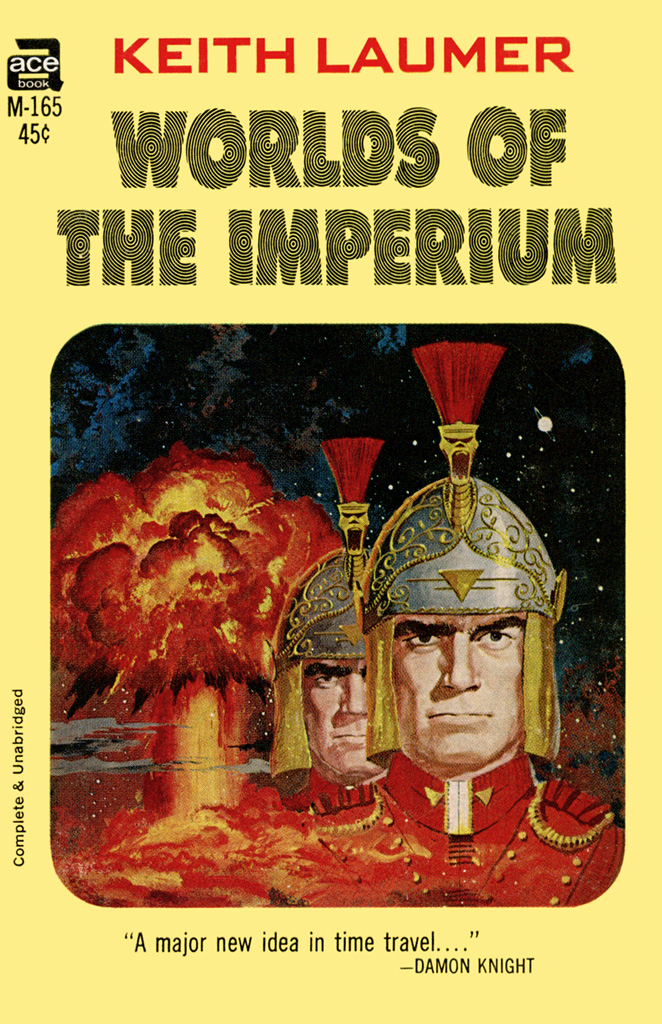
Ed Valigursky’s cover for the 1967 edition
From the inside page: “For Brion Bayard, the discovery of an alternate world to Earth where history took a different turn in the road was not a pleasant experience. His kidnapping brought him some startling revelations. Here was a world in which appeared identical doubles of famous personages–including a dangerous and hated dictator named Brion Bayard!
His assignment was simple enough. Dressed as his double, Brion was to enter the enemy stronghold, kill the dictator, and take his place until law and order could be maintained.
But once having seen his mirror-image brother, Brion had a little inclination to murder him as some other people had to let him live.”
Initial Thoughts: SF Encyclopedia describes Laumer’s Imperium sequence as his most interesting series. I assume that’s why I acquired the first volume.
For book reviews consult the INDEX
For cover art posts consult the INDEX
For TV and film reviews consult the INDEX
 Science Fiction and Other Suspect Ruminations
The only Edmund Cooper I think I have a copy of (still unread, but I’ve read the synopsis) is Five to Twelve, which left me with the impression he was a rather deeply embittered misogynist. I’d like to read more of the earliest Laumer work. His chronologies are so confusing because so much of that work was collected and recollected and shuffled around in so many different editions, it’s much too easy to double-dip.
Re-Cooper: That’s my general sense as well from the reviews I’ve read. I made it part way through A Far Sunset before setting it down a few years ago.
Laumer: The strategy of success for full-time SF authors! (reprints and fix-ups).
JB: Laumer: The strategy of success for full-time SF authors! (reprints and fix-ups).
A little unfair. Given the SF magazine market’s predominance into the early 1960s — and that SF book publishing in the US didn’t even start till the 1950s, except for a few small specialty companies like Gnome House — what choice did authors have to recoup on their earlier work?
Also, if SF truly is a literature of ideas — yeah, yeah, don’t laugh — there’s something to be said for prototyping those ideas in short fiction form first. PKD’s output in the 1960s, forex, wouldn’t have been possible without those hundred-odd short stories during the 1950s.
As for Laumer: in the early 1960s he was a fairly promising, competent B list SF entertainer — other than in his Retief series, which was deeply stupid bilge he could reliably churn out and sell to Fred Pohl — and Worlds of the Imperium, which he had first sold to one Cele Goldsmith’s mags, is a sample of him in that mode. Unfortunately, after leaving the US Diplomatic Service, he then tried to make a living writing SF full-time which only a select few achieved without breaking under the strain — Silverberg, Dick, and Sheckley are the most obvious examples, and the latter two didn’t have a great time. In Laumer’s case, he had a stroke, rapidly went downhill, grew embittered, and then was dead.
~ ~
And speaking of Pohl, I’ve been reading or re-reading his A Plague of Pythons (1965) aka Demon In My Skull , and The Years of The City (1984).
The latter is interesting, since it’s a number of stories outlining a future history of New York, drawing on Pohl’s experience (I think) running local political campaigns.
https://www.isfdb.org/cgi-bin/pe.cgi?26099
The former is lesser work, but also interesting inasmuch as it’s a workmanlike, fairly terse early-1960s era SF novel that’s ostensibly a commercial entertainment — so on the face of things product not much different than Laumer’s Worlds — and yet in it Pohl nevertheless presents (a.) an arguably darker vision of humanity than found in Kornbluth and Tiptree, and does it (b.) with a straightforward manner of “That’s just how people are, you know.”
https://www.isfdb.org/cgi-bin/title.cgi?1384
I mean, all of what you said validates my comment. Few full-time authors and thus those who they deployed all possible ways to reuse and refashion and reprint….
James Gunn even promulgated Gunn’s Law: “Sell it twice!” Of course he sold a lot of it more than twice, with magazine sales, stories collected into fix-ups or collections as you will, sold a third time slicing those books sideways into new collections like SOME DREAMS ARE NIGHTMARES and THE END OF THE DREAMS. And he sold “The Cave of Night” both to radio and television, and THE IMMORTALS or some portion of it for a TV movie and then a series. I’d say he’s the champion, but van Vogt may have him beat by sheer volume of reshufflings.
Brunner rewriting his novels years and years after original publication dates — in periods of hardship — also strikes me as a particularly notable example.
Iceland! I have been looking at making that trip. Please feel free to make any suggestions if you encounter something remarkable (or at least notable).
We’re currently driving all the way around the country (with a few extra days in Reykjavík and a sidetrip to the little art town of Seyðisfjörður). It’s all remarkable. Maybe not on the established top 5 list but utterly worth your time — walking around the rim of Haverfell volcano crater.
Okay, the volcano rim is going on the list…
I don’t know where you are from but as with all Nordic countries, it’s super easy to drive (I went to Norway last summer). I wouldn’t hesitate to rent a car (like we did) and drive around the country. It can be a bit hard to book places — even long in advance — in all the locations you desire (most of the southern coast, among the most visually stunning landscapes in the country, is particularly expensive due to the lack of substantial towns) so be aware.
Thank you for this good advice.
I’ve read The Worlds of Imperium. It’s very entertaining and over the top and the author clearly knows that it’s over the top. When I was reading it, one of the things that really stood out was how much time he spent describing the uniforms, which is unusual for science fiction. It did contribute to the story — you can learn a lot about a society by looking at the clothes and this was no exception. In some ways, his detached irony makes the story seem like it belongs in a later era, but also the plot is very much of the golden age of science fiction.
When I saw the Pangborn cover, my first thought was that it looked like a movie poster for a bad fantasy movie from late ’70’s early ’80’s. It even has the color palate from that era, which I suspect has something to do with the type of film they were using at the time.
Not a fan of the Pangborn cover. While I don’t always care about the connection to the contents, Pangborn is a deeply introspective author and the cover, well, isn’t that vibe at all. Haha.
As for Laumer, yeah, your description matches what I’ve read about it (although I did not know about his uniform obsession). There’s a lot of great scholarship on textiles and history for sure.
The uniforms are interesting because the Imperium is very much a military focused society where the men have elaborate uniforms — I kept thinking about how Kaiser Wilhelm would have loved the uniforms in the Imperium.
Considering the interest you’ve shown in clothing in SF (I know we previously discussed Bayley’s The Garments of Caean) you should write something up on your interests. Do you have a site?
I haven’t read the Cooper — I keep hearing he was a British writer of some interest but I haven’t found his works to seem intriguing. I’ve read lots of St. Clair from the ’50s and I particularly like her “Idris Seabright” stories. But I’ve haven’t gotten to her ’60s novels.
I read and very much liked Pangborn’s Still I Persist in Wondering back when the book came out. And I read Worlds of the Imperium a decade or two back, and thought it pretty good, probably Laumer at close to his best.
The only one of her stories under Seabright that I’ve read is “Stawdust” (1956) — never managed to review it. Found it fascinating and a bit oblique.