This is the 22nd post in my series of vintage generation ship short fiction reviews. While I have dabbled in the more esoteric as of late due the rapidly decreasing number of available choices, thanks go out to all who have joined some part of my read-through already. I’ve also compiled an extensive index of generation ship SF–expanded from a monograph by Simone Caroti–if you wish to track down my earlier reviews on the topic and any that you might want to read on your own.1
Previously: George Hay’s Flight of the “Hesper” (1952)
Next Up: TBD
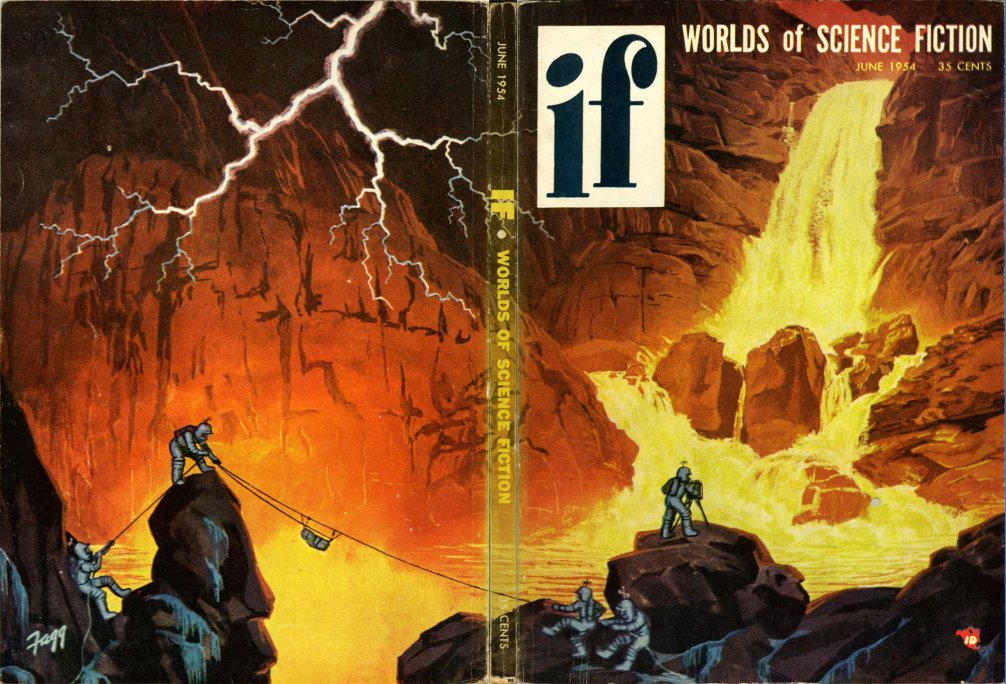
Kenn Fagg’s cover for If, ed. James L. Quinn (June 1954)
2.75/5 (Below Average)
Mari Wolf’s “The First Day of Spring” first appeared in If, ed. James L. Quinn (June 1954). You can read it online here.
As I mentioned in my only other review of Mari Wolf’s work, she’s best known for her contributions to fandom including the Fandora’s Box column (1951-1956) in Imagination. In addition, Mari Wolf (1926-) published seven short stories between 1952 and 1954, six of which appeared in If. Unfortunately, after her divorce in 1955 from fellow SF author Rog Phillips (1909-1966), she stopped publishing SF. Here is a brief bibliographic blurb on her life, career, and SF endeavors. Ted White wrote an article about her in the fanzine e*I*5 (Vol. 1 No. 5) December 2002 (here). The issue also includes Wolf’s short story “Prejudice” (1953), which only received a fanzine publication.
The Nature of the Generational Voyage
Wolf’s story contains a highly unusual generational ship set-up that isn’t entirely fleshed out. From the interspersed details, various “worlds” (self-contained vessels) departed Earth generations before for reasons unknown. Each ship takes its name from a nation or area on Earth (New Chile, New Australia, New France, New America, etc.). A separate group of spacers periodically interact with the small self-contained “worlds” and appear to live on various planetary surfaces across the galaxy. Due to the regularity that some groups of spacers interact, perhaps some choose to accompany the “worlds” on their voyages. It’s implied that they might add genetic material to the small populations. What’s unusual is that the inhabitants of the “worlds” are not the first groups to colonize the expanse. Maybe some settled down and others moved on? Regardless, there’s the sense of an earlier mass exodus from Earth in which some groups still choose to wander without planetary home.
Trina (an inhabitant of a “world”) and Max (a spacer) start a tentative youthful love affair after he voyages down to the surface of New America for their Spring Festival. But there’s stress below the surface. Like a sailor of old, he feels the pull of the seas, of exploration, of vast expanses. Trina feels the pull of her small home, the familiar faces, the carefully regimented and controlled lives. The spacers identify a potential planet for New America to settle. Momentarily seduced by Max’s worldview, Trina’s interjection at a council meeting convinces the powers of New America to agree to slow their engineers and scope out the planet. Trina and Max descend to the inhabited surface. She experiences shock at expanse of distant horizons and press of people and buildings. Will anyone living their predictable and calm lives on New America be convinced to settle?
Unfortunately, the softly told story verges on bland and unmemorable. Wolf admirably attempts to focus in on the emotional landscape of the dwellers of the “worlds” and the “spacers.” It all feels a bit vacuous and formulaic. If you’re new to Mari Wolf’s fiction, check out the far superior “The Statue” (1953) first. Her earlier story manages a far more engaging emotional heft.
Recommended only for completists fans of the subgenre.
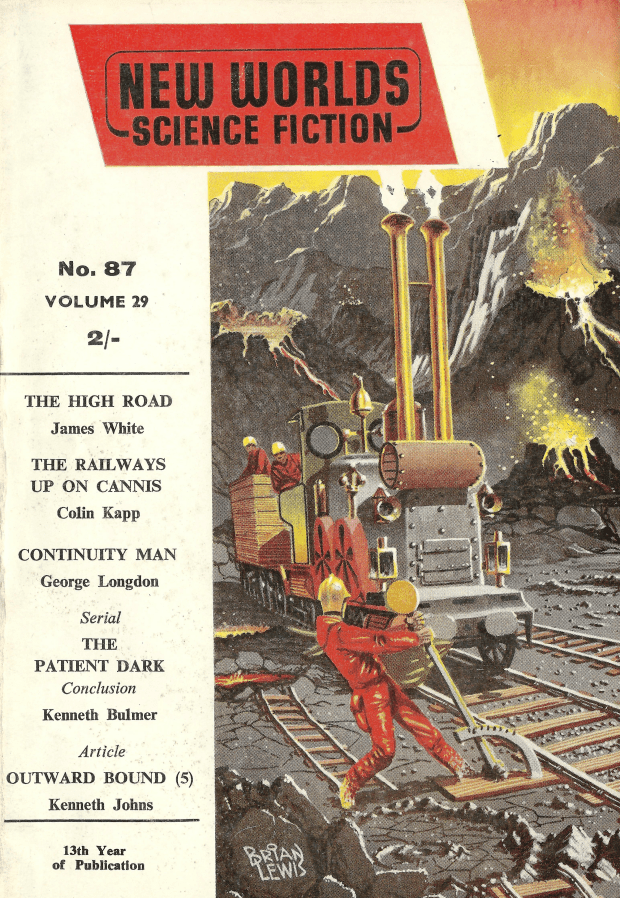
Brian Lewis’ cover for New Worlds Science Fiction, ed. John Carnell (October 1959)
3/5 (Average)
Francis G. Rayer’s “Continuity Man” first appeared in New Worlds Science Fiction, ed. John Carnell (October 1959). He writes here as George Longdon. You can read it online here.
Francis G. Rayer (1921-1981) was a UK author and technical journalist. He published across the few available British avenues primarily in the 50s and early 60s. After Michael Moorcock took over the editorship of New Worlds from John Carnell, Rayer stopped publishing. He might be best known for his Magnus Mensis series of short fictions (1950-1961), which appeared in New Worlds and Science Fiction Adventures.2
The Orifice That Beckons and Burns
“Continuity Man” follows the daily lives of the few remaining survivors of a generation ship Styria, “a silver mote amid the scattered suns beyond Capella” (36). Despite the pulpy cosmic rendering, the ship itself appears to slip further and further into entropic decay as it approaches “journey’s end” (36). Two children, Tony and Suzy, notice the changes. No new toys replace the frayed and tattered. The ship’s forest smells and feels wrong, redolent with rot. The candy tastes off. Their foster parents don’t seem to have answers, or even a heartbeat. Their foster parents withhold knowledge of the journey’s approaching end fearing it might deepen the anxiety and trauma of both children.
Both kids obsess over a small room, and a round hole filled with “ravening fires,” hidden within the expanse that is the ship (37). They throw their broken toys into the chasm. Tony struggles with traumatic memories of the wrapped body of his real mother as it slip into the chute (38). They both feel that the hole in the floor steals away everything of value and meaning in their world. Depression and fear takes over. They must confront their robotic caretakers.
I found elements of “Continuity Man” quite effective, in particular the rendering of the entropic interiors of the generation ship. As Brian W. Aldiss’ Non-Stop (1958) appeared in print the previous year, I imagine Rayer draws on Aldiss’ (far superior) depiction of claustrophobic and choked interiors. Unlike Aldiss, there’s a deliberate simplicity to Rayer’s vision (there are no mutants or telepathic animals or disturbing religions) — which unfortunately can’t help but settle on a banal Adam and Eve-style resolution. Another possible parallel can be made with Arthur Sellings’ “A Start in Life” (1954). In Sellings’ take on the generation ship, robots must figure out how to care for two surviving children. Both stories contain an innate goodness. Both sets of robotic parents want the best for the children. Both struggle to identify how to care for traumatized humans.
Recommended only for completists fans of the subgenre.
Notes
- Simone Caroti’s The Generation Starship In Science Fiction: A Critical History, 1934-2001 (2011). My index indicates my additions with a (*). ↩︎
- If you want a story-by-story rundown of the majority of Rayer’s stories in SF magazines, check out John Boston and Damien Broderick’s Building New Worlds: 1946-1959: The Carnell Era, Volume One (2013), New Worlds: Before the New Wave, 1960-1964: The Carnell Era, Volume Two (2013) and Strange Highways: Reading Science Fantasy, 1950-1967 (2013). ↩︎
For book reviews consult the INDEX
For cover art posts consult the INDEX
For TV and film reviews consult the INDEX
 Science Fiction and Other Suspect Ruminations
I finished The First Day of Spring, for me it was 3/5. The idea that generation ship crew will grow too used to the enviroment to exchange it even for a paradise is interesting, even if I already met it (in a much later novel). However, I agree that the marco-world (universe) is underdeveloped – after all, it seems that the world’s (i.e. ship’s) goal is to finally settle on a planet – but they are reluctant even to check a potential candidate. And spacemen so quick that they don’t take samples:
“You brought no samples. No vegetation, no minerals. . .” “Not even air samples,” Aaron Gomez said softly. “Why?” Bernard sighed. “We didn’t want to wait,” he said. “We wanted to get back here, to tell you.”
and the fact that is hasn’t took a lot of time to get to the planet – it seems they are in a much denser galaxy.
Thanks for stopping by! And for reading along with me. I can’t say that either story really transfixed me — and thus I struggled to write reviews.
There are a LOT of issues in the logic of both stories. Yeah, you aren’t going to convince anyone unless you actually make a case that the planet is safe. And the planet they settle on just feels like another earth… nothing about anything in the story feels (other than the strange constricted vista on the “world”) different or memorable in its otherness. Shoddy concept development for sure. Wolf clearly wanted the focus to be on the emotions of all the characters. But that too feels rote and by-the-numbers…
As for ” The idea that generation ship crew will grow too used to the enviroment to exchange it even for a paradise is interesting” — yeah, this is a standard trope in the subgenre for sure. See John Brunner’s far superior “Lungfish” (1957): https://sciencefictionruminations.com/2019/12/17/generation-ship-short-story-review-john-brunners-lungfish-1957/
I’m going to check Lungfish, thanks!
Be sure to share your thoughts on “Lungfish.” One of my favorite 50s gen ship stories — by far.
The second story is more interesting and it fits more in a smaller volume. The setup is more interesting, this decaying ship with the last two kids… the twist about foster parents I guessed just before it was revealed and the final pompous speech by the boy sounded a bit forced, but overall solid 4*
Yup. I agree. I still despise the the Adam and Eve implications…. not a ending I ever enjoy if played straight. I love when authors ridicule the idiocracy of Adam and Eve delusions — such as Thomas M. Disch’s masterpiece The Genocides (1965) https://sciencefictionruminations.com/2023/01/08/book-review-the-genocides-thomas-m-disch-1965/
I read Genocides a few years ago, a strong but gloomy piece. Gonna check your review.
As for Adam and Eve, purely as an attenpt to allude to a new beginning is fine with me – yes, delusional in real world, but in fiction – why not, after all it has a long tradition.
A couple of obscure generation ship things for your consideration
“Journey to Alpha Centauri“ by John MacVey – which is mostly non-fiction about the engineering of a generation ship, but includes a fiction section with the journals of a traveler on the ship (and a timeline including a failed mutiny).
The concept album “Intergalactic Touring Band” has four songs about generation ships (one about recruiting the passengers, two about failed ships, and one about the celebrations following a successful arrival)
‘
Thank you! I think someone brought up Journey to Alpha Centauri a while back…. maybe even back when I was on Twitter. The name sounds familiar. However, I’ve never heard of the album. I don’t frequently update my list. I’ll add them when I eventually get around to it.
I might have mentioned it before to you – I’ve been known to repeat myself
Do you have any favorite gen ship stories?
My favorite is probably the one I encountered first – Orphans of the Sky, but I also like the quasi-generation ship novel “Learning the World” (by Ken MacLeod)
Yeah, Orphans was the first of the subgenre I encountered as well. As I probably mentioned before, there’s a review from the first year of the site (I actually wrote the review as a teenager and had it originally posted to Amazon before I migrated it over to my new site in my early 20s). I should give it a reread eventually! The only Heinlein I’ve been thinking about returning to….