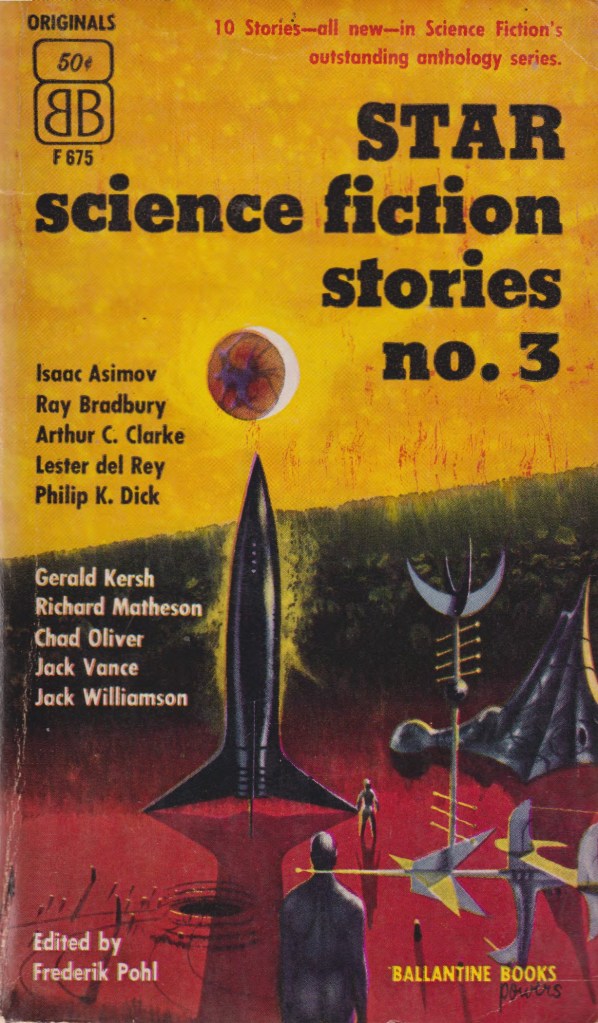
Richard Powers’ cover for the 1955 edition
3.5/5 (collated rating: Good)
Ballantine Books’ illustrious science fictional program started with a bang–Star Science Fiction Stories. According to Mike Ashley’s Transformations: The Story of Science-Fiction Magazines from 1950 to 1970 Frederik Pohl’s anthology series of original (mostly) stories was “intended as both a showcase of Ballantine’s authors and a lure to new writers.” Paying better rates than magazines, the Star series foreshadowed the explosion of original anthologies that would provide a sustained challenge to the eminence held in the 50s by the magazine.
I’ve selected the third volume of the six-volume series.1 It contains an illustrative cross-section of 50s science fiction. Philip K. Dick’s “Foster, You’re Dead” (1955), Richard Matheson’s “Dance of the Dead” (1955), and Jack Williamson’s “Guinevere for Everybody” (1955) are not to be missed.
Recommended.
Brief Plot Summaries/Analysis
“It’s Such a Beautiful Day” (1955), Isaac Asimov, 3.5/5 (Good): The anthology starts off with an effective Isaac Asimov satire of the suburban experience. The creation of suburbia in the 1950s (and subsequent mass white flight) generated increased commutes between home and urban work. The home became a bunker to protect the American family from any threat (fallout shelters, a community away from diversity and interaction with “the other,” etc.).2
Asimov speculates that new, almost instantaneous, transportation portals will isolate the family completely from the external world. A minor glitch in the transportation system instills a change in the young Richard Hanshaw, Jr. He isn’t as willing to trust the portal — and decides to trek to school by foot. His teacher calls mother in shock and suggests psychological treatment. An intriguing, and gentle, satire on American conceptions of normalcy, the new-fangled post-War emergence of psychology as a therapeutic practice, and the suburban experience.3
“The Strawberry Window” (1955), Ray Bradbury, 3/5 (Average): The story follows a family on Mars. The father, Will, spends his day constructing the settlement town. He’s possessed by the dream of Mars and humanity’s conquest of the stars: “It’s not just us come to Mars, it’s the race, the whole darn human race, depending on how we make out in our lifetime. This thing is so big I want to laugh, I’m so scared stiff of it” (31). His long-suffering wife Carrie yearns for the small sounds and big memories that anchor her to Earth. And so Will comes up with a compromise, an expensive compromise.
Ultimately, this is beautiful polish to a banal, almost jingoistic, defense of humanity’s supposed destiny to expand and conquer: “There’s nothing better than Man with a capital M in my book” (32). I am far more interested in the more subversive and quietly critical moments of Bradbury’s other Mars stories. This one is simplistic propaganda of conquest. Despite the enjoyable thematic core (the effects of leaving Earth) and polished telling, I’d classify “The Strawberry Window” amongst his most disappointing and forced. For superior Bradbury that I’ve covered, check out “The Highway” (1950) and “The Pedestrian” (1951).
“The Deep Range” (1955), Arthur C. Clarke, 3/5 (Average): One of the reasons I feel a special attraction to 50s SF is its interest in the working-class experience of the future. Of course, for the reader of the present futuristic trappings suggest a certain glorification of what would be a new form of the mundane daily grind. The heroic blue-collar stories in James Gunn’s fix-up Station in Space (1958) come to mind. In Clarke’s “The Deep Range” humanity farms the seas. Instead of terrestrial herds of sheep or cows, shepherds in submersibles with dolphin assistants protect herds of meat-yielding whales from predatory sharks.
An effective slice-of-working class experience set in an evocative locale. It’s an immersive little story that draws on Clarke’s own interest in scuba diving and underwater adventure. Regardless, I remain uninterested in returning to Clarke’s work in anything more than an anthologized tale here and there.
“Alien” (1955), Lester del Rey, 3/5 (Average): Due to an comically improbable collision at sea, Larry Cross and his alcoholic crewmate Al Simmonds find themselves stranded on an island with an alien which “could swim out of a sunken ship at the bottom of the sea” (51). Al Simmonds is injured and Cross must keep the man alive and figure out the alien’s intentions. A classic SF problem story in which man must figure out a modus operandi in a bizarre new scenario. It’s polished. It’s solid. It’s predictable.
“Foster, You’re Dead” (1955), Philip K. Dick, 5/5 (Masterpiece): Mike Foster spends his school days practicing survival skills–digging, making knives, weaving baskets–in case of a nuclear attack. The kids snicker at him as he walks past. They don’t own a fallout shelter at home. His father refuses to pay into the NATS (National Security fund). If a bomb hit, Mike wouldn’t even be granted access to the school shelter. He’s possessed by a deep, perpetual, encompassing trauma.4 His walk home is nightmarish. Mechanical newspaper machines shout excitedly about “war, death, amazing new weapons” (67). The public shelter beckons with its neon lights but he has no money in his pocket for entry. And the store with the new shelter model mocks with its advertisements: “a powered heating and refrigeration system” and “self-servicing air-purification network” with “three decontamination stages for food and water” (68). Reluctant to yet again confront his father about their lack of shelter, he gazes at the new model and talks to the salesmen. He imagines that every evening he’d sleep in its encapsulating embrace, womb-like.
One of the absolute best fallout shelter themed SF stories I’ve ever read. It’s a fascinating collision of crisp prose, commentary on the arms race, and an evisceration of the complicity of commercialism in Cold War terror. Joins William Tenn’s “Generation of Noah” (1951), Daniel Galouye’s Dark Universe (1961), Modecai Roshwald’s Level 7 (1959), and Fritz Leiber’s “The Moon Is Green” (1952) amongst the best on the theme.
“Whatever Happened to Corporal Cuckoo?” (1953), Gerald Kersh, 3.5/5 (Good): In the fourteenth and fifteenth centuries surgical diagrams called “Wound Men” crop up in medical miscellanies in Europe. These illustrations–the human form hacked, slashed, smashed, cut, pierced, bloated–served as an annotated table of contents to guide the reader through various injuries and diseases. Kersh imagines a literary version of himself returning to New York City from WWII interacting with a fantastical manifestation of a Wound Man on board the Cunard White Star liner Queen Mary. Corporal Cuckoo, the “Wound Man” in question, regals the narrator (Kersh) with the history of his scarred and mutilated form that mysteriously heals from every injury.
The reader becomes immersed in a historical military narrative that begins in the early 16th century. There’s a bizarre sense of horror and fantastical displacement. Like some crushed and deformed specimen, Cuckoo becomes an encyclopedic, and culminative, glimpse of humanity’s relentless obsession with death and violence.
Interesting and memorable. I’ll keep on the lookout for more of Kersh’s SFF.
“Dance of the Dead” (1955), Richard Matheson, 4/5 (Good): My third favorite story in the anthology transplants the standard narrative of a young adult straying from the path set out by parents and small town community onto a break-neck road trip in a drug and alcohol drenched near-future. Len, Bud, Barbara, and Peggy race their car towards St. Louis. Bud tries to get Barb to take snuggle–“act of promiscuous love-play; usage evolved during W.W. III” (114)–and take drugs: “Have a jab, Bab” (115). In the kaleidoscope of the new and relentless peer pressure the lessons her mother taught her slowly erode. All her inhibitions come crashing down when the quartet see the transcendent nightmare that is the titular dance of the dead.
Manifesting the SPEED of the car, Matheson’s prose resonates with pulse and hum, snippets of song and signage, slang and youthful lust: “At a hundred miles an hour let me DREAM my DREAMS!” (115). It’s frantic. It’s zappy. It’s vibrant. Recommended for fans of the more linguistically experimental (and bleak) of 50s visions.
“Any More at Home Like You?” (1955), Chad Oliver, 2.75/5 (Below Average): Dangerously close to joke story territory (what I classify stories that rely on a silly last page twist designed to generate a chuckle), Oliver re-imagines the classic flying saucer story. A young “man” named Keith crashes his advanced spacecraft in the swanky Bel-Air neighborhood of LA. He seems friendly. Friendly residents take him in. He meets with politicians. He gives a canned speech at the UN. But what’s the secret behind his sudden appearance? Does he really represent a massive Galactic Civilization as he claims? When the pieces all fit together, there’s a gentle sense to it all mixed in with a little, rather silly, “snip” at humanity’s claims to galactic centrality.
If you’re new to Oliver, I recommend tracking downs his two generation ship short stories–“Stardust” (1952) and “The Wind Blows Free” (1957). This one was not for me.
“The Devil on Salvation Bluff” (1955), Jack Vance, 3.25/5 (Above Average): As my last Vance review came in 2021–The Languages of Pao (1958), I looked forward to this anthology as a way to return to his fiction. “The Devil on Salvation Bluff” imagines a religious colony (everyone calls each other “Brother” or “Sister”) on a planet named Glory without clear scientific or societal patterns. If anything, disorder, irregularity, and chaos is the pattern. Regardless, the community attempts to impose an almost monastic order on their lives. The colonists brings with them a massive clock, build communities in precise patterns, and carve up the landscape with linear canals and irrigation.
In classic missionary fashion, the colonists attempt to impose their religion and regularity on the humanoid inhabitants of Glory, nicknamed Flits, that spend their days indulging in their passions, seemingly random rituals, and goat herding. Using salt as a bribe, they momentarily convince the Flits to settle in a new village created by the colonists. After Brother Raymond and Sister Mary kidnap the chief of the Flits to identify the psychosis they think might underline their impulsive, random, and occasionally destructive actions, the true psychological truth of the planet emerges. Vance suggests that dogmatic religion must shift and change to adapt to the moment.
Fits in with an intriguing cluster of often brilliant 50s stories exploring the clash of Earth religion and the SFnal new–Ray Bradbury’s “The Man” (1949), Arthur C. Clarke’s “The Star” (1955), James Blish’s A Case of Conscience (novella 1953, novelized 1958), Walter M. Miller, Jr.’s A Canticle for Leibowitz (stories 1955-1957, novelized 1959), etc.
Somewhat recommended.
“Guinevere for Everybody” (1955), Jack Williamson, 4.5/5 (Very Good): An artificially created Guinevere stands “chained” in a “vending machine” tempting sleepy passengers in an airport with her plaintive calls (169). “You like me, huh?” she asks strangers as they pass (170). “Won’t you by me?” she cajoles (170). The implication is clear. The reason for her sudden appearance in train stations, and others of her model, far less so. Chimberley represents General Cybernetics, a company building “managerial computers” to replace human workers (171). Chimberley attempts the origins of “THE VITAL APPLIANCE!” with her all too human sex appeal, and disturbing tendency to spout advertisements for other products (170). He, little more than a cypher manifesting the displacement of the mechanical age, feels drawn to her as “his best friends were digital computers” (171). He discerns that she is a recent product created, produced, and distributed by one of these vast managerial computers. Giddy with excitement he sees her as “something human management would never have had the brains or the vision to accomplish” (172). He purchases her from the vending machine and sets off to find the producing facility. But a line has been crossed, and another.
This story bothered me (in a good way) far more than it should. Williamson integrates little comments about how the mechanical (think AI unleashed on the US government) ignores the human experience. And how Chimberley, alone, adrift, insular, feels fulfilled by a programmed device that is but a fragment of a capitalistic assault on the consumer. This disturbed satirical gem took me by surprise. I will be on the lookout for more 50s Williamson short stories.
Notes
- Eight if we count the one-volume Star Science Fiction Magazine (1958) and Star Short Novels (1954). ↩︎
- There is a ton of scholarship on both of these ideas that I have referenced in various reviews in the past. Here is a short list! Elaine Tyler May’s Homeward Bound: American Families in the Cold War Era (1988, rev. 2017); Thomas Bishop’s Every Home a Fortress: Cold War Fatherhood and the Family Fallout Shelter (2020); Laura McEnaney’s Civil Defense Begins at Home: Militarization Meets Everyday Life in the Fifties (2000); and Robert A. Beauregard’s When America Became Suburban (2006). ↩︎
- For “normalcy” see Anna G. Creadick’s Perfectly Average: The Pursuit of Normality in Postwar America (2010); For the growth of psychology as medical practice in the post-War moment see Ellen Herman’s The Romance of American Psychology: Political Culture in the Age of Experts (1995). ↩︎
- I am reminded of studies of childhood trauma conducted on the students of Abo Elementary, New Mexico, a school built underground as a fallout shelter. ↩︎
For cover art posts consult the INDEX
For book reviews consult the INDEX
For TV and film reviews consult the INDEX
 Science Fiction and Other Suspect Ruminations
“Seven if we count the one-volume Star Science Fiction Magazine.“
Eight if you count the 1954 STAR SHORT NOVELS, also edited by Pohl, containing
Little Men · Jessamyn West · na *
For I Am a Jealous People! · Lester del Rey · na *
To Here and the Easel · Theodore Sturgeon · na *
Yeah, forgot about that one. I think I own a copy, somewhere…
What was your take on volume 3?
Pretty much similar to yours. “Guinevere for Everybody” was the biggest surprise–I’d certainly never read anything remotely like that from Williamson. I remain fond of ’50s-vintage Clarke, and that story–and the novel it was hacked out of, or gave rise to–are among my favorites of his. I liked his attitude back then, though it wore progressively less well as the decades passed. I remember a TV interview (probably in the 1980s) in which he gave his prognostications of the future. He talked about short-term space and technological progress, then said he expected a “time of troubles” not too far off, but then things would come together and really take off! I would rather have had him pay some serious attention to the “time of troubles.”
I was blown away by the Williamson. I too had not read anything close to it by him before. And in the current era of AI weaponized to amputate our own governmental agencies without a care for the human impact, it hit particularly hard. And the main character is such a strange person — unable to make connections with real humans, seduced by this mechanical facsimile of a human (it’s not entirely clear what she actually is)… such a wonderful brew.
The title to the Clarke seemed familiar, and now I know why. I remember he had a submarine novel but assumed that the short story came first vs. a portion taken from the novel. What is the rest of the novel even about? There wasn’t much plot in this section.
It’s been a long time. The plot was rather meandering as I recall, more like an amble through a museum than the more familiar pup-derived pulse-pounder to which most SF writers of the time aspired, with Clarke genially explaining the exhibits he had prepared. Slow but thoughtful I can appreciate with a writer as smoothly capable as Clarke had become by that time. Looking at the Wikipedia entry on the book, I see there’s a fair amount that I didn’t remember too well, so I’d refer you to that—much better than I could do.
I remember Earthlight (1955) having a somewhat similar sense of meander — the main character wasn’t really an active participant in anything, simply observing what was happening around him.
Clarke was fundamentally not very interested in up-close conflict–rather unusually for a popular fiction writer. He said (repeatedly) that Stapledon was his great inspiration and generally kept a similarly detached affect even when he was writing about things literally down to earth.
Clarke was very much an author of my childhood — I read everything from Rendezvous with Rama to Imperial Earth (which I remember being my favorite). I haven’t read much of his work — other than a story here or there — since.
Gerald Kersh was Harlan Ellison’s favorite writer. Kersh wrote many enormously original and distinctive novels and stories but your best one stop entry point for his SFF work is NIGHTSHADE AND DAMNATIONS, a short story collection edited by HE.
Do you have any favorite stories of his? The Kersh was interesting and did whet my palate.
I read most of the stories ages ago but I do know the Ellison collection was the first Kersh book I read and it made me a fan and collector. Many of his novels would not be classified as F or SF, yet his manner of writing can make you feel as if they are (FOWLER’S END is a good example of this) but many of the stories fit into those categories. He was just a unique writer.
I can’t promise I’ll get to it soon but I’ll put it within radar range — so many books and plans at the moment.
Don’t think I’ve read any of this stories in this one before, not even the PKD, which is embarrassing. At some point I will hunker down and make my way through the Star Science Fiction series, since I have PDFs of all of them. I don’t really have an excuse. The Williamson especially sounds interesting. The closest point of comparison I can think of is his “With Folded Hands…,” which I think is great.
Hello Brian, thank you for the reminder about the Williamson story. I was seriously surprised by this one! I, of course, look forward to any thoughts you have on the stories in this anthology. I started reading the 6th volume for some reason and put it down last year after finishing a few rather average stories. This one is a far more polished reading experience.
When the STAR anthology series started, it paid a significantly higher rate than the magazines of the time and its quality followed. After the mid-’50s hiatus, Pohl tried to turn it into a magazine and published one issue, which fell flat because of distribution failures. Stories that had been bought for a next issue instead became STAR SF STORIES 4 in paperback (a pretty decent book). However, the publisher then cut the pay rates and the last two volumes were pretty mediocre, with a few gems hidden in the muck. Source: Anthopology 101: The Pohl Star . The author thought more highly of the fifth volume than either of us.
As mentioned above, Fowler’s End is probably one of the best Kersh novels but is some distance from SF. A great read though, full of memorable dialogue.
I fluked across a copy of The Best of Gerald Kersh and that contains the memorable SF stories The Brighton Monster and Men Without Bones – amongst others.
Thank you for the suggestions. Yes, I’m more likely to read his overtly SFF works in the near future than anything else he might have written.
In the Vance story a key point is that the native Flits are actually fully human. They’re descendants of a crashed colony ship 500 years earlier who have adapted over the generations to the planet’s peculiarities.
By the end of the story it’s clear that the recently arrived colonists are already starting down the same path as the Flits must have done centuries earlier…
De-evolution (or at least adaptation) of human colonists happens in several of his stories and adapting to (or at least surviving) chaotic conditions is the theme of his slightly later, more famous The Men Return (1957), where Earth enters a patch of non-causalty in space.
The idea that multiple sun’s light might influence people psychologically is expanded on in his novel Marune: Alastor 933 (1975), where the planet is in a multi-sun system and the many differing light conditions affect people’s moods and daily life. They do have accurate forecasts of the various suns movements and light combinations though. There’s even a chart in the book detailing this!
Haha, yeah, I was trying to keep some details out of the review. But yes, it certainly helps to understand the cycle. I wrote a review of Marune years back. I’m glad your brought it back up as I did not remember the connection (or the chart). https://sciencefictionruminations.com/2012/07/07/book-review-marune-alastor-933-jack-vance-1975/
Sorry, the way you worded it, I wasn’t sure you had picked up on the reference – it’s quite brief and fairly easy to overlook. I first read it decades ago in an old Ace Double and I’ve read it several times since – it grows on you!
“Humanoid”? You are right — I am didn’t want to give away the secret! Haha. But yes, the story had its charm and seemed to be a somewhat rare attempt by Vance to be a little bit didactic in his “religion must change with the times” messaging.
I’ve read this collection but remember little of it. You’re description of the Williamson jogged a memory–of pleasant surprise and puzzlement. I also second the endorsement of ‘With folded Hands’ above, another good Williamson story.
Dick’s ‘Foster, You’re Dead!’ is one of my all time favourites. You are absolutely right describing it as a masterpiece. I’ve long been struck by how Dick anticipated the Situationist critique of the nuclear shelter industry in the story–something I briefly discuss in my article ‘Science Fiction and the Situationist International’:
https://newreadings.cardiffuniversitypress.org/articles/10.18573/newreadings.139
Ooof, I don’t know what happened with this comment. I haven’t been having much luck with your site lately. It doesn’t seem to like me anymore!
Thanks for the link!
But yes, WordPress has been a bit glitchy as of late. They make changes and then they seem to have unintended consequences and then things get righted after a bit. I fixed the formatting.
I wanted to devote a long-form review the Dick. If I ever started a podcast, I’d 100% feature it as a pair with the William Tenn shelter story I also linked (you should read that one as well if you haven’t!).
How did I miss your Tenn reviews first time around? It’s been a strange two years these last two.
Have you read Tenn’s ‘Down Among The Dead Men’? That is one of my all time favourite sf shorts ever!
I think I’ve read Eastwood Ho! but recall precious little. I’m pretty sure I haven’t read the other–which I will shortly correct!
Not sure! I look forward to your thoughts on “Generation of Noah” (1951).
Thoroughly agree on PKD’s ‘Foster, You’re Dead’, which I recently caught up with via the ‘Selected Stories’ collection.
Wonderfully framed narrative (and very economically presented too) and that closing paragraph (or observation on the part of one of the key characters) was perfectly pitched. Looking forward to engaging with his other short stories of the 50s and 60s.
Yeah, it’s a good one! As you said, I found it effectively structured and presented. If you want another spectacular satire of the nuclear panic (and by extension the nature of 50s masculinity) in the US, check out William Tenn’s “Generation of Noah” (1951). It’s quite early in his career and he would only improve his wit as the decade went on.
Sorry – no idea why my post seems to have been published 3 times!
No worries. I deleted the extra ones!
Thanks for that recommendation. I have a copy of William Tenn’s ‘Time in Advance’ collection (four stories) but this is a new one to me. Oh and thanks for tidying up my repeated posting! 🙂
No problem. Not sure what wordpress was doing…
No problem. Read any pre-1985 SF recently?
Currently reading Thomas Disch’s first novel ‘The Genocides’ – beautifully written and at times fairly confronting & unsettling. I’m about 10 pages from the end and at this stage still can’t quite predict how it’s going to resolve!
It’s a good one! My review: https://sciencefictionruminations.com/2023/01/08/book-review-the-genocides-thomas-m-disch-1965/