Book Review: Secret Rendezvous, Kobo Abe (1977, trans. 1979)

(Tadanoi Yokoo’s cover for the 1979 edition)

5/5 (Masterpiece)

In Kobo Abe’s Secret Rendezvous (1977, trans. 1979) the hospital stretches like a recumbent body, leaking fluids through its membranes and undefined in its expansiveness, across the urban landscape. Within its labyrinthine interior, humans (agents of “disease”) animate various functions of the hospital for their own purposes–some sinister, some scientific, some sinisterly scientific. The hospital body lurches and vibrates with the sounds of its doctors and orderlies as they rewire the building’s organs and nerves in order to experiment on themselves and their patients. Within this veritable entity lacking a functional guiding agent, a harrowing, existential, and surreal Freudian mystery unfolds. Continue reading

Adventures in Science Fiction Interior Art: Monday Maps and Diagrams (Science Fiction) 3/25/19: A French edition of Mark S. Geston’s Lords of the Starship (1967) and Out of the Mouth of the Dragon (1969)

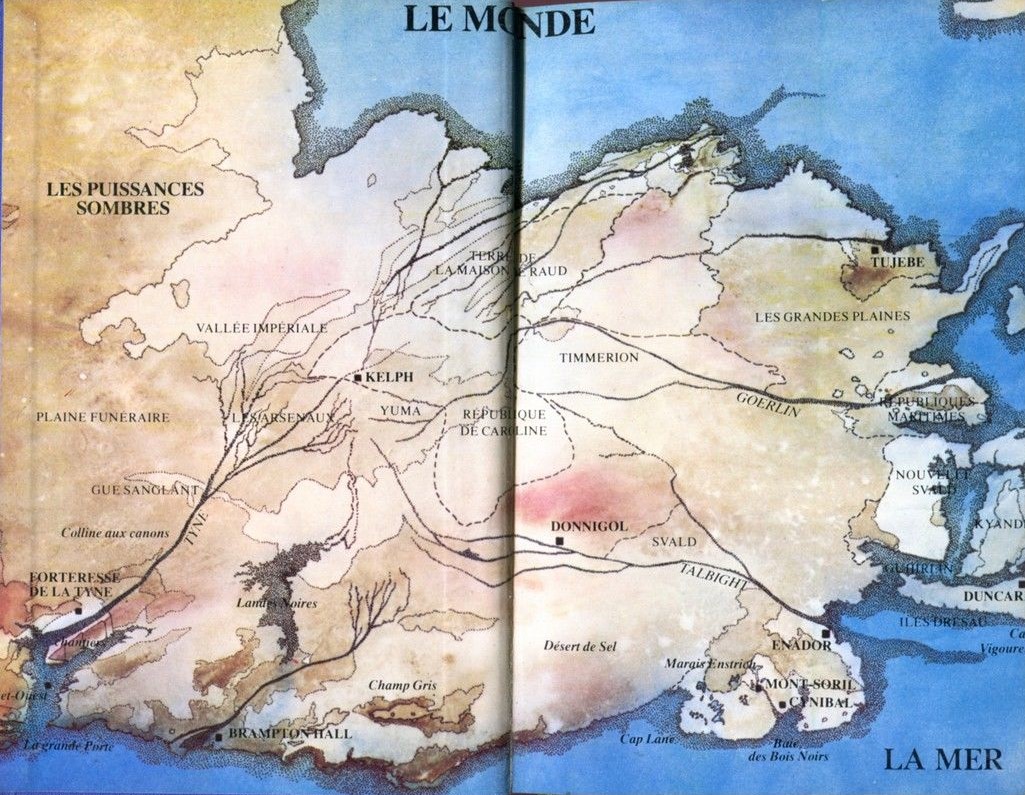
Today’s installment of Monday Maps and Diagrams returns to the worlds of Mark S. Geston. In 1980 French publisher OPTA released the first two volumes of Geston’s The Wars series, Lords of the Starship (1967) and Out of the Mouth of the Dragon (1969), in a handsome volume with a striking interior map by Claude Fritsch. The series charts the slow climb out of a Dark Age, where the landscape is littered with unusual mutants and the relics of past technologically superior empires and peoples…. I find the map and cover try to evoke more “medieval” imagery than the actual novels (I mean, even in the first one, the technology exists to “construct” a spaceship).

Enjoy! And, as always, comments are welcome and appreciated!

My review of Lords of the Starship (1967).

Citation: Claude Fritsch’s interior map (above) and cover art (below) for the 1st French OPTA edition of Les seigneurs du navire-étoile / Hors de la bouche du dragon (1980). Continue reading

Adventures in Science Fiction Cover Art: Crashed Spaceships, Part III

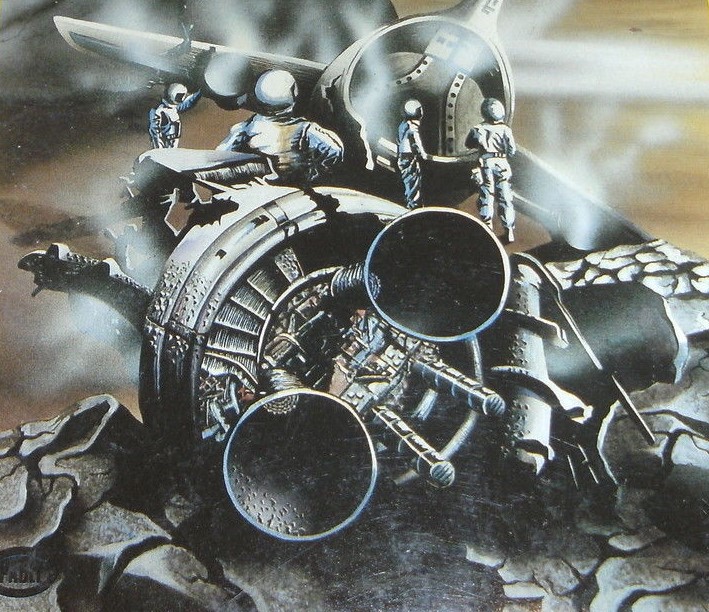
(Detail from Alan Daniels’ cover for the 1980 German edition of Open Prison (1964), James White)

The crashed spaceship — a wrecked hulk spinning in the emptiness of space, shattered metal struts strewn across an alien landscape…. I find few SF scenarios more nostalgic than this one as a younger me was obsessed with books about the societies formed from the survivors of such cataclysms (Anne McCaffrey’s Acorna Universe sequence, of dubious quality now, was a cornerstone of my youth).

I have selected a range of fascinating covers which add to a series I made in 2012 (Part I) and 2013 (Part II). My favorite of the bunch is Tibor Csernus’ cover for the 1973 French edition of Clifford D. Simak’s Time and Again (1951) due to the verdant and wet landscape the spaceship finds itself in. My second favorite is Dean Ellis’ “descriptive” cover for the 1974 edition of Alan Dean Foster Icerigger (1974). It doesn’t try to be surreal but rather depicts a scene straight from novel. I usually prefer when the artist takes a more unusual approach but in this case Ellis narrows in on the wonder of the premise. Continue reading

Short Story Reviews: Four Stories from New Worlds Science Fiction (April 1964), ed. John Carnell

To mix things up a bit I decided to review four stories in John Carnell’s last issue of New Worlds Science Fiction (April 1964) before he handed over the reins of the dying publication to Michael Moorcock, who would elevate it to New Wave greatness. Other than the James White serial Open Prison, which I plan on reading in book form when I procure a copy, three of the four authors reviewed below owed much of their careers to John Carnell, and would see few stories in print after his departure (see the individual story reviews for details). Only Barrington J. Bayley, writing as P. F. Woods, would see continued publication (and growing popularity) in New Worlds under Moorcock.

Of the stories I recommend reading William Spencer’s rumination on overpopulation and urban life,  “Megapolitan Underground.” The others are worthwhile only for die-hard fans of Carnell’s New Worlds and other editorial projects. Continue reading

Updates: Recent Science Fiction Acquisitions No. CCV (Farmer + Simak + Effinger + New Dimensions Anthology)

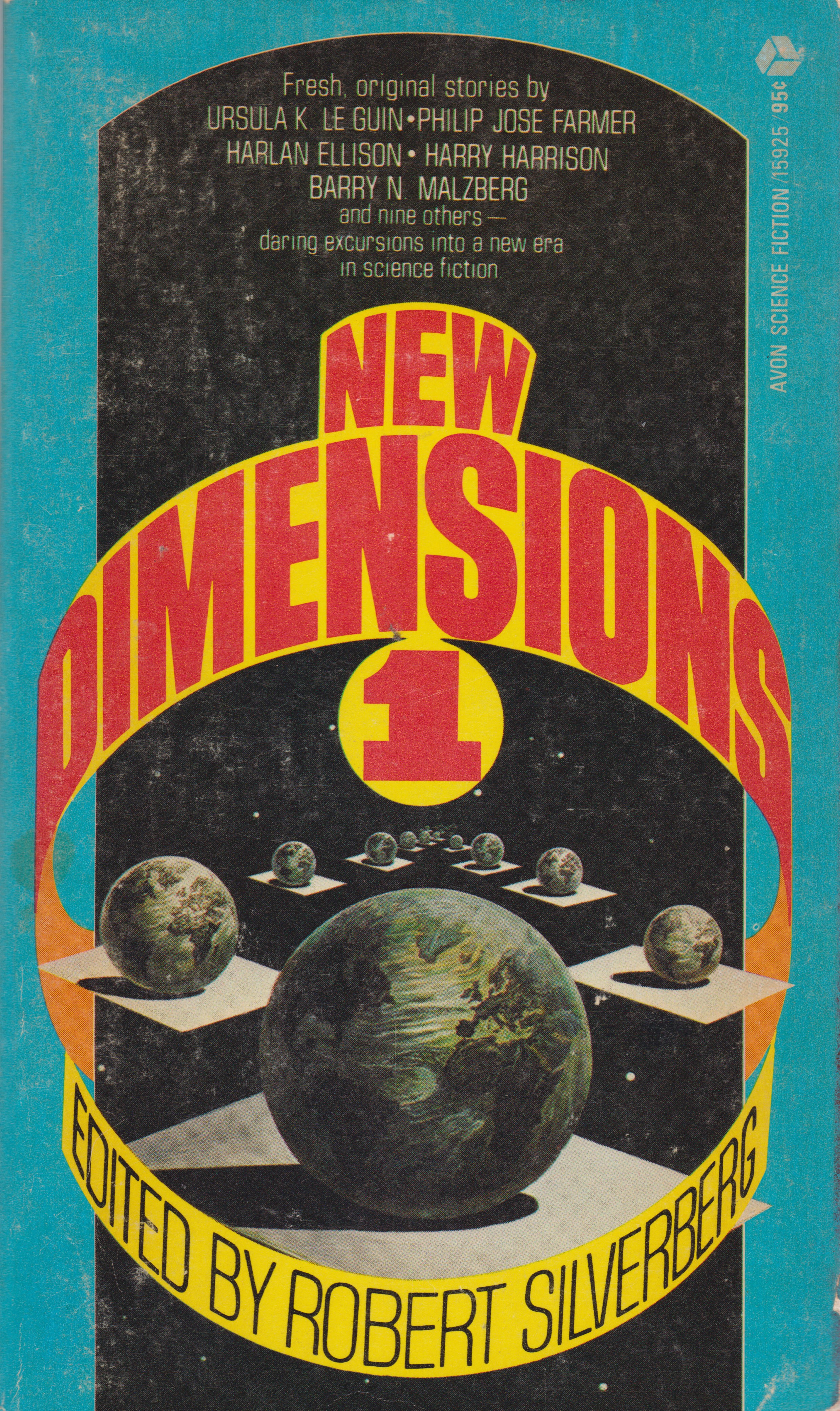
1. I recently read and reviewed enthusiastically New Dimensions 3, ed. Robert Silverberg (1973). Inspired, I procured quite a few more in the series… Here is number 1. Looks like an absolutely spectacular lineup — Le Guin, Ellison, Malzberg, Lafferty, etc.

2. One always needs more Clifford D. Simak, right?

3. Huge fan of George Alec Effinger’s novels and short stories. Here’s what I’ve reviewed so far…. Heroics (1979), Irrational Numbers (1976), and What Entropy Means to Me (1972).

4.  Philip José Farmer, despite multiple masterpieces, churned out a lot of crud… I expect this will fall in that category.

Note: The hi-res scans are of my personal copies — click to enlarge.

Let me know what you think in the comments!

Enjoy!

~

1. New Dimensions 1, ed. Robert Silverberg (1971)

(Uncredited cover for the 1973 edition) Continue reading

[Short] Diaristic Fragments on Czech Experimental Film: The Ear (1970), dir. Karel Kachyna

8/10 (Very Good)

On the night of 20-21st of August 1968, the Warsaw Pact countries (led by the USSR) invaded Czechoslovakia ending the period of liberalization known as Prague Spring. And with it, the Czech New Wave film movement “ended.” Regardless, Karel Kachyna filmed The Ear (1970), a paranoid psychological thriller redolent with New Wave stylings, that brandishes a proverbial middle finger in the direction of the Communist Party. Unsurprisingly, the film was promptly banned until 1989, and Kachyna Continue reading

Updates: Recent Science Fiction Acquisitions No. CCIV (Ely + Abe + Coulson + Malec)

1. Overpopulation + an author I’ve not encountered before? Can there be a better combo? I’ve long been a fan of the subgenre–and I’ve gathered a substantial number of both read and unread overpopulation-themed SF into a list. And yes, I know Laser Books has a reputation for publishing low-quality crud…. I am not expecting a masterpiece!

2. I’ve been on a Kobo Abe kick as of late! Secret Rendezvous (1977, trans. 1979) is, as of now, my favorite read of the year–I hope to have a review up soon. Back cover blurb here.

I went ahead and purchased another “SFish” Abe novel… I’ve seen Abe’s 1966 film adaption of his own work (directed by Hiroshi Teshigahara) and it’s a brilliant cinematic experience. I’m hoping the novel has some of the same magic!

3. Another source material novel for one of my favorite SF films–Frankenheimer’s Seconds (1966)… I’m 50 odd pages through the novel and some of the scenes in the movie are identical. The book and movie diverge as the story unfolds…. I look forward to finishing Ely’s disconcerting SF thriller.

4. And finally, a complete and utter unknown quantity…. Scroll down to find out.

Note: the hi-res scans are of my personal collection. As I am not a “collector,” I tend to go with cheaper copies even if it means they have substantial imperfections.

As always, thoughts and comments are welcome.

Enjoy!

~

1. Unto the Last Generation, Juanita Coulson (1975)

(Kelly Freas’ cover for the 1975 edition) Continue reading

Adventures in Science Fiction Interior Art: Monday Maps and Diagrams (Science Fiction) 2/18/19 — David Brin’s Sundiver (1980)

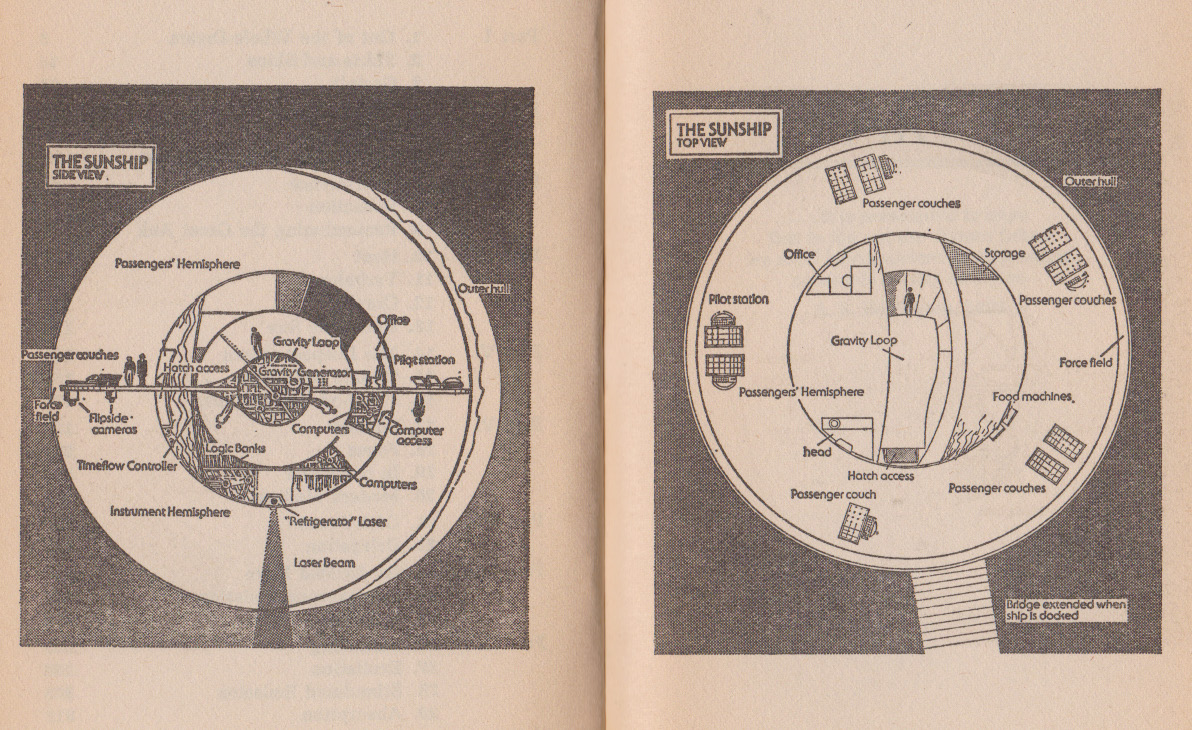
Today’s diagram comes from David Brin’s first novel in the Uplift sequence, Sundiver (1980). I remember virtually nothing from the novel (I must have been 15 when I read it), although, I was intrigued enough to read ALL the sequels. The years have sequestered them to the “I enjoyed them as a kid but probably wouldn’t enjoy them now” category. This series on maps and diagrams was a nostalgic journey…. leafing through the pages of tomes I had long forgotten.

The diagram in Sundiver is a vehicle to descend below the surface of the sun. As with so many diagrams and maps, I’m unsure if it is needed or adds to the reading experience. But like a gorgeous cover, the image draws you in…. and suggests grand adventures and fascinating worlds.

The artist is David Perry.

The Diagram (click to enlarge)

Citation: Hi-res scan of my personal copy of the diagram from the 1983 Bantam edition of David Brin’s Sundiver (1980) [click for larger image]. Continue reading

Book Review: The Word for World is Forest, Ursula K. Le Guin (1972)

(Richard Powers’ cover for the 1976 edition)

4.5/5 (Very Good)

Won the 1973 Hugo for Best Novella. Nominated for the 1973 Nebula for Best Novella.

In November 1969, word of the My Lai Massacre (March 16, 1968), where American soldiers killed (and raped and mutilated) between 347-504 unarmed South Vietnamese civilians, reached American newspapers. Ronald L. Haeberle’s iconic (and horrifying) photograph of massacred children and adults–superimposed with, “Q. And babies? A. and babies,” the chilling lines from NBC’s interview with massacre participant Paul Meadlo–was transformed into the “most successful poster” opposing the Vietnam War by the Art Workers Coalition. While written (most likely) before news of the massacre appeared in the press, Ursula K.  Le Guin brilliantly channels this general anti-war anger, transposed to an alien local with colonizing humans as villains, in The Word for World is Forest (1972). Note: Le Guin wrote her uncannily similar novel in 1968, before word of the massacre appeared in the news. Continue reading